

7 A.M. at the North Gate
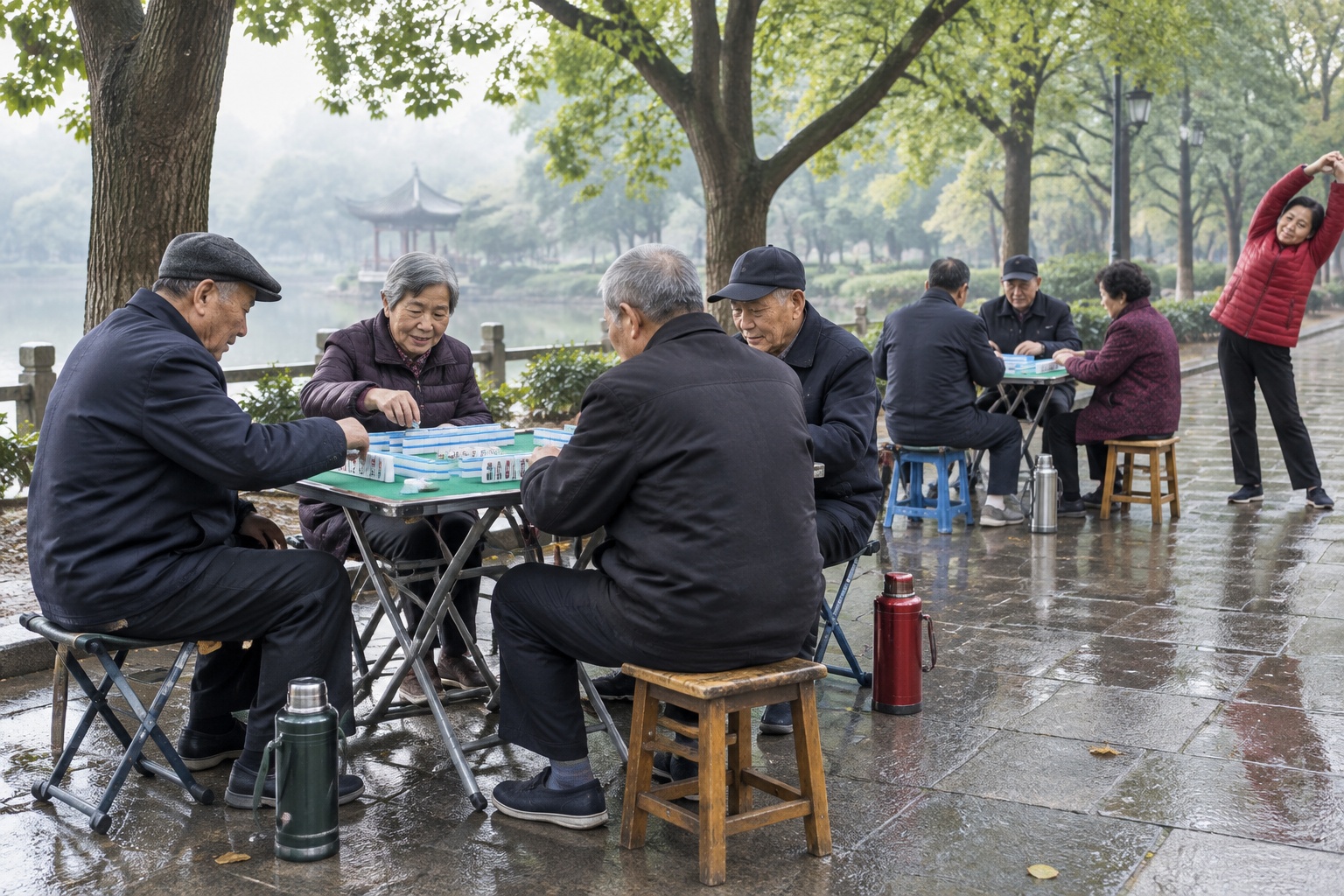
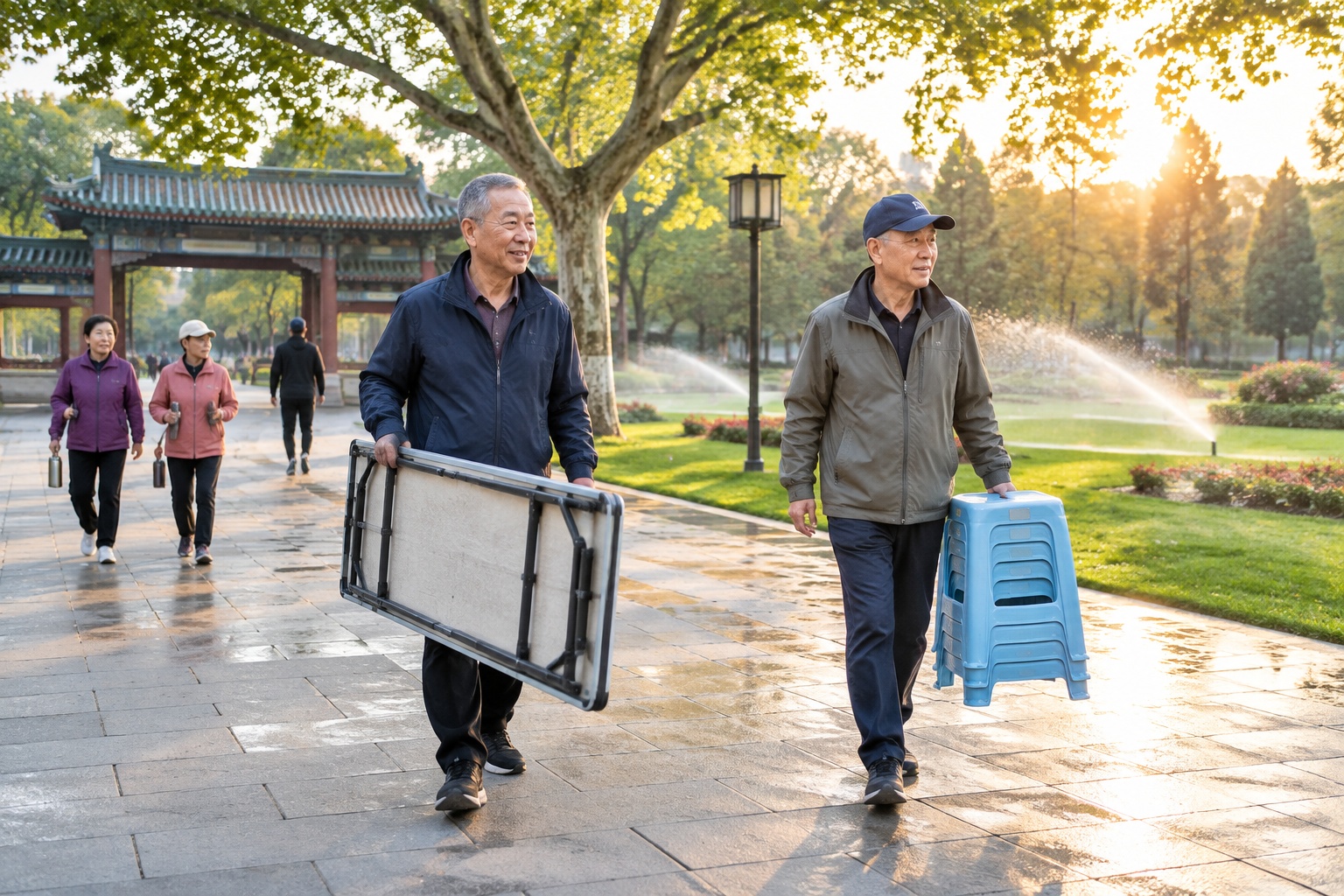
The park opens before the city does. At 7:10 on a damp Tuesday in Chengdu, the pavement inside the north gate of People’s Park is still dark from last night’s rain, and a woman in a red down jacket is halfway through a set of slow arm circles, counting under her breath. Behind her, a man in a tracksuit drags a folding table across the tiles. Two more follow with stools. Within ten minutes six tables stand in a loose row, and the click of mahjong tiles has replaced the hiss of the sprinklers.
Karen, a retired school administrator from Portland, Oregon, watches from the gate with a paper cup of hot soybean milk. She has been in China four days, visiting her daughter. “Nobody told them to be here,” she says. “Nobody’s in charge. They just arrived, and now it’s a thing.”
Who Actually Has Time for This
From twenty feet away the crowd looks uniform: grey hair, dark jackets, thermos flasks. Up close, these retirees come from very different economic places.
China’s statutory retirement age has long been low by global standards — 60 for men, 55 for women in offices, 50 for women in factories and shops. A reform passed in 2024 and effective this January raises those ages gradually over 15 years: men to 63, women to 55 or 58. That matters in a country where 297 million people, about 21 percent of the population, are 60 or older.
For urban retirees who spent their careers in state-owned factories, schools or government offices, the average enterprise pension runs somewhere between 3,000 and 4,000 yuan a month — roughly $420 to $560 — and teachers and civil servants usually get more. Many own their apartments outright: in the housing reforms of the late 1990s, work units sold flats to the people living in them at prices that look unreal today. No mortgage, no rent, vegetables from a market two blocks away. A few thousand yuan a month stretches further than an American would guess.
That is the retirement you can see in the park. It is not the whole country. Rural residents and people who never held a formal urban job draw a basic pension whose national floor was raised to 123 yuan a month in 2024 — about $17 — though richer provinces top it up substantially. Plenty of people in their sixties and seventies are still farming, still taking construction work, still raising grandchildren in villages with no park bench at all.
The Choir That Never Holds an Audition
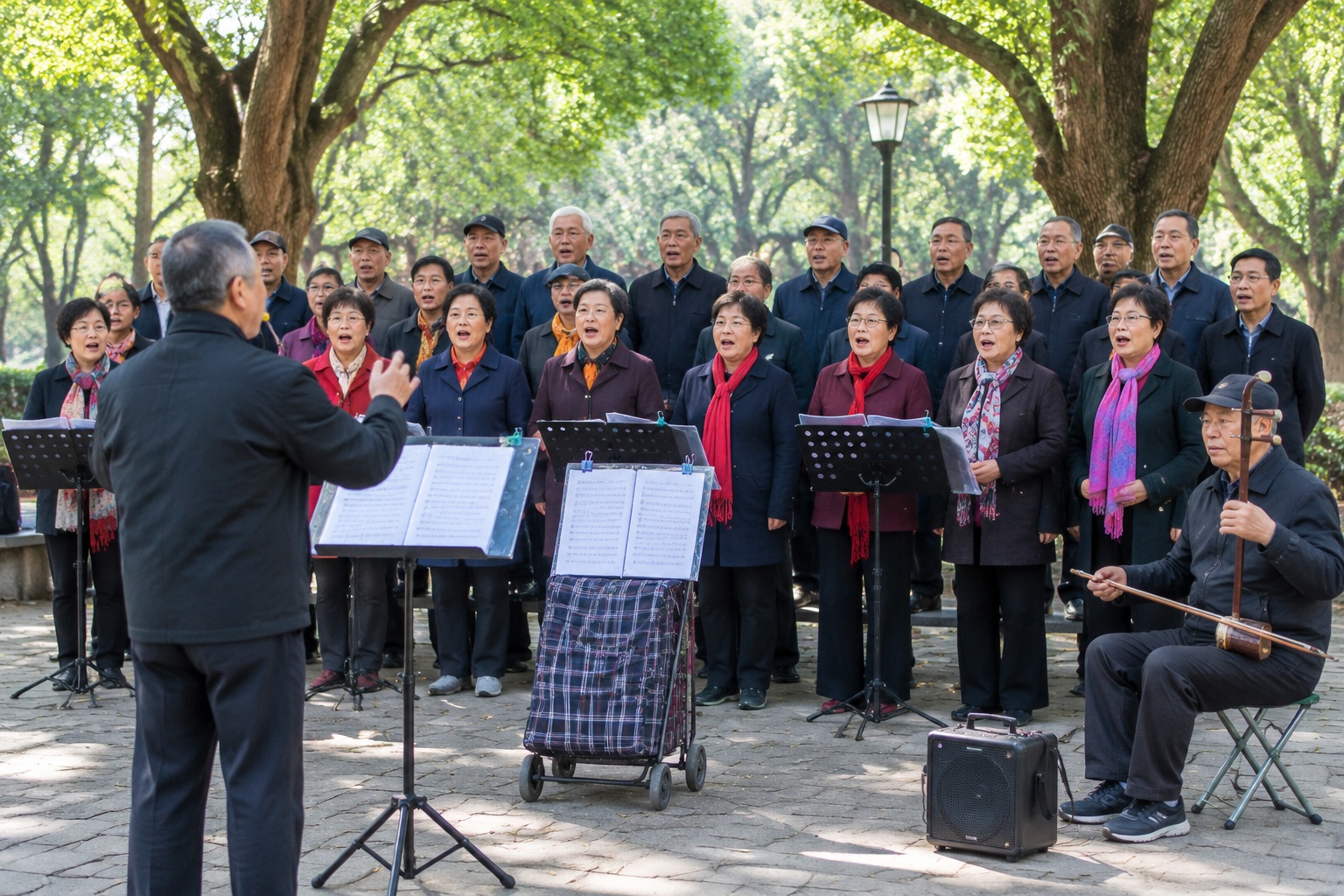
By eight, a second shift has gathered under the camphor trees at the park’s center: about forty people in three loose rows, facing a man with a chrome whistle around his neck. An erhu player tunes. Someone wheels a small amplifier into place. The group starts a song from a 1960s film that most of them can sing without looking at the words.
The lyric sheets are there anyway — copied at a print shop, slid into plastic sleeves, clipped to music stands and shopping carts. The repertoire runs from film songs and Yunnan folk tunes to “My People, My Country,” a patriotic song that became a karaoke standard after the 2019 film of the same name. A woman arrives twenty minutes late, squeezes into the back row, and finds the melody within a verse.
None of it requires money, registration or permission. That is the point. For people whose working lives were organized by a danwei — a work unit that supplied the job, the housing and often the friends — singing outdoors in a group restores something retirement quietly takes away.
Square Dancing and the Argument About Volume
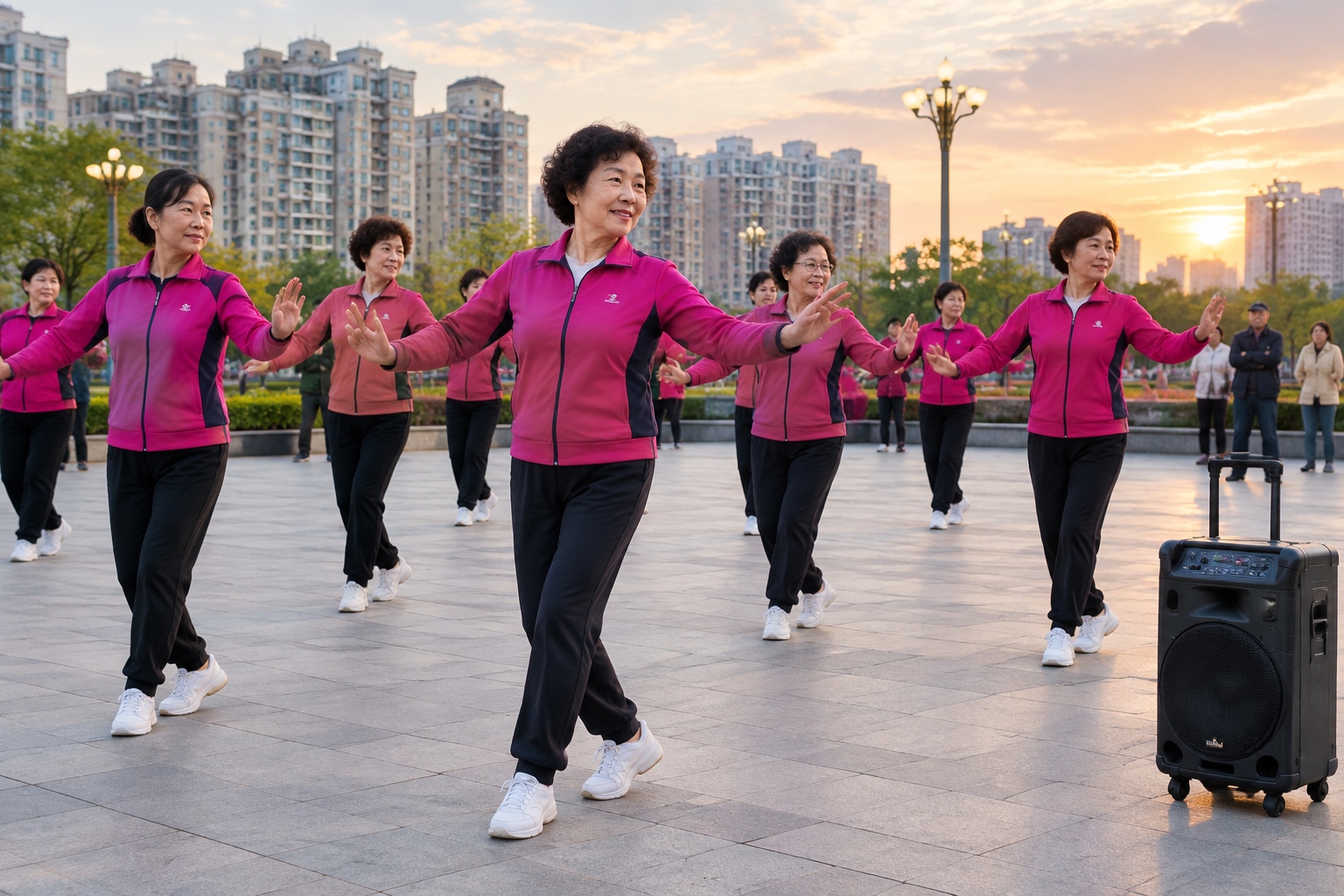
At seven in the evening the same plaza handles a different crowd: thirty to sixty women, a few men, roughly 50 to 75 years old, in rows facing a rolling speaker the size of a suitcase. The routine follows a video learned on Douyin, China’s short-video app. Square dancing — guangchangwu — is mocked online as a national embarrassment and is also one of the country’s most effective public health programs, run for free by its own participants.
It has a conflict record. Through the 2010s, Chinese news carried regular stories of neighbors throwing objects from balconies and of lawsuits over 9 p.m. noise. The Noise Pollution Prevention and Control Law, in force since June 2022, gave local authorities clearer power to set hours, locations and volume limits, and many parks now post signs listing them. Some groups bought wireless headphones and dance in near-silence — fifty people moving in perfect time with no music anyone else can hear.
Mahjong Is Not Really Gambling
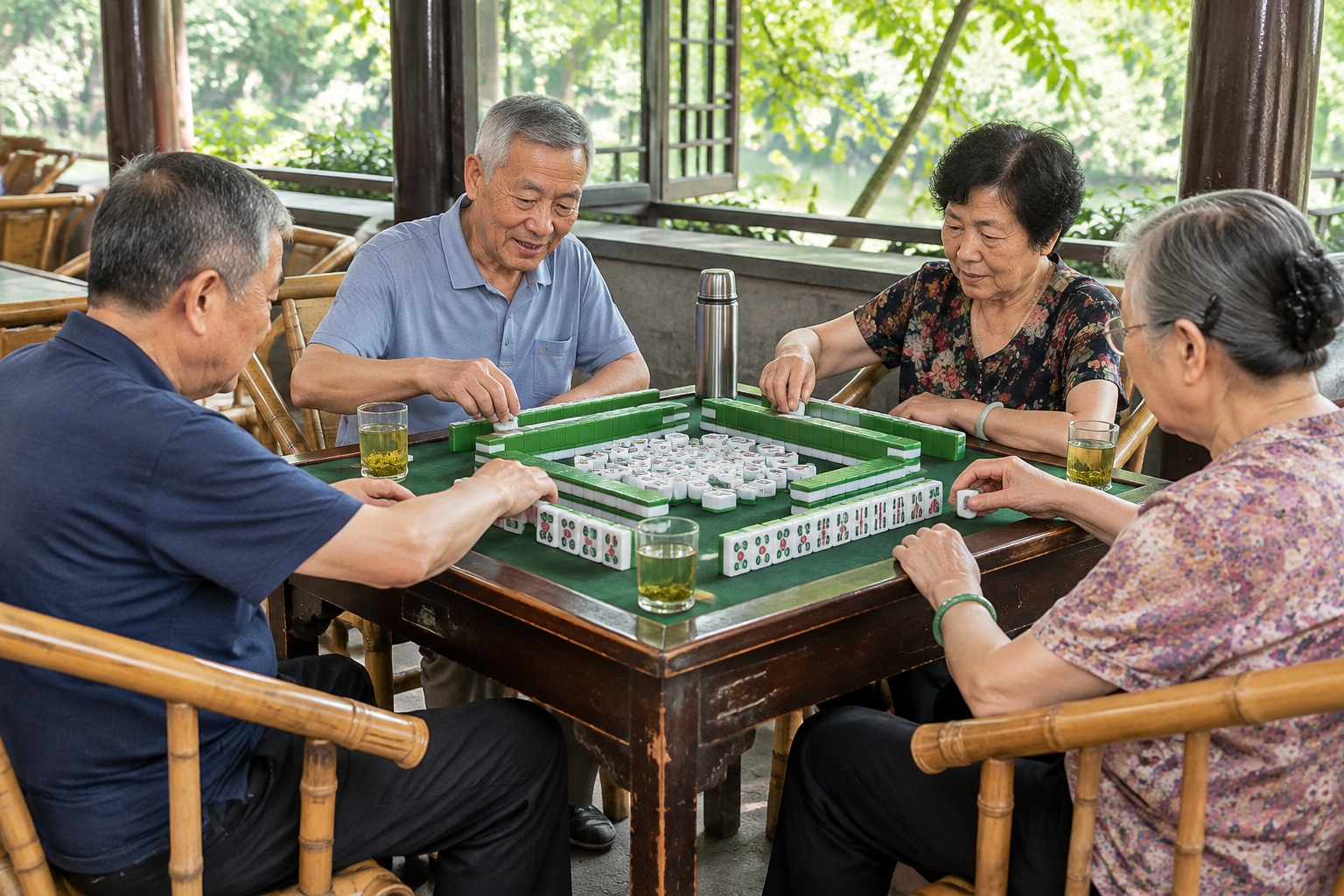
Back at the tables, the tiles have been clicking for two hours. Four players, a square table, jasmine tea at 15 yuan with unlimited refills. The variant is Sichuan mahjong, faster and more aggressive than the Cantonese version: hands play out to the end — “bloody battle to the end,” locals call it — so every round produces more winners and more noise.
Stakes are usually two yuan a point, and a bad afternoon costs 30 or 40 yuan, the price of lunch and a taxi home. What looks like gambling to a foreign eye works as something else: a low-stakes contract that lets near-strangers sit together for four hours, tease each other and keep their arithmetic sharp.
Three Retirements, One Park
Mr. Liu, 63, spent 34 years at a textile machinery plant. He arrives at 6:20, sings until 8:15, eats an eight-yuan bowl of wontons outside the gate, and walks home to cook lunch for himself and his wife, who still works part-time. At two he is back for mahjong. At 5:30 he collects his grandson from primary school. “My day has a schedule,” he says. “That’s the whole trick.”
Auntie Zhang retired at 50 from a department store and now runs a 60-person dance group through a WeChat chat of 137 members. She choreographs on her phone at night, buys costume fabric in bulk online, and collects ten yuan a month from each dancer to cover speaker batteries and cables. It is the only money involved. “If I stopped, forty people would call me.”
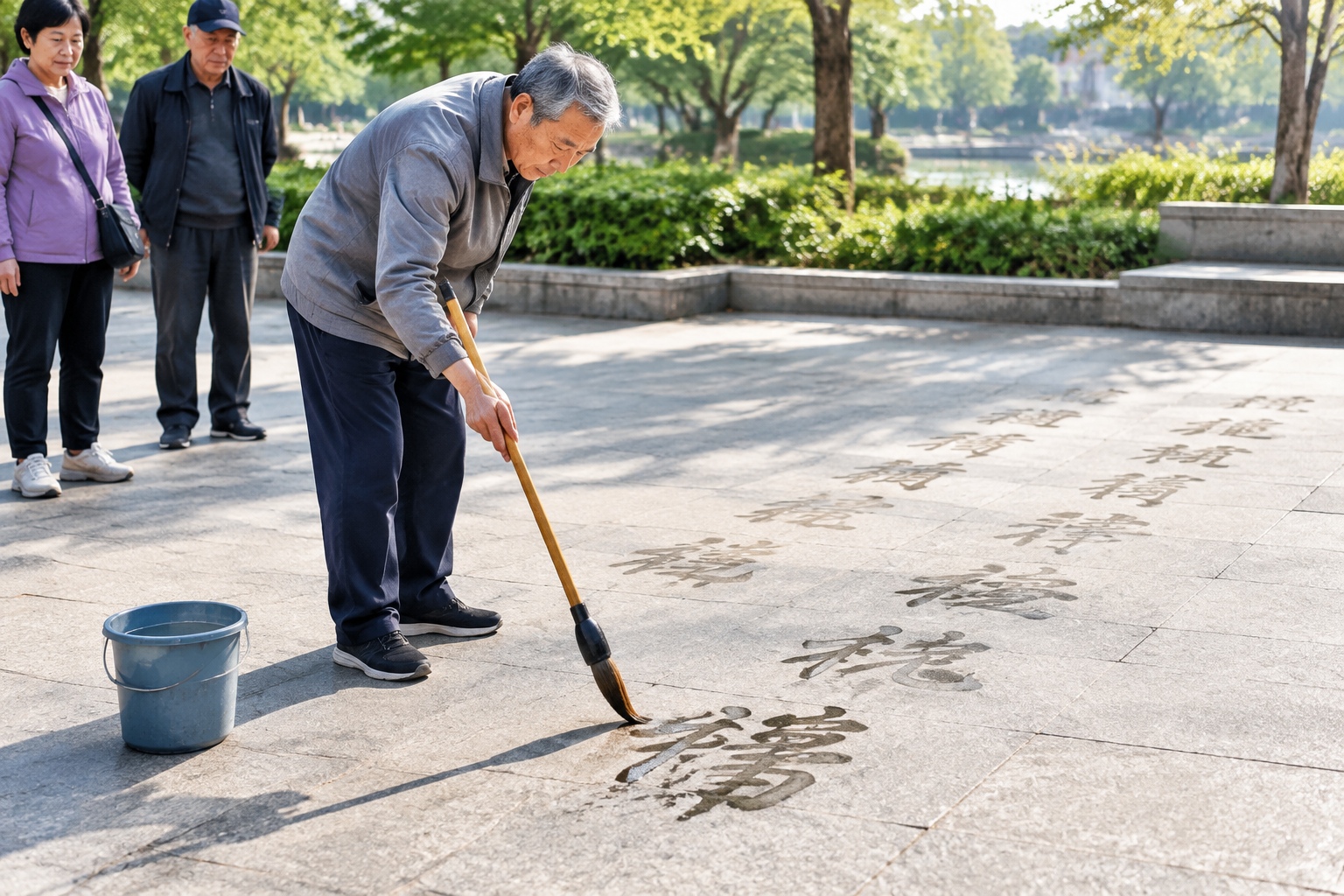
Mr. Chen, 71, a former middle school teacher, arrives alone, fills a long-handled sponge brush with water, and writes Tang dynasty poems in large characters on the stone pavement. The sun erases each line in about three minutes. He doesn’t say much, and people stop to watch anyway.
What an American Recognizes, and What She Doesn’t
Karen keeps comparing the park to home. In the United States, organized activity for older people usually happens indoors: a senior center with a schedule, a sign-in sheet and a parking lot. Parks are for jogging, dogs and quiet.
Here the space is dense, mixed-age and loud — teenagers filming dance videos in one corner, retirees singing in another, a toddler chasing pigeons between them. Almost everyone arrived on foot. That is the structural difference people miss: most of these retirees live within a fifteen-minute walk. When your social life is a bus ride and a registration form away, you go less. When it is downstairs, you go every day.
The Unwritten Rules, and Who Keeps Them
Nearly all Chinese city parks are free to enter, and urban park green space per person has roughly doubled since 2000, to about 15 square meters. No ticketing system means regulars allocate space themselves; the choir spot under the camphor trees belongs to whoever gets there first, and after a few years it simply belongs.
Written rules exist too. Park staff in vests walk through with decibel meters. Dance groups get hours, often 7 to 9 p.m., and boundary noise limits. When a residential tower goes up beside a plaza, the negotiation restarts: complaints, mediation, a new sign. It is messy municipal work, and it happens in thousands of neighborhoods every year.
What the Park Says About Aging in China
The park is not a solution to China’s aging problem. Free infrastructure can only carry so much. The pension gap between city and countryside is real and wide, loneliness in villages has no chorus to join, and care still falls heavily on families. The government’s push for a “silver economy” — a market projected to reach roughly 7 trillion yuan by 2035 — will not change that by itself.
But the morning crowd makes an argument that is easy to overlook: proximity and permission matter more than money. Give people a walkable, free, unreserved space and let them organize themselves, and the small things that make old age bearable — a fixed schedule, a group that notices when you don’t show up, a reason to leave the apartment before eight — appear on their own.
Karen stayed two hours. She didn’t sing or dance or play. She took about forty photographs and one video of the mahjong tables. “In Portland, if forty people did this at seven in the morning, somebody would call the police,” she said. “Here, everyone just walks around them.” Then she walked around them.
Start the discussion at forum.chinacomes.com