
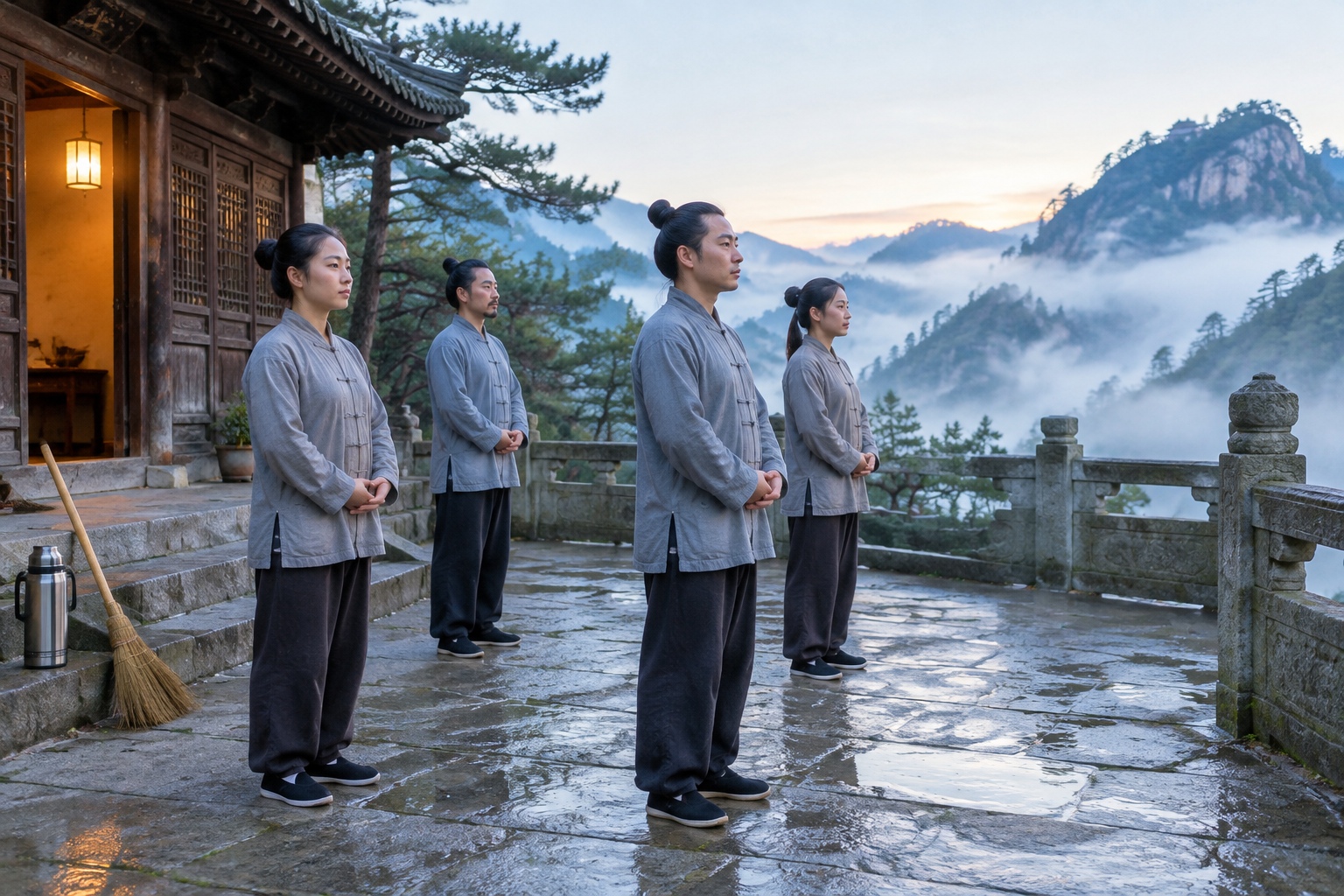

5:20 A.M. on Wudang Mountain
At 5:20 in the morning the courtyard is still black, and the only sound is a broom. Someone is sweeping wet flagstones in the dark, long unhurried strokes, pushing rainwater toward a drain. It is about 8°C. The air smells of pine smoke and damp rock. I am standing outside a guest room in a borrowed jacket, convinced I have gotten the time wrong.
I have not. By 5:35, four men in grey cotton jackets and black cloth shoes have lined up in the yard, facing east. Nobody talks. Nobody stretches. They stand with knees slightly bent, arms curved as if holding a large invisible ball at chest height. Fifteen minutes pass. Twenty. The ridge above the temple goes from ink to slate to a pale grey wash, and still nobody moves.
I came to Wudang for a week to find out what Taoist martial arts actually are, as opposed to what I had absorbed from films. What I found was less dramatic and harder to describe: a routine, a set of household rules, and a group of men genuinely uninterested in the question I kept asking.
Where Wudang Is, and Who Lives There
Wudang Mountain sits in Shiyan, a city in the northwest of Hubei province, central China. It is not a remote secret. UNESCO listed its ancient building complex as a World Heritage site in 1994 — halls and palaces built along the slopes from the Tang dynasty onward, with the biggest push in the early 1400s, when the Ming emperor Yongle ordered a bronze, gilded Golden Hall cast in Beijing and hauled up to the 1,612-metre summit in 1416.
Getting there is not mystical either. A high-speed train from Wuhan takes roughly three to four hours to Shiyan East; from the station, a bus or taxi reaches the scenic area gate in about an hour. Entry plus the mandatory shuttle bus costs a few hundred yuan in high season, and the cable car is extra. There are turnstiles, noodle stalls, a ticket mini-program and tour groups in matching hats.
Several dozen ordained Taoist priests live on the mountain; more people are lay students, staff, cooks and vendors. I stayed in a small guesthouse attached to a temple courtyard, sharing a corridor with three priests and a rotating cast of students from Shenzhen, Chengdu, France and Germany.
Standing Still for Twenty Minutes
Morning practice starts with standing, not punching. In Chinese it is zhan zhuang, “standing like a post.” You bend your knees a little, round your arms, drop your shoulders and stay there. It looks like nothing. After four minutes your thighs are shaking.
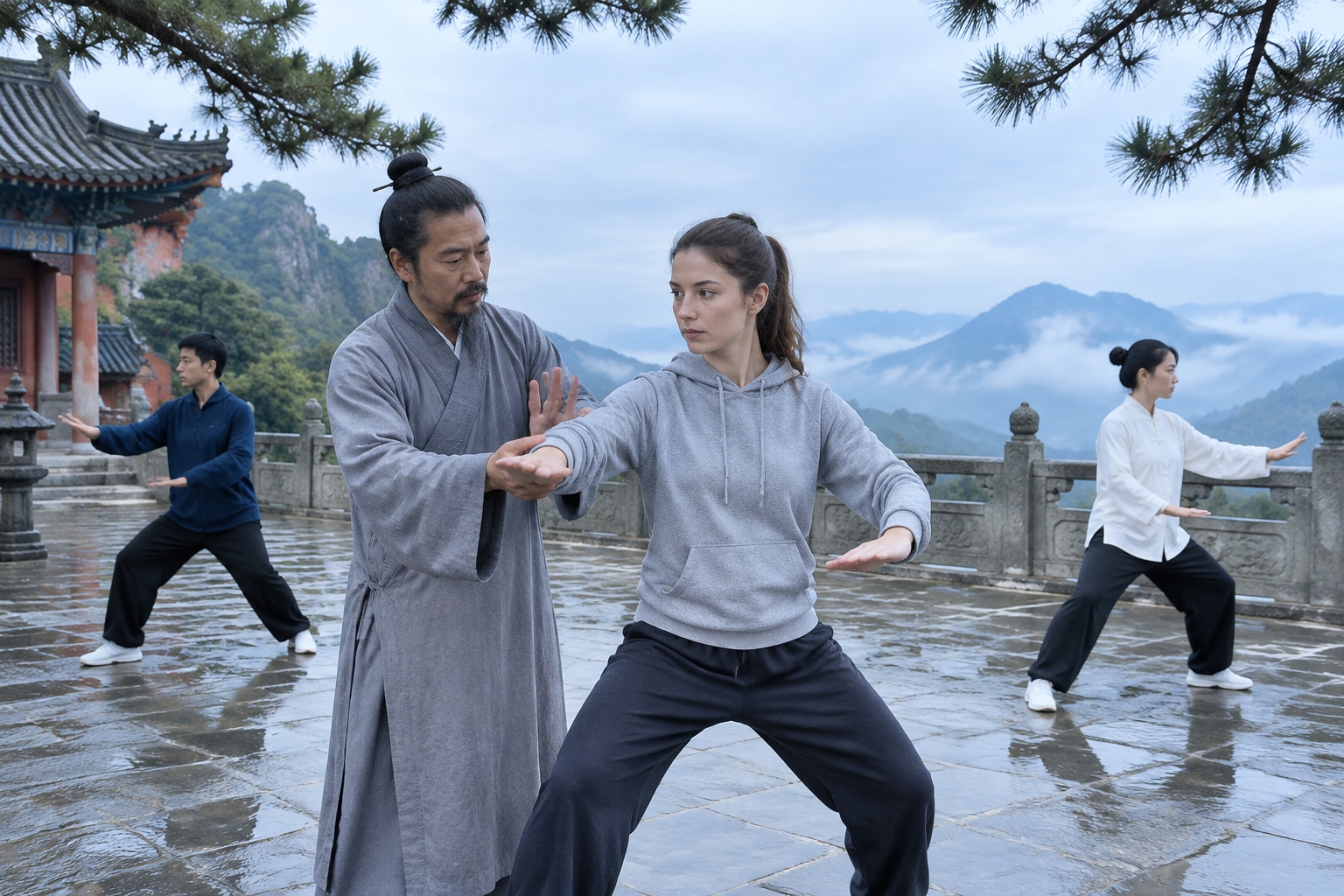
Then comes a slow taiji form — the kind that takes about twenty minutes and never speeds up — and then pushing hands, tui shou: two people with forearms touching, circling, each waiting for the moment the other commits too much weight.
“Softness Is Not Weakness”
The priest who agreed to talk asked to be identified only by his surname, Luo. He is 46, grew up in a village two hours away, and came at 17 because his uncle was already here. He has been on Wudang since, apart from two years in Wuhan that he calls “a mistake I needed to make.”
“Foreigners arrive because they saw a film,” he said, sitting on a bench with a thermos of green tea. “They want to learn to fight. After two weeks, most of them want to learn to stand still. That is the harder skill.”
I asked about the phrase I kept hearing: yi rou ke gang, using softness to overcome hardness. He put down the thermos and pushed my forearm with two fingers. When I pushed back, he moved with it, and my effort ran out into empty air.
“If you push, I don’t push back,” he said. “I let your strength finish. It finishes in the air, and then you are off balance. Very boring to watch, very hard to do.”
That is close to a line in the Tao Te Ching: the highest good is like water. Water is soft, and it wears through stone. It is a philosophical claim before it is a fighting technique, and Luo was not interested in which of the two I found more impressive.
Breakfast at a Long Table
Meals happen at one long wooden table in a plain room with paper screens: rice porridge, steamed buns, pickled radish, tofu, stir-fried mountain greens, a kettle of tea. No meat, no alcohol, no phones out. People eat quickly and quietly, then wash their own bowls in cold water.
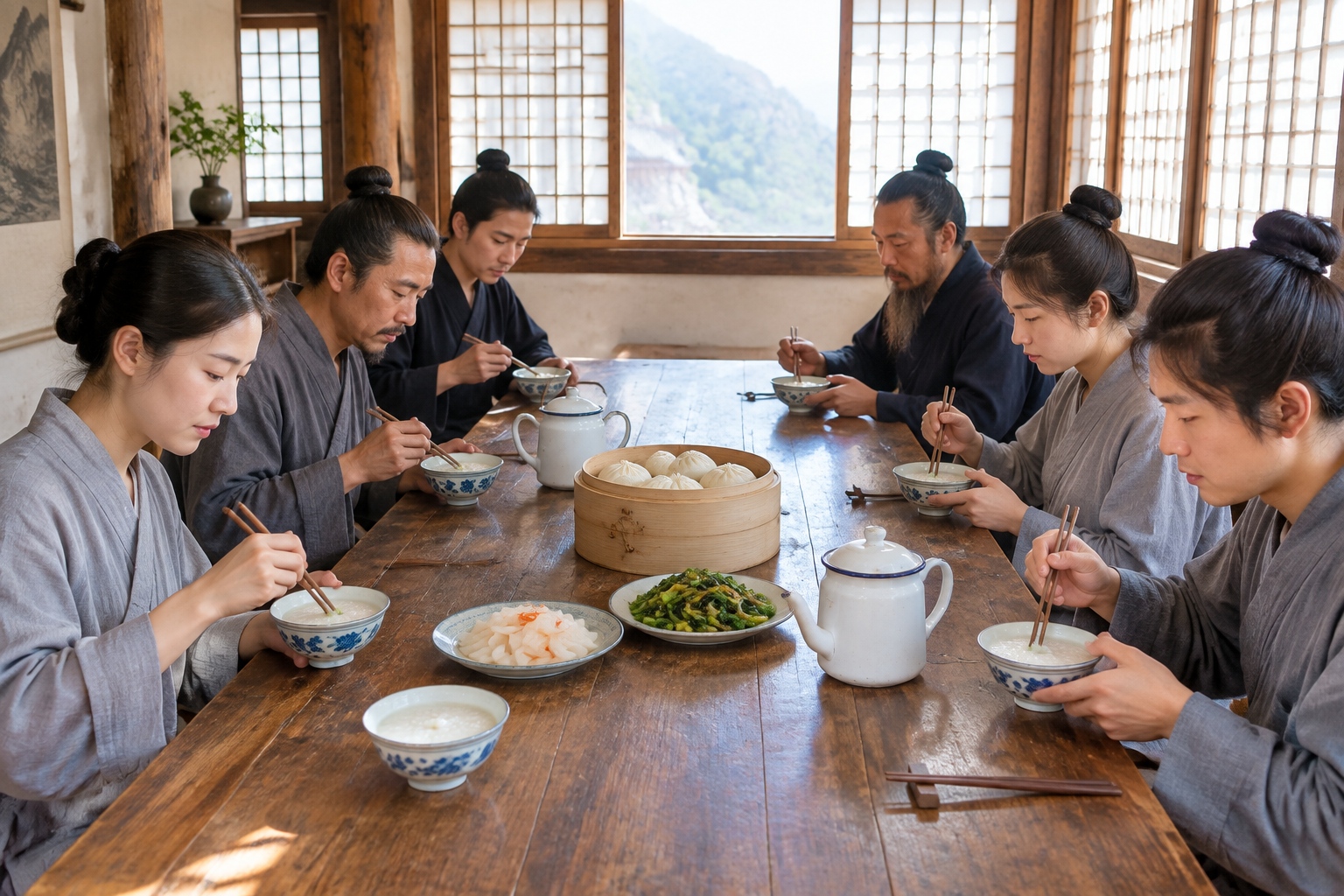
The cook is a 68-year-old woman from a nearby village who has worked here nineteen years. She said the number of people at the table changes every week, which is the part she dislikes. Students come for a month, get bored or homesick, and vanish. She keeps a mental list of who still owes money.
What surprised me more than the training were the household rules: fixed lights-out, no alcohol on the premises, no arguing in the courtyard, a schedule that rearranges itself only for weather. It felt less like a martial arts boot camp than a large, quiet, slightly underfunded family with a very old routine.
What the Movies Get Wrong
The wuxia films and novels most foreign readers know — swordswomen running up bamboo, masters levitating — are a genre with their own rules, about as literal as a Western built around a duel at noon. Wudang’s own legend, the 13th-century Taoist Zhang Sanfeng, is credited in popular storytelling with inventing taiji after watching a snake and a crane fight. Historians are more careful: the internal arts took shape over centuries and through many people, and the legend is better read as an origin story than a record.
What is actually taught on the mountain is closer to mechanics and habit. Weight shifts. Breathing. Balance while someone pushes you. Joints moving the way they were designed to move. A product manager I met, 32 and three months into a leave from Shenzhen, said the first thing that improved was not his fighting but his neck.
Kung Fu Means Time, Not Superpowers
In Chinese, gongfu is not primarily a film genre. It means work, effort spent, and by extension the skill that effort produces. It turns up in everyday phrases like fei gongfu, “to take time and trouble.” A cook has gongfu with a knife. A teacher has gongfu with a class. Nobody acquires it in a montage.
The people training around me were mostly not aspiring warriors. A 55-year-old retired nurse from Chengdu came for her blood pressure and her sleep. A French engineering student on a gap year came for a language he could not speak and stayed for the schedule. The small schools around the mountain quoted me monthly fees of roughly 3,000 to 6,000 yuan, room and three vegetarian meals a day included, less per month on longer stays. Most first-timers quit within a week; winter finishes off a few more.
Luo was blunt about what city dwellers get out of it. “They don’t need a teacher to tell them to be calm,” he said. “They need a reason to sleep at nine and get up at five.”
The Mountain Is Also a Business
It would be dishonest to call Wudang untouched. The scenic area is managed, ticketed and busy, and the money shows in new paving, cable cars and hotels. Down the hill there is an evening performance with amplified music and fog machines, where young men in silk perform acrobatic versions of forms they also practice sincerely at dawn. Both things are true at once.
Some priests worry about it openly. Ordination is slow, pay is modest, and a young man with good form can earn more teaching short courses to visitors, or posting fifteen-second videos, than by staying in a hall for a decade. One younger priest had about 200,000 followers on a short-video platform and was matter-of-fact about it: the videos brought students, and the students paid for roof repairs.
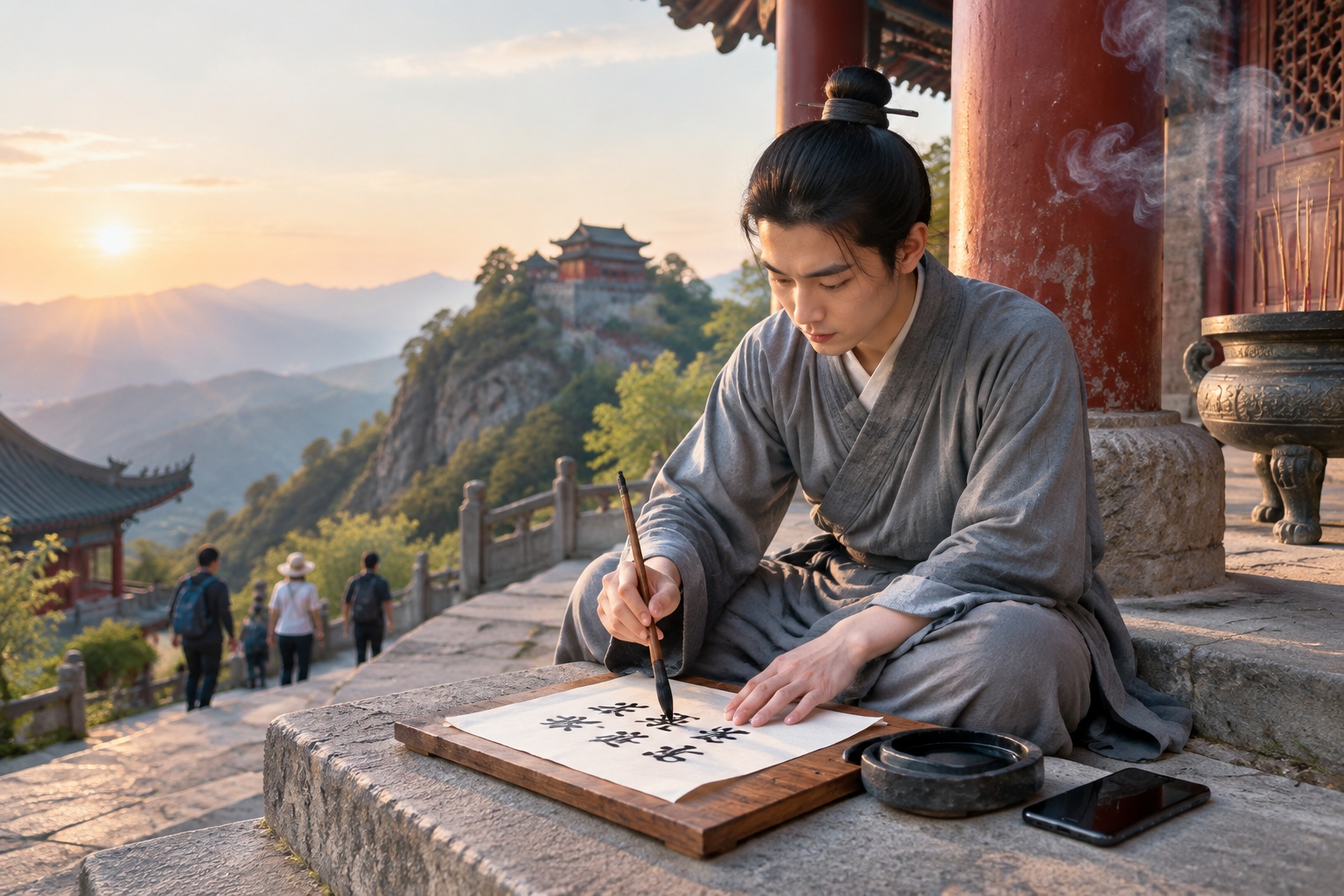
Older residents described the trade-off differently. They did not object to tourists. They objected to the pace. “People come here to slow down and then photograph everything,” one of them said, sweeping. “Fine. Sweeping is also practice.”
What I Carried Down the Hill
On my last morning the broom started at 5:20 again. I stood in the yard with the others for twenty minutes, and my legs shook exactly as much as on the first day. Nothing secret had been transmitted to me.
What I took away was smaller and more useful: a habit of standing still before reaching for my phone, and a working definition of kung fu that has nothing to do with fighting — effort, repeated, over a very long time, until it becomes part of how you move through a day. The Taoist version of that idea includes rivers, seasons and not forcing things. The everyday version fits in a rented apartment. Same word.
Luo walked me to the gate and shook my hand the way he did everything: briefly, without hurry. “Don’t practice hard,” he said. “Practice often.”
Start the discussion at forum.chinacomes.com