
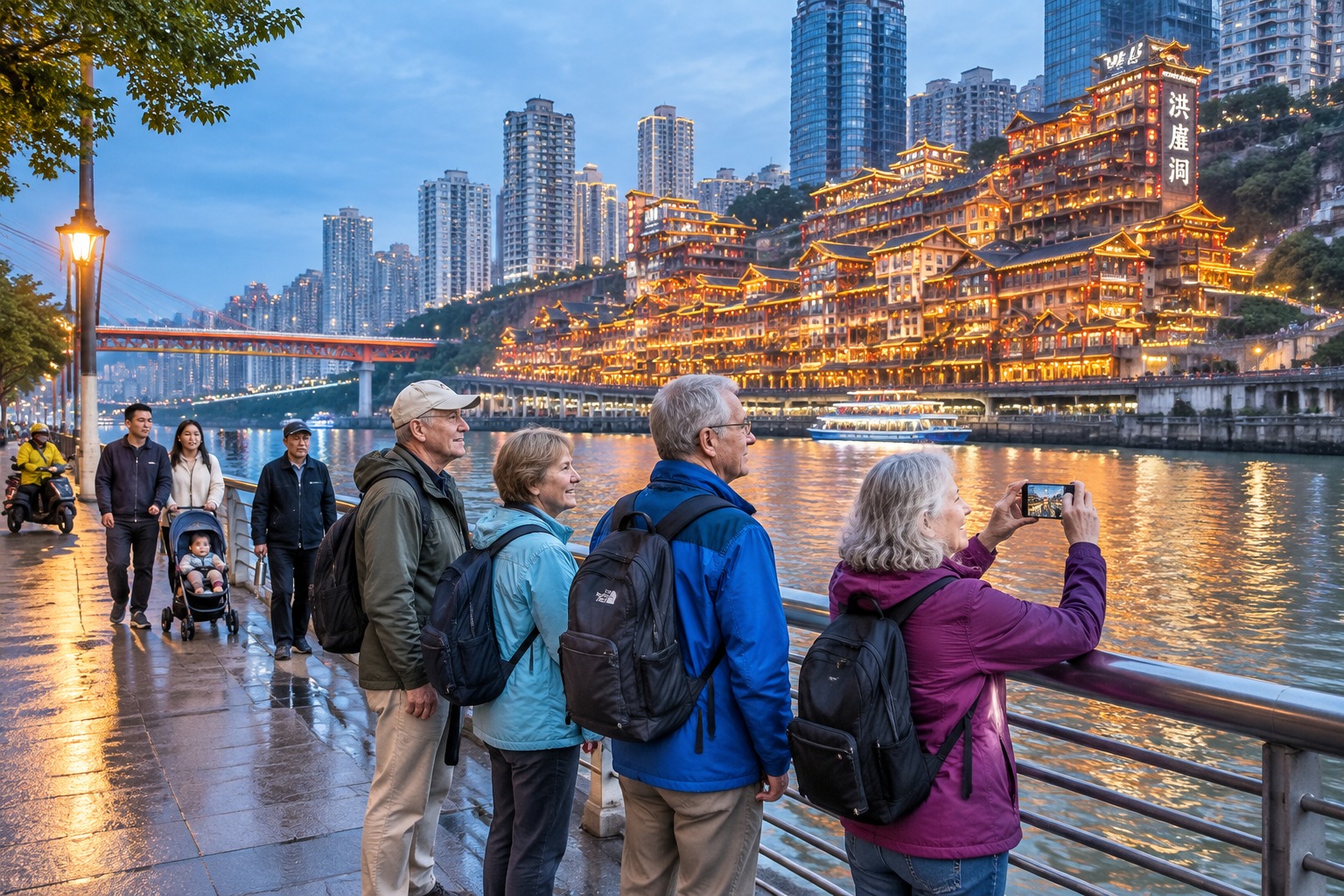

Shanghai, 8:15 a.m.: The Line Outside No. 76 Xingye Road
By 8:15 on a Tuesday morning in early November, the queue outside No. 76 Xingye Road is twenty people deep. The building is a shikumen — a brick lane house with black-tiled eaves and a narrow stone door frame — and it stands in the middle of some of the most expensive property in China. Two hundred meters east, a young woman in a puffer vest walks past a row of brunch places holding a paper cup of coffee. Admission to the site of the First National Congress of the Communist Party of China is free, but you reserve a time slot on your phone, and the early ones go first.
Twelve of the people in line are Americans. Most are retired. One teaches high school history in Oregon. One is a Chinese-American chip engineer from San Jose. One is a 68-year-old retired school librarian from Dayton, Ohio, named Karen Whitfield, who has carried the same folded rain jacket for six days.
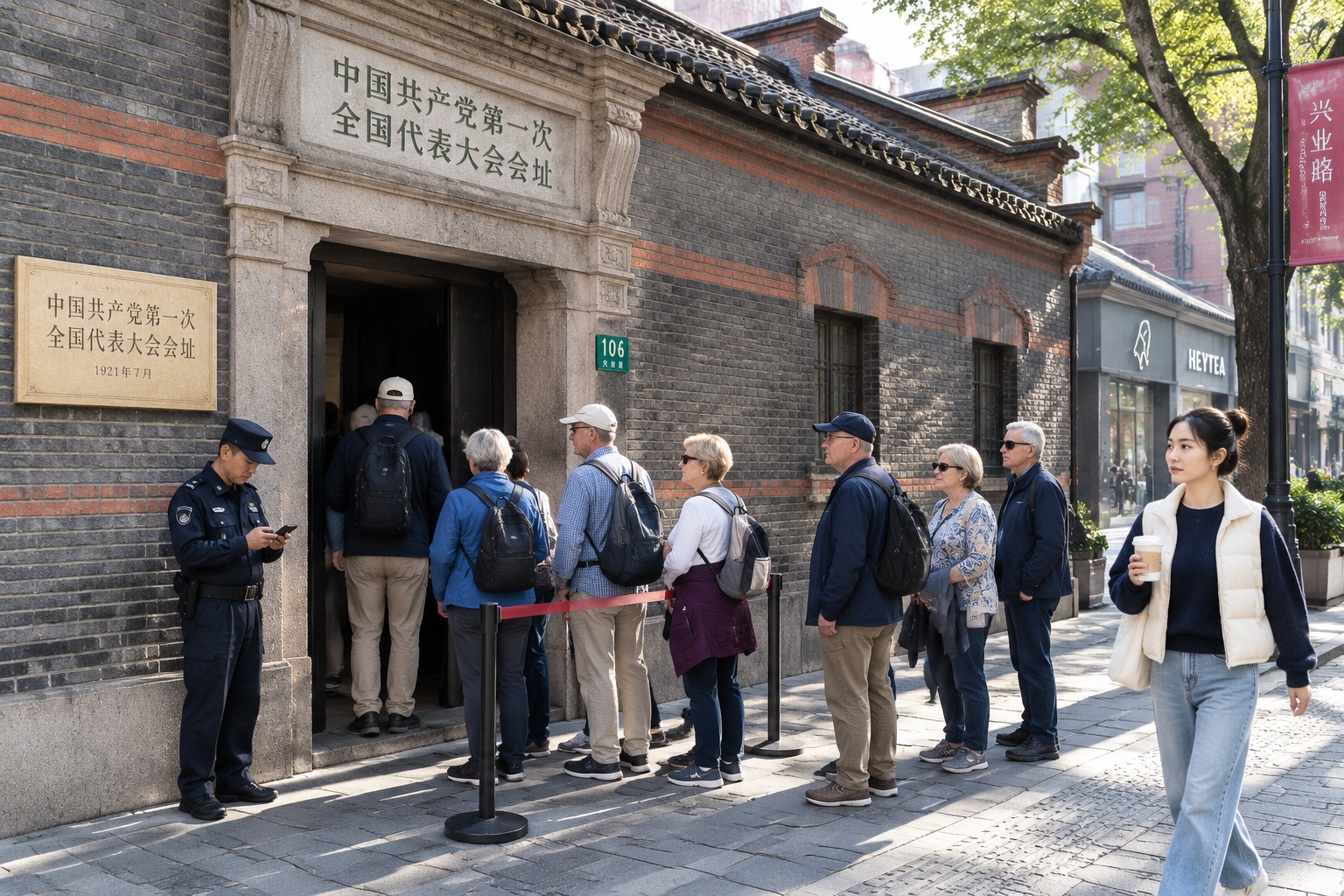
Inside, the exhibition is quiet and well lit. Photographs of the thirteen delegates who met here in July 1921. A reconstructed meeting room with teacups on the table. Labels in Chinese and English explaining that most of the men were in their twenties and thirties. Karen reads every English line. So does everyone else, which is unusual on a package tour.
Why Americans Book a “Red Route” at All
Their guide introduces herself as Lily Zhou, 34, born in Chongqing, history degree from a university in Wuhan. She has led this itinerary eleven times. “I tell them on day one that I’m not going to tell them what to think,” she says on the bus, half turned in her seat. “I tell them to ask me anything, including the things they assume I won’t answer.”
The route itself is not exotic to Chinese travelers. Shanghai first: the Congress site, the former residence of Sun Yat-sen, the Jewish refugee museum in Hongkou. Then west by train to Chongqing, China’s wartime capital from 1937 to 1946, where the Nationalist government, foreign correspondents and the Communist Party’s Southern Bureau all worked within a few kilometers of one another. Then the Red Crag sites — Hongyan, Zhazidong, Baigongguan — where more than 300 prisoners were executed in late November 1949, hours before the city changed hands. Twelve days, roughly $2,000 to $4,000 per person on the ground depending on hotels.
Zhou says most of her clients are over 55 and come for two reasons. The first is curiosity about a stretch of history their own textbooks skipped. The second is a version of the same question: why is this country the way it is?
The Train West: 1,700 Kilometers and a Bowl of Noodles
The G-series train from Shanghai Hongqiao to Chongqing North takes a little under eleven hours. China’s high-speed network passed 48,000 kilometers of track in 2024, and this line is not even one of the celebrated ones. The view out the window moves from office towers to rice paddies to the terraced edges of the Three Gorges, and the group sleeps through most of it.
On the platform at Chongqing North, the ground is wet and the air smells like diesel and fried chili. Chongqing is a municipality of roughly 32 million people spread across an area about the size of South Carolina, built on steep hills where two rivers meet. Zhou warns the group about the stairs. She is not exaggerating; the city has escalators and public elevators cut into the hillsides, and people use them the way New Yorkers use the subway.
Liziba: A Train That Runs Through a Building
At 9:40 the next morning, on Metro Line 2, a six-car monorail slides straight through the sixth, seventh and eighth floors of a 19-story apartment block. The station is Liziba. The line opened in 2005 as China’s first straddle-beam monorail; the tower came later, built around the track because there was no space for either one alone. Residents complained about the noise for years, and engineers eventually fitted rubber pads under the rails.
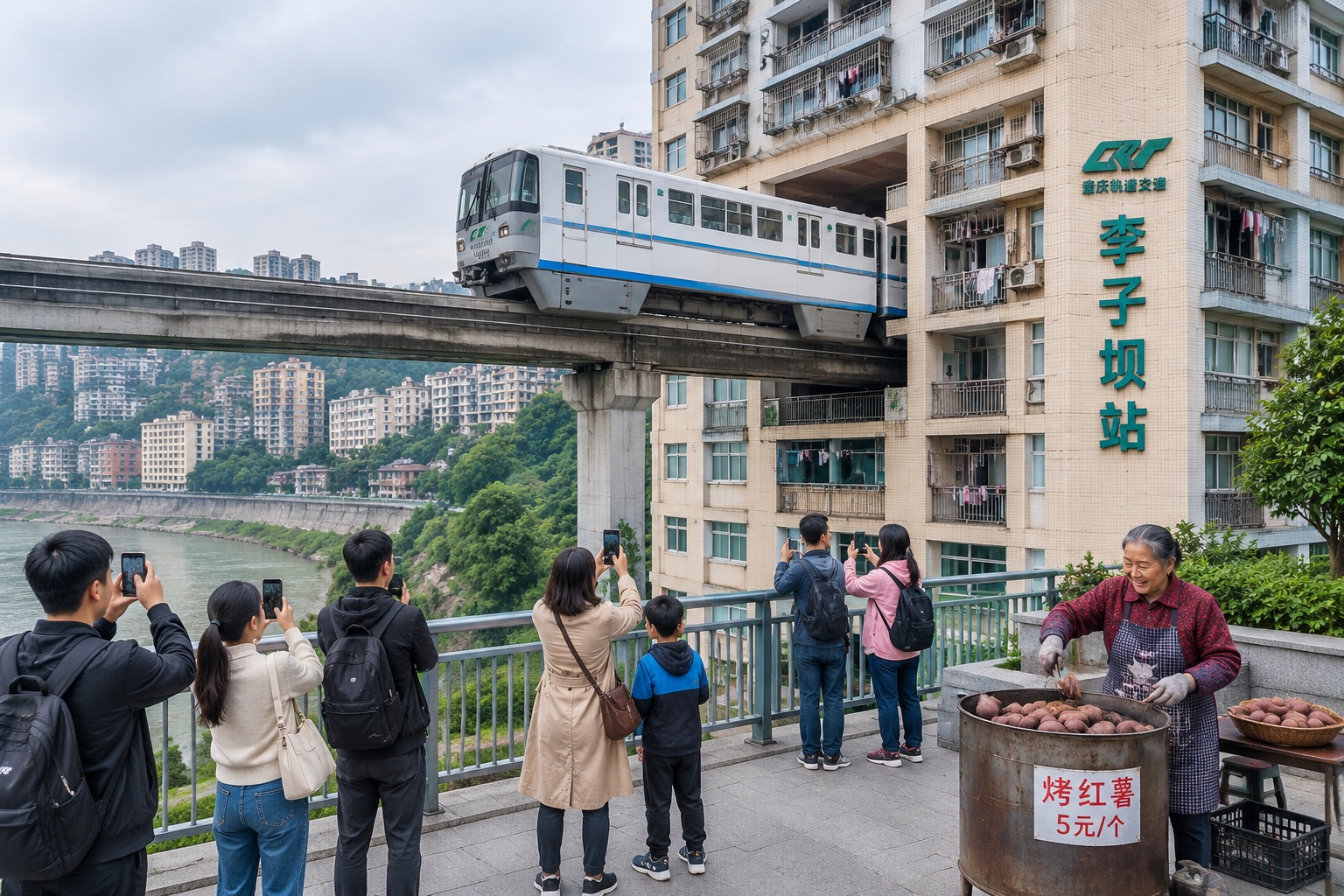
Outside, on a viewing platform built for exactly this purpose, about a hundred people a day wait with their phones up. A grandmother selling roasted sweet potatoes from a metal drum does steady business. The Americans take forty photographs each. Then they buy two-yuan tickets and ride two stops, because it is a real train and it goes somewhere.
What the Red Crag Museums Show, and What They Leave Out
The prison sites in Shapingba are the emotional center of the trip, and they are not subtle. Cells with iron bars, a torture room, handwritten farewell letters enlarged on the walls. On November 27, 1949, guards shot prisoners and set fire to the buildings as the People’s Liberation Army approached the city; more than 300 people died. The exhibition labels include English, but the English covers perhaps a third of the Chinese text, and the group leans on Zhou to fill the gaps.
She does, including the parts that make her audience uncomfortable. When the engineer from San Jose asks about the Cultural Revolution, she answers without deflecting. When someone asks why the museum’s timeline jumps quickly from 1949 to the 1980s, she says: “Because that’s how it was designed. You can read about the rest on your own.” Two people in the group disagree loudly about what the exhibits mean. Nobody resolves it.
The Lunch That Broke Karen Whitfield
It happens three days later, and it is not in a museum. It is 11:20 in the morning in a residential block in Yuzhong district, at a subsidized community canteen for older residents. Chinese cities have been opening these by the hundreds over the past few years; lunch here costs 12 yuan, about $1.70, and by half past eleven the queue is out the door.
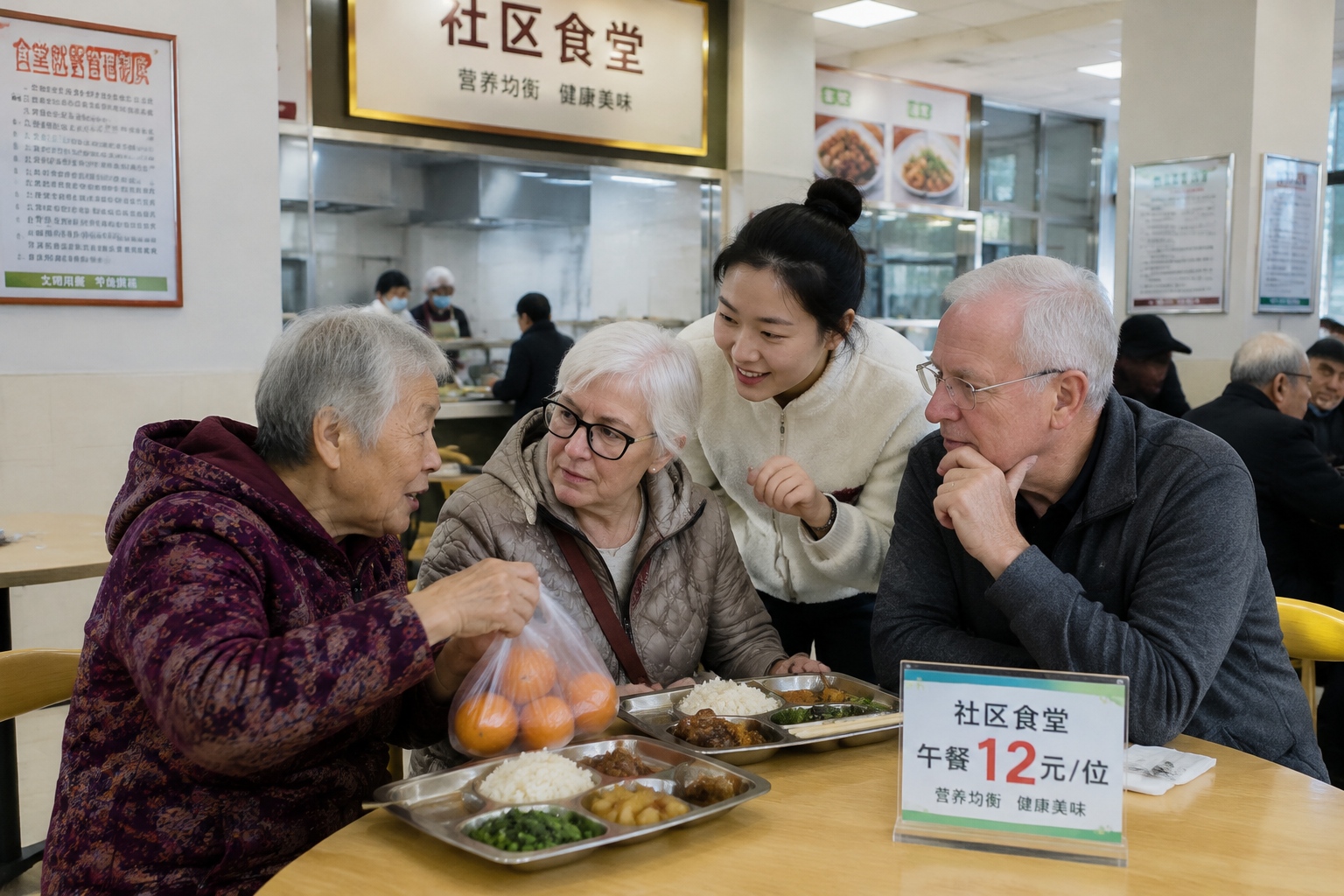
A woman named Tan, 78, shares a table with the visitors and explains, through Zhou, that she has eaten here five days a week since her husband died and that her two children live in Shenzhen and Chengdu. She has a plastic bag of oranges that she insists on opening. She asks Karen where she is from, and when Karen says Ohio, Mrs. Tan says she has never been on a plane.
Karen starts crying. Not at the prison, not at the memorial, but here, over a tray of rice, stewed pork and greens. Later, drying her face with the back of her hand, she tries to explain it. “I expected a museum about ideology,” she says. “And instead there’s this woman who outlived her husband and still eats lunch with her friends and hands out oranges to strangers. They made it to lunch. That’s the whole thing. They made it to lunch.”
Night on Nanbin Road
That evening the group walks the riverside promenade on Nanbin Road, across the water from the Yuzhong peninsula. Hongyadong, an eleven-story stilt-house complex clinging to the cliff, is lit up gold, and half the city seems to be photographing it. Dance groups take over the wide pavement in shifts: a line-dancing circle of women in their fifties, then a couple doing ballroom to a Bluetooth speaker.
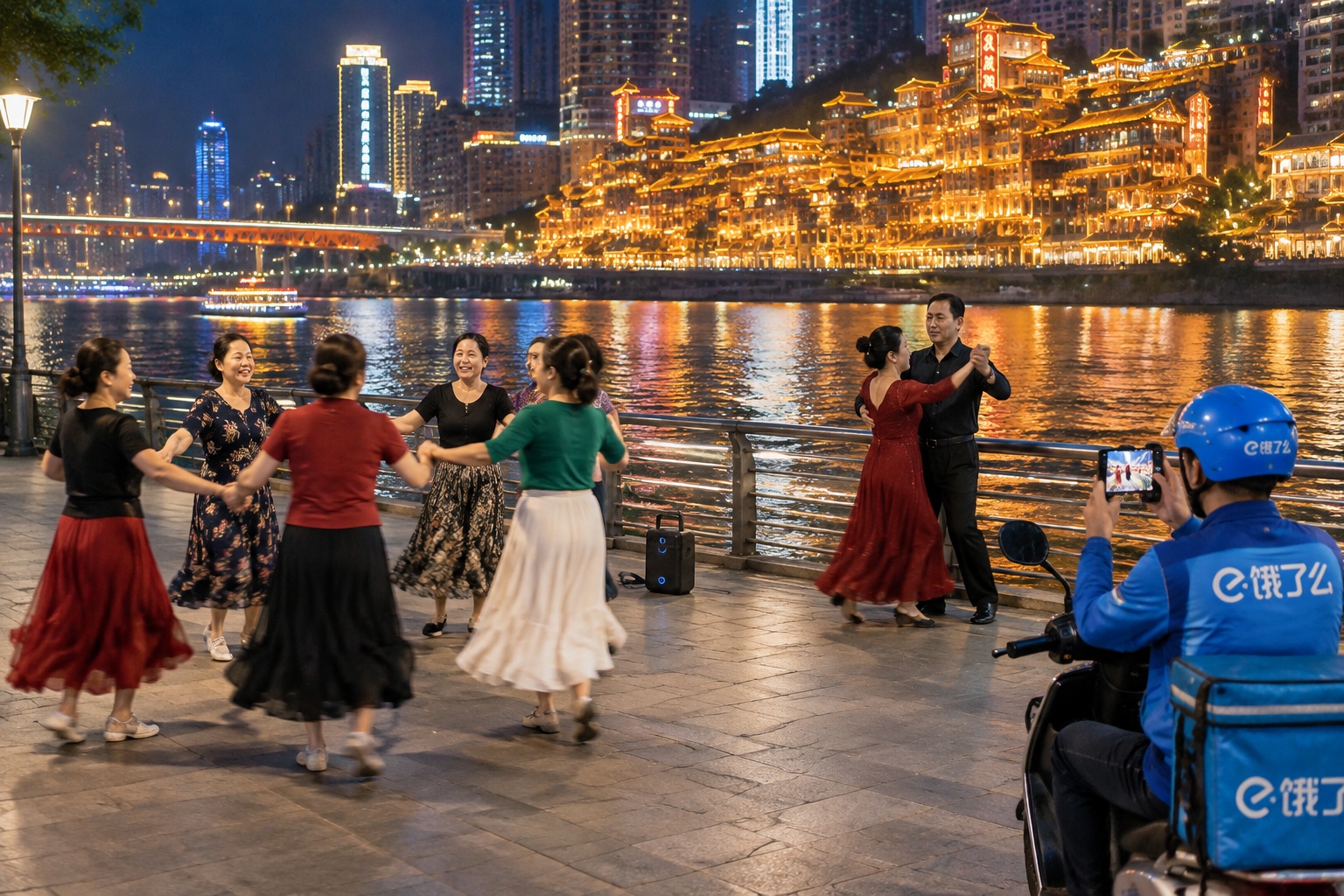
A delivery rider named Xiao Peng, 24, stops to check his phone near the group. He came from a county in Guizhou three years ago and says he clears around 6,000 yuan in a good month, working eleven hours a day and renting a room for 900. He is not interested in the museums. He is interested in whether the Americans like Chongqing hotpot, and whether they know that the city has a monorail running through a building. He films them with his phone to send to a friend, then rides off through traffic.
What Ten Days Cannot Show You
A tour is a selection, and this one is selected carefully. Zhou is candid about it: the itinerary is built around the 1920s, the 1940s and the 2020s, and it steps lightly over the decades in between. The property slowdown that began in 2021 is visible from the train, where cranes stand over half-finished apartment towers. The gap between a municipality of 32 million and the villages four hours into the mountains is real, and no twelve-day schedule crosses it.
The Americans notice some of this on their own. The high school teacher photographs a stretch of half-built towers. The engineer asks about youth unemployment and gets an answer that is careful and not entirely reassuring. But they also notice things that no brochure promised: that the subway is cheap and clean, that a 78-year-old woman can live alone on a modest pension and eat lunch out five days a week, that strangers will spend ten minutes helping a foreigner reload a payment app.
If You Want to Make the Trip Yourself
United States citizens can currently enter China without a visa for up to 240 hours (10 days) if they are transiting to a third country or region and arrive through an eligible port — useful for a shortened Shanghai–Chongqing version. Museums on this route are generally free but require online reservations, usually through a WeChat mini-program. High-speed rail tickets can be booked with a passport, and you will need it at the gate. Alipay and WeChat Pay both accept foreign credit cards now, and almost nobody takes cash. March to May and September to November are the sane months; Chongqing in July is a 40°C city built on stairs.
Back at Hongqiao
On the last morning, the group stands in Shanghai Hongqiao Station with their luggage, waiting for trains in four directions. Karen has a photograph on her phone of Mrs. Tan holding up an orange. She says she is not sure what she will tell people at home. “That it’s complicated,” she says. “And that it’s full of people having lunch.”
Start the discussion at forum.chinacomes.com