

Morning Music in the Mud-Brick Lanes
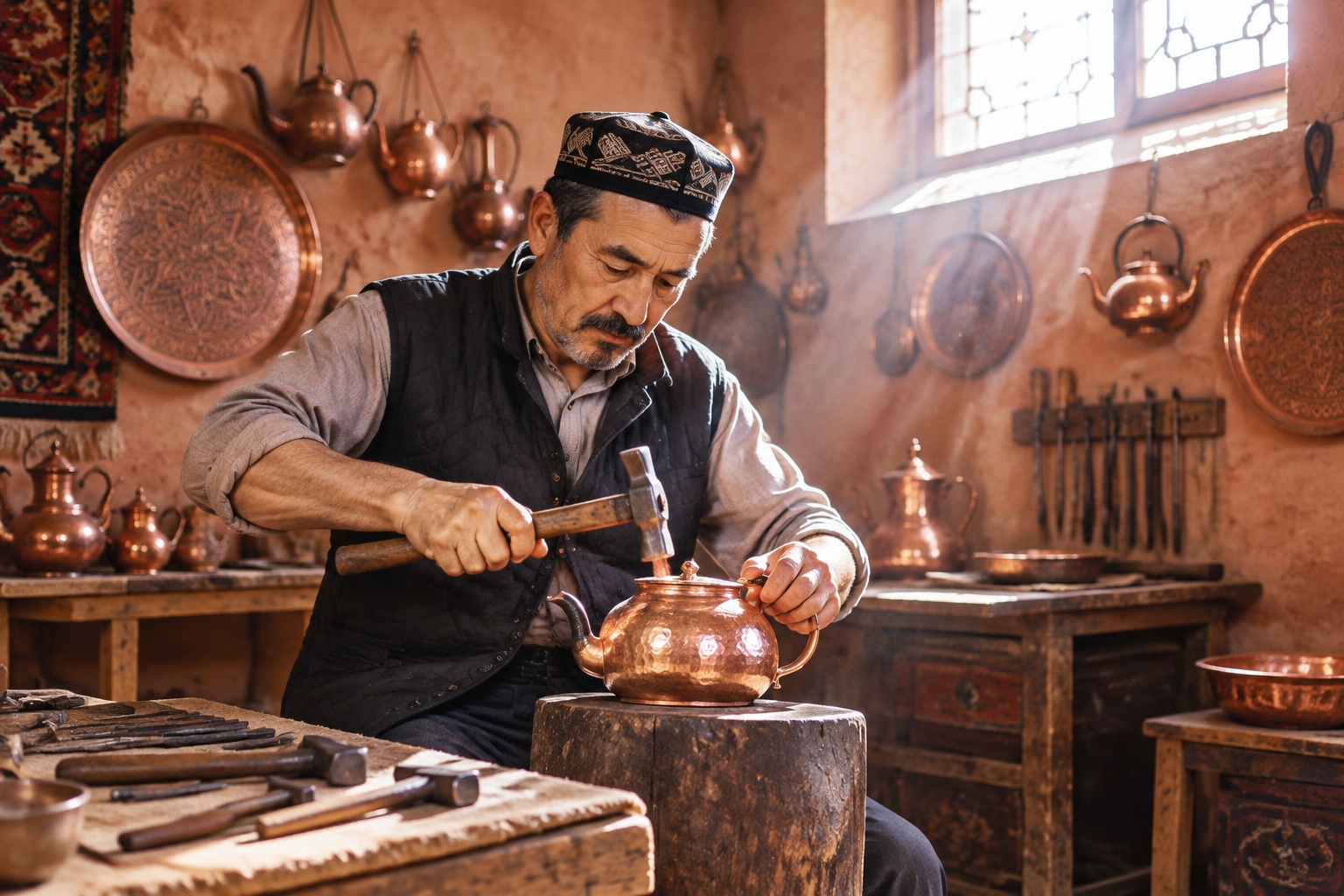
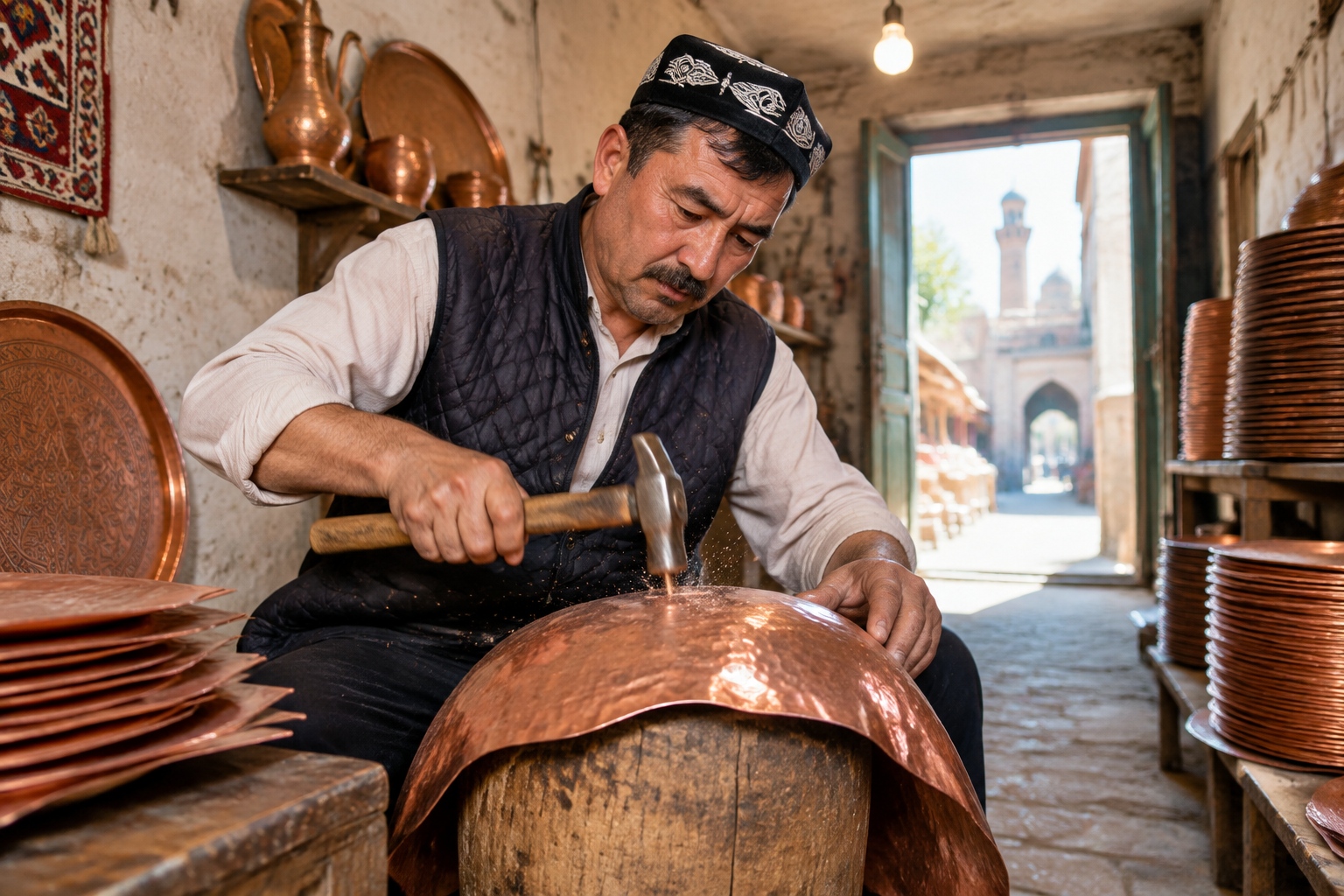
In Kashgar’s Old City, the first sound of the day is not a car horn. It’s the deep, rhythmic ring of hammer on copper. I hear it as I turn down a narrow lane off the main bazaar, around nine in the morning. The sun has just climbed over the flat roofs, and dust hangs in the air. Inside a small workshop that smells of fire and metal, 51-year-old Turdi, a Uyghur smith, is turning a flat copper disc into the body of a kettle. He lifts a two-handed hammer and brings it down—a dull thud, then a sharper ping as the metal curves. He doesn’t look up. His arms move like they’ve learned the motion from three generations of hands.
Standing beside me is Anwar, a young Uyghur guide who speaks fluent Mandarin, English, and his native Turkic dialect. He explains that Turdi’s family has worked at this same spot for three generations. “The old city looks small, but it has seven hundred years of stories in its walls,” Anwar says. The walls, made of rammed earth and dressed with terracotta bricks, still carry traces of the Silk Road, when caravans loaded with tea, silk, and spices passed through this oasis town.
Kashgar sits in the southwestern tip of Xinjiang, near the borders of Kyrgyzstan and Tajikistan. For centuries it was a trading hub, and its old district has always been where Central Asian and Chinese cultures collide. The result is a neighborhood full of sounds, smells, and trades: rug weavers, knife makers, wood carvers, and, of course, copper smiths.
“In the old days, every house here used copper,” Turdi says, looking up for the first time. He wipes his forehead with the back of his sleeve. “Now not every house. But many families still keep a pot from their mother or grandmother.” He points to a row of finished jugs hanging on the wall. Their surfaces, etched with flowers and crescent moons, gleam in the light from a high window.
The Long Craft: From Copper Sheet to Teapot
Turdi’s workshop is not a factory. Tools hang from hooks, their wooden handles darkened from years of sweat. A small coal furnace sits in the corner, and an electric bellows pumps steady air. Turdi’s younger brother Ismail heats a copper sheet until it turns bright red, then the two of them plunge it into a bucket of cold water. Steam hisses, and the metal cools into a workable state.
Turdi begins shaping the center of the pot by placing the soft copper on a steel stake. He uses a heavy hammer first, then a lighter one, then an even lighter sequence of blows to create the curved profile. Each pass is slower than the last. After an hour, the bowl has lost its flat look and is taking the round shape of a teapot body.
“It takes about four hours to finish the body,” Ismail says, “and another full day to ornament it if the customer asks.” He shows me a traditional pattern called “Laylaha,” a series of V-shapes that suggest the petals of a tulip. It is carved by tapping a chisel along a stencil—a technique Turdi learned from his father and passed on to his son.
No machine can fully replace the hand. A hand-hammered pot retains tiny irregularities in the surface, and that is what buyers pay for. “It is not perfect. That’s what makes it alive,” Turdi says. He claims he can spot a fake copper pot from its weight, from the way the bottom is joined, and from the colour of the metal after cleaning.
Tea, Bread, and a Copper Vessel: The Heart of Uyghur Hospitality
The copper pot is not meant for display. It is meant for tea. After the workshop, Anwar takes me to a tea house a few lanes away, called Yashil Chaikhan, or Green Tea House. Along the way, we pass a tandir oven, where a young man sticks pieces of dough onto the inner wall; later he pulls out golden round naan bread with a crispy crust and soft centre.
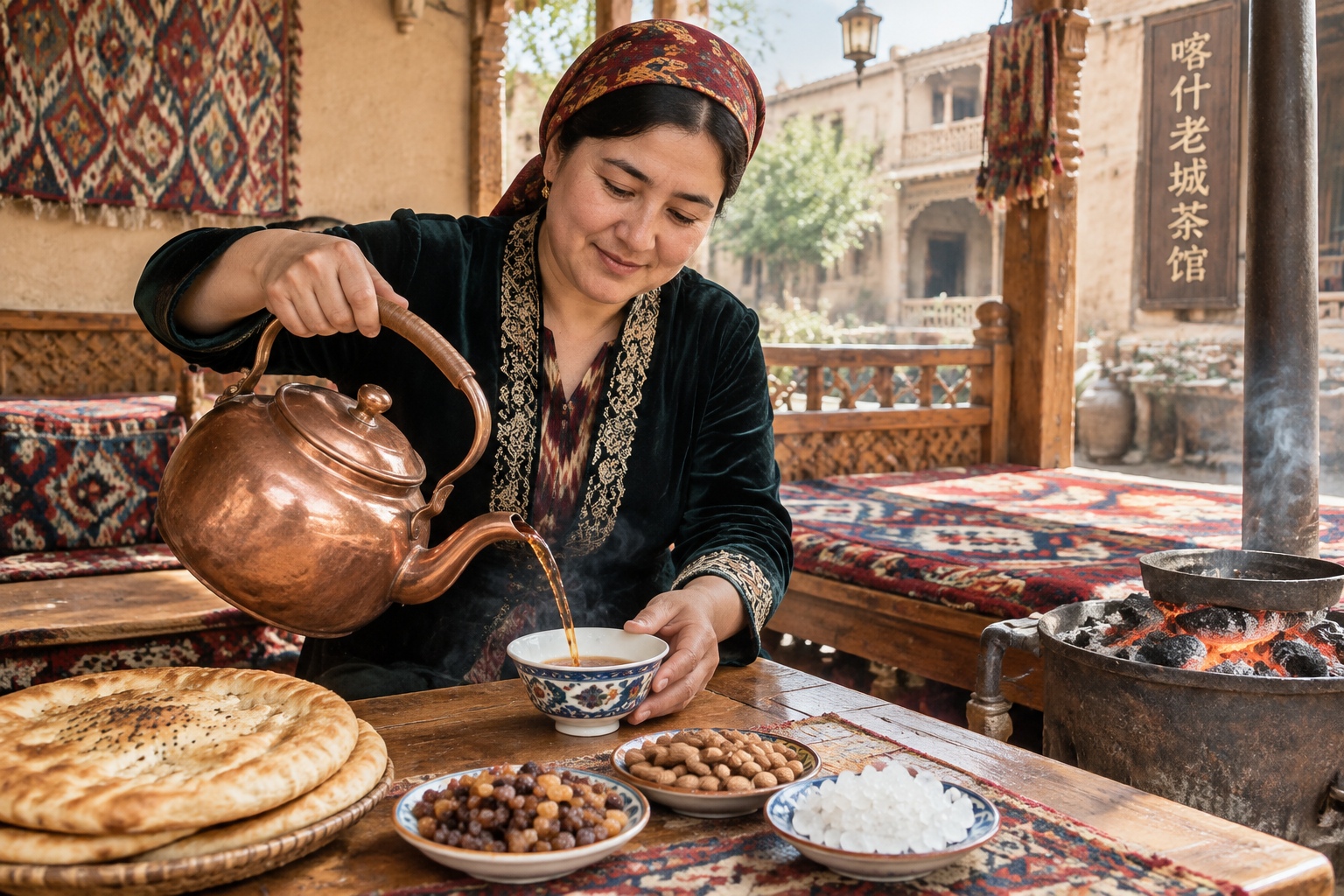
Inside, low wooden platforms are covered with colourful carpets, and the air smells of charcoal-grilled mutton and fresh herbs. A middle-aged Uyghur woman carries over a large copper pot polished until it shines. A small burner underneath keeps it hot. She pours the tea into a porcelain bowl, then pours it back into the pot, repeating the motion to cool and aerate it.
Anwar explains that tea is the first thing offered to a guest in Uyghur custom. Copper pots are preferred because they distribute heat evenly and hold it longer. The tea is usually black tea grown in the Tianshan mountains, sometimes mixed with milk and salt, and served with sugar cubes, raisins, almonds, and lokum—Turkish delight. At the bottom of my second bowl, I see a brown residue—a sign that the pot has been well seasoned. The inner surface is tinned, so the tea never takes on a metallic taste.
“A copper pot can last a lifetime if you care for it,” the tea house owner says. She inherited her pot from her mother, and it has been used daily for over thirty years. When the tin coating wears off, she takes it back to a smith like Turdi to be re-tinned. That repair service is still a core part of the craft’s economy.
The Old City Reborn—and the Rhythm of Its Small Shops
Over the past two decades, Kashgar’s Old City has undergone a large renovation. Many crumbled mud-brick houses have been rebuilt with the same look, but with modern plumbing and electricity. The narrow lanes have been widened a little, and some shops now sell generic souvenirs: fridge magnets, plastic camels, and knockoff Uyghur hats. But genuine workshops still exist, tucked away behind the tourist storefronts.
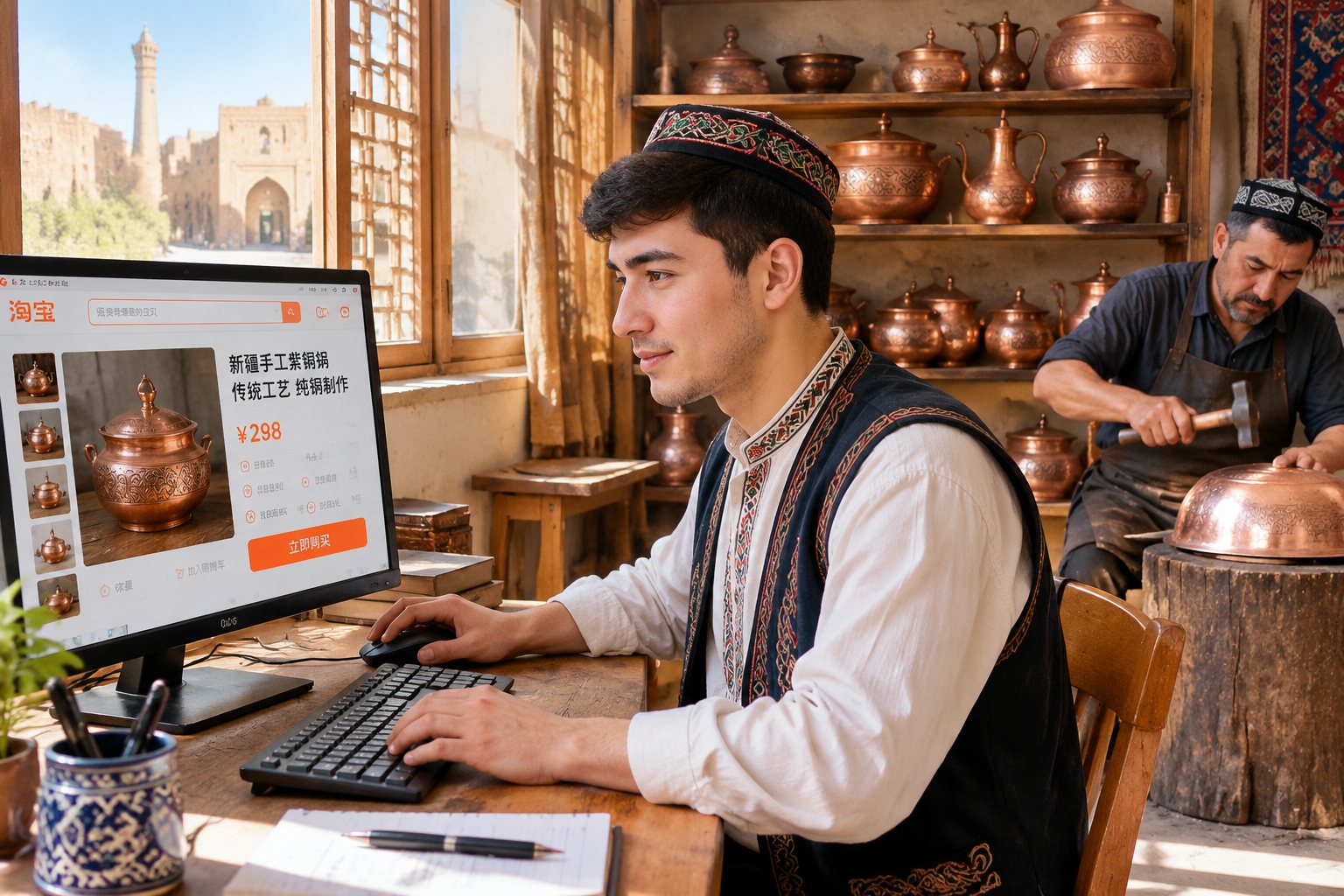
Turdi says business has changed. Tourists buy his smaller pieces—teapots, plates, small vases—as souvenirs. Local residents still bring old copper pans for repair or re-tinning. And he now receives orders from online stores in Beijing and Shanghai, where interior designers use hand-hammered copper to give modern apartments an older soul.
“Ten years ago, I thought about closing the shop,” Turdi says. “My son didn’t want to take over. He was studying in Urumqi.” Now his son helps sell online and manages a WeChat store. On weekends, the family runs a short “copper maker experience” for tourists. The fee is 200 yuan (about 28 US dollars), and visitors spend three hours making a small bowl to take home. “It gives them a reason to remember us,” he says.
Yet the pressure is real. Copper is not cheap; a full-sized pot needs more than a kilogram, costing around 100 yuan in raw materials. Imported sheets from Kazakhstan or Russia vary in quality. To keep prices low, some workshops use machine presses that leave fake hammer marks. Ismail is dismissive. “Tourists who really care always ask for hand-made,” he says. “We have to teach them the difference.”
Looking Ahead: A Family Business in Young Hands
Turdi’s son, in his mid-twenties, does not see himself becoming a full-time smith. He likes the business side. He has set up an online shop on Taobao and posts short videos on Xiaohongshu, China’s lifestyle platform, showing his father at work. “People watch a hammer hit copper for a few minutes. It’s calming,” he says with a laugh. Some videos have millions of views. That exposure gives the craft a global stage and justifies a higher price than a factory-made pot.
“We are not making money like tech companies,” he admits. “But there is something real. The pot in your hand becomes darker and shinier each year. You can’t say that about plastic.” He mentions that a few friends have also started learning traditional crafts. The local government has funded an “intangible cultural heritage experience centre” on the main street, offering free classes to young people.
A Craftsman’s Footing at the Edge of China
In the late afternoon, I return to Turdi’s workshop. The day’s work is almost done. He is rubbing a finished copper pot with a cloth soaked in vinegar and salt to give it a bright, golden shine. He pauses and looks up. “My grandfather made pots for the caravans. My father made them for the village. I make them for people I will never meet. But the pot must be honest—flat bottom, straight spout, comfortable handle.” He hands me the pot. It has a warm, solid weight. I can feel the tiny hammer marks on the surface, like a language written by hands.
Outside, the evening prayer call drifts over the city. Smoke from a kebab stall curls around the corner, carrying the scent of cumin and grilled lamb. A man wheels a cart of melons past, their sweet perfume trailing behind him. Turdi turns on a small lamp and starts polishing another piece. The hammers fall silent for now, but the echo of a thousand years of craft still rings through one copper pot.
Start the discussion at forum.chinacomes.com