

The part of the journey nobody notices
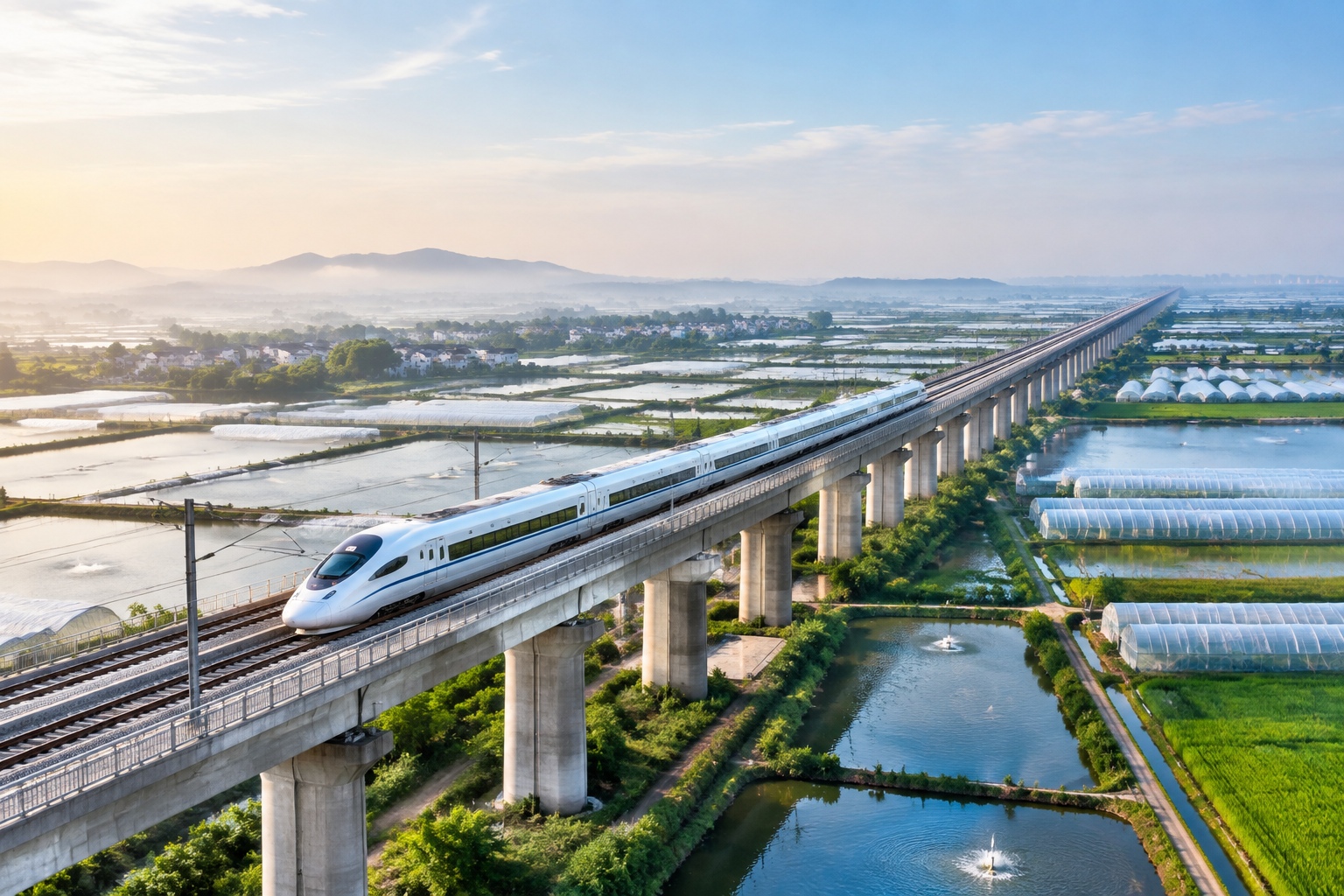
Somewhere between Suzhou North and Wuxi East, the Beijing-Shanghai high-speed train settles into a long, level run. Outside the window: fish ponds in neat grids, greenhouse roofs catching the morning light, a canal, a row of half-finished apartment towers, then more ponds. Inside, a man is on a video call. A student sleeps with her headphones on.
Almost nobody on board realises that for roughly half an hour of this trip the train is running on the longest bridge in the world. Not the tallest, not the most elegant. The longest, by a wide margin. The Danyang-Kunshan Grand Bridge runs for 164.5 kilometres, most of it less than 20 metres above flat farmland.
Which raises the question visitors ask almost every time they look out of a train window here: why build a 164-kilometre bridge where there is no river to cross?
The basics: 164.5 km, opened in 2011
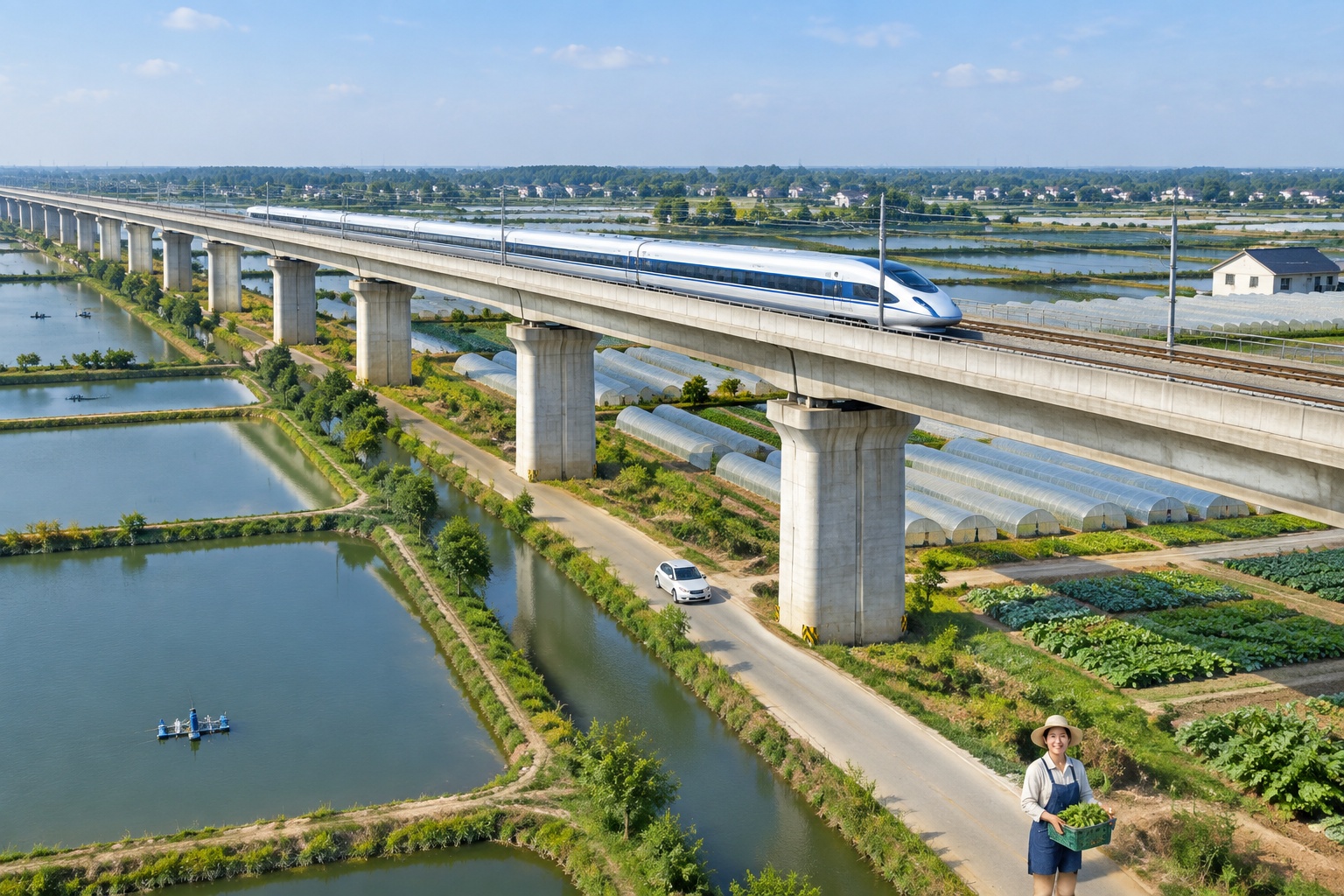
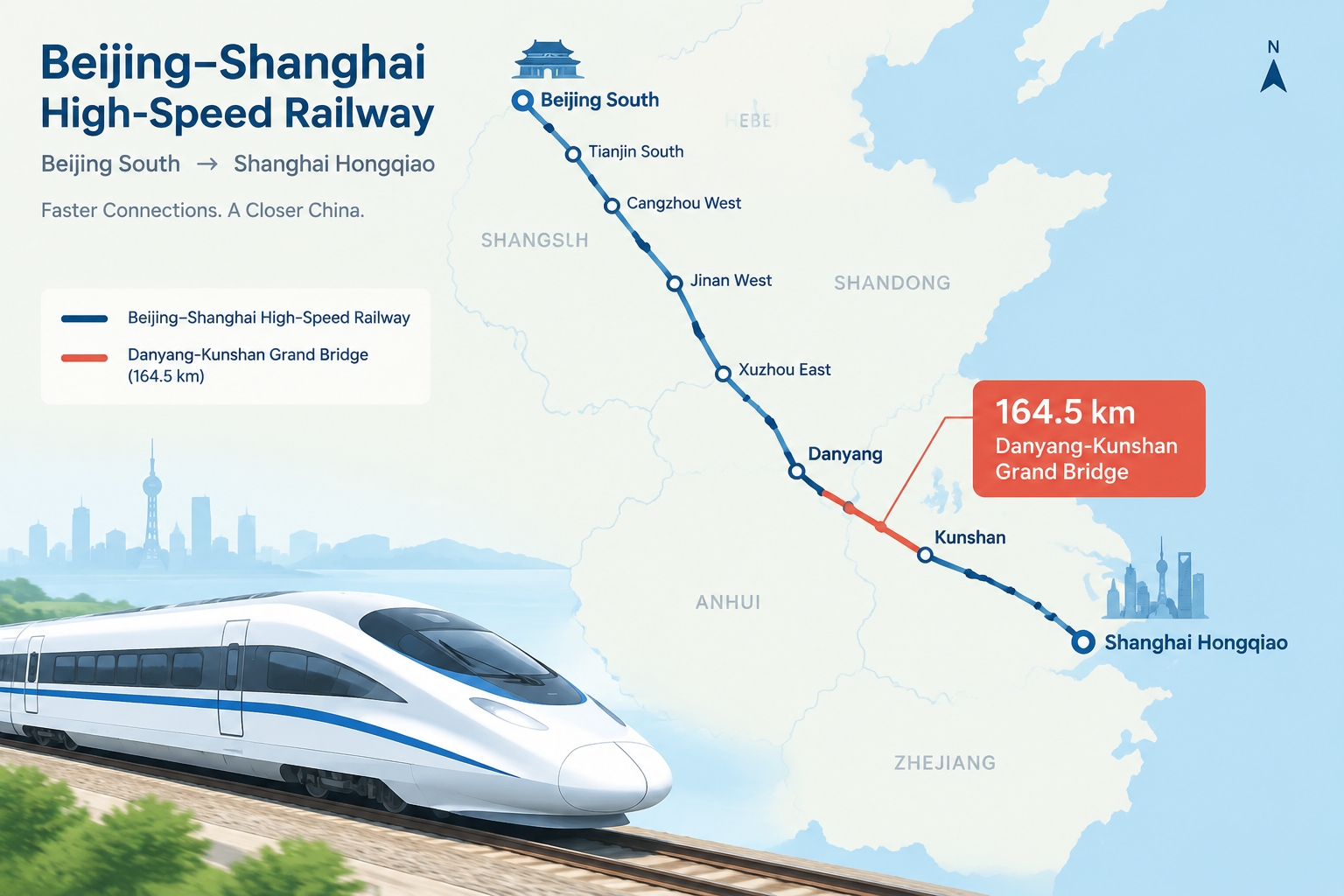
The Danyang-Kunshan Grand Bridge opened on 30 June 2011, together with the Beijing-Shanghai High-Speed Railway. It carries that line across the Yangtze River Delta, from Danyang in Jiangsu province to Kunshan, on the western edge of Shanghai, passing Changzhou, Wuxi and Suzhou on the way. Guinness World Records lists it as the longest bridge in the world, in any category.
The scale is hard to grasp, so here are comparisons. It is more than four times the length of the Lake Pontchartrain Causeway in Louisiana, which held the record for the longest bridge over water for decades. It is longer than the road distance from London to Bristol, or from Boston to Springfield, Massachusetts. A car at motorway speed would need about an hour and a half to cross it.
The railway it belongs to is 1,318 km long and connects Beijing South with Shanghai Hongqiao in about four and a half hours. The bridge is not a landmark at either end of that trip. It is the middle of it.
Why build a bridge where the land is flat
The instinct that bridges exist to cross water or valleys is reasonable enough. It is also a habit formed by geography. In the Yangtze River Delta, the problem is not gaps in the land. It is the ground itself.
The delta is built from thousands of years of river silt. Below the topsoil lie soft clay and sand with a high water table. Put a heavy, permanent load on that kind of ground and it consolidates: water is squeezed out, and the surface settles, usually unevenly, and usually for years.
That matters far more for a railway than for a road. A motorway can tolerate gentle dips and rises; drivers hardly notice them. A high-speed line cannot. Chinese high-speed track is built as slab track, with concrete slabs in place of loose ballast, and its geometry tolerances are measured in millimetres. At 300 km/h, a dip that a car absorbs without comment becomes a jolt, and an uneven settlement pattern becomes a maintenance problem that never quite ends.
Engineers working across this plain had three broad options.
Build on the ground, on a compacted embankment. Cheap per kilometre, but on soft clay it needs years of staged loading to squeeze the water out before track can even be laid, and it keeps settling afterwards. It also takes land permanently: a 50-metre-wide embankment running 164 km would remove roughly 800 hectares from farming and cut every small road, field drain and canal in its path.
Cut straight through: expropriate whatever stands in the way, move villages, reroute roads.
Or go over the top: drive piles down through the soft layers, build piers on the piles, and lay the track on a continuous concrete deck.
They chose the third. The result behaves less like a bridge in the traditional sense than like a very long, very stiff platform.
Keeping 164 kilometres of deck level
Under every pier sits a group of piles: concrete columns driven or bored 60 to 80 metres through soft clay until they reach firmer ground. The weight of the structure and of the passing trains travels down those piles instead of into the compressible layers above them.
Above ground, the bridge is deliberately repetitive. Standard spans are about 32 metres, cast as box girders weighing roughly 900 tonnes and moved into position by launching gantries, the same class of machinery used across China’s high-speed network. Where the route crosses water, including a stretch over Yangcheng Lake, famous in China for its hairy crabs, spans are adjusted so that piers do not crowd the lake bed.
The design goal is not zero movement, which is impossible on soft ground. It is movement that is slow, small and predictable. Adjacent piers must stay within millimetres of one another in relative terms, because the track above them is continuous. Drainage, waterproofing and expansion joints are specified for a service life measured in decades, with a 100-year design horizon and scheduled inspections rather than emergency repairs.
What passengers actually feel
Not much, and that is the achievement. Most travellers cannot tell where an embankment ends and the bridge begins. There are no joints thumping under the wheels; the ride is quieter and smoother than on older track.
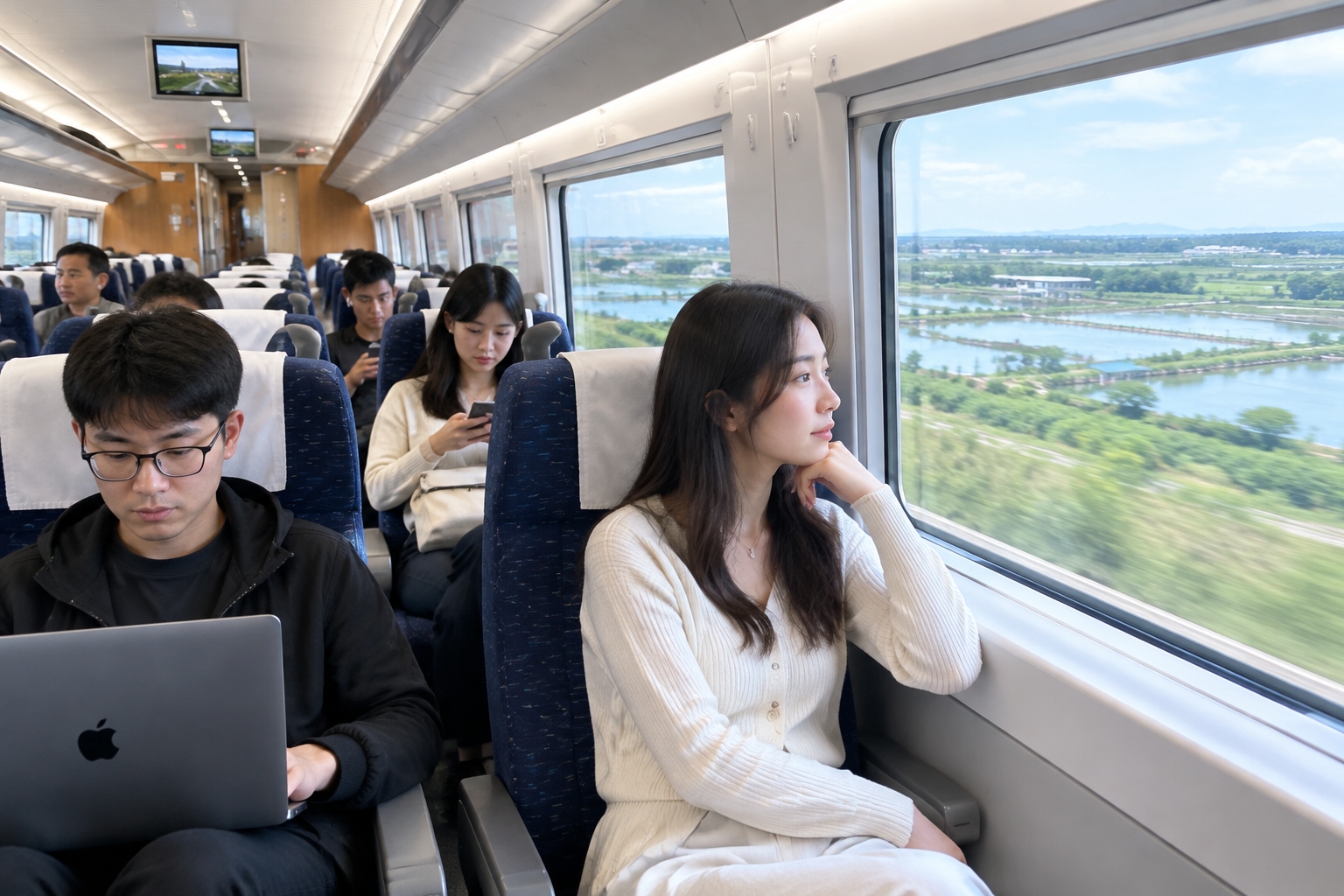
The view is a slow, wide scroll: fish ponds, rice fields, rows of plastic greenhouses, logistics parks with long white roofs, canals carrying barges, roads that vanish underneath you with cars queued at crossings that no longer exist because the railway goes over them.
Because trains also stop at Changzhou North, Wuxi East and Suzhou North, you cross the bridge in stretches rather than in one continuous half hour. If you want to watch it properly, take a seat on the left side heading south from Zhenjiang South towards Kunshan, and count how rarely the horizon shows a hill.
What the bridge changed for the towns beneath it
Before 2011, Shanghai to Suzhou meant an hour or more on the old line, or the expressway with whatever traffic it had that day. Now it is about 25 minutes. Shanghai to Wuxi is roughly 40 to 50 minutes, and Shanghai to Nanjing about 70. Zhenjiang, Changzhou, Wuxi, Suzhou and Kunshan all sit within a morning’s reach of Shanghai.
The effect is not that everyone commutes; housing costs and where the jobs actually are still decide that. What changes is how casual movement becomes. A manager can take a morning meeting in Wuxi and be back in Shanghai for dinner. An engineer can visit three suppliers in a day. A family can drop in on grandparents for lunch and be home before dark.
The corridor’s economic geography is visible from the window: industrial parks, logistics hubs and new housing in sequence. Kunshan, technically a county-level city administered by Suzhou, reported GDP above 500 billion yuan, roughly US$70 billion, larger than the economies of many countries. It would be simplistic to give the railway all the credit, but the railway is what allows those plants to draw workers, suppliers and customers from several cities at once.
There is a freight story too. The old Beijing-Shanghai railway is one of the busiest mixed-traffic lines anywhere, and moving passengers onto dedicated track freed up capacity for goods.
Common questions about a bridge on a plain
Was it simply more expensive than building on the ground?
Per kilometre, yes. A viaduct costs more than an embankment. But construction cost is the wrong single measure. Add land acquisition, the years of pre-loading soft clay before track laying, the cost of rerouting roads and canals, and decades of maintaining a structure that keeps sinking. On delta geology, the elevated option was the practical one, not the extravagant one. Piling also let construction move quickly with girder-launching machinery, which is a large part of why the line opened when it did.
If it crosses nothing, is it really a bridge?
Structurally, yes: piles, piers, spans, bearings, expansion joints. What differs from a river bridge is where the engineering effort goes. A river crossing is about one-off problems: deep-water foundations, navigation clearance, very long spans, cables or arches. The Danyang-Kunshan bridge is about repetition and consistency, thousands of near-identical piers and a deck flat enough to keep a train comfortable at 300 km/h for half an hour.
Does it block the land underneath?
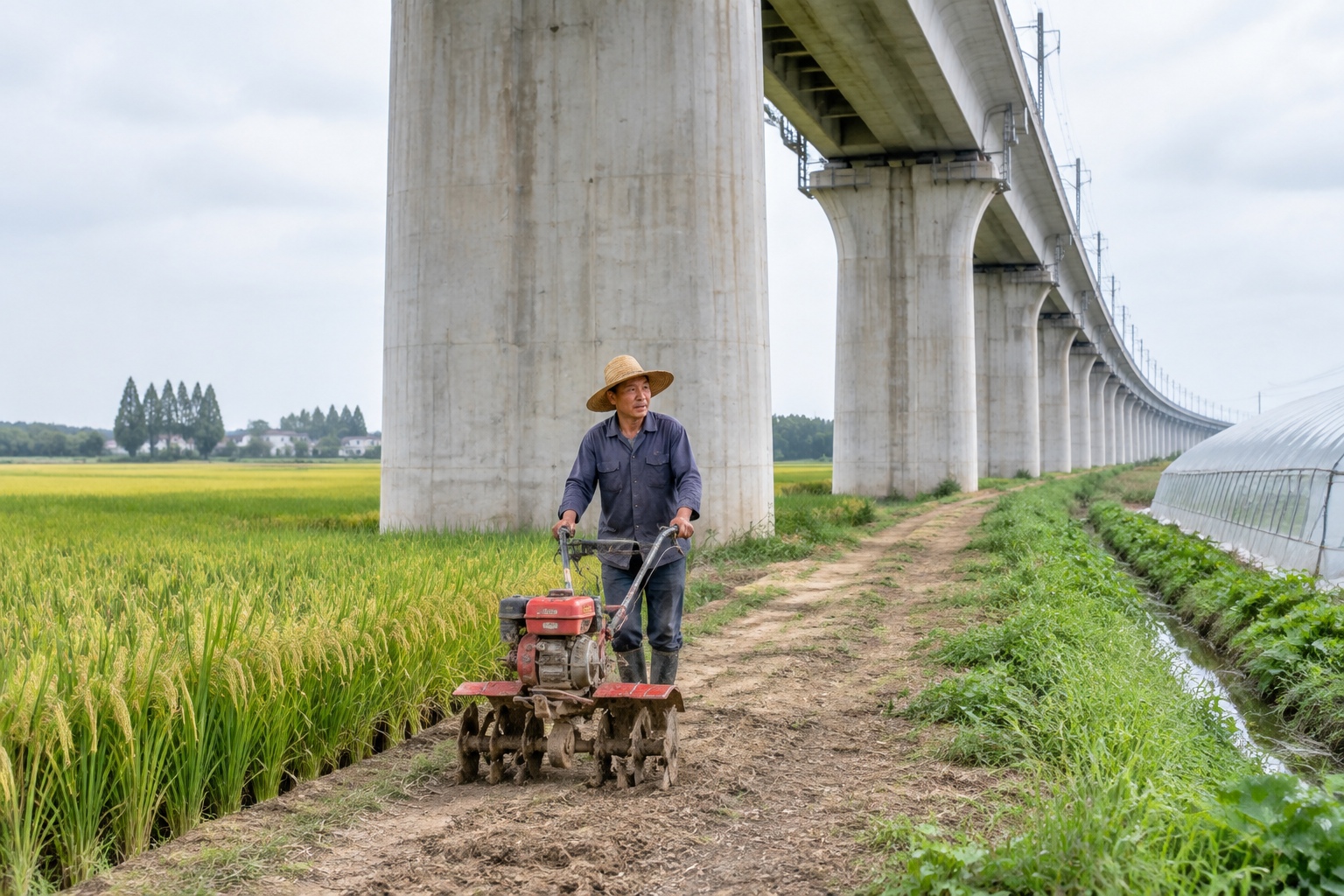
Less than people expect. Only the piers occupy ground permanently. Farm machinery still crosses, fish ponds and paddies continue in the deck’s shadow, and small roads pass underneath. It works more like a roof over working farmland than a wall across it.
The most ordinary mega-structure in China
Ask passengers on the Beijing-Shanghai line what the world’s longest bridge looks like, and most will shrug. They are ordering a coffee to be delivered to their seat at the next station stop, answering email, or asleep. The bridge does its job so well that it disappears into the routine of a four-and-a-half-hour trip.
That may be the more interesting fact. The debate about Chinese infrastructure usually focuses on how fast it gets built. The Danyang-Kunshan Grand Bridge is a reminder that the harder engineering comes afterwards: holding a flat, level line across ground that would rather sink, for decades, quietly enough that nobody looks up.
Start the discussion at forum.chinacomes.com