

A Morning in the Rosewood Town
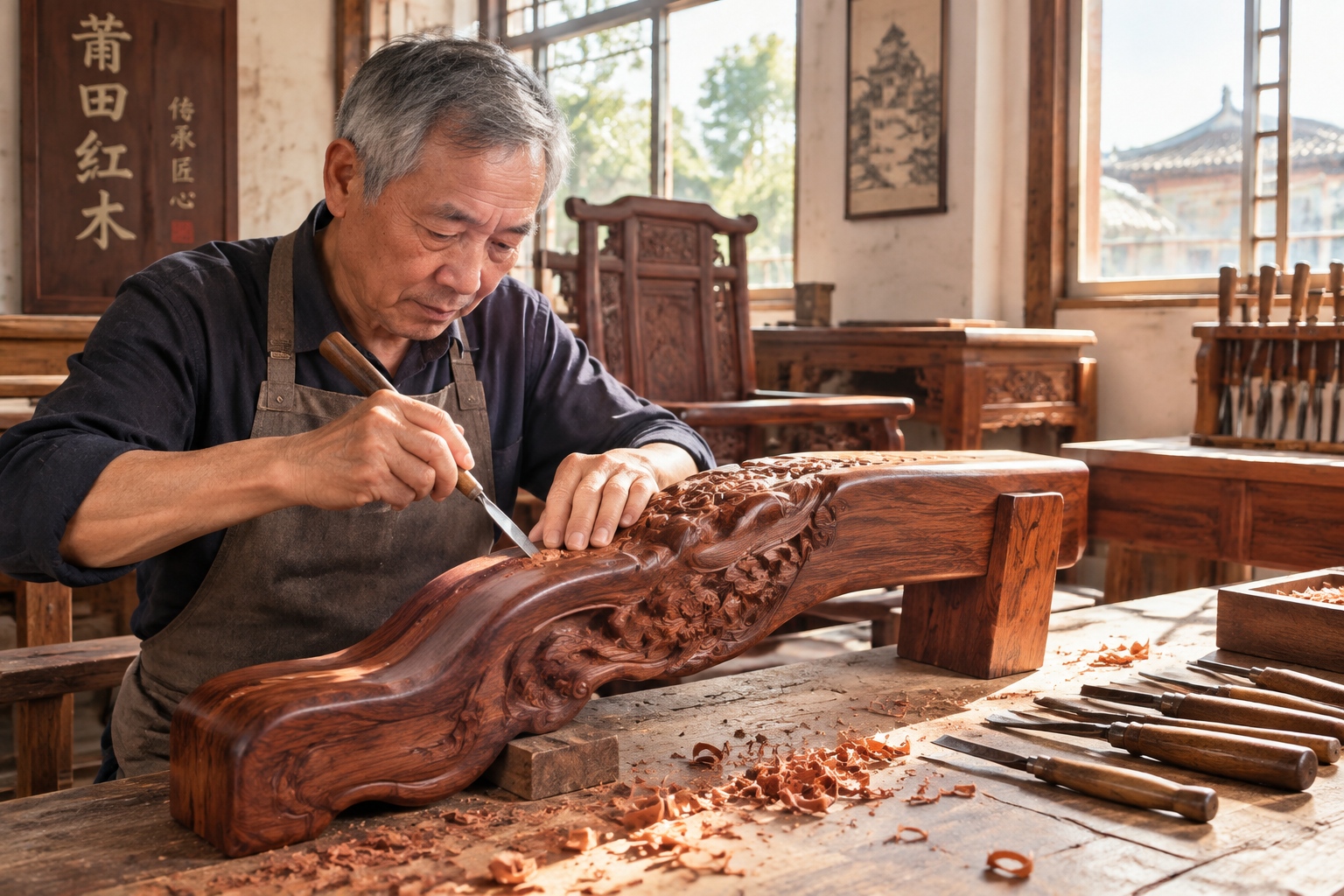
At 6:30 a.m., the sawdust is already flying in Bantou, a cluster of villages in Putian, a coastal city in southeast China. In a low-slung workshop, 62-year-old Chen Huaming leans over a plank of wood that costs more than his monthly salary. He is carving a cloud dragon into the armrest of a sofa chair — a piece that will eventually sell for more than $100,000. The wood is called hualimu — fragrant rosewood — and its scientific name is Dalbergia odorifera. In Chinese, it is also known as xiangzhimu, literally “fragrant wood.”
Chen has been doing this for 40 years. His father did it before him, and now his son does it too — though in a very different way. The workshop smells of sweet resin and camphor. The plank glows with a golden-brown grain that looks like a painted landscape. “This wood doesn’t need any decoration,” Chen says, running a rough finger along the surface. “The pattern is the art.”
What Is Fragrant Wood Anyway?
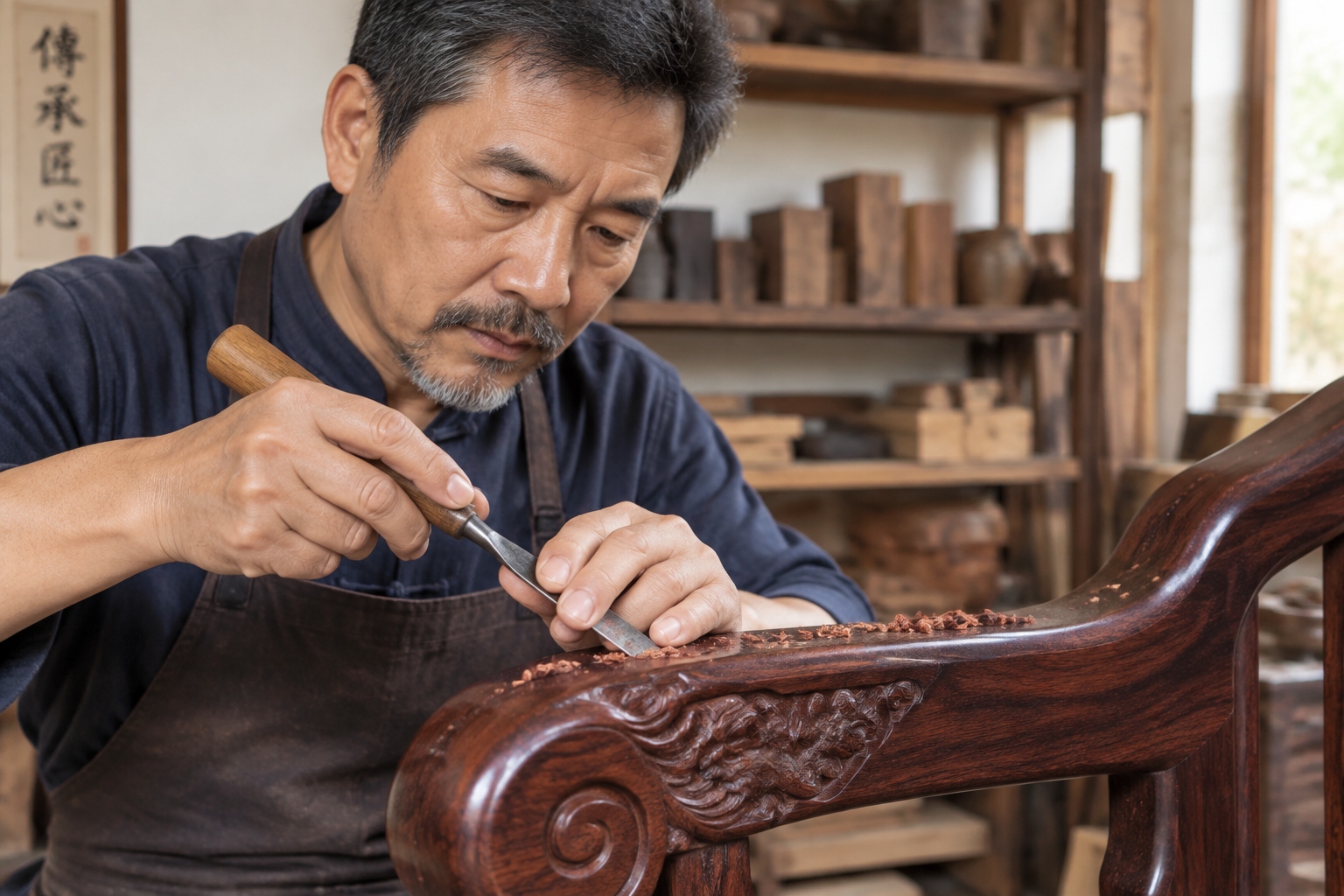
To understand why a piece of furniture can cost as much as a sports car, you have to know the raw material. Fragrant wood, or Dalbergia odorifera, belongs to the rosewood family. It grows only in southern China, especially on Hainan Island, and in parts of Vietnam and Laos. For centuries, it was reserved for emperors and the elite. Its density makes it heavy and hard, yet its oil content gives it a natural resistance to insects and rot. The grain — dark swirling lines against a golden background — is often compared to abstract paintings.
The most prized form is Hainan yellow rosewood, known as haihuang in the trade. A single log can sell for tens of thousands of dollars. The Chinese government has banned logging of wild Dalbergia odorifera since the 1990s, but plantation wood and imported relatives are still legal. That scarcity is exactly what drives the price.
Why Putian?
Putian sits about two hours north of the provincial capital Fuzhou. For centuries, the region has been known for skilled carvers — many imperial palaces used craftsmen from this area. In the 1980s, when China’s economy began to open up, local workshops started making reproduction Ming and Qing dynasty furniture. The business exploded. Today, the neighboring county of Xianyou alone has more than 3,000 companies related to rosewood furniture. The industry employs hundreds of thousands of people across the region.
Walking through the town, you see a strange mix: ancient-style pavilions next to glass showrooms, delivery trucks parked beside temples. Every village seems to have at least one furniture factory, and the air carries the hum of electric sanders mixed with the rhythmic thud of hammers.
Hand Work vs. Machine Work
Not every piece that leaves Putian is handmade. Many workshops now use CNC machines to pre-carve patterns, which cuts costs and time. But the top-end pieces still demand human hands. “A machine can copy a pattern, but it can’t feel the wood,” says Chen. He points to a corner bracket on a cabinet. The curvature looks organic, as if it grew there. “To carve that by hand takes three days. A machine could do rough shaping in an hour, but then a craftsman still has to refine it for another two days.”
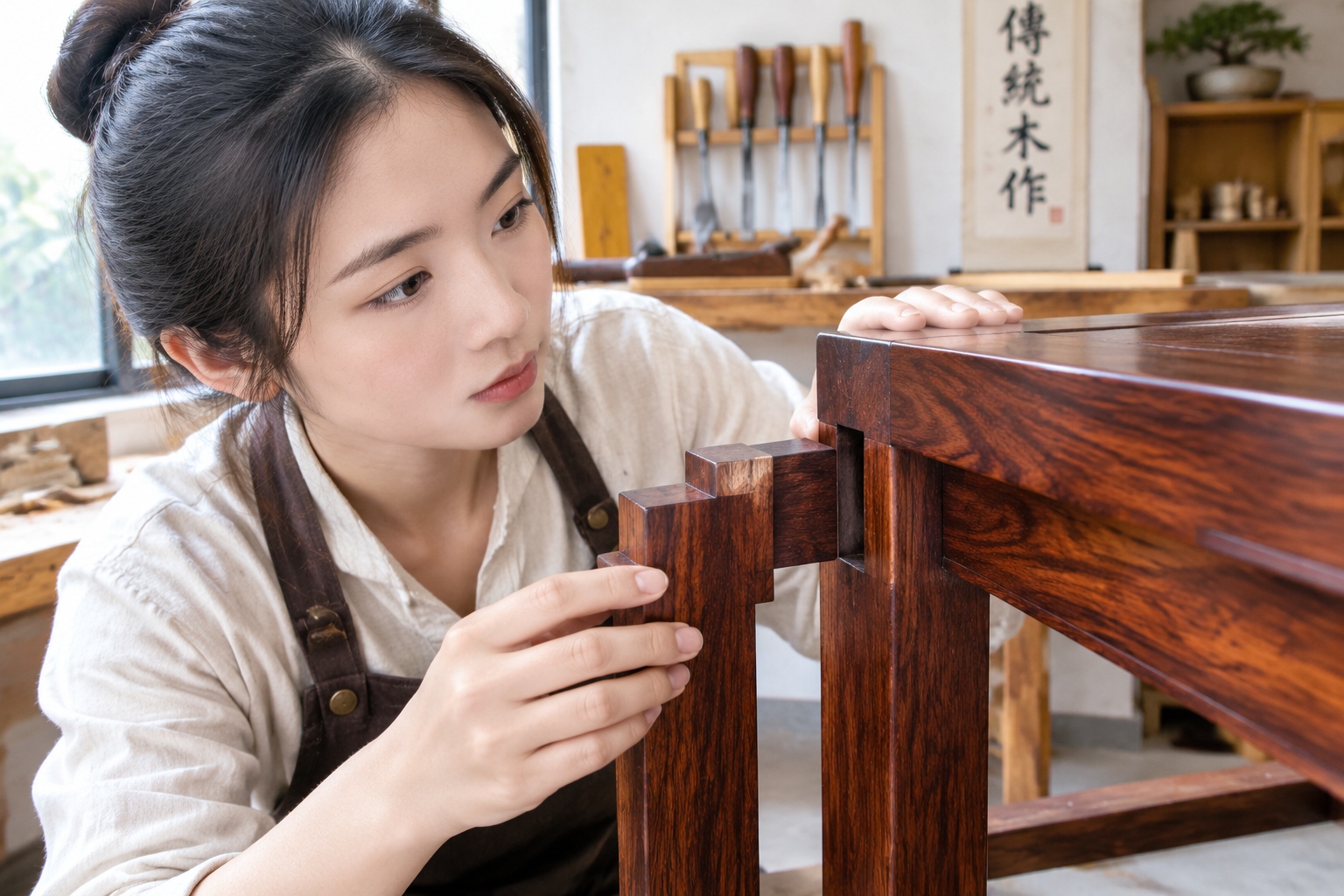
The real signature of good rosewood furniture is the joint — the mortise-and-tenon system that uses no nails or glue. The fit must be so precise that after decades, the joint gets even tighter as the wood expands and contracts. Chen’s workshop still builds every frame this way. He remembers a customer from Beijing who brought in an antique chair for repair. The chair was 200 years old, and the joint had become loose. “We just took it apart, shaved a sliver of wood, and reassembled it. It’s now stronger than before,” he says with pride.
From Workshop to Livestream
The biggest change in recent years has been the way furniture is sold. Walk into any seven-story showroom in Bantou, and you’ll see rows of sofas, chairs, and cabinets — but also young people holding selfie sticks. Livestream e-commerce has become the region’s main sales channel. On platforms like Douyin (China’s TikTok), furniture sellers broadcast from their stores all day, showing close-ups of wood grain and answering questions from viewers in real time. Some streams get over 10,000 viewers at once. One 28-year-old seller, Lin Fang, told me she sold 30 pieces in a single afternoon. “Customers like seeing the actual item and watching us knock on the wood to show it’s real,” she said. “You can’t fake the sound.”
Online sales have also made prices more transparent. In the past, buyers depended on middlemen and inflated prices were common. Now, comparisons are one click away. That has forced many workshops to focus on quality and honest labeling — a big step for an industry once plagued by fakes.

The Young Blood and New Styles
It would be easy to think that rosewood furniture is for old people. It’s not. A growing number of buyers in their 30s and 40s are turning to “new Chinese style” furniture — simple, clean lines with a few classic elements. Designers in Putian are starting to blend traditional techniques with modern needs. For example, a cabinet might use traditional joinery but have hidden drawers for laptops and cables. A dining table might be lower, designed for a sitting-on-cushion lifestyle, but with adjustable legs.
Chen’s son, Chen Jian, 31, runs his own workshop with two friends. They use smaller pieces of fragrant wood to make tea trays, jewelry boxes, and even phone stands that cost less than a typical rosewood chair. “My father thinks we’re wasting good wood,” Chen Jian laughs. “But I want people to touch this material every day without needing a mansion.” That’s exactly what livestream buyers often ask for — something with real wood they can use.
The Realities of the Trade
Of course, the industry is not without problems. Rare wood means high stakes, and every year brings news of counterfeits or overpriced pieces. Some workshops use cheaper woods like African rosewood and dye them to look like hualimu. The government has tried to crack down, but the smell of the real thing — a sweet, peppery fragrance — is hard to fake, and experienced buyers still rely on their noses. There’s also the environmental question. While China has planted large forests of hualimu, it takes at least 50 years for the tree to reach harvestable quality. Plantation wood has less oil and a paler grain. That’s why old-growth logs are practically priceless — and why some collectors treat furniture like stocks, buying and selling based on market trends.
Locals have mixed feelings. Older craftsmen worry that young people won’t spend a decade learning the trade. “You can teach technique, but not patience,” says Chen Huaming. His son counters: “We make more money by making small items and selling online. That’s also how we keep the business alive.”
A Craft in Motion
Standing in Chen’s workshop, surrounded by half-finished sofas and the scent of wood, it’s hard not to feel a sense of reverence. The furniture isn’t just a table or a bed; it’s a piece of material culture that carries generations of knowledge. In a country that changes so fast, it’s reassuring to see something that still values time. But time, in this town, is also a commodity. The craftsmen work at a pace that has not changed much in a century, even as the world around them rushes to live-stream and 3D print.
Whether it’s a $200,000 chair placed in a Shanghai penthouse or a $50 tea tray shipped to a young collector in Guangzhou, every piece carries the same story: a tree took decades to grow, a craftsman took days to shape it, and a trade took centuries to reach this point. In Putian, the line between heritage and commerce has never been thin. It is, in fact, a single, continuous grain.
Start the discussion at forum.chinacomes.com