


The first question usually arrives before “hello”
It’s 7:20 on a Saturday morning outside a produce market in a county town in Hebei. A man in his sixties rolls up on a small electric cart with a flatbed roughly the size of a double bed, stacked with cabbage, spring onions and two crates of eggs. No cab. No door. No seatbelt. Just a plastic stool bolted to the frame and a steering bar that looks borrowed from a scooter.
Standing next to him is Daniel, a 27-year-old from Manchester who teaches English at the local middle school. He’s been in China four months. He watches the cart for a long moment and then asks the question thousands of foreigners ask every year, in almost identical words: “Is that… allowed?”
Not “what’s it called.” Not “how much does it cost.” The first question is nearly always about permission. That tells you something about where the curiosity comes from.
So what is a sanbengzi, exactly?
The word is casual, not technical. San means three, beng is the puttering sound, zi just makes it a noun. Chinese people use it the way English speakers say “van” — as a category, not a model.
Underneath the nickname sits a whole family of vehicles: open flatbed electric cargo trikes, enclosed three-wheelers with a small cab and a bench seat, petrol-powered three-wheel motorcycles still common in some rural areas, and hand-built contraptions welded together in a backstreet workshop. Prices, speeds and legal status vary so wildly that any single answer you read online is probably wrong for the specific cart in front of you.
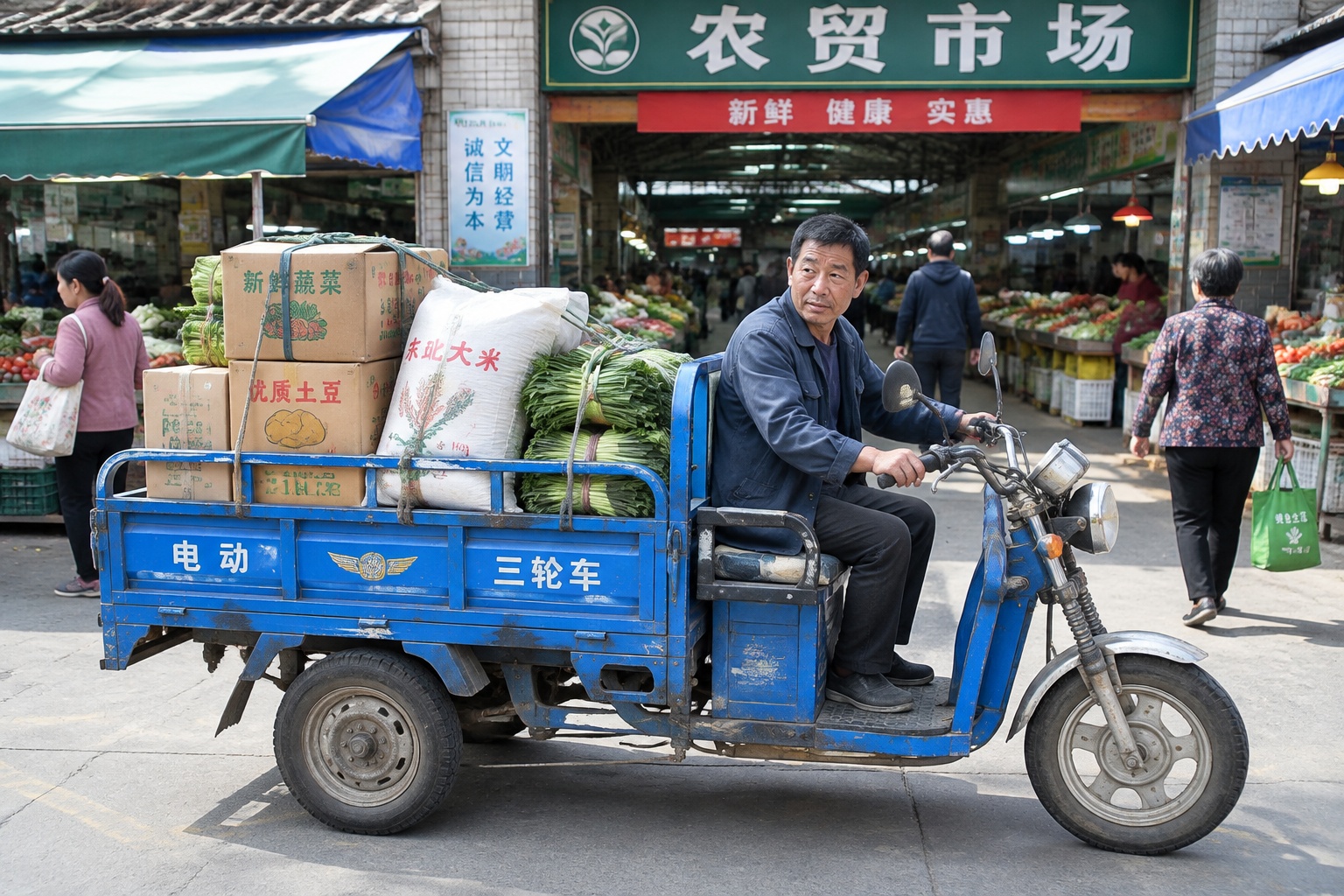
Where do they show up? Everywhere that isn’t a big-city downtown. County towns. Suburban edges of second-tier cities. Market entrances, building supply streets, the alleys behind a wet market. The drivers are often small traders, delivery riders for local couriers, renovation workers hauling cement and tiles, or grandparents doing the morning shop. In villages, a trike may be the household’s only motor vehicle.
“Is it safe?” — the question almost everyone asks
This one is fair, and it’s the one Chinese people rarely answer defensively.
Look at a cargo trike honestly and you see a metal frame, a motor and a battery. There is no crumple zone, no airbag, no crash structure. It can tip if you take a corner too fast. Loaded badly, it gets unstable. On a rainy day, the brakes on a cheap one are not something you want to test.
But context changes the math. These vehicles live at 20–30 km/h on short trips — the last two kilometres from the wholesaler to the stall, the school run four blocks away, the run to the recycling yard. Most accidents involving them are low-speed scrapes, and the biggest real risk isn’t the crash itself but the lack of insurance when something goes wrong.
Ask a driver and you get a shrug and an accounting answer: “I drive it 800 metres a day. A van would cost me 60,000 yuan and I’d never find parking.”
“Is it legal? Do you need a licence? A plate?”
Here’s where foreigners expect a yes-or-no and get a map instead.
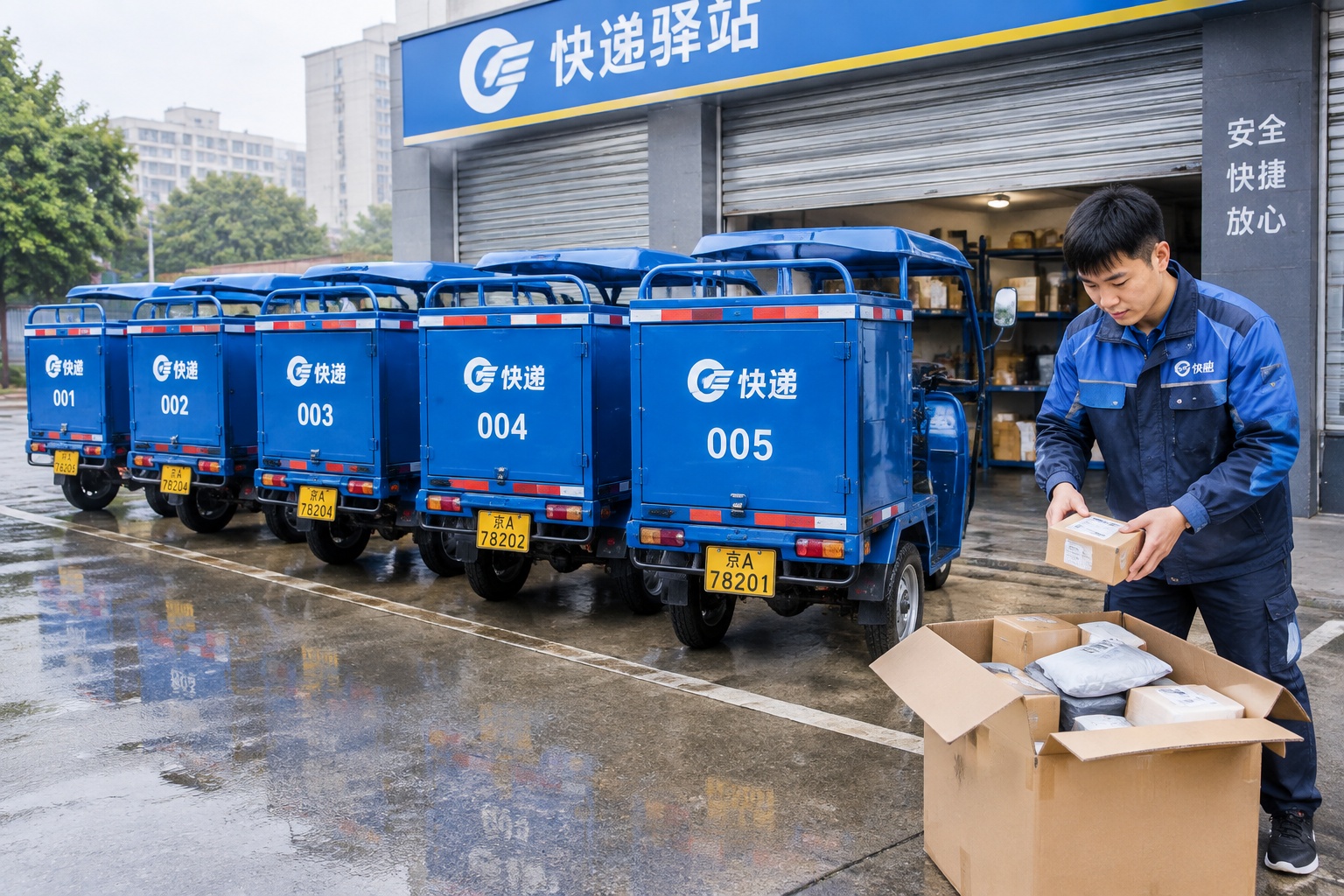
On paper, most electric three-wheelers in China are classified as motorcycles, not bicycles. That means a D-class licence, a plate and insurance. Many of the cheap ones sold in rural areas are never registered at all, and enforcement has traditionally been light outside city centres. In recent years, though, that has tightened fast. Beijing stopped unlicensed low-speed three- and four-wheelers from using public roads on 1 January 2024. Dozens of other cities have restricted them on main arteries or during rush hour.
Meanwhile, the biggest, most visible fleet in the country is fully legal. Since 2018, delivery companies have been rolling out standardised courier trikes — same size, same colour, a plate and a uniform number on the back. Walk past a courier station in any Chinese city and you’ll see thirty of them parked in a row like a small municipal vehicle pool.
So the honest answer to “is it legal?” is: it depends on the vehicle, the city, the road and the year. Daniel’s market driver, on a 25 km/h cart on a side street in a county town, was not the same legal creature as a 50 km/h enclosed three-wheeler cutting across a provincial capital.
“How fast? How far? How much?”
Foreigners want a spec sheet. Locals think in terms of errands.
The rough ranges, though, are useful. A basic open cargo trike sells for about 3,000–6,000 yuan (roughly $420–840). An enclosed one with a cabin, a windscreen and a proper seat runs 8,000–15,000 yuan. Second-hand ones in county towns change hands for as little as 800 yuan. A full charge from a wall socket costs a couple of yuan and takes six to eight hours; lead-acid models go 40–70 km on a charge, lithium ones further. Top speed: 20–30 km/h for the governed ones, 40–50 km/h for the bigger models. Payload: 300–500 kg is typical, and people genuinely do move a small apartment with one.
The number that surprises visitors most isn’t the speed. It’s the running cost — a few cents per kilometre, no licence, no parking fee, no fuel.
“Can it go on the highway? Why don’t we have these at home?”
No, and no.
Chinese expressways have a minimum speed around 60 km/h, and most provinces bar motorcycles from them outright. A vehicle that tops out at 35 km/h has no business on that road, and no owner is arguing otherwise.
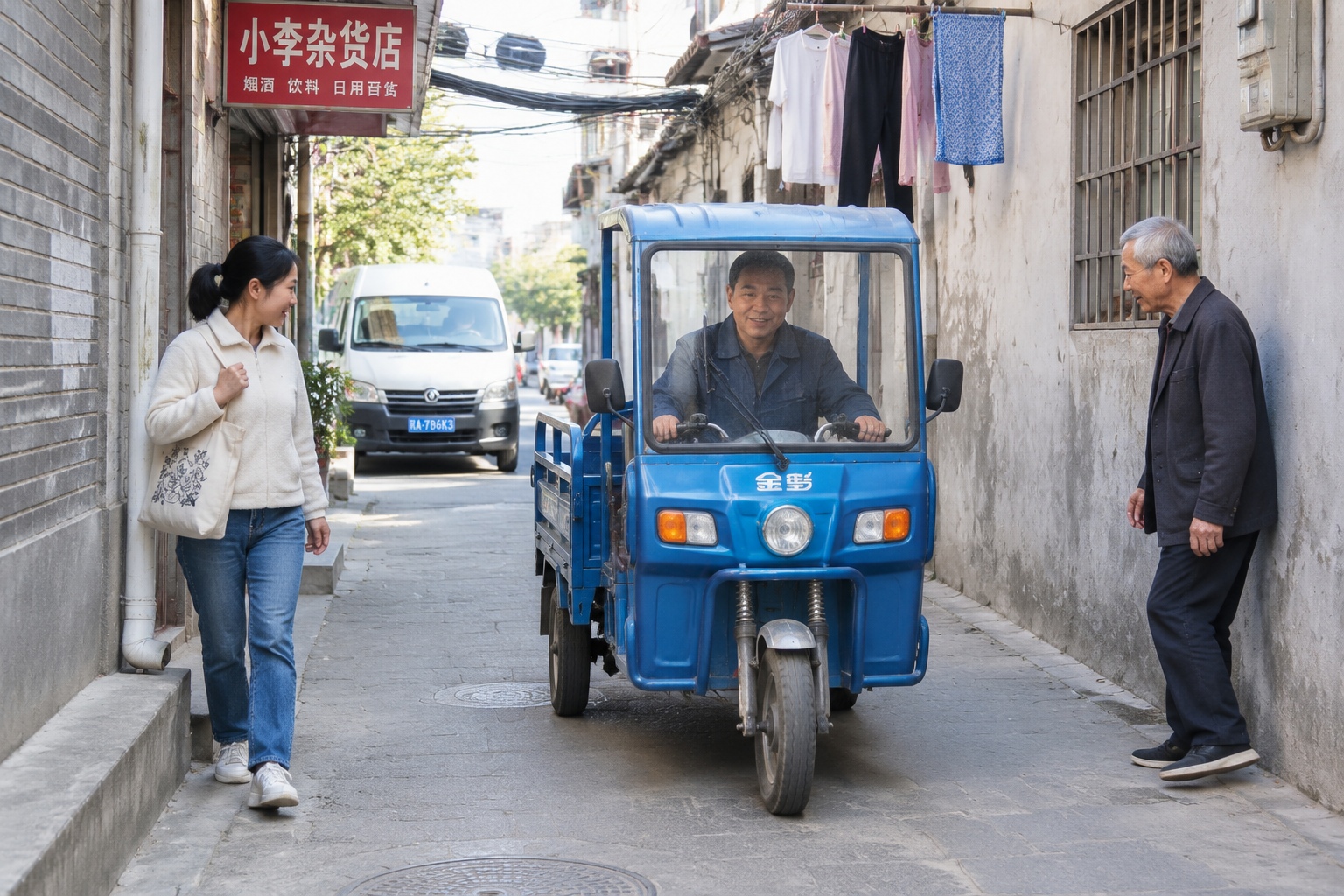
City centres are a different story, and the answer explains a lot about why these carts are so rare in the US or Europe. In many Chinese cities, three-wheelers are banned from main roads but tolerated in the small streets where they’re actually useful — the 4-metre-wide lanes that delivery vans can’t enter and that make up a huge share of the urban grid. In a European or American city, the same job is done by a van, a cargo bike, or a courier on foot, because streets are wider, distances longer, labour more expensive, and insurance and liability rules make an unregistered motor vehicle a serious legal problem rather than a small fine.
There’s also a simple substitution story. In the US, a cheap used pickup truck does what a trike does here. In China, that truck costs more, parks worse, drinks more fuel and can’t fit down the alley.
“Why is it so quiet, so cheap, so useful?” — the view from the street
Chinese people don’t romanticise these vehicles. They’re tools, and they’re evaluated the way tools are.
Ask a courier station manager what the trike is for and you get a list: 300 parcels a day, 40 km of stops, four alleyways a van can’t get into, one battery swap at lunchtime. Ask the woman selling grilled skewers at 10 p.m. and the trike is her shop — flatbed, griddle, gas bottle, folding table, all in one, parked and unpacked in eight minutes. Ask a father in a suburban estate and it’s the school run for two kids, in a district where the nearest bus stop is 1.2 km away. Ask a renovation crew and it’s 20 bags of cement in one trip instead of four taxi-van runs.
The economics are the point. A trike turns a fixed cost (a shop, a van, a delivery contract) into a variable one you can pay off in a season.
“How many people fit? What does it feel like to ride in one?”
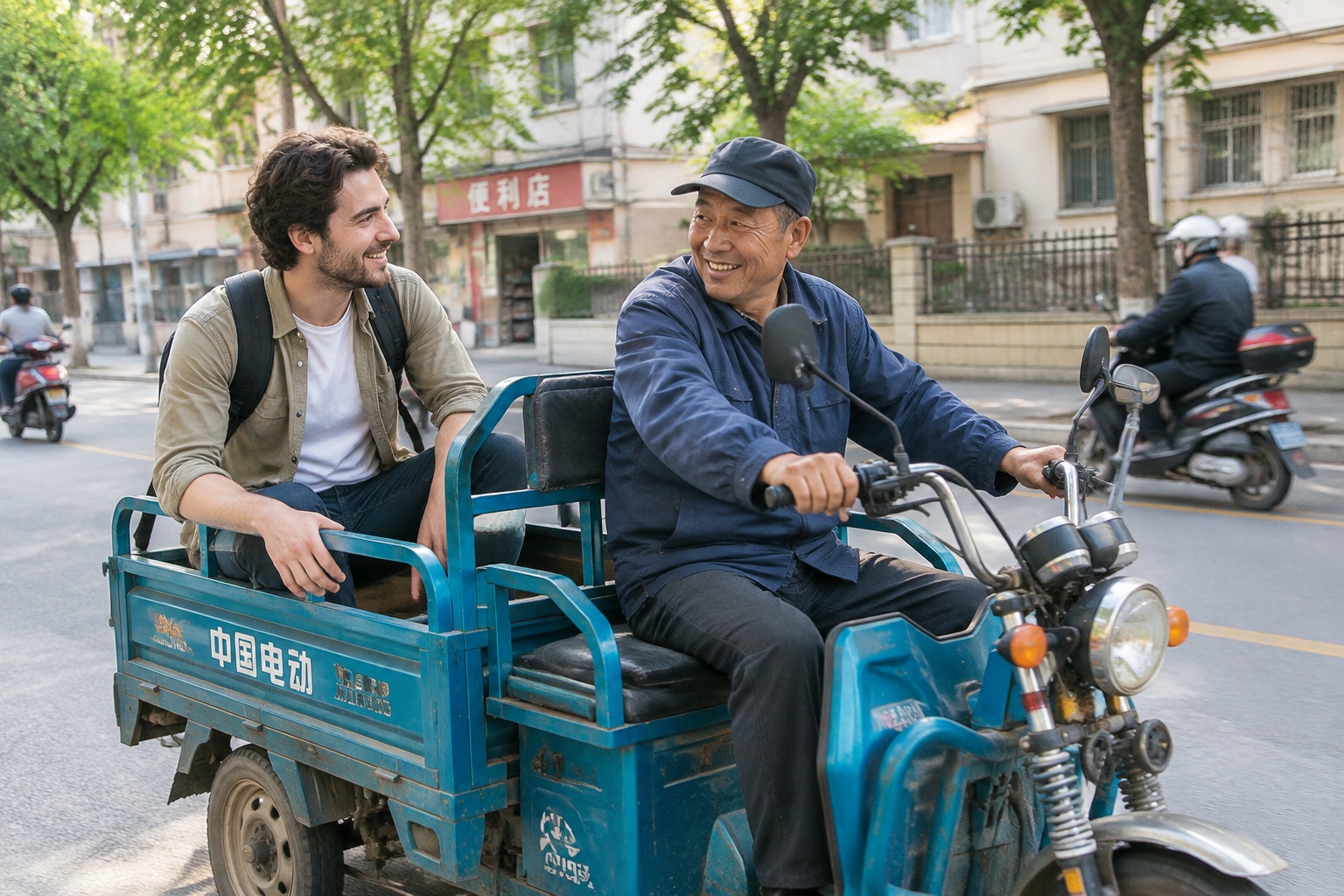
Legally, most enclosed models are registered for one or two people. In practice, three adults will squeeze in, and a child or two on a lap is not unusual in a county town.
The experience is more memorable than the spec. You sit higher than you expect and feel every pothole through a suspension that is essentially a suggestion. The motor makes a rising whine instead of a roar. On a wet tiled street, the back end steps sideways a little. Turning at speed feels like a negotiation. Passers-by look at you because a foreigner in the back of a sanbengzi is still a small local event.
Nobody describes it as comfortable. Plenty of people describe it as fun.
“Can a foreigner buy one? Rent one? Drive one?”
Buying is easy. Shops will sell to anyone with cash or a phone. Registering is where it gets complicated: putting a plate on a three-wheeler generally requires Chinese identity documents, and often local residency. Driving it legally requires a Chinese licence with a D endorsement, and China does not recognise International Driving Permits — short-stay visitors can apply for a temporary driving permit, but the paperwork assumes you’re driving something a rental company handed you.
That leaves the tourist version: in a handful of places — Dali, Yangshuo, some coastal towns, a few scenic areas — you can rent a small electric vehicle for a day with a passport and a deposit. This is a local arrangement, not a national rule. It varies by town, by season and by whoever is on duty that week. And a rental agreement signed at a roadside stall is not the same thing as insurance.
Watching a 30-second clip of someone tearing around a village on a trike is not a guide to what’s allowed where you’re going.
What those odd questions are actually about
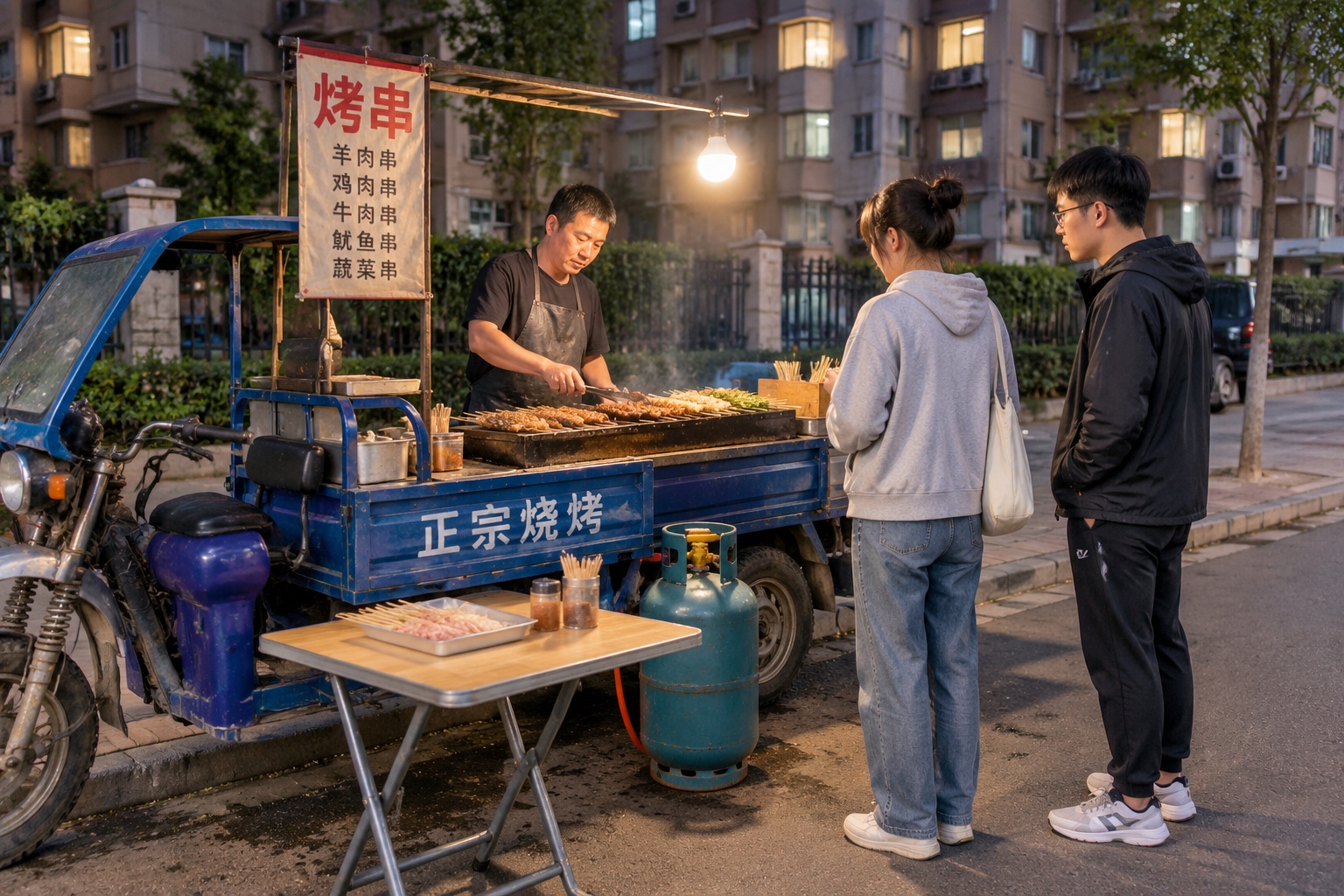
The questions sound strange because they’re asked from a different system. In Germany or Ohio or Manchester, a motor vehicle without a plate, a licence and insurance is a violation waiting to be discovered. In a Chinese county town, a 25 km/h cart carrying vegetables 800 metres to a market stall sits in a different category altogether — closer to a wheelbarrow with a motor than to a car.
Neither reading is wrong. They’re just built from different lives.
By 8 a.m., Daniel’s cabbage cart has been unloaded and the driver has gone home. He’ll be back tomorrow. The most useful thing a visitor can do with these carts isn’t to decide whether they’re a symbol of anything. It’s to notice who’s driving, what’s on the flatbed, and how far it actually goes — because that tells you more about ordinary Chinese life than any headline about the country ever will.
Start the discussion at forum.chinacomes.com