


Nine in the morning, and the messages are already stacking up
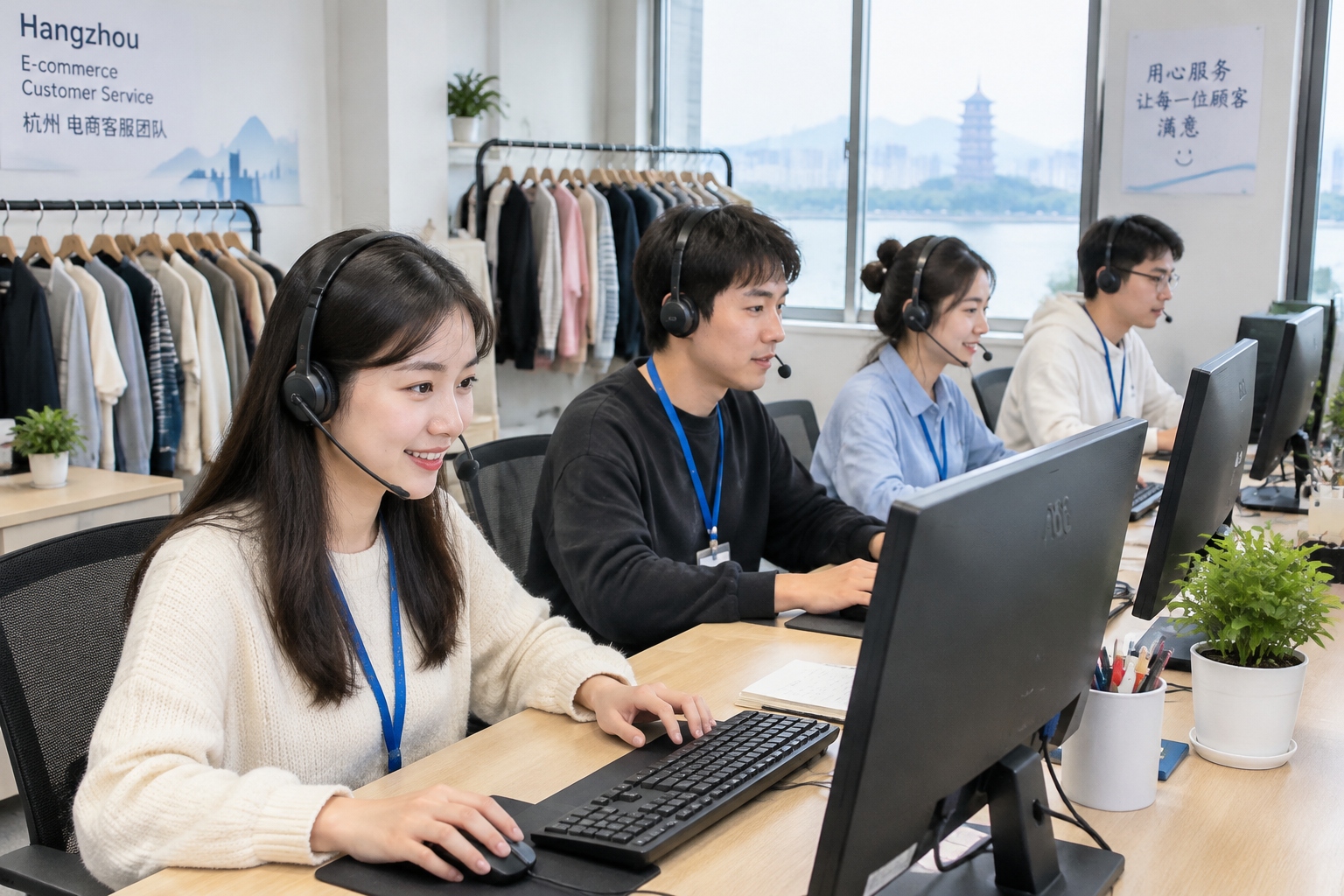
By 9 a.m. in a converted office building on the outskirts of Hangzhou, Xiao Fang has already cleared forty-two chat windows. She works for a mid-sized shop selling women’s clothing on Taobao, China’s largest online marketplace. Her headset is pushed back off one ear. On her dual monitors, orange chat bubbles blink open faster than she can read them.
“Is this size true to fit?” “Why hasn’t my package moved in two days?” “Can I return it if the color looks different?” The questions arrive in a steady stream, sometimes two or three from the same customer before she can type a single reply.
If you have ever shopped on Taobao, you have probably talked to someone like Xiao Fang. The little chat icon next to every product isn’t a bot’s decoration. For most shops, there is a real person on the other side, often expected to answer within seconds. That expectation is the quiet engine behind the convenience foreign shoppers hear so much about.

What the e-commerce boom looks like from a desk
China’s e-commerce industry is enormous. Online retail sales run into the trillions of yuan each year, and platforms like Taobao, Tmall, JD, and Pinduoduo have reshaped how hundreds of millions of people buy almost everything—groceries, phones, winter coats, live crabs.
That scale created a whole category of work that barely existed twenty years ago. Customer service for online shops, known in Chinese simply as kefu, employs a large share of young workers, many of them women in their twenties, many without university degrees. The job rarely makes headlines, but it is one of the most common entry points into the digital economy.
Xiao Fang, 26, came to Hangzhou from a county town in Anhui province four years ago. “My cousin did this first,” she says during a brief gap. “She told me it’s stable, indoor, no heavy lifting. Compared to a factory line, that sounded good.” Her shop isn’t huge—maybe fifteen people total, including the designers, photographers, and warehouse packers. The customer service team is four.
The rhythm of a shift
A normal day runs from 9 a.m. to 6 p.m., but “normal” is a flexible word in this trade. During big sales—the June 18 festival, the November 11 Singles’ Day blowout—shifts stretch late into the night, and the team sleeps in rotation. On those days, a single person might handle hundreds of simultaneous conversations.
The pace is relentless even on an ordinary Tuesday. Taobao tracks response time, and shops are rated partly on how fast and how satisfactorily they reply. A slow kefu drags down the store’s score, which affects how often the shop’s products get shown to new buyers. So speed isn’t just courtesy. It’s survival.
Xiao Fang keeps a library of pre-written replies—greetings, sizing charts, return policies—that she can fire off with a keyboard shortcut. But the hard part is never the standard questions. It’s the angry customer whose dress arrived with a loose thread, the anxious buyer messaging at midnight to ask if the package will arrive before a wedding, the person who simply wants someone to agree that waiting is frustrating.
When the robots arrived
A few years ago, the shop installed an AI chatbot. On paper, it was supposed to lighten the load. In practice, it changed the job rather than shrinking it.
The bot now handles the easy, repetitive questions: tracking numbers, store hours, basic sizing. That sounds like relief, and partly it is. But it means the conversations that reach Xiao Fang are the complicated, emotional ones—exactly the kind that take the most patience.
“The machine does the simple stuff,” she says. “What’s left for me is the people who are already upset, because the bot couldn’t solve it.” She has learned to spot the moment a customer types “transfer to human.” By then the mood is usually tense.
This is a pattern showing up across China’s service economy. Automation absorbs the routine and pushes humans toward the parts that still need a human—reading tone, defusing anger, deciding when to bend a rule. The technology is real and genuinely useful, but it hasn’t made the human disappear. It has made the human’s job more concentrated.
The emotional labor nobody prices in
Mid-afternoon, a customer sends a string of furious messages in all caps because a refund hasn’t posted. Xiao Fang doesn’t flinch. She apologizes, checks the backend, explains the bank’s processing delay, offers a small coupon, and keeps her tone soft the whole way through. Five minutes later the customer is calm. She closes the window and immediately opens the next.
“You can’t bring your own mood to work,” she says. “If I’m having a bad day, the customer can’t feel it. That’s the rule.” There’s a term for this that researchers use—emotional labor—the work of managing your own feelings to produce the feeling the job requires. For a kefu, it is the core skill, even though no training manual lists it that way.
She tells me the small victories matter. A customer who starts out shouting and ends by typing “thanks, you were really helpful” can carry her through the afternoon. “When someone changes a one-star review to five stars after we talk, that feels good,” she says. “It means I actually fixed something.”

A life built around the chat window
After work, Xiao Fang shares a rented apartment with two colleagues, a twenty-minute electric-scooter ride from the office. Rent in Hangzhou isn’t cheap, and the salary—a base wage plus a performance bonus tied to sales and ratings—leaves modest room to save. She sends some money home. She is learning video editing on the side, hoping to move into the content and livestream part of e-commerce, where the pay can be better.
That ambition is common. The kefu desk is often a doorway, not a destination. Some move up into shop management, some switch to running livestream sales, some leave the industry entirely. The churn is high, and the work can wear people down. Xiao Fang is honest about the fatigue. “Your eyes hurt, your wrists hurt, and you talk to angry strangers all day,” she says. “But I’m not stuck. I’m learning things here.”
Why this story matters
When shoppers overseas marvel at how fast and cheap Chinese e-commerce has become, the explanation usually points to logistics, factories, and platform algorithms. All true. But there is also a less visible layer—millions of people like Xiao Fang, typing patiently through screens, absorbing frustration so a transaction can feel smooth.
She doesn’t think of herself as part of anything grand. By 6 p.m. she logs out, stretches her neck, and checks her own phone for the first time in hours. The chat windows will refill tomorrow. For now, she’s just a tired 26-year-old heading home, part of the human machinery that keeps the world’s biggest online marketplace running.
Start the discussion at forum.chinacomes.com