
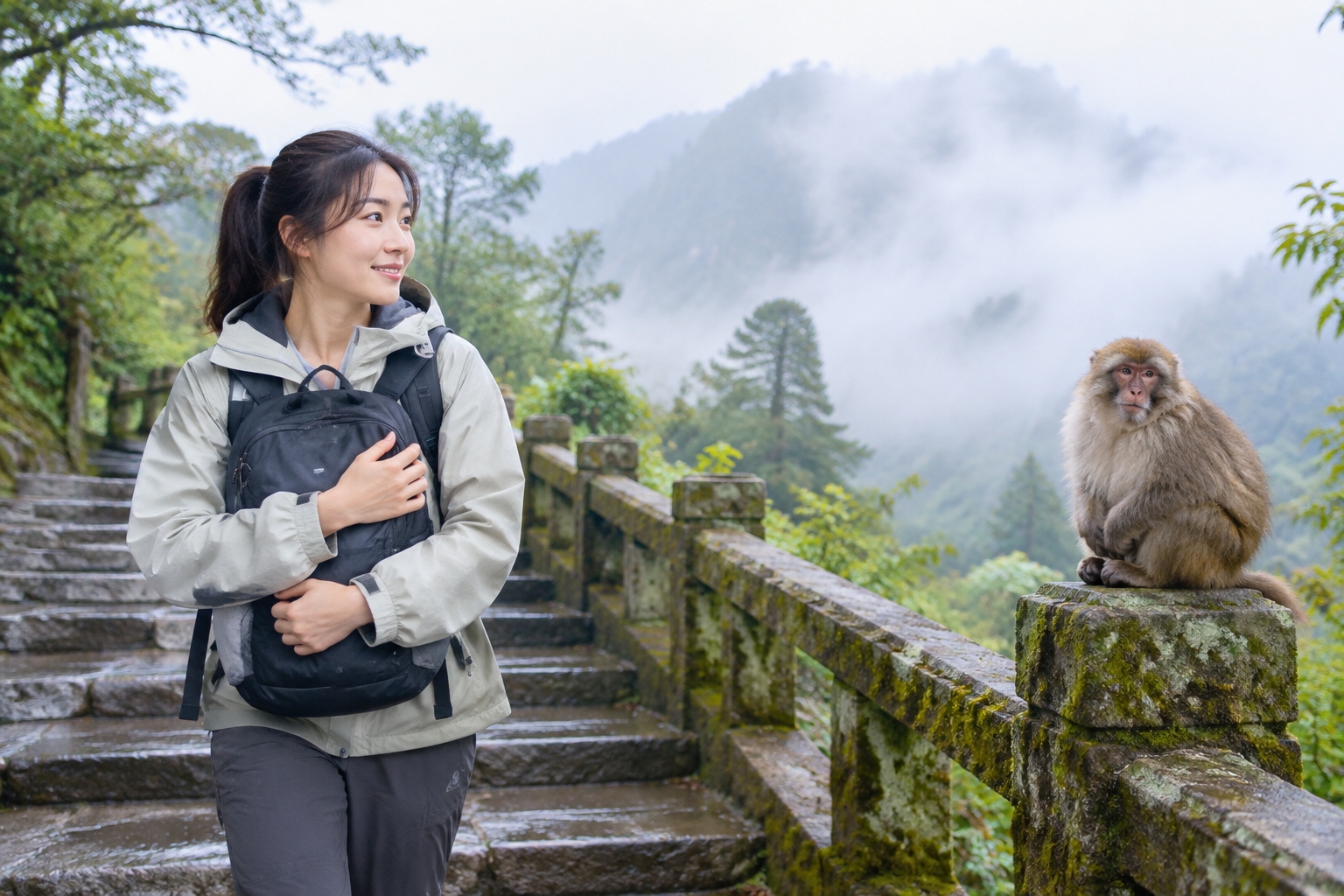

Do Mount Emei’s Monkeys Really Steal Your Bag?
The first clue was the crinkle.
I was somewhere above Qingyin Pavilion on Mount Emei, in Sichuan province, climbing a staircase of wet stone, when I heard the unmistakable sound of a plastic snack bag being handled. I wasn’t holding one. I looked left. A Tibetan macaque — roughly the size of a well-fed toddler, wearing the expression of a man who has just found your wallet — was working the side pocket of the backpack belonging to the woman in front of me.
She screamed. He didn’t flinch. He got the bag. She got a story.
By the time I reached the summit, three strangers had told me, unprompted, that the monkeys ‘will take your phone.’ A man renting bamboo walking sticks at the bottom of the mountain had promised they could ‘open your bag like a person.’ So I spent parts of three days walking the monkey zone with different bags and different habits, to work out how much of this is folklore and how much is plain truth.
Short answer: yes, Emei’s monkeys really do steal bags. No, not the way you’re picturing.
What Are the Emei Monkeys, Exactly?
They’re Tibetan macaques (Macaca thibetana) — stocky, brown-grey, with faces that flush red when they get excited. Adult males can weigh 15 kilograms or more, and they come equipped with canine teeth that make the argument for them.
Locals call them Emei Mountain monkeys, or sometimes ‘monkey lay devotees’ — a polite nod to the fact that this is a Buddhist mountain, not a zoo. Mount Emei is one of China’s four sacred Buddhist mountains and has been a UNESCO World Heritage site since 1996, which is a long-winded way of saying it is both a religious site and a very busy tourist destination.
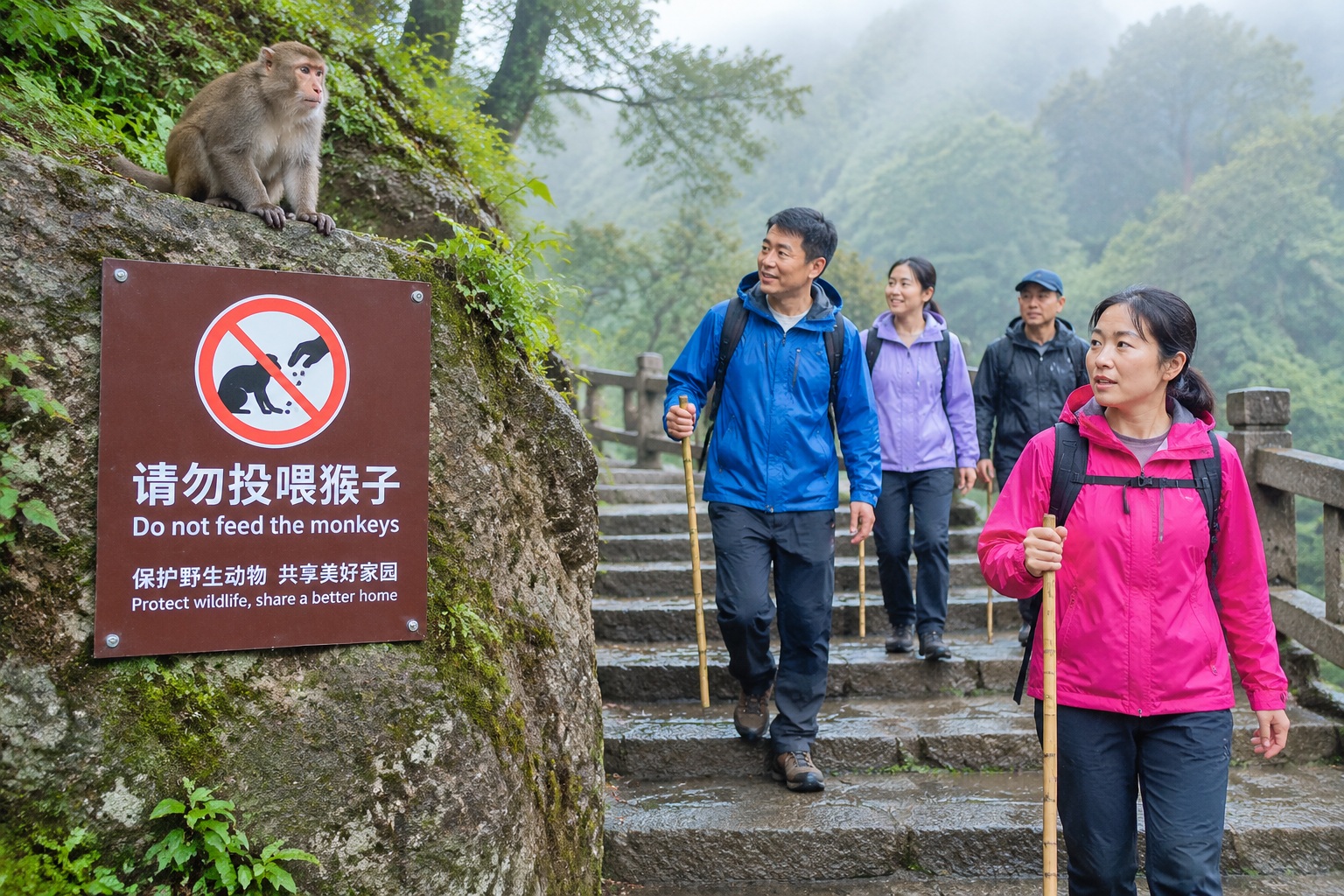
The monkeys are a protected species in China, and that status matters in practice. Shooing one away is fine. Hurting one is not a small matter, and the signs on the trail say so.
Why Emei’s Monkeys Got So Bold
Decades of feeding. A monkey that has been handed food by humans learns that humans are a vending machine with legs, and macaques live in troops where habits spread. The park banned feeding years ago, put up bilingual warning signs, posted wardens along the trail, and has relocated individual monkeys that became too aggressive. But the behavior is already baked into the population. You are not dealing with wild animals. You are dealing with animals that have been studying tourists for thirty years.
It’s worth saying plainly: most encounters are annoying, not dangerous. The overwhelming majority of visitors walk through the monkey zone with nothing worse than a lost bag of chips and a decent story. But bites do happen every year, they aren’t trivial, and they are nearly always connected to food.
My Three-Day, Entirely Unofficial Bag Test
This wasn’t science. It was one person, three days, and a lot of stone steps. But here’s what changed how the monkeys treated me.
Day one: a big backpack worn on one shoulder, phone in hand, water bottle in a mesh side pocket. Two monkeys followed me for maybe 200 meters. One put a hand on my dangling strap. Nothing was opened, but I had made myself the most interesting object on the trail.
Day two: same backpack, both straps on, everything zipped, phone buried in a pocket, nothing dangling. The monkeys glanced at me and lost interest within seconds. I have never felt so relieved and so personally insulted at the same time.
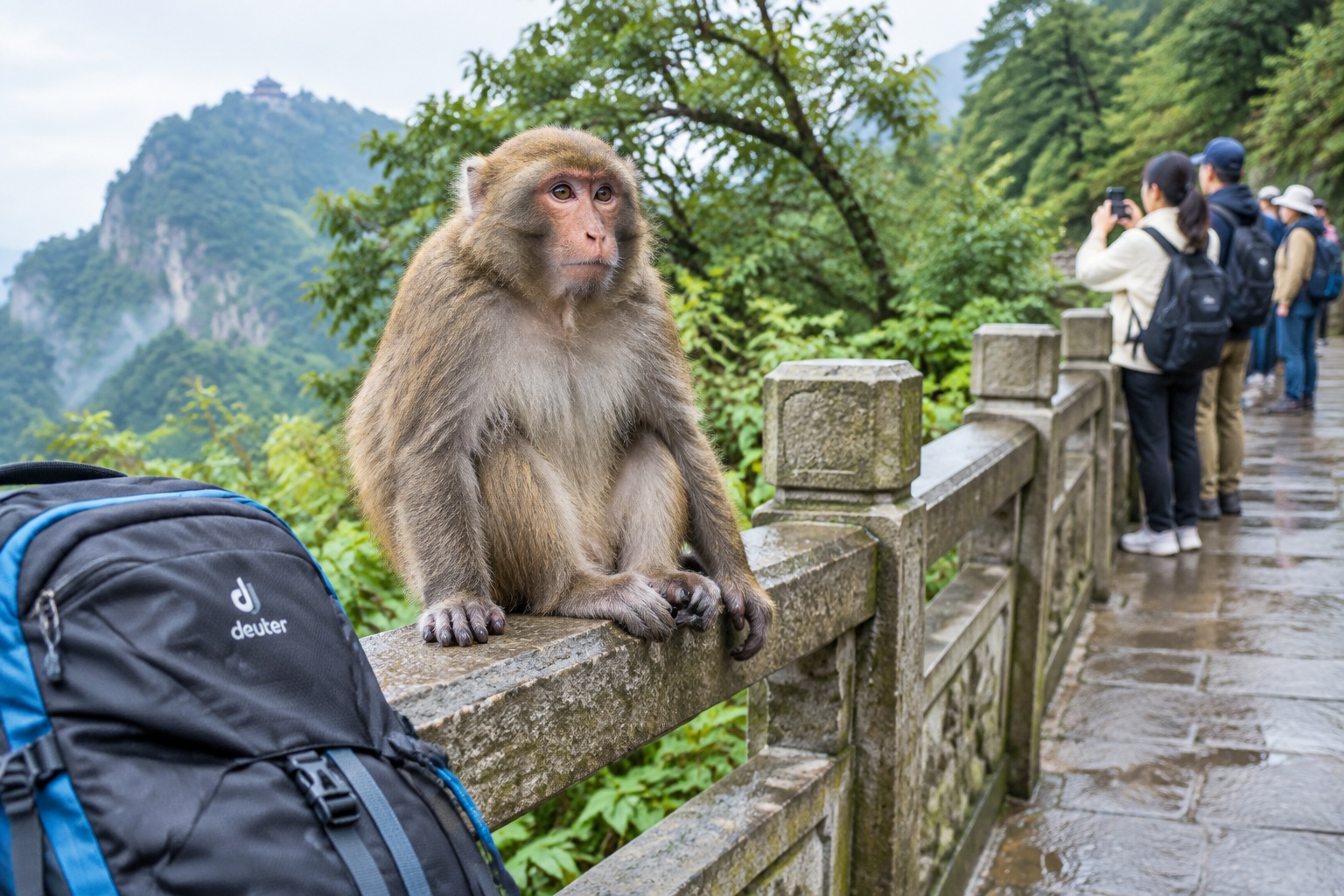
Day three: standing at a railing with my backpack worn on the front of my body, like a tourist on a crowded metro. A macaque hopped up beside me, rested a hand on my shoulder strap, and then — this is the part people don’t believe — tested my zipper with two fingers. It didn’t get in. Not because I was brave, but because the bag was closed and pressed against my chest.
Later that day I watched a monkey unzip a stranger’s backpack while he filmed it at arm’s length with his phone. Four seconds, give or take. It took out a bag of bananas and left the phone alone. Make of that what you will.
The People Who Actually Handle the Monkeys
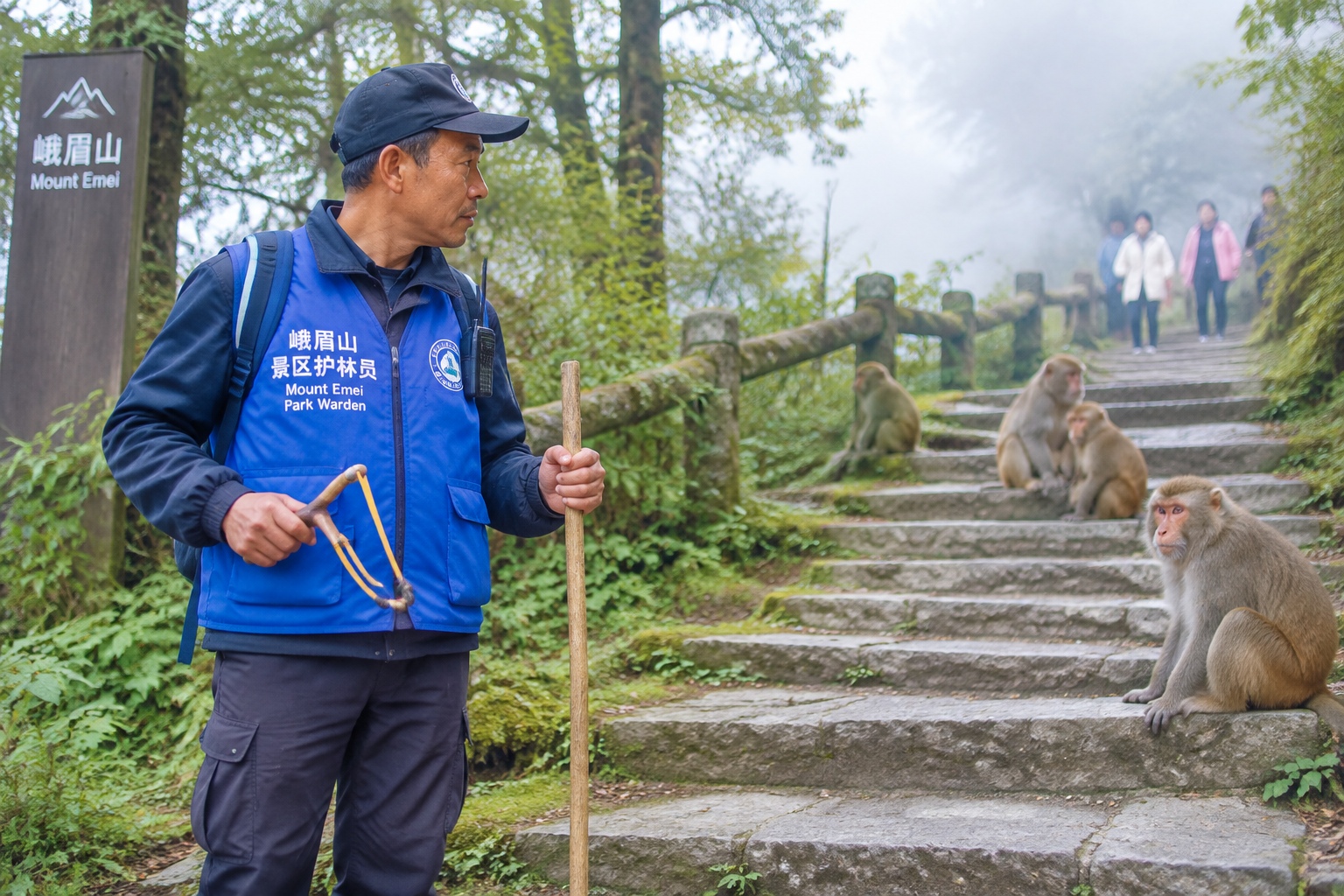
You’ll spot them: wardens in blue vests, carrying slingshots and long sticks. The slingshot isn’t aimed at the animal. It’s fired at the ground to make a sharp crack, which is usually enough to move a troop along. It’s the least glamorous wildlife management job imaginable, and it works better than any advice in a travel forum.
Along the trail, people sell bamboo walking sticks for a few yuan. Buy one for the stairs, not for a fight. Swinging a stick at a protected animal is a bad idea on every level — legal, medical and practical. Nobody along that trail is going to wrestle a monkey for your backpack, and neither should you.
The Playbook: Rules That Actually Work
- Don’t carry a plastic bag. The crinkle is a dinner bell, and once it rings you can’t un-ring it.
- Put food and drinks inside a zipped compartment, never in an open mesh side pocket.
- Wear your backpack on both shoulders, or hold a shoulder bag against your chest. Dangling straps are an invitation.
- Zip everything. They can work zippers. They have watched thousands of humans do it.
- Don’t feed them. Not one peanut, not ‘just this once.’ You are training tomorrow’s problem.
- Don’t smile with your teeth showing. To a macaque, bared teeth is a threat, not a greeting — useful to know before you pose for a selfie.
- Don’t stare. Long eye contact reads as a challenge.
- Don’t crouch, don’t turn your back, don’t try to pet one. Small children and monkeys belong at opposite ends of the trail.
- Keep your phone in an inside pocket.
- If a monkey grabs your bag, let it go. Nothing inside is worth a bite.
- Walk through the monkey zone; don’t picnic in it. Eat your snacks 300 meters further up.
- Go early. Tour buses unload mid-morning; the monkeys are calmer and less food-conditioned before the crowd arrives.
If a Monkey Bites or Scratches You
This is the part worth memorizing.
- Wash it immediately with soap and running water for at least 15 minutes. This is the single most important step.
- Go to a clinic the same day. There are medical points on the mountain and rabies clinics in the town at the foot of the mountain. Don’t wait to see how it feels tomorrow.
- Get rabies post-exposure prophylaxis. It’s widely available in China and typically costs a few hundred yuan; immunoglobulin, if it’s needed, costs more.
- Report it to park staff so there’s a record, and keep your vaccination card for the rest of your trip.
Rabies is rare, but it is not a gamble anyone should take. Monkey bites also get infected easily, which is its own reason to stop by a clinic.
What It Costs, and When to Go
Prices change, so check official channels before you go, but at the time of writing the main entrance ticket was around 160 yuan in high season and 110 in low season, the shuttle bus up to Leidongping around 90 yuan for the round trip, and the cable car to the Golden Summit roughly 65 yuan up and 55 down. Bamboo sticks cost single-digit yuan. A bag of chips you will lose: about eight.
Mount Emei is roughly 90 minutes to two hours from Chengdu by high-speed train, which makes it an easy overnight rather than a pilgrimage. On national holidays, daily visitor numbers run into the tens of thousands. If you want the monkey zone without the crush, aim for early morning.
Where the Monkeys Aren’t
Worth knowing: the grabbing happens in a fairly small stretch, mostly around the ecological monkey zone below Qingyin Pavilion. Above it, past the long climb toward Hongchunping, the crowds thin out and the monkeys become scenery rather than salespeople.
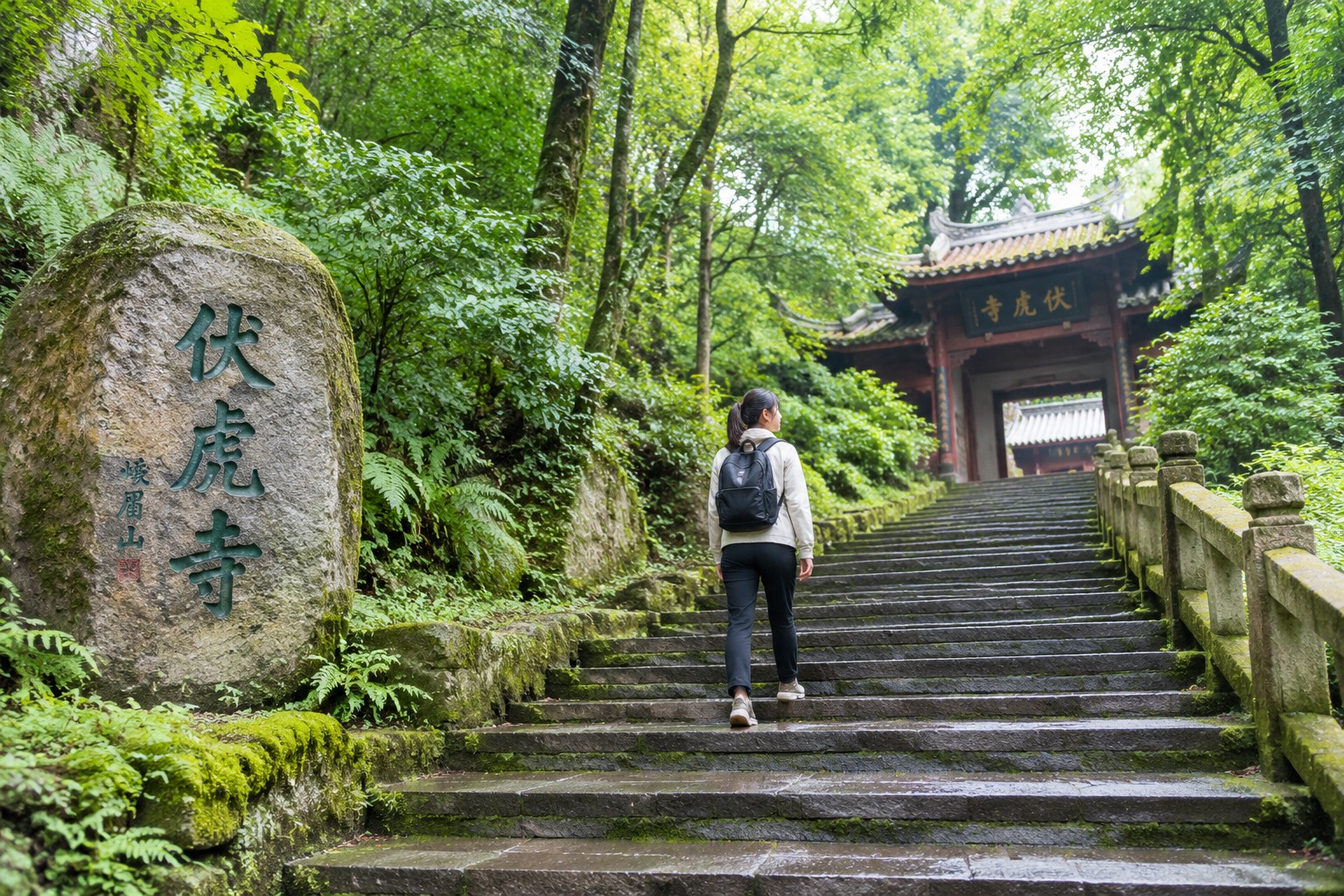
If you want a genuinely quiet side of the same mountain, the lower temples are underrated. Fuhu Temple, near the base, is all moss, forest and birdsong, with a fraction of the foot traffic. Wannian Temple has the bronze elephant statue and, on a weekday morning, room to breathe. The contrast is the interesting part: the same mountain, ten minutes apart, one half working hard for tourists and the other half simply being a forest.
So — Do They Really Steal Bags?
Yes. But they’re not muggers. They’re opportunists with better hands and more patience than most humans, and they have learned exactly which tourist is holding a snack in an open bag while looking the other way.
The monkeys didn’t ruin Mount Emei. They’re part of what makes it memorable, and they’ve been part of this mountain’s story far longer than any of us have been visitors. Keep your snacks zipped, your hands free, your distance respectful, and your ego flexible enough to accept that a five-kilogram primate outsmarted you.
Then climb the last few thousand steps and watch the sunrise from the Golden Summit. That part, no monkey can take from you.
Start the discussion at forum.chinacomes.com