
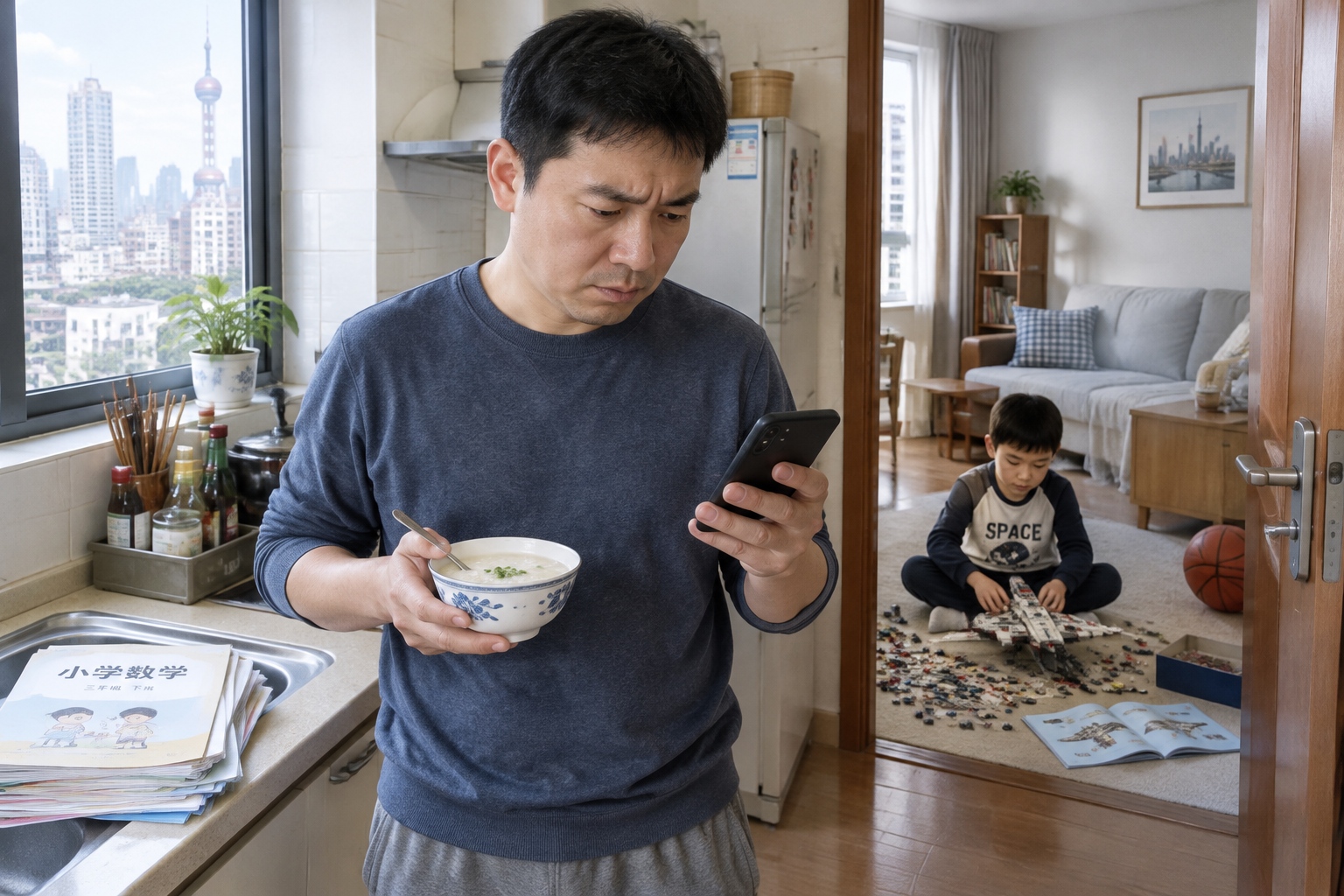

Saturday, 7:40 a.m., and Someone Is Already Behind
Li Wei is 38. He works in product at a logistics company in Pudong, and he has not slept past eight on a Saturday since his son was in kindergarten. He is standing in the kitchen with a bowl of congee when his phone buzzes. It’s the class parents’ group — 463 people, mostly silent, occasionally volcanic.
Today’s message is an ad. Children’s Guoxue Enlightenment Class. Saturday, 2 p.m. Sixteen sessions, ¥3,980. Free hanfu included.
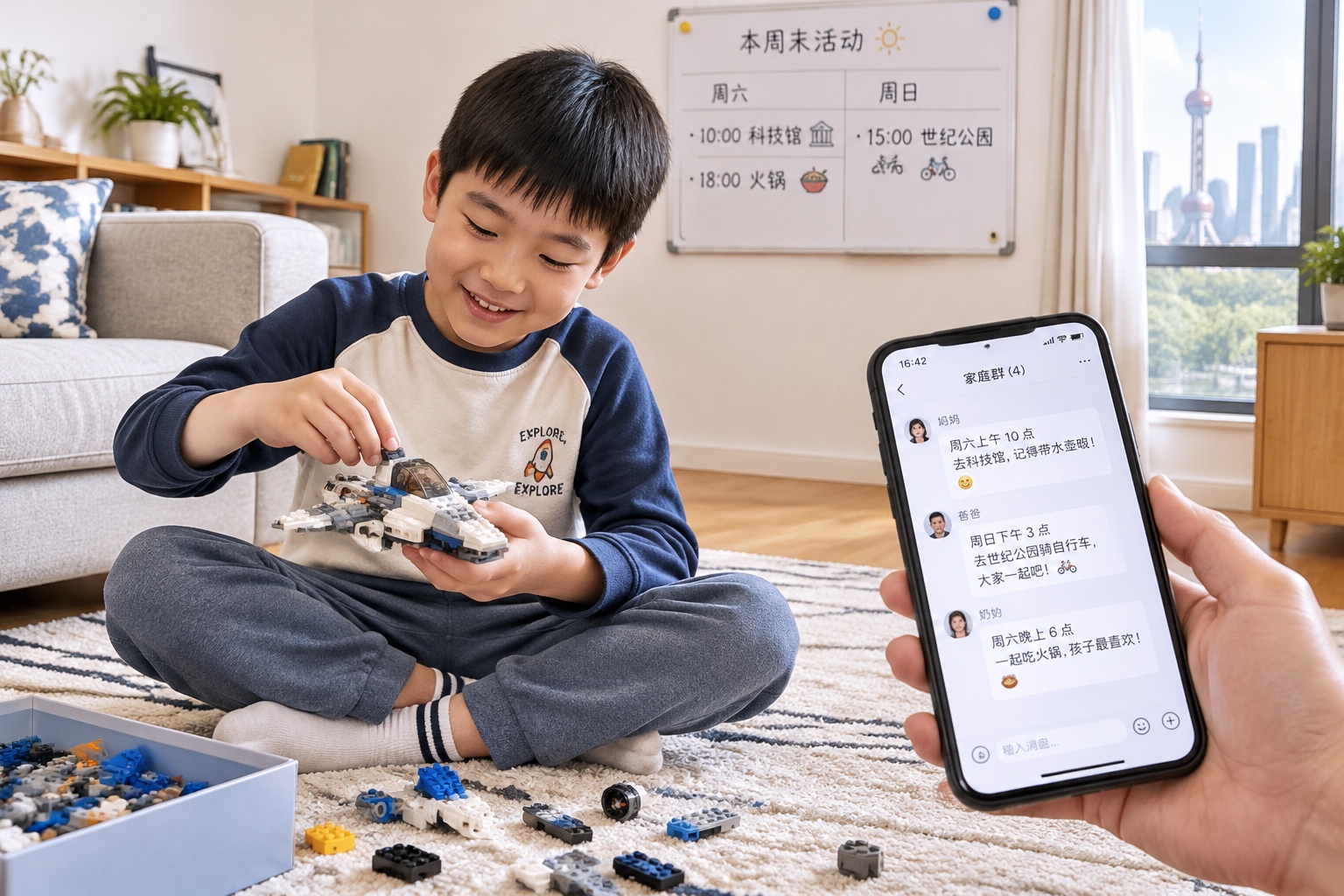
Down the hall, his son Duoduo, eight years old and in third grade, is building a spaceship out of LEGO on the living-room floor. He is narrating the launch to himself. He hasn’t asked anyone to come play.
Li Wei reads the ad twice. Then he does the thing Shanghai parents do at 7:40 on a Saturday morning: he opens his calendar app and stares at it.
Why a Shanghai Dad Is Torn Over a Guoxue Class
Here is what his Saturday already looks like. Basketball, 9:00 to 10:30, in a gym on the sixth floor of a shopping mall. Lunch. Twenty minutes of Chinese handwriting practice, which usually takes fifty. English at four — a class of six in a converted apartment, run by a teacher who used to work for one of the big chains that got pushed out of weekends by the 2021 “double reduction” policy. Then dinner, bath, bed. Weekend gone.
Guoxue — literally “national studies” — is the umbrella term for classes built around classical Chinese texts: the Analects of Confucius, the old children’s primers like the Three Character Classic, sometimes Tang poetry, calligraphy, tea ceremony and hanfu folded in.
Adding it means a third paid activity, one more negotiation over screen time, and one more adult driving across the Huangpu on a Saturday afternoon. Saying no means watching the group chat fill up with other families’ schedules.
It’s worth saying clearly: this is not what every Chinese family does. Plenty of Shanghai kids spend Saturdays at their grandparents’ flat, in the park, or doing absolutely nothing, and their parents are fine with it. Nobody publishes a clean national number for guoxue enrollment. The classes sit inside the much larger non-academic training market — coding, basketball, art, English, traditional culture — where demand is concentrated in big cities and among parents with degrees, disposable income and a nagging feeling that weekends are a resource being spent.
What Actually Happens in a Confucius Classics Class
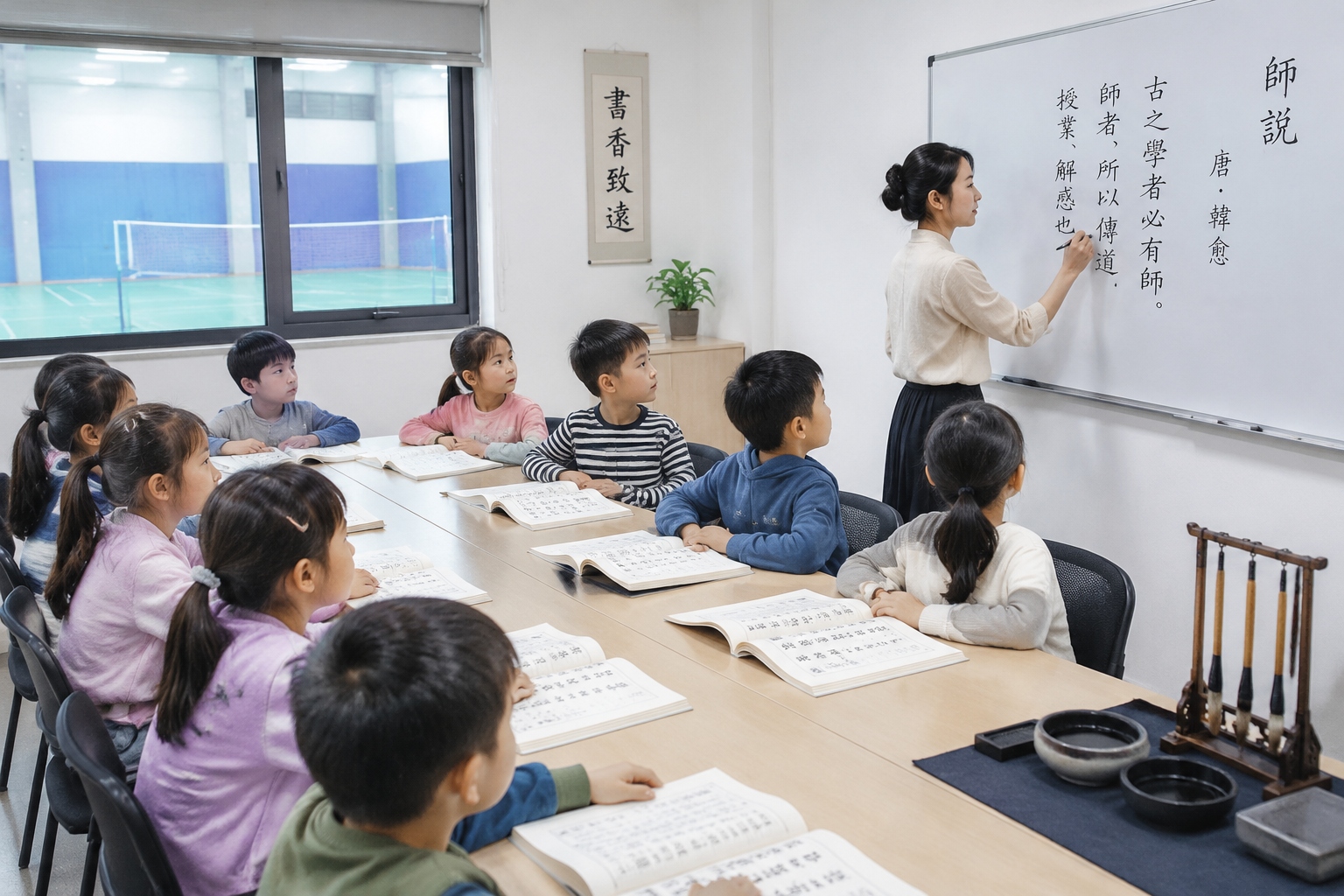
On a recent Saturday I sat in the back of one, on the fifth floor of an office building near Zhongshan Park, next door to a badminton court. Twelve children, ages six to nine, at long tables. A teacher in her thirties, surnamed Zhou, writes four characters on the whiteboard: 学而时习之.
She reads the line aloud. The children repeat it. She reads it again. Then she tells a story about a friend arriving from far away, and asks who in the room has a friend who moved to another city. Six hands go up. A boy explains, at length, that his best friend moved to Suzhou and he saw him once at a mall.
The last twenty minutes are calligraphy. Ink, brushes, newspaper underneath, a character copied eight times. Duoduo-class energy: two kids have ink on their faces by the end.
That’s the honest middle of the market. Fees in Shanghai typically run ¥200–300 for a 90-minute session, or ¥3,000–8,000 for a semester. At the higher end, studios add hanfu photos, tea ceremony, a “little gentleman” graduation ceremony, and marketing copy about 君子人格 — the character of a noble person. At the lower end are small reading groups that mostly read and discuss, closer to a book club with an old text. Somewhere in between is a lot of packaging.
The three kinds of class exist side by side, and parents rarely get a clear label saying which one they’re paying for.
The Real Anxiety Behind Chinese Parenting
I asked four parents why they were considering it. Nobody mentioned politics. Almost nobody mentioned exam scores. What came up was heritage, focus, and other people.
“My daughter reads English picture books by herself, but she has to stop and think before writing her own name in Chinese,” said Chen, a mother in Minhang with a six-year-old. “That bothers me more than I expected.”
Wang, a father of two in Yangpu, is less sentimental. “I want him to be able to sit still,” he said. “Ninety minutes with a book and a brush. If he can do that at seven, he can do his homework at twelve.”
Liu, whose son is in the same class as Duoduo, was the most direct: “Half the class is doing something on Saturday. If we do nothing, I feel like I’m the only parent not paying attention.”
Then there’s the demographic backdrop. China recorded about 9.5 million births in 2024, down from 17.9 million in 2016. Fewer children has not meant less intensity; it has meant more spending per child, often with grandparents contributing. More than 13 million students registered for the college entrance exam in each of the past two years.
The Pushback: Memorizing Isn’t Understanding
Not everyone in the room is convinced. Ms. Xu has taught in Shanghai public primary schools for 22 years, and she is blunt about the recitation-first version of the genre.
“I’ve met eight-year-olds who can chant the whole Dizigui and still grab a toy out of another kid’s hands,” she said, referring to the Qing-dynasty primer that some schools have quietly dropped, and that critics call a manual for obedience. “Manners come from being corrected in the moment. Not from a text.”
A researcher at a Shanghai university who studies classical education puts the problem differently. The modern classics-reading movement goes back to the 1990s, when educators like Wang Caigui argued that children should memorize canonical texts young, before they can fully understand them. The idea has real supporters and a real critique: that recitation produces performance rather than comprehension.
“Tradition is worth teaching,” she said. “The question is whether you’re teaching a text or teaching a child to think about a text. Those are different products, and parents often can’t tell them apart from the brochure.”
The other concern is simpler and harder to argue with: hours. Many Shanghai primary schools now run after-school care until 5:30 or later, which means children are already indoors for most of the daylight on weekdays. Saturday afternoon may be the last stretch of unstructured time a third-grader has.
Traditional Culture Meets Modern Education — and a Market
This isn’t only a consumer trend. China’s education ministry issued a national guideline on traditional culture in schools back in 2014, and the unified Chinese-language textbooks rolled out from 2017 increased the share of classical poetry and prose, with roughly 129 classical pieces across six years of primary school. Classical Chinese is now a scored part of the language exam.
But the weekend rush is driven by something more personal. For most of these parents, guoxue isn’t a political statement. It’s a way of buying something that can’t be graded — a cultural foundation, a sense of rootedness, a child who can sit quietly with a brush. After double reduction cleared the big academic chains out of weekend slots, small studios moved into the gap, and now coding, basketball, English and the Analects compete for the same two days.
The result is a market that is genuinely mixed: serious teachers, sincere parents, and a fair amount of costume drama.
Is This So Different From a Saturday Chinese School Abroad?
If you grew up outside China, some of this will feel familiar. Heritage-language schools in Toronto and California, Hebrew school, Sunday school, Kumon on a Saturday morning — all of them are parents paying money so their kids inherit something they’re afraid of losing.
The difference is direction. Abroad, the fight is to keep a minority language and identity alive against the current. In Shanghai, Chinese is the majority language and the school system already tests classical texts. The anxiety isn’t preservation — it’s distinction. Which is a subtler, more competitive, and frankly more expensive kind of worry.
One Trial Month, Then Decide
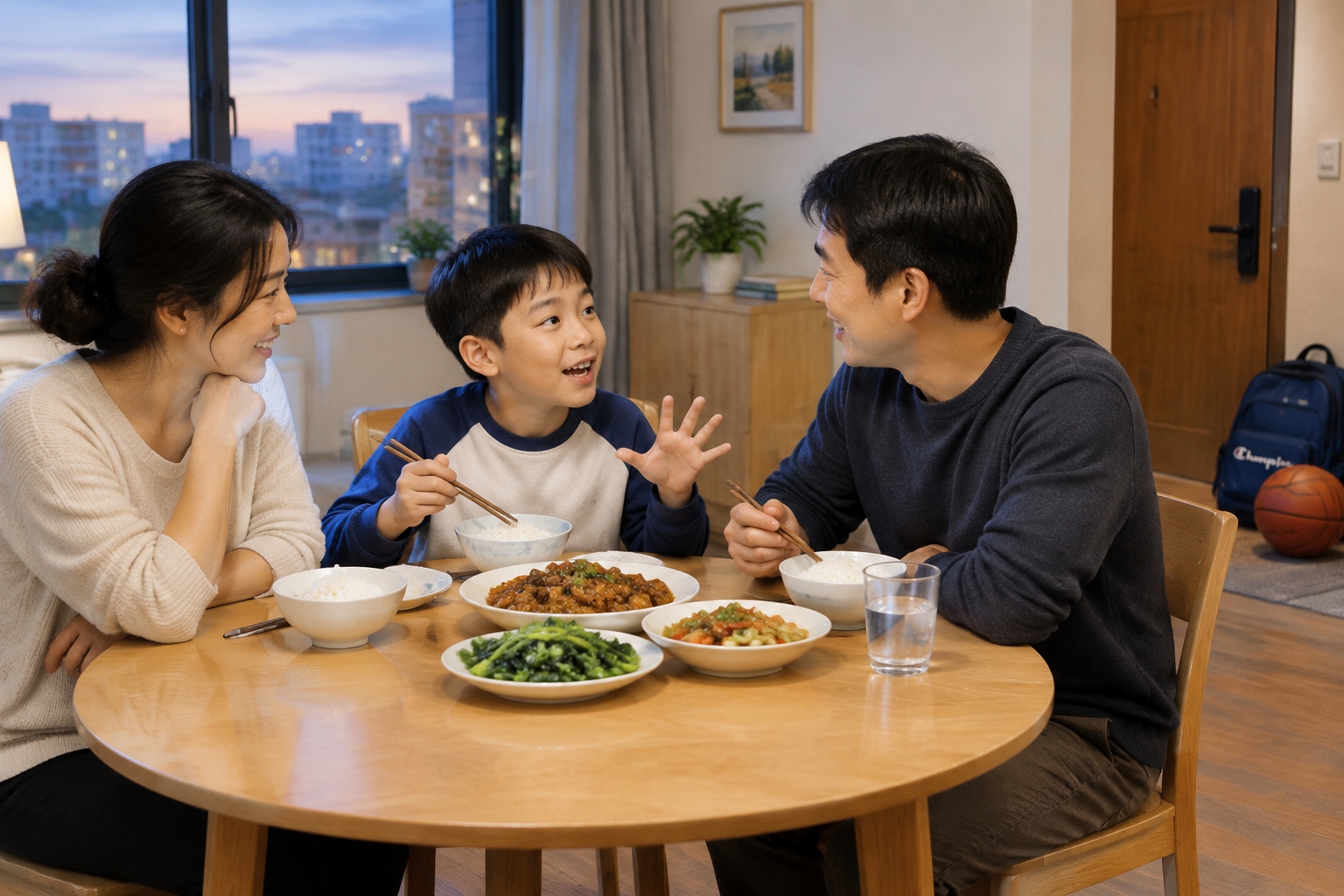
In the end, Li Wei did the least dramatic thing available. He signed up for four sessions instead of a semester, about ¥950, and told the teacher he’d decide afterward. The first class is next Saturday.
His test isn’t a score. It’s whether Duoduo mentions the story about the friend from far away at dinner, on his own, without being asked. If he does, they’ll keep going. If he doesn’t, Saturday afternoon becomes scooters in the park and a basketball that gets used until dark.
“I don’t need a nine-year-old gentleman,” Li Wei said. “I’d just like him to still like Chinese when he’s fifteen.”
There’s no correct answer here, and nobody in that 463-person group chat has one either. If you want to see what China actually looks like right now, this is often where it lives: not in the headlines, but in a father standing in his kitchen at 7:40 on a Saturday, deciding how to spend an afternoon.
Start the discussion at forum.chinacomes.com