

A Village That Wakes Up Before the Tour Buses
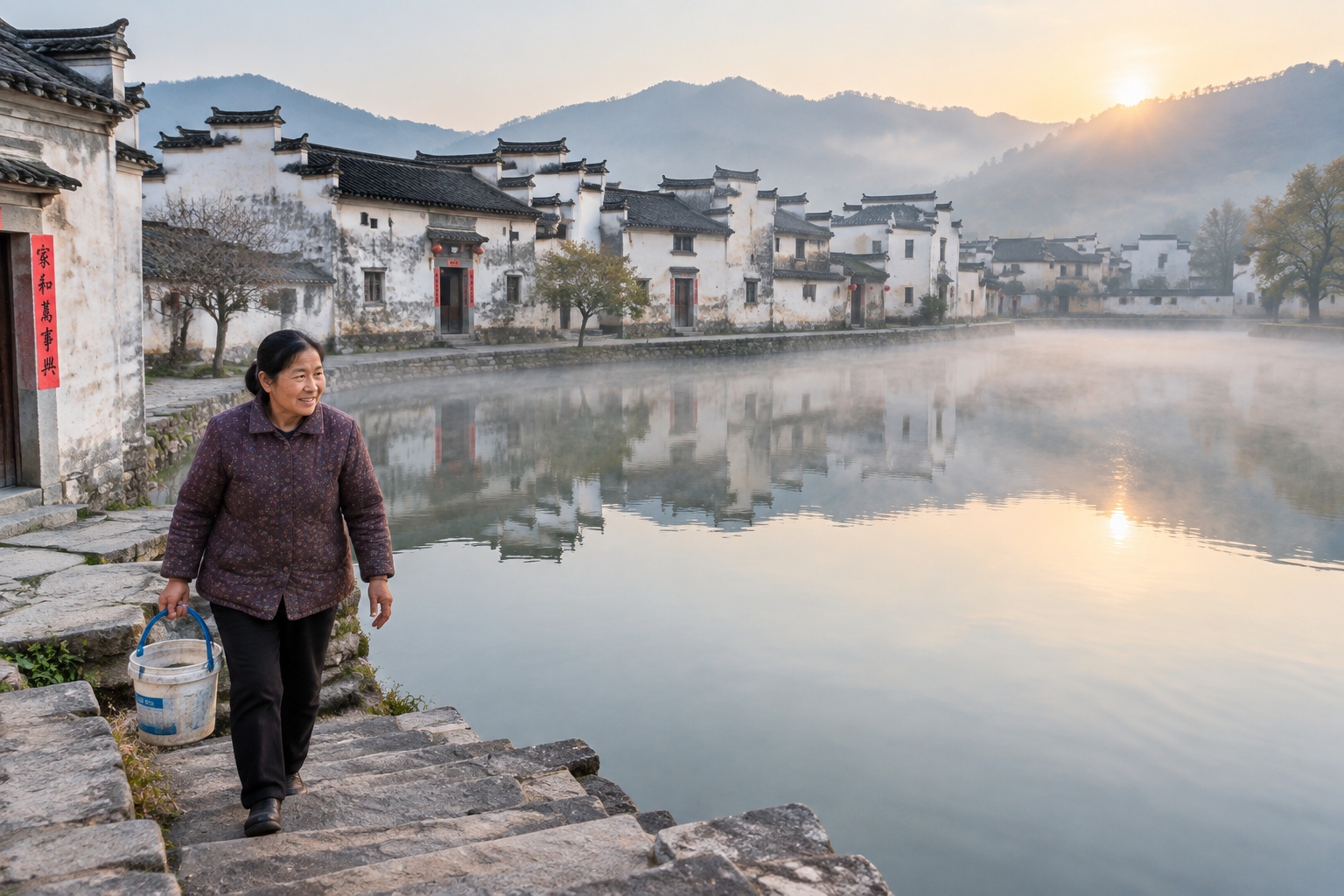
At 6:20 on a cold November morning, the water in Hongcun’s central pond is doing two jobs at once. In one corner a woman in a padded jacket is rinsing a basket of greens. Twenty metres away, a man lowers a plastic bucket on a rope and pulls up water for his kettle. Nobody is photographing either of them. The first tour group is still an hour and a half away, somewhere on the highway from Huangshan.
Hongcun sits in Yixian County, Anhui Province, in a valley at the foot of the Huangshan mountains in eastern China. It is around 900 years old, home to roughly a thousand people, and has been a UNESCO World Heritage Site since 2000, listed alongside its neighbour Xidi. About 140 Ming and Qing dynasty houses still stand: whitewashed walls, grey tile roofs, stepped horse-head gables.
That is the version most visitors see. The more interesting question is what the painting is like to live in.
The Water Is the Village’s Operating System
Hongcun was not designed to be looked at. It was designed to work.
In the early 1400s the village’s Wang clan hired a geomancer and rebuilt the settlement around a water system. The layout is usually described as a cow: a hill called Leigang as the head, two old trees as horns, four bridges as legs, a crescent pond called Yuezhao (Moon Pond) as the stomach, and the larger South Lake as the belly.
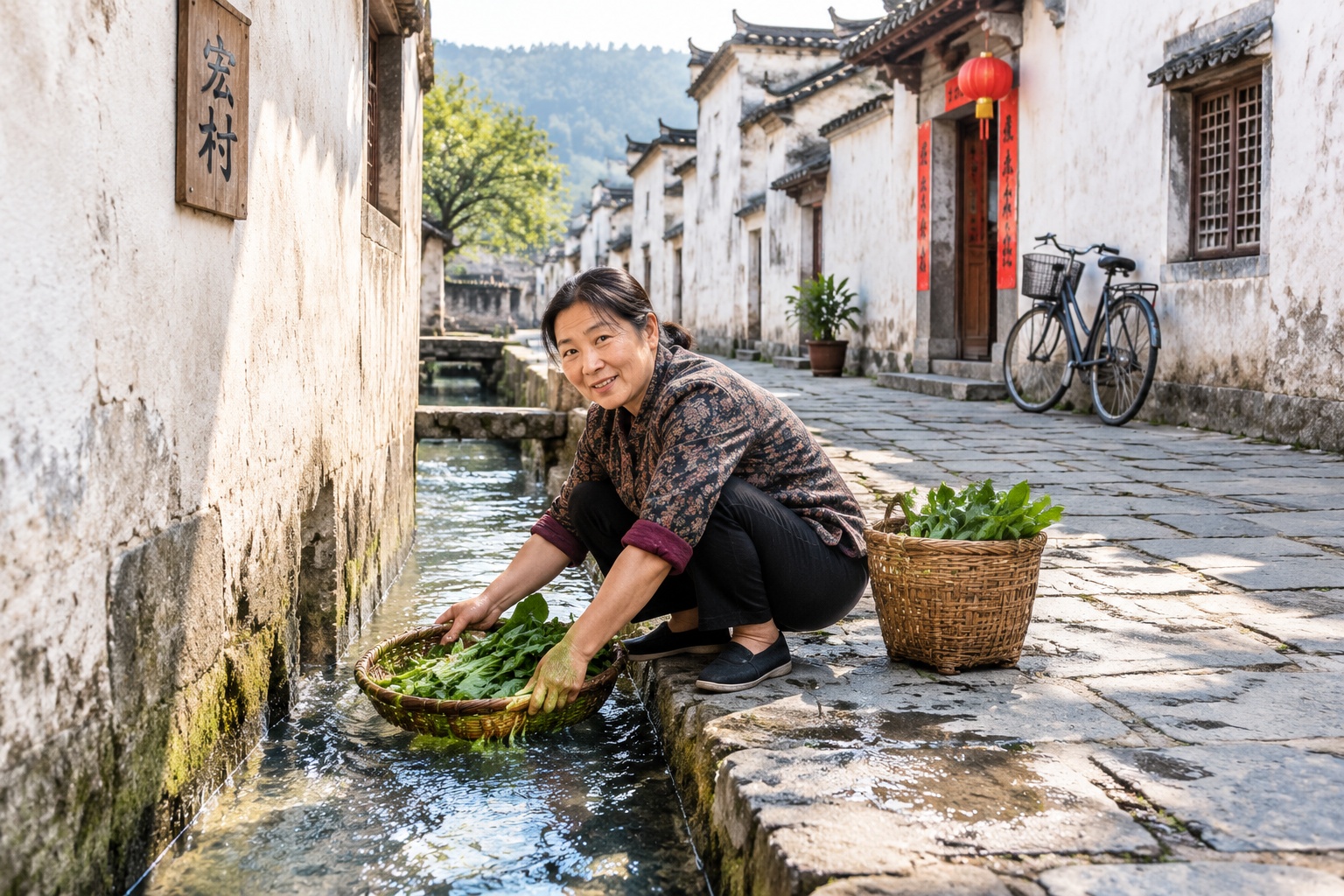
More than a kilometre of stone channels still threads through the alleys, carrying water down from the hills and past people’s doorsteps. The rules for using it are old and mostly still followed: drinking water early in the morning, then vegetable washing, then laundry further downstream. Soap in the channel is a real offence, and a villager will tell you so, not gently.
For a visitor, the channels are scenery. For a household they are plumbing, drainage, fire safety and air conditioning in one. On summer evenings families drag stools into the alley beside the water, because the moving current makes the air a few degrees cooler. That is not a heritage practice. It is just what works.
What It Feels Like When Thousands of People Walk Past Your Door
Admission costs around 100 yuan, about 14 US dollars. On an ordinary weekday a few thousand people walk through. During the first week of October or the Spring Festival holiday, daily numbers can reach the tens of thousands, and the lane between the entrance and Moon Pond becomes a slow queue of umbrellas and selfie sticks.
Tourism money is shared here in a way that surprises most foreign visitors. Part of the ticket revenue flows back to the village, and households receive an annual dividend. The sums are modest and change from year to year, and people are vague about the exact number the way people are vague about any money that arrives without a payslip. It still changes the politics of the place: most residents are not merely tolerating tourists. They are stakeholders.
The daily rhythm is sharp. Between 8 a.m. and 5 p.m. the main lanes belong to visitors. By 6:30 the buses have gone, shutters start coming down, and the same alleys fill with televisions, children doing homework and somebody’s grandmother on the phone. The village becomes a neighbourhood again.
The Family Maths of a World Heritage Village
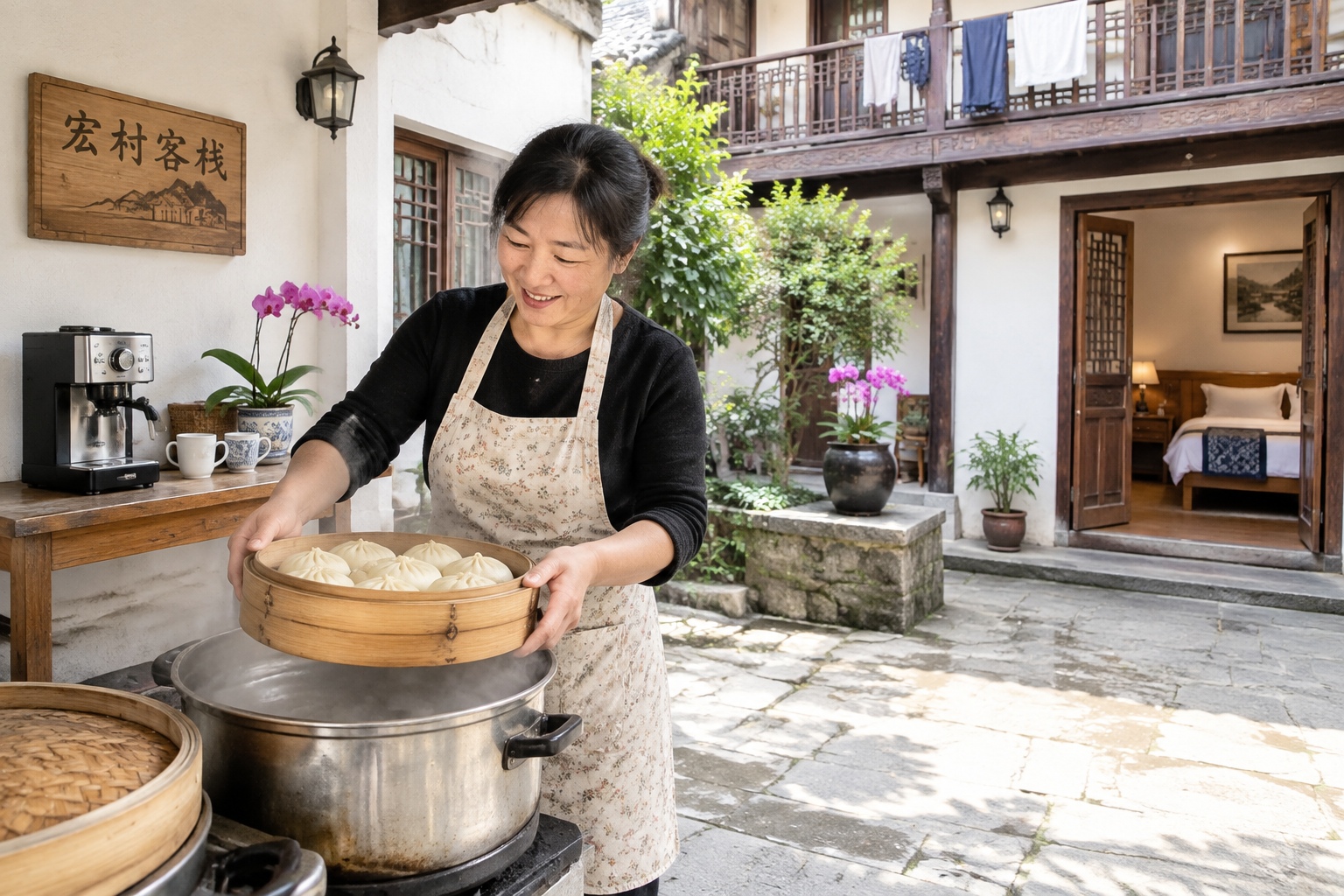
Walk through the back lanes and you can count the changes. A house that was a family home a decade ago is now a nine-room guesthouse with a coffee machine in the courtyard. Next door, an elderly couple still cooks on a wood stove and rents two upstairs rooms to a friend of a cousin.
Running a guesthouse is the main way a family stays. A well-placed six-room inn can bring in 300 to 700 yuan a night in high season and far less in January. Booking platforms take a cut. Cleaning, laundry and breakfast are usually done by the family itself, which means a mother who once worked in a Hangzhou factory is now up at six steaming buns for guests.
Not everyone stays. Younger villagers still leave for Shanghai, Hangzhou or Shenzhen, for wages a village shop cannot match, and some of the sharpest arguments here are about whether to come back. Those who do often bring something the village did not have before: a small roastery, a design studio printing tote bags, a guesthouse with underfloor heating and a booking page in English. Some of those businesses work. Some quietly close after two seasons.
The Parts That Are Not in the Painting
Heritage protection comes with rules, and the rules cost money. You cannot replace a rotten beam in your own house with concrete. Repairs need approval and traditional materials, done by carpenters who are getting older and more expensive. Termites are a permanent problem in old timber. There is no central heating, and a Hui-style house in January is a genuinely cold place to sleep.
That is partly why several families have moved to the newer housing outside the old village and turned their ancestral home into a shop, a teahouse or a rental. Walk through at night and you can see which windows stay dark. Some are investments. Some are simply rooms nobody wants to heat.
There are quieter frictions too. A good share of the storefronts along the main lanes are rented by people from outside — Wenzhou, Hefei, sometimes further afield — selling souvenirs made in factories rather than in Anhui. Residents notice. They also know that rent money is real money, and that a shop selling plastic fans pays better than a shop selling nothing.
What the Village Still Makes, and Still Keeps
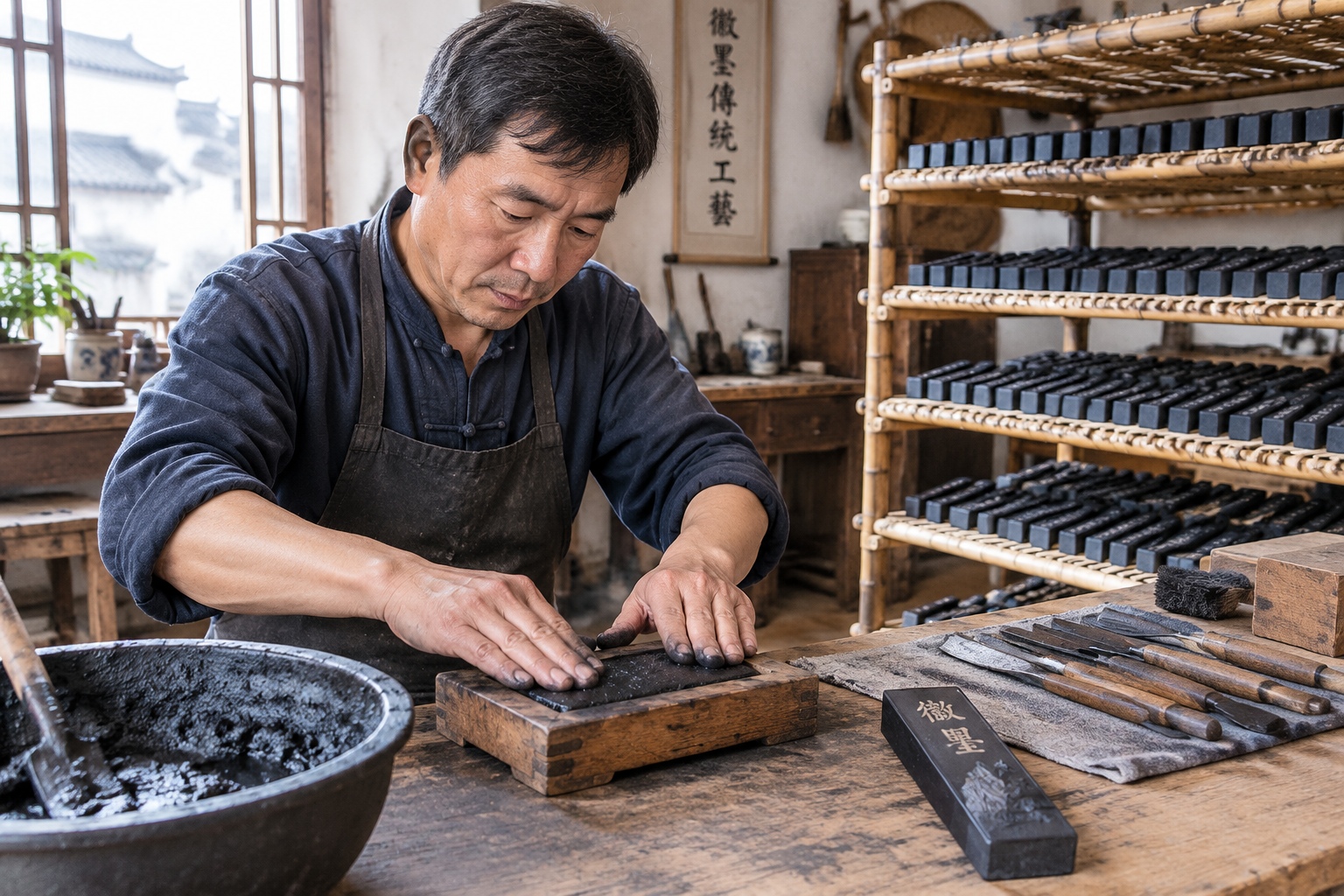
This is a region that has been making ink, inkstones and paper for a thousand years, and some of it is still alive. You can watch an ink stick being pressed and dried by hand. You can buy a She inkstone cut from local stone in a workshop two streets from the pond. The flaky sesame cakes sold near the entrance, baked in clay barrels, are made by people who live here.
Everyday life keeps its own calendar too. Weddings and funerals are still held in the ancestral hall with the doors open. At Spring Festival, pork cures under the eaves and the whole village smells of wood smoke. Schoolchildren walk to class past tour groups photographing the wall they pass every day, which is either mundane or surreal depending on how old you are.
If You Go: A Few Practical Things
Stay overnight. Day-trippers get the middle of the day, which is the least interesting shift. A room inside the old village buys you the two hours before and after, when the place belongs to residents.
Get up early. Between 6 and 8 a.m. the channels are full of people washing, shopkeepers are eating breakfast, and the light on Moon Pond is at its best. Nobody minds you being there as long as you are not blocking the steps.
Ask before photographing faces. People here are used to cameras and mostly relaxed about them, but used to is not the same as agreed to. A nod takes a second.
Buy something small from someone who lives here. In Hongcun, tourism is not abstract. It is the reason some families stayed, and the reason some upstairs rooms stand empty.
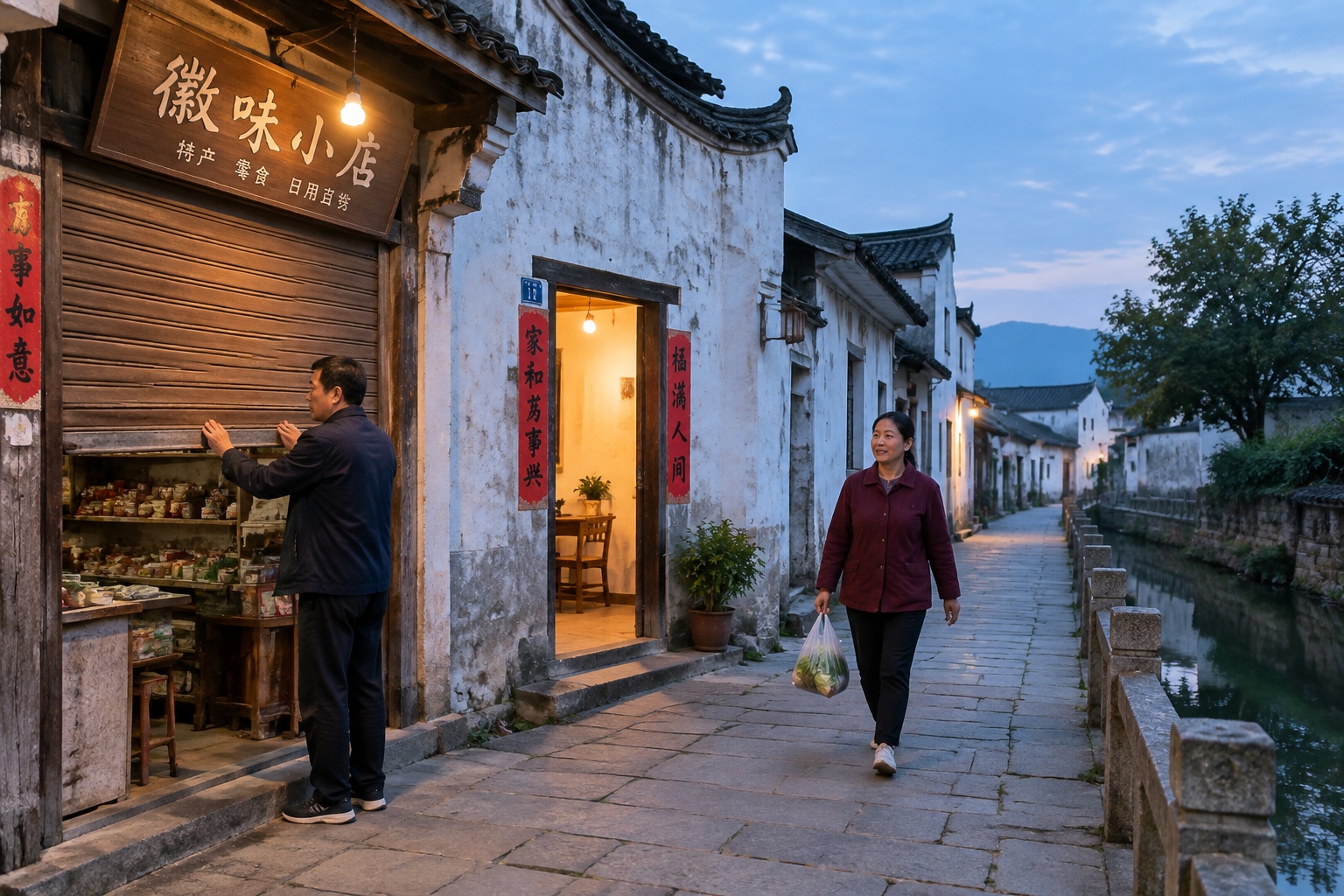
The Painting Is Also a Living Room
On the walk out, past South Lake, there is a moment when the reflection of the white walls in the water is so exact it looks retouched. Then a woman comes out of a doorway with a bucket and breaks it. That is Hongcun: photographed a hundred thousand times a day, and still with laundry to do.
Start the discussion at forum.chinacomes.com