

Morning on the Hillside Steps: The Porters’ Climb
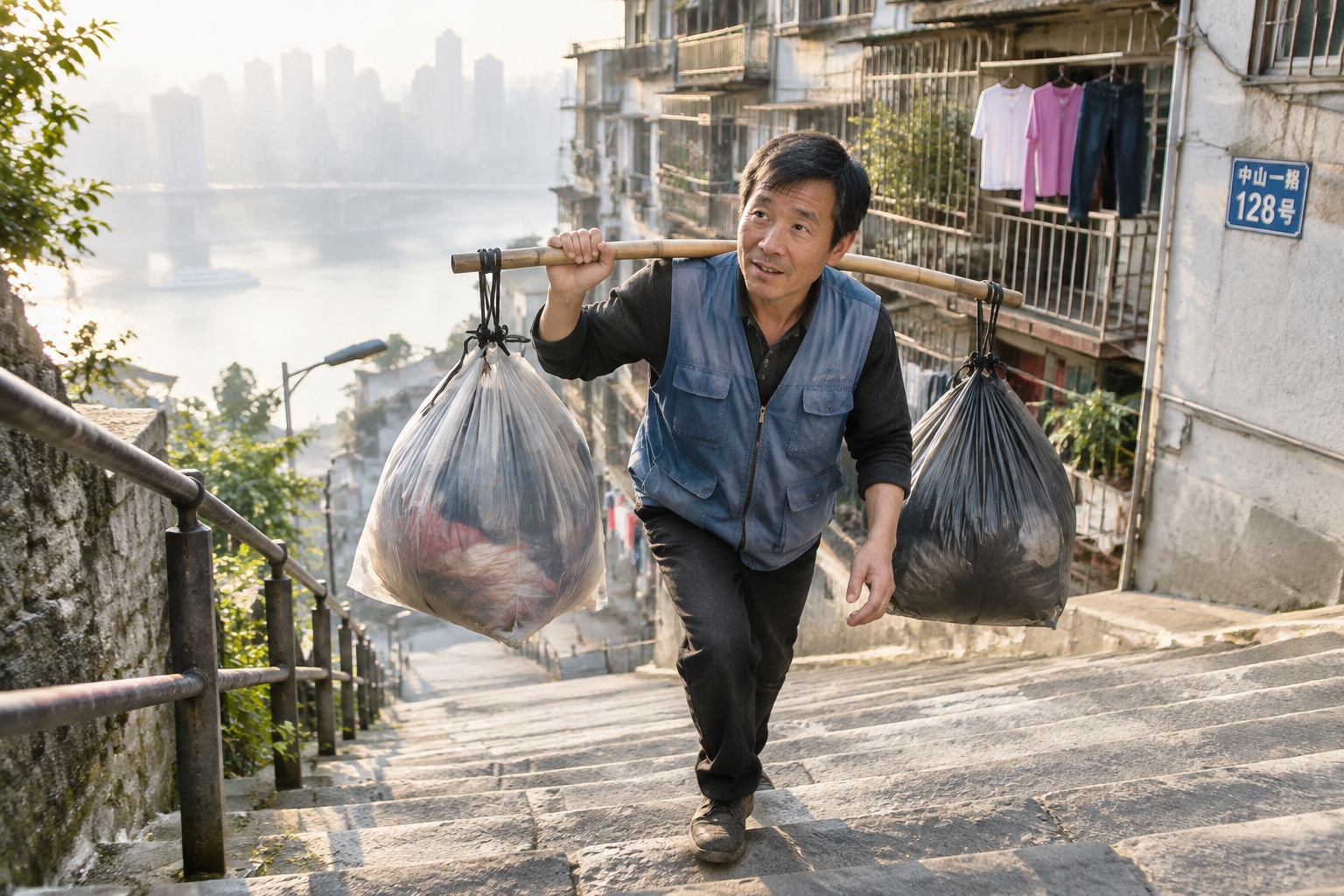
At 7:30 a.m., the air in Chongqing’s Yuzhong District is already thick with humidity. The stone steps of the Shancheng Trail glisten from last night’s rain. A man in his fifties, wearing a faded blue vest and canvas shoes, balances a bamboo pole across his shoulder. Two bulging nylon bags hang from each end—one filled with vegetables from a nearby market, the other with cardboard boxes destined for a small shop uphill. He is a bangbang, one of Chongqing’s legendary porters.
His name is Lao Wang. He has been carrying goods on these steps for over twenty years. “When I started, there were hundreds of us here every morning,” he says, pausing to wipe sweat from his forehead. “Now, maybe thirty.” The bamboo pole creaks as he shifts his weight. Each step is deliberate, practiced. He knows exactly where the stone is worn smooth and where a loose tile might trip him.
The bangbang trade grew from Chongqing’s geography. Built on steep hills where the Jialing and Yangtze rivers meet, the city has almost no flat ground. For decades, before elevators, escalators, and delivery apps, porters were essential. They hauled refrigerators, furniture, coal, and groceries up staircases too narrow for vehicles. Today, they mostly carry smaller loads—market goods, packages, construction materials—but their presence still defines the city’s rhythm.
Hotpot in an Air-Raid Shelter: Taste of the Dockyards
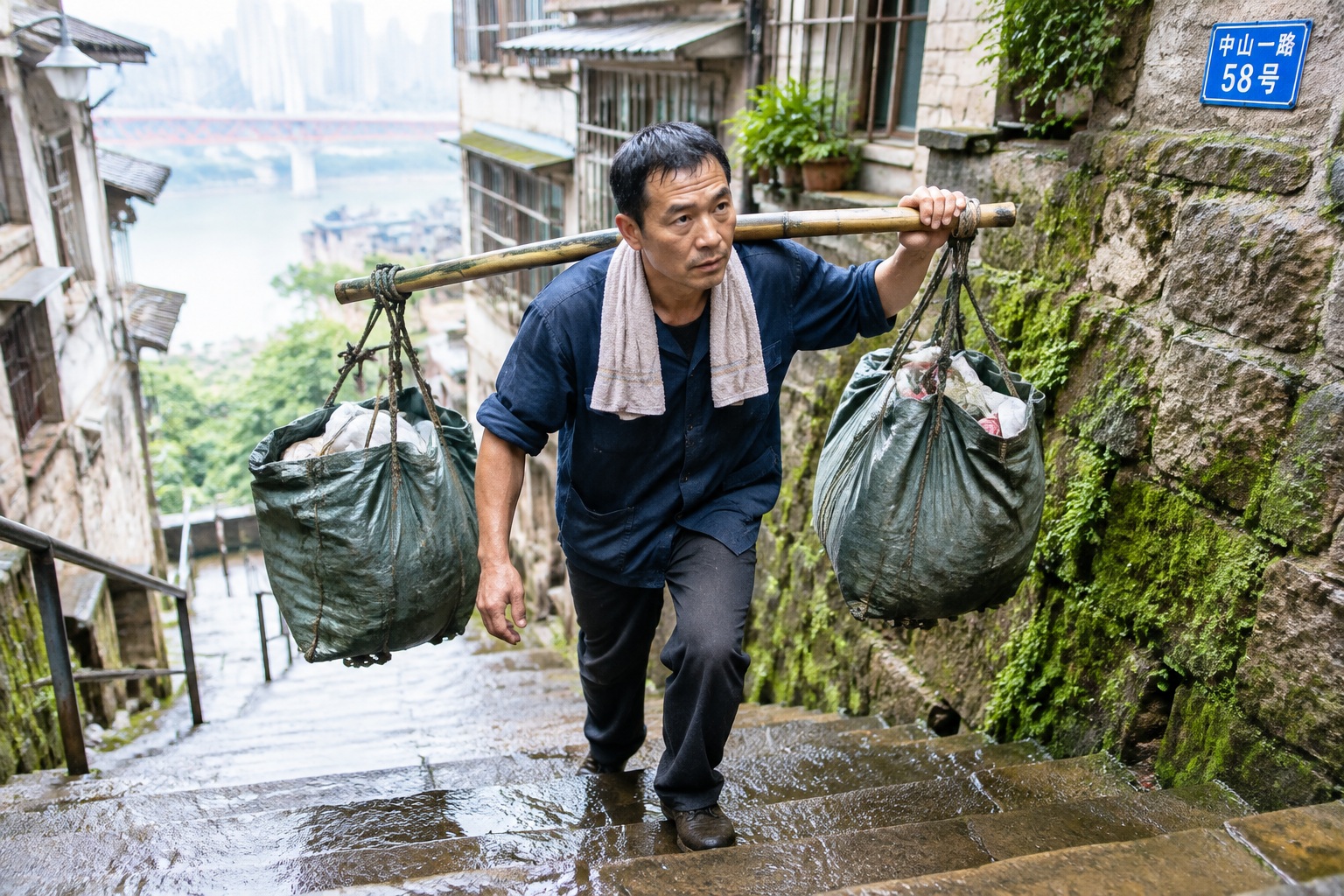
By noon, the heat is punishing. I duck into a tunnel on the edge of the Shancheng Trail. The entrance is unmarked—just a dark opening in a hillside covered with ivy. Inside, the temperature drops ten degrees. This is a fang kong dong, an old air-raid shelter from World War II, now converted into a hotpot restaurant.
The space is narrow and low-ceilinged, with rough concrete walls and long wooden tables. A waitress in a red apron brings a bubbling pot of crimson broth. The smell is overwhelming: chili, Sichuan peppercorn, beef tallow, garlic. Around me, families and office workers slurp noodles and dunk thinly sliced beef into the oil. No one looks at their phone. The conversation is loud, animated, and entirely local.
Chongqing hotpot is not a meal; it is a social ritual. Its origins trace back to the 19th century, when dockworkers at the Chaotianmen port cooked cheap cuts of meat and offal in spicy broth to mask the smell and warm themselves. They ate standing up, quickly, between shifts. The air-raid shelters came later, during the Japanese bombings of the 1930s and 1940s, when residents took refuge underground. After the war, some shelters became cheap eateries. The combination—dockworker food in a bomb shelter—is now a quintessential Chongqing experience.
How the Terrain Shapes Daily Life
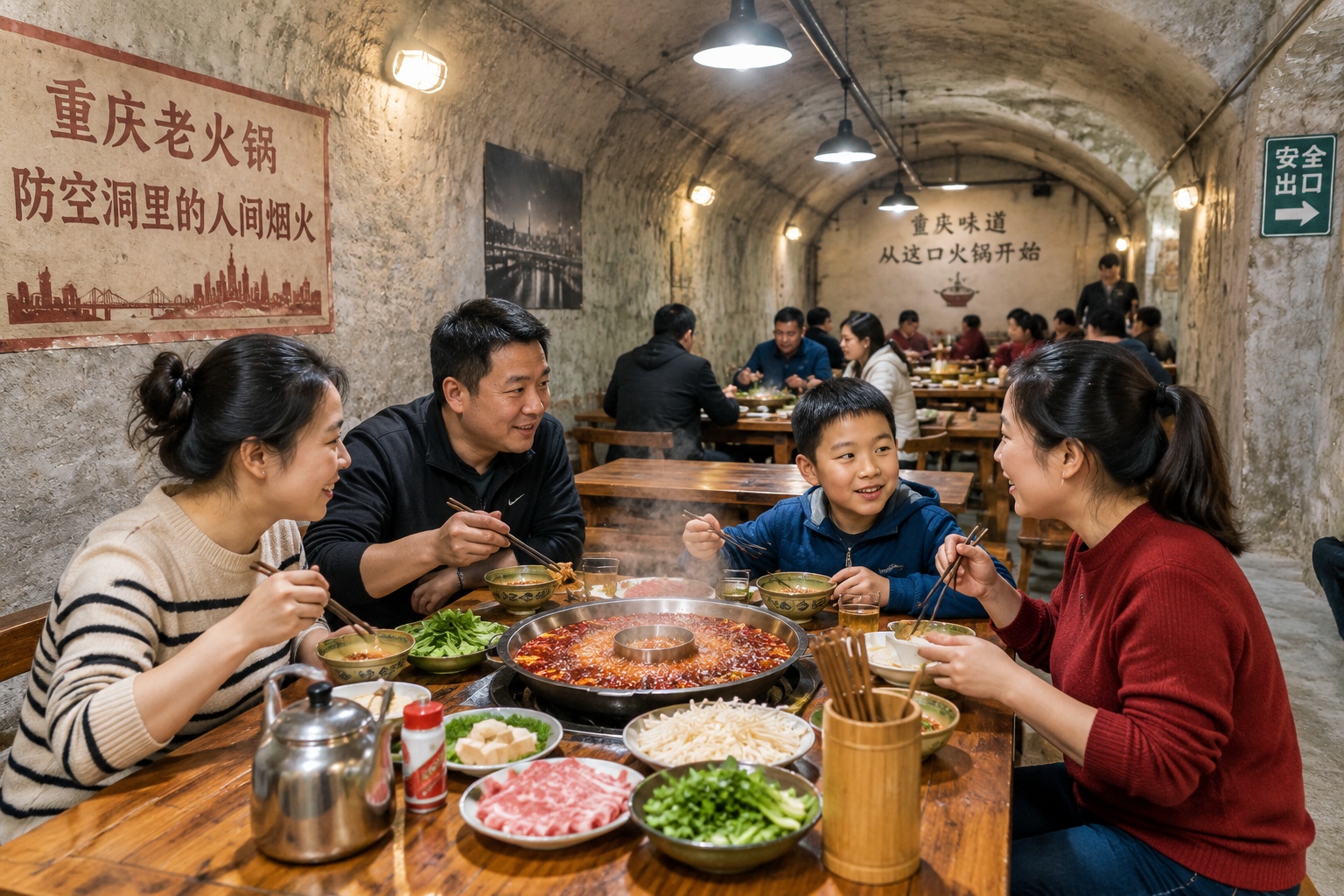
Chongqing is often called a “mountain city,” but that undersells it. The central districts are a labyrinth of steep slopes, cliffs, and valleys. Roads spiral. Buildings have entrances on multiple levels—you might enter a shop on the ground floor and exit on the tenth. The famous monorail at Liziba Station runs directly through a residential building, a feat of engineering that has become a tourist attraction.
For locals, the terrain is simply life. Children learn to climb stairs before they can ride a bike. Grocery shopping means carrying bags uphill. The city has built escalators, elevators, and cable cars to help, but many neighborhoods still rely on footpaths. The Shancheng Trail, a 3.5-kilometer walkway connecting several districts, is both a commuter route and a park. On weekends, it fills with joggers, elderly couples, and tourists taking photos.
This verticality also preserves old communities. While new skyscrapers rise in Jiangbeizui and Yuelai, the older neighborhoods—like Shibati and Xiahaoli—cling to the hillsides. Here, residents know their neighbors. They dry laundry on balconies that overlook the river. They grow vegetables in small terraced plots. The pace is slower, more intimate. Redevelopment is coming, but for now, these areas remain a window into a Chongqing that existed before the boom.
The Porters Today: Fewer, Older, But Still Essential
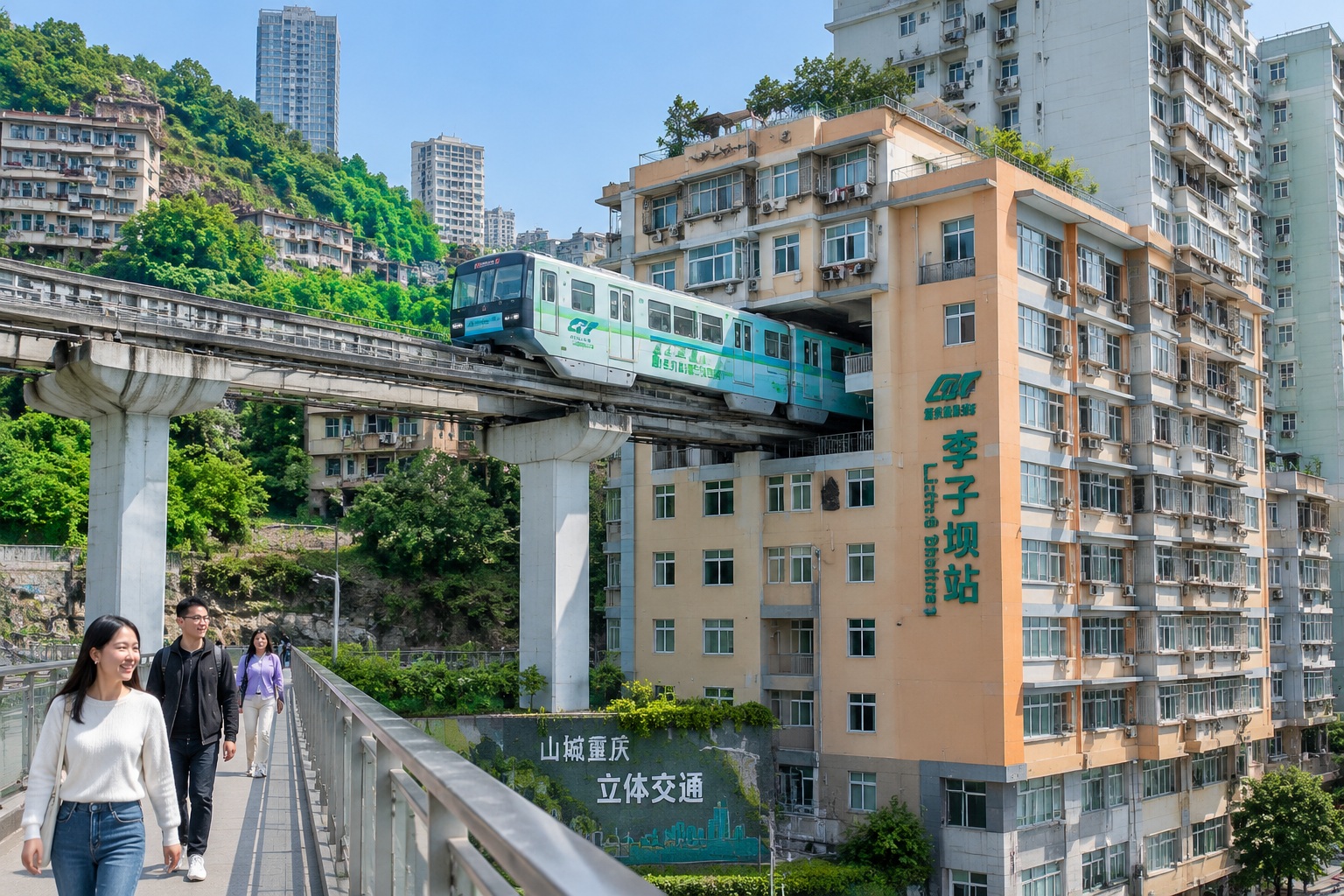
Back on the steps, I meet another porter, Mr. Li. He is 62, with gray hair and a quiet demeanor. He earns about 100 to 150 yuan (roughly $14–$21) a day, depending on the load. “Young people don’t want to do this,” he says. “It’s hard on your knees and back. My son works in a factory in Guangdong. He sends money home.”
Mr. Li’s story reflects a broader shift. As China’s economy has grown, manual labor jobs have become less attractive. Delivery apps like Meituan and Ele.me now handle many small errands. But porters still find work where apps cannot go: narrow staircases, crowded markets, construction sites with no vehicle access. Some have adapted by specializing in moving services, using handcarts and small tractors. Others, like Mr. Li, continue because they lack other options or simply prefer the independence.
The city government has recognized their cultural value. In 2020, Chongqing included the bangbang trade in its intangible cultural heritage list. There are occasional training programs and health check-ups. But the number of porters continues to decline. Most are over 50. The bamboo pole, once a symbol of resilience, is becoming a relic.
What Travelers from Other Hilly Cities Can Learn
For visitors from San Francisco or Lisbon—cities also defined by hills—Chongqing feels both familiar and alien. San Francisco has its cable cars and steep streets; Lisbon has its funiculars and tiled staircases. But Chongqing’s scale is different. The hills are steeper, the density higher, the infrastructure more improvisational. Here, a public elevator might connect a street to a shopping mall. A footbridge might span a six-lane road and a river. The city constantly reinvents how to move people vertically.
What stands out most is the integration of old and new. A high-speed rail station sits next to a 200-year-old temple. A hipster coffee shop opens inside a former factory. The bangbang porters walk past delivery drones being tested on a rooftop. Chongqing does not choose between tradition and modernity; it piles them on top of each other, like the city itself.
Final Steps
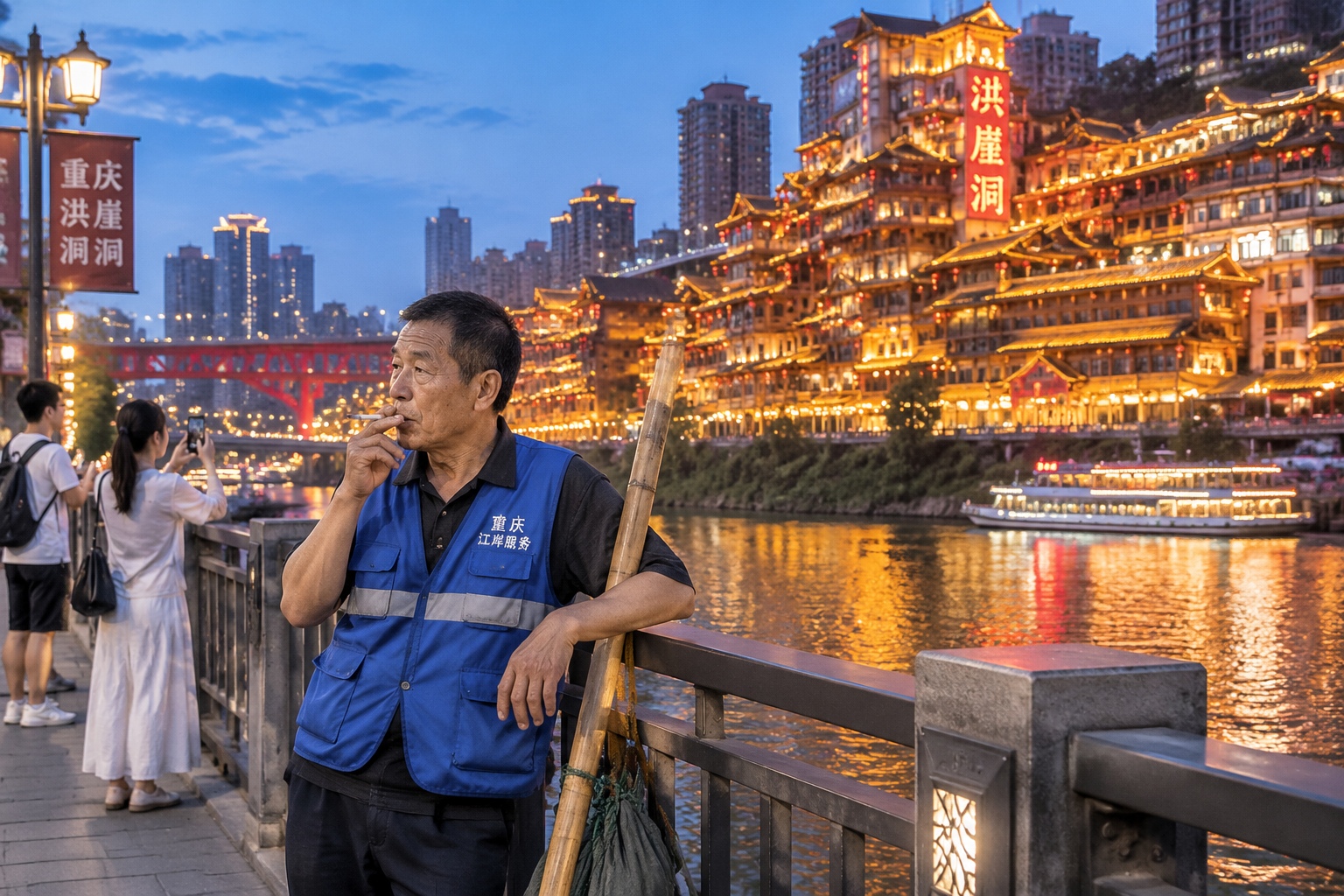
As dusk falls, I climb the last set of stairs to a viewpoint over the Jialing River. The lights of Hongya Cave glitter below. A group of tourists takes selfies. Nearby, a porter rests his bamboo pole against a railing, smoking a cigarette. He looks out at the same view, but sees something different—the city he has carried on his shoulders for decades.
Chongqing is not an easy city. It demands physical effort from everyone who lives here. But that effort creates a kind of intimacy. You know your neighbors because you climb the same stairs. You know your food because it comes from the same market. You know your city because you feel it in your legs. For a visitor, it is exhausting and exhilarating. For a local, it is simply home.
Start the discussion at forum.chinacomes.com