

The Morning the Dust Settled
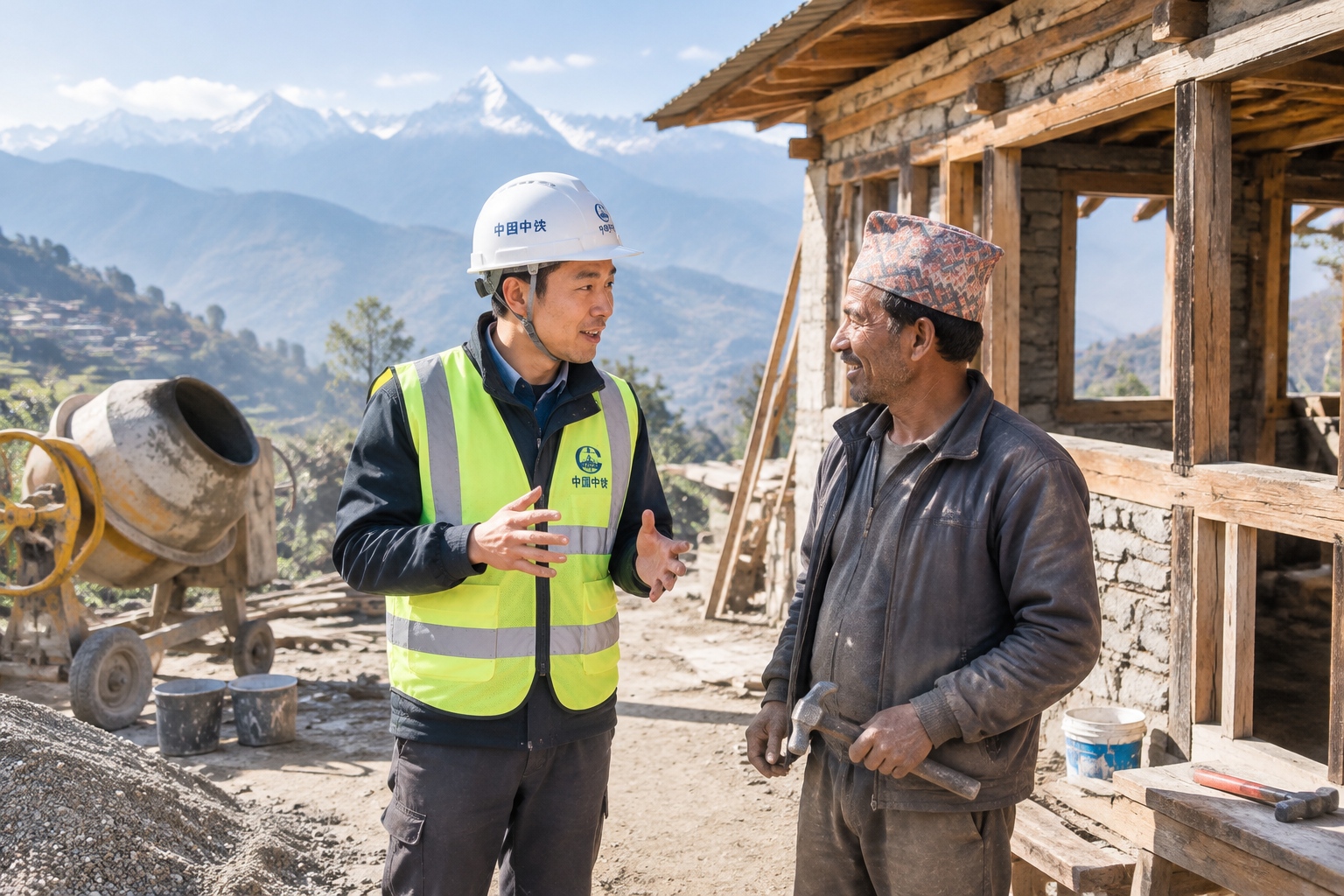
At 8 a.m. above a village on the May 2015 edge of Kathmandu Valley, the air already smelled like crushed bricks and dust. Li Qiang, a structural engineer from Hunan Province in central China, crouched beside a wall that had somehow survived the earthquake but had split more than a few centimeters away. He ran his fingers along the fissure, feeling for movement. A shy voice broke his focus: a Nepali woman in a crimson sari held out a tray with two glasses of milky tea. She gestured to the unfinished building across the courtyard: “Our new home. Thank you.”
Li wiped the sweat from his forehead before taking the glass. He had arrived in Nepal not with a government rescue team, but with a small group of volunteers from China. Two years earlier, in April 2015, a 7.8-magnitude earthquake had devastated the country, killing nearly 9,000 people and damaging more than half a million structures, including centuries-old temples in Kathmandu. The Chinese volunteers he traveled with were part of a largely invisible wave of civilian aid that continued long after the international rescue crews had packed up their equipment.
Who Were the Chinese Volunteers?
They were not a centralized delegation. The volunteers came from many walks of life: engineers like Li, a pediatrician from Chengdu, a psychology graduate student from Beijing, a retired logistics officer from Kunming. They found each other through WeChat groups, raised money from friends and local businesses, and used vacation days to cover their time abroad. Some went for two weeks; others stayed for several months.
“We felt a connection because we have our own scar tissue,” Chen Fang, a psychotherapist from Beijing, explained. In 2008, the Wenchuan earthquake killed more than 87,000 people in western China. Chen Fang had worked with local social workers there. “When a friend sent me news about Nepal, I saw the same patterns: children who stayed silent, old people who repeated the date over and over. That familiarity made me decide to go.”
Unlike large aid organisations, these informal teams did not run big budgets or drive branded trucks. They rented vans, shared rice with local families, and slept in tents or half-finished rooms. Many spoke only basic Nepali, but they learned to communicate through gestures and construction-site drawings.
Rebuilding Walls, Learning from Local Hands
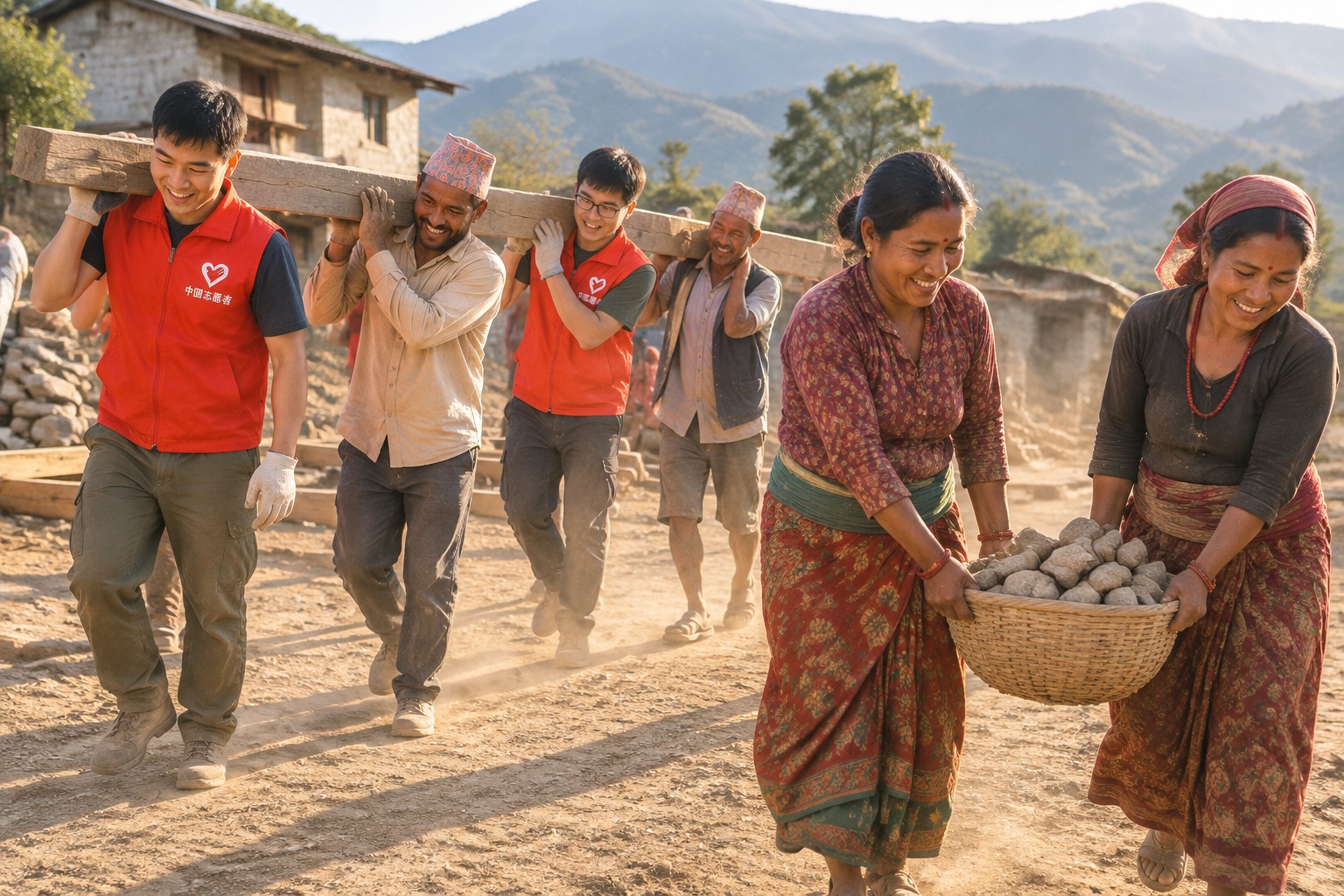
The actual reconstruction process was slow and intimate. The volunteers had no mobile crane or pile driver. They worked shoulder to shoulder with local masons and carpenters, mixing cement by hand and salvaging bricks from the rubble.
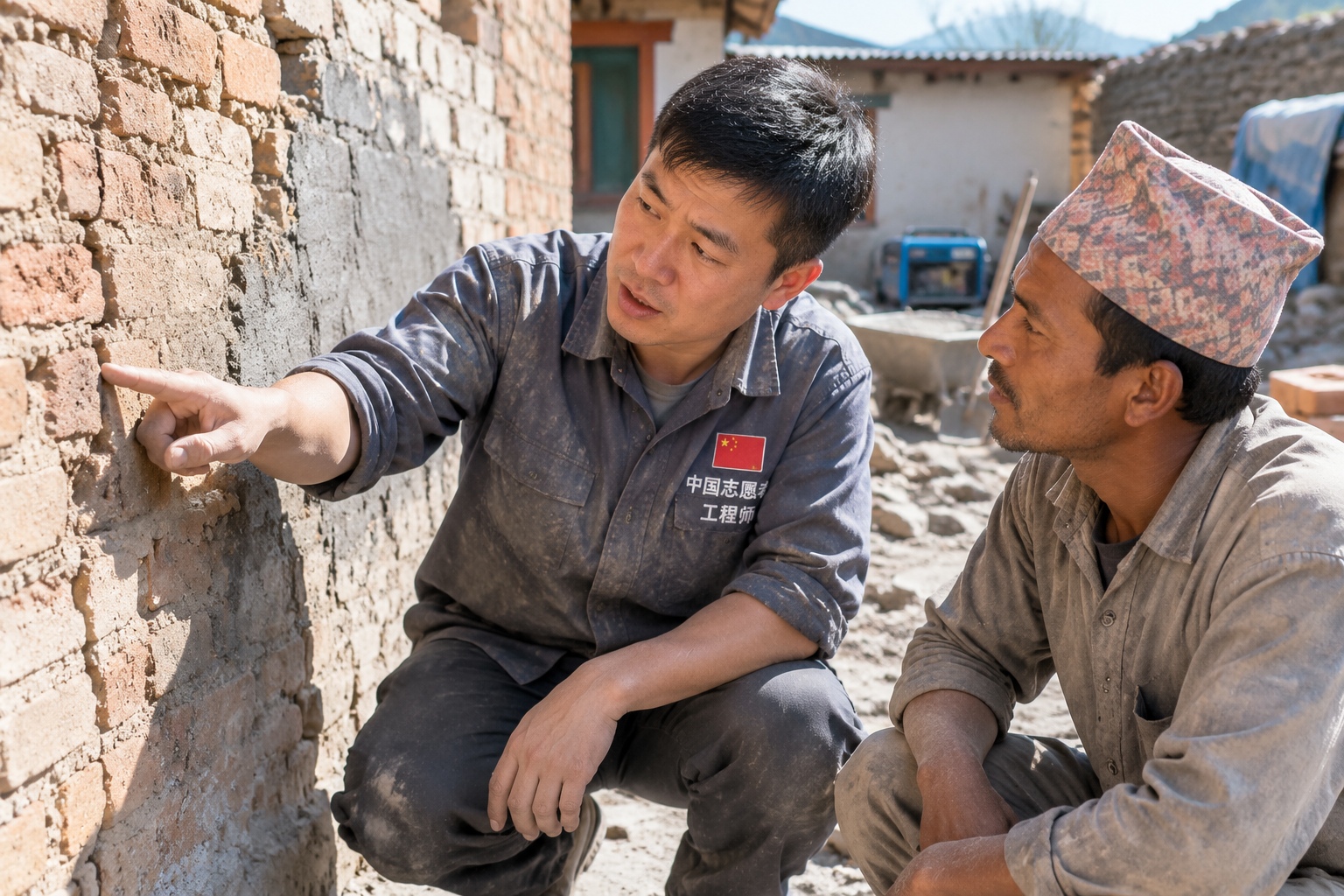
“We came expecting to teach, but we were also students,” Li said. He had originally proposed a concrete frame solution for a small community building, but the villagers were hesitant. They explained that a rigid concrete box would trap humidity, and during the monsoon the inside would become unbearably damp. Instead, they preferred a timber frame with brick infill—a traditional Newari construction technique that had been proven to sway and flex during seismic shocks.
So Li spent the first week cross-checking old wooden joints and watching how a local mason chiseled a notch. He measured, he sketched, he questioned. “In engineering school, you’re taught to look for maximum strength,” he admitted, wiping dirt from his neck. “Here, they taught me to look for flexibility.”
A Lesson in Not Imposing
This process of learning was not always smooth. One volunteer, a graduate from Shanghai, once grew impatient when villagers rejected a modern roofing sheet in favor of clay tiles. “It takes twice as long and may crack again,” he said. But an older man calmly explained that the village had used the same tiles for generations, and that replacement was easy if one broke. “You don’t need a special store. You can make it with the same clay from your own field.”
The team learned to slow down. They began to understand that some choices were not about cost or efficiency, but about confidence and continuity. “We don’t want to give you a perfect box that will stand out for a decade and then be impossible to maintain,” the old man told them. The final design kept stone foundations, wooden columns, and traditional tiled roofs, guided by Li’s structural analysis.
Li recalled a long evening discussion about the shape of a doorframe. “I thought it was pointless. But it mattered to the family. So we measured the old frame together, and rebuilt it exactly the same, just stronger.”
The Invisible Wound: Psychological Recovery
While Li worked with walls, Chen Fang worked with the unbuilt spaces inside people. She carried no medical tools, only a roll of paper, crayons, and a few cloth dolls.
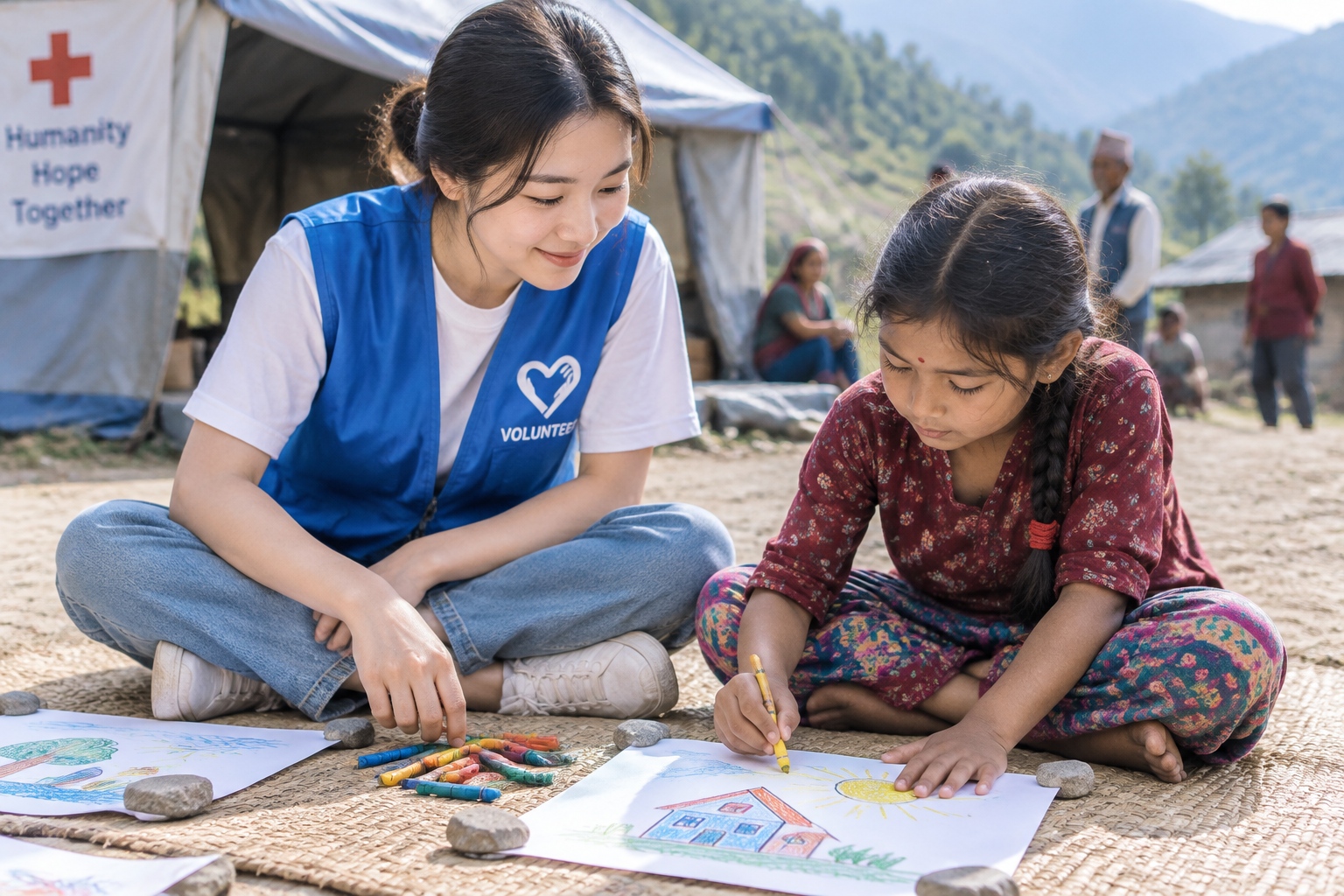
Every afternoon, she sat on a woven mat under a tarpaulin, drawing with children. The first day, an eight-year-old girl drew a house that tilted to the left, with no door. She looked at the paper, then turned it over, as if ashamed. Chen Fang did not push. Instead, she drew her own house next to the girl’s: an old, crooked house with a big window and a cow peeking out. The girl giggled. By the third week, the girl had added a straight door and a small sun. To an outsider, it was just a child’s drawing. To Chen Fang, it was a sign of a newly reorganized mind.
“Children reconstruct their world through play and drawing. When the earthquake snapped that image, we didn’t need to talk about the event repeatedly. We needed to help them recreate a safe image on the page,” she explained.
The Patient Work of Silence
Adults were harder to reach. One morning, Chen Fang saw an elderly man standing alone at the edge of his ruined courtyard, staring at piles of personal items: clothes, a birdcage, a broken cabinet. He did not speak. Instead of joining the group activity, Chen Fang brought a plastic chair, sat next to him, and waited. After forty minutes, he began to talk about a particular tree in the yard that had survived, and how its shadow used to fall across the house. “That was the first time he acknowledged he had a future,” Chen Fang said.
She stressed that she did not come to “fix” anyone. “When you lose a home, the pain is real, and the worst thing we can do is hand out a pamphlet saying stay strong. The real thing is presence—your attention, your willingness to sit with their memory without turning away.”
Voices from the Community
The volunteers’ presence registered in small gestures. The shopkeeper who sold them biscuits said, “They didn’t throw money at us. They asked what we needed.” A local carpenter who worked beside Li for two months told us, “At first, I thought Chinese workers were too fast. But these volunteers watched, and they let me show them. That made us partners.”
A woman who received a rebuilt house from a different group still remembered her volunteer’s handshake: “He did not look at his phone. He looked at me. He said, ‘Your kitchen will be brighter than before.’ That was the first moment I believed it.”
Chinese volunteers offered their own candid accounts. “I thought I was going to give a lot,” said a young volunteer from Guangzhou. “But what I actually did was hold a flashlight, buy tea, and sometimes just watch. The people around me taught me what quiet courage looks like.”
When the Volunteers Left
The construction project had a clear deadline. Flights were booked, jobs were waiting back home. In the last week, the team rushed to finish the plastering, install window frames, and paint the walls of a temporary school. They also handed over a kit with dozens of drawings, messages, and a photo album for each family.
On the final morning, Li stood outside a newly finished house with a dark red door. The girl who had once drawn the lopsided house came up and pulled his sleeve. She looked up and said, in careful English, “My home.” Then she placed her hand on her chest: “My heart.” Li later wrote to his WeChat group, “The house has walls. The heart has a door. We opened it.”
Beyond Houses: What Is Really Rebuilt?
Reconstruction in Nepal did not end in six months, and the volunteers did not pretend it did. The area was still recovering when some of them came back a year later, not to work but to visit. They slept on mats in the homes they had helped to build, ate dal bhat with the same families, and attended a wedding of a local mason.
Meanwhile, their relationships to China had been quietly altered. In Beijing and Shanghai, some volunteers started small discussion sessions about development and solidarity. A psychology student from Beijing wrote a popular online essay about how “helper” and “helped” are never fixed roles; the exchange of stories rebuilds both sides.
Li put it simply in a video call: “The gaps in the walls we fixed. The gaps in people’s hearts take much longer. But we learned to wait without breaking eye contact.”
That may be the quieter, deeper result of Chinese volunteers in Nepal: not merely a row of structures with weatherproof roofs, but a shared understanding that rebuilding is a conversation that continues long after the cement dries.
Start the discussion at forum.chinacomes.com