

A Bottle That Doesn’t Belong on the Bar Shelf
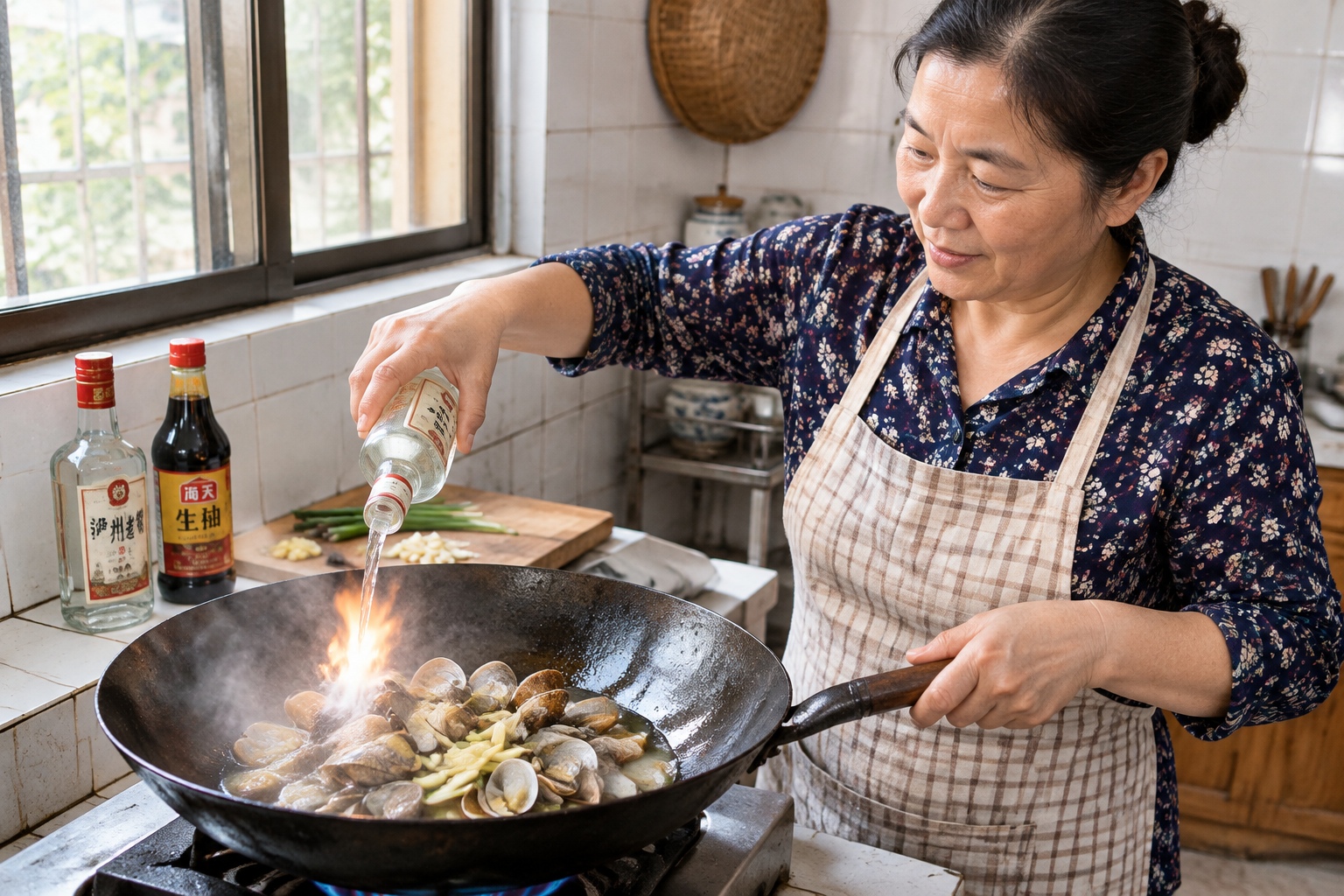
In a third-floor apartment in Chengdu, a glass bottle with a red plastic cap sits wedged between the soy sauce and the rice vinegar. It is 52 percent alcohol by volume. It cost about 15 yuan. Nobody in the family drinks it.
On the days the market has fresh clams, that bottle comes down. The wok goes over the highest flame the stove will give, garlic and ginger go in, the clams follow, and then a capful — maybe two — of clear liquor is poured along the rim of the wok rather than into the middle. There is a hiss, a brief blue-orange flare, and a smell that is sharp for about three seconds and then gone. What is left is a plate of clams that taste of the sea and not of the mud they came out of.
Foreign visitors usually notice the baijiu bottle on a restaurant table. They rarely notice it in the kitchen. But in millions of Chinese homes, a bottle of baijiu does more work as a seasoning than as a drink.
First, What Baijiu Actually Is
This matters, because English-language recipes often treat “Chinese cooking wine” and baijiu as the same thing. They are not.
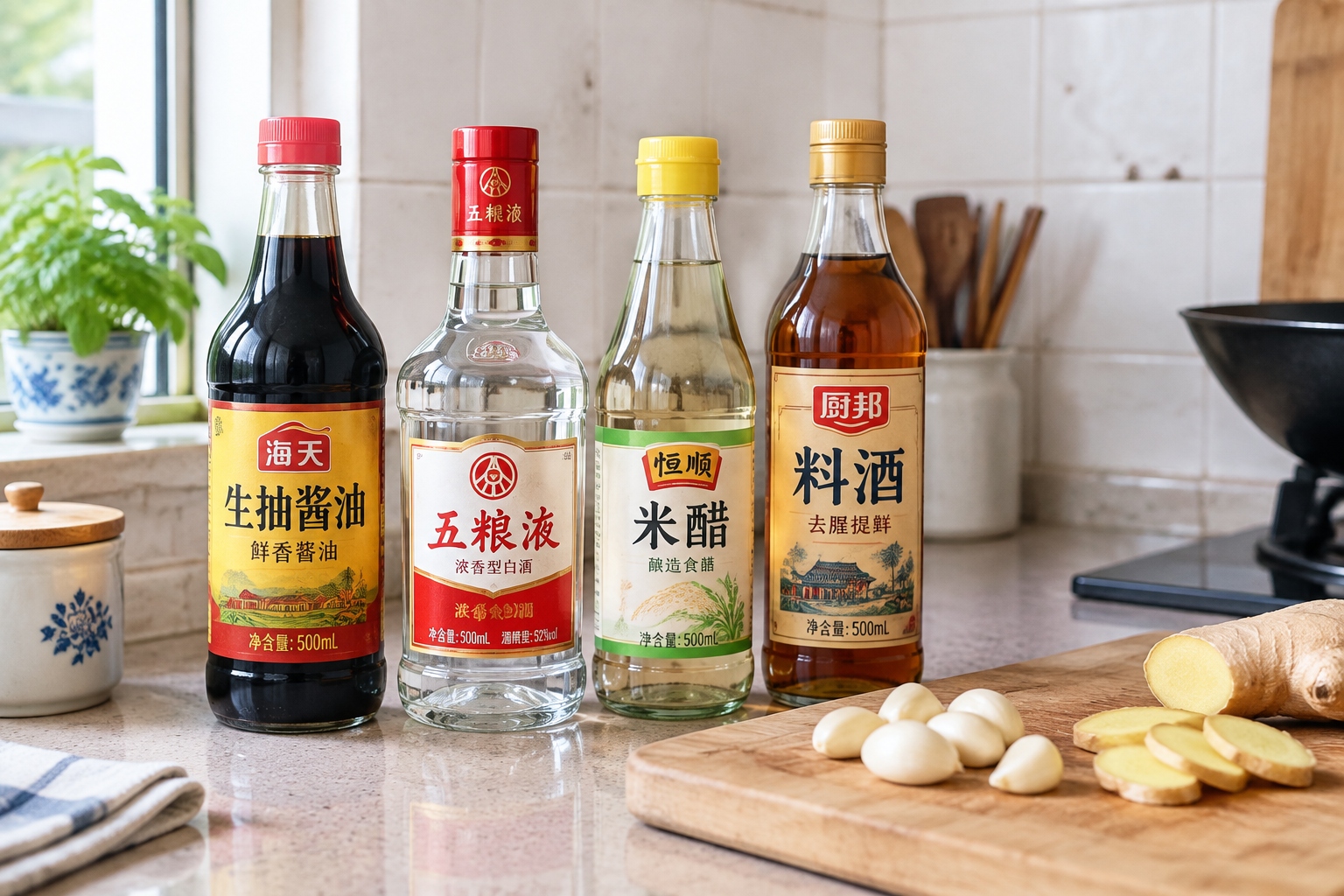
Baijiu is a distilled spirit, usually made from sorghum, sometimes with wheat, rice, or corn. It is fermented with a starter culture called qu, then distilled, which pushes it to somewhere between 38 and 68 percent alcohol. It comes in aroma families. Light-aroma (清香), the kind in a green bottle of Erguotou, is clean and slightly grainy — the workhorse of the kitchen. Strong-aroma (浓香), from places like Luzhou and Yibin, is fruitier and heavier. Sauce-aroma (酱香), the Moutai family, is the most expensive and the most distinctive, with a savory, soy-adjacent depth.
Cooking wine — liaojiu — is a different product entirely. It is usually huangjiu, a fermented rice wine around 15 to 18 percent alcohol, salted and often spiced so that people will not drink it. Shaoxing wine belongs to that family. On a Chinese supermarket shelf, a bottle of cooking wine costs five to ten yuan; a 500ml bottle of light-aroma baijiu costs around fifteen to twenty. Both live in the same cupboard, and cooks reach for them for different jobs.
Distilling arrived in China somewhere around the 13th or 14th century. Putting strong liquor in food is older than that in spirit, if you will forgive the phrase: alcohol was used to preserve meat, to soak medicinal herbs, and to clean the surface of cured sausages long before anyone wrote a recipe down.
Three Jobs Baijiu Does in the Pan
1. Killing the smell of “gamey”
Chinese home cooks talk about xing — the muddy, metallic, or barnyard note in river fish, lamb, pork liver, kidney, and sometimes chicken. Alcohol dissolves many of the compounds responsible and carries them off as vapor. That is why a splash goes into the water when you blanch pork ribs, and why fish gets a spoonful before it is steamed.
2. Building aroma
Baijiu is full of esters — the same family of molecules that make fruit smell like fruit. Hit a screaming-hot wok and they volatilize in a second or two, which is why cooks pour it against the metal rather than into the food. You get the aroma without the raw alcohol taste.
3. Tenderizing and protecting
In marinades, alcohol helps carry flavor compounds into the meat. In winter sausage-making, a wipe of baijiu over the meat and casing keeps mold and bacteria in check during the weeks the links hang to dry — an old food-safety trick that families in Sichuan, Hunan, and Guangdong still swear by.
Where It Shows Up on the Table
You will almost never find a recipe titled “baijiu chicken.” The liquor is an instruction buried in the middle of a method, often written as “add a little liquor” (加少许白酒). Here is where it is actually used.
Stir-fried clams and razor clams
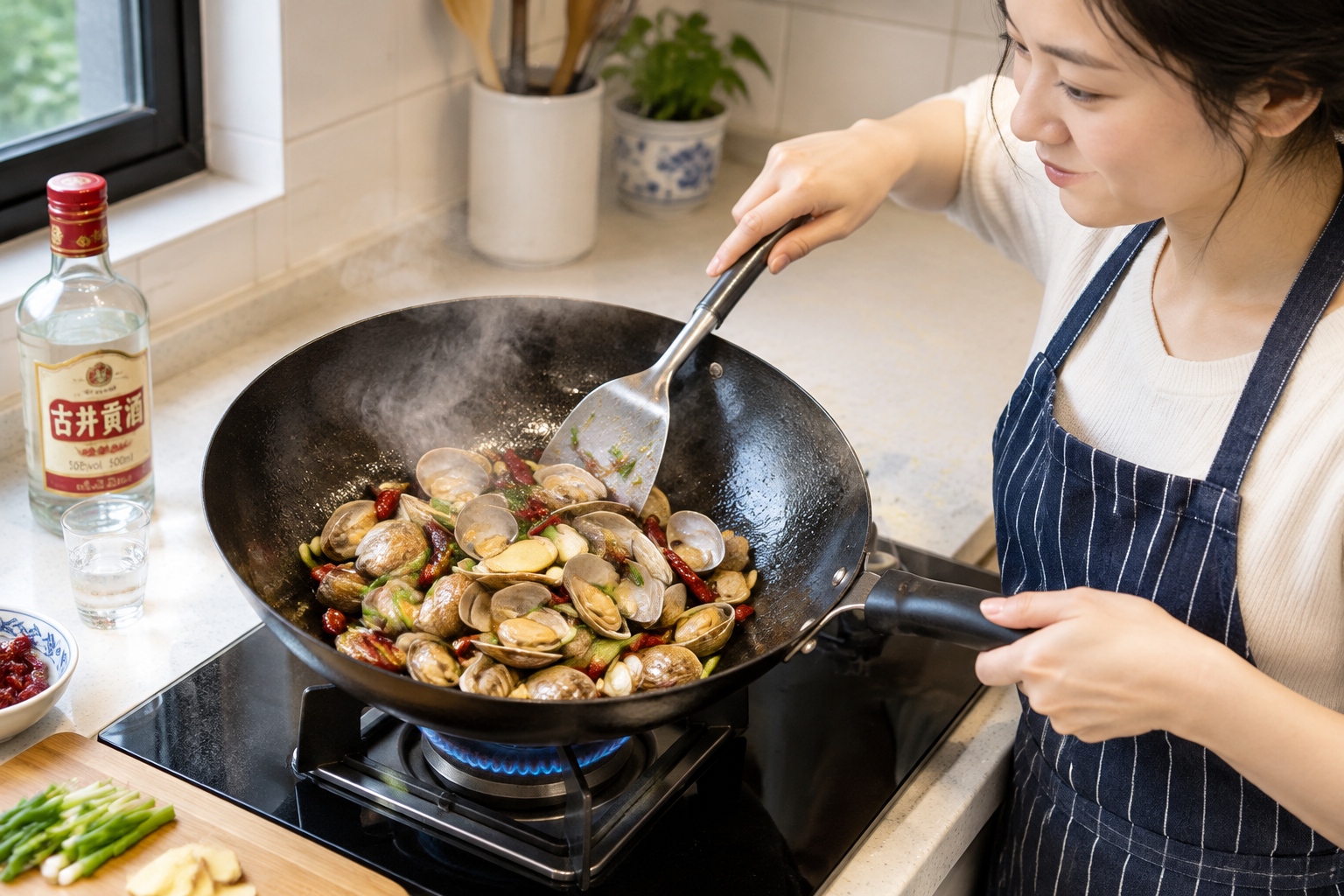
The most common home use. Rinse the clams, get the wok as hot as it will go, add oil, garlic, ginger, and dried chilies, then the clams, then a capful of baijiu along the edge. Cover for a minute. Finish with soy sauce and scallions. The liquor does in ten seconds what an hour of soaking cannot.
Drunken shrimp and drunken crab
A raw preparation, mostly along the coast. Live shrimp are submerged in a mix of baijiu and huangjiu with ginger, scallions, and sometimes goji berries, and eaten within hours. The baijiu is doing two jobs at once: a high-proof environment that knocks down surface bacteria, and the sharp alcoholic bite that defines the dish. It is not something to make casually if you have any concerns about food safety or alcohol.
Braised pork belly
A spoonful goes in during the searing step, before the soy sauce and rock sugar. It cuts the heavy smell of cold pork and leaves a faintly floral note under the caramel.
Dumpling fillings
For 500 grams of minced pork, one tablespoon of baijiu stirred in before the aromatics. Frozen or supermarket mince often carries a smell that Chinese cooks find unpleasant; the liquor settles it. Cabbage and chive fillings, in particular, taste cleaner for it.
Steamed fish
A spoonful over the fish, plus ginger, before it goes into the steamer. When it comes out, the liquid on the plate is poured away — it holds exactly the fishiness you were trying to remove. Fresh soy sauce and hot oil go on after.
Winter sausage and cured meat
Every December, balconies across southern China fill with hanging links of sausage. Before hanging, the meat and casing get wiped with baijiu. It is part of the recipe, not a garnish.
How to Use It Without Ruining Dinner
A few rules that home cooks pass on, mostly by watching rather than reading.
Pour at the edge, not the center. The rim of a wok is the hottest part. Alcohol hitting it flashes off fast, taking the unwanted smells with it.
A teaspoon to a tablespoon is the range. For a family-sized stir-fry, a capful or two. More than that and the dish tastes like a bar.
Cheap is correct. Light-aroma Erguotou, the kind sold in green bottles for around 15 yuan, is the standard kitchen bottle. Cooking with Moutai is a rumor that mostly circulates as a joke about people with more money than sense.
Not all the alcohol burns off. A quick stir-fry can retain a meaningful fraction; a forty-minute braise retains much less. If you are cooking for a child, someone pregnant, or anyone avoiding alcohol, use the liquid from rehydrating mushrooms, a little rice vinegar, or simply skip it.
Huangjiu is the gentler alternative. For most braises, Shaoxing-style huangjiu gives a rounder flavor and less of a bite. Baijiu is the tool you reach for when you need power, not polish.
A Cook’s Family Notes
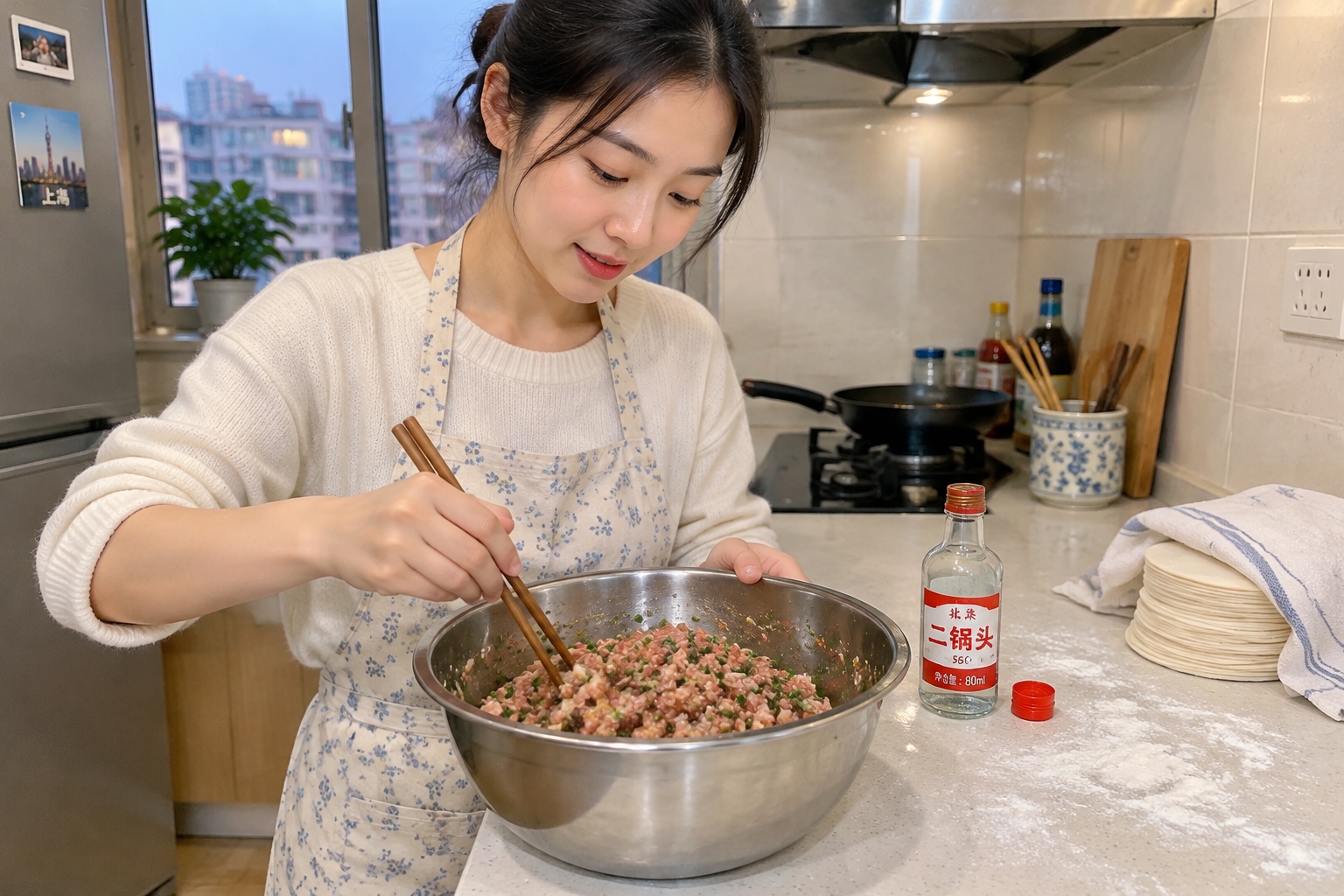
Wang Jing, 29, lives in a rented flat in Shanghai and works in graphic design. She learned to cook from her grandmother over WeChat video calls, mostly in 2022, when traveling home to Hunan was not easy.
“She never gives me grams,” Wang says. “She says, garlic — a lot. Baijiu — one cap for fish, two for lamb. Then she holds up the bottle cap to the camera.”
Her kitchen shelf has an 80ml bottle of Erguotou, bought for 9 yuan. She uses it maybe twice a month — clams, dumpling filling, and once, unsuccessfully, on a piece of salmon. Her former roommate, a German student, watched her pour liquor into a fish and asked whether it was some kind of religious ritual. “I said no, it is to make it not smell like a fish.”
What she does not do is drink it. Neither do most people her age in her circle. Baijiu’s decline as a social drink among young urban Chinese is real and well documented; the kitchen is where it quietly persists. A bottle lasts her a year.
Tradition in a Bottle You Would Never Toast With
There is a tension worth sitting with here. On the banquet table, baijiu is ceremony, hierarchy, and sometimes obligation. In the kitchen, it is a cheap tool that does a specific job, and it does not care about anyone’s status.
Walk into a Chinese grocery store and you will see the two economies side by side: gift boxes of sauce-aroma baijiu behind glass, and, two aisles over, green bottles and 500ml jugs priced for people who intend to pour them into a wok. Some of the same brands appear in both places.
The next time you see a bottle of 50-something percent liquor sitting on a kitchen counter next to the vinegar, it probably is not party leftovers. It is the seasoning. It has been doing its job for centuries, one capful at a time.
Start the discussion at forum.chinacomes.com