

Sixty-eight yuan, one hour, and a pair of thumbs that find the knot in four seconds
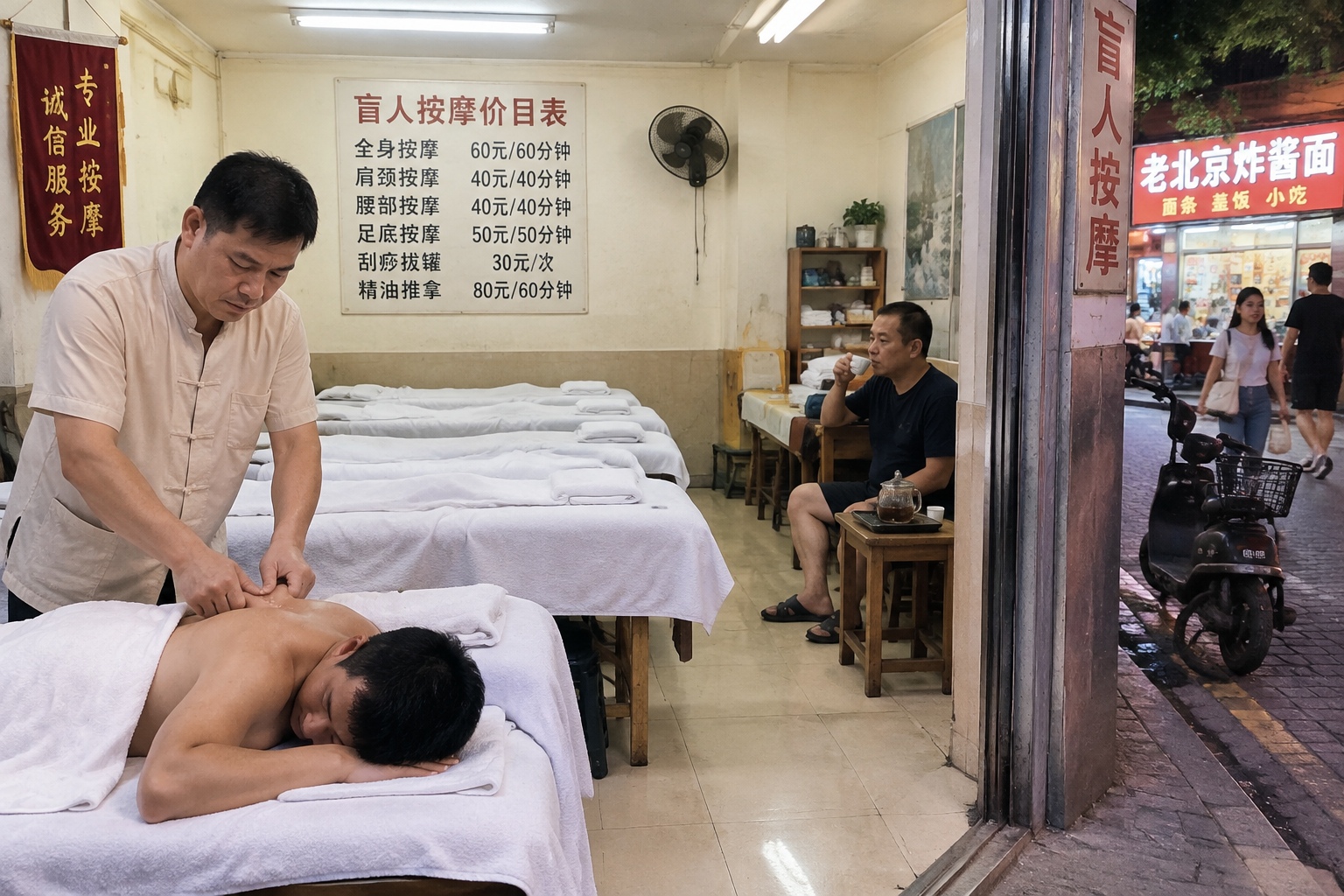
It’s 9 p.m. in Chengdu. The shop is about the size of a garage: six vinyl-covered beds, a plastic chair, a wall fan, and a man named Lao Chen who has been blind since birth and has done this work for 22 years.
He finds the knot at the base of your neck almost immediately. Then he leans in with his thumb, and for about ten seconds you seriously consider asking him to stop. You don’t. An hour later you pay 68 yuan — around nine US dollars — and walk out able to turn your head again.
That one transaction explains a lot about ordinary life in China. Bodywork here is cheap, it sits on almost every commercial street, and people treat it as routine maintenance rather than an occasional luxury. Great news if you’re visiting — as long as you know which kind of shop to walk into.
Three services that foreigners constantly mix up
In most Western cities, “massage” means one thing: a spa, candles, soft music, maybe $120 for an hour. In China the same hour costs $8–25, and the shop is usually squeezed between a noodle restaurant and a phone-repair stall. But there are three distinct categories, and they do genuinely different jobs.
- 盲人按摩 (mángrén ànmó), blind massage — usually built on tuina technique. Built for pain.
- 足疗 (zúliáo), foot massage — built for relaxation. Often 90 minutes, with a herbal soak, fruit and tea.
- 采耳 (cǎi’ěr), ear cleaning — a Sichuan specialty. Built for sensation.
Mixing these up is the most common mistake visitors make. Booking a foot massage for a back problem that’s been bothering you for months will waste your money. Booking a proper tuina session when all you wanted was to be pampered can be genuinely uncomfortable.
Blind massage: what it actually is, and who it’s for
The background, briefly
Around 17 million people in China live with visual impairment, and massage is one of the few professions with a long-established training pipeline. Special-education universities such as Changchun University run tuina programmes, and there’s a national certification exam for the trade. The result is tens of thousands of small, mostly owner-operated shops, many staffed by people whose hands are better at reading tissue than your eyes are.
Two things follow from that. This is not charity — it’s a profession with qualifications, and skilled practitioners are genuinely skilled. And because the shops are small and rents are low, prices stay low. Chain foot-massage brands and hotel spas are a different business entirely.
What tuina actually feels like
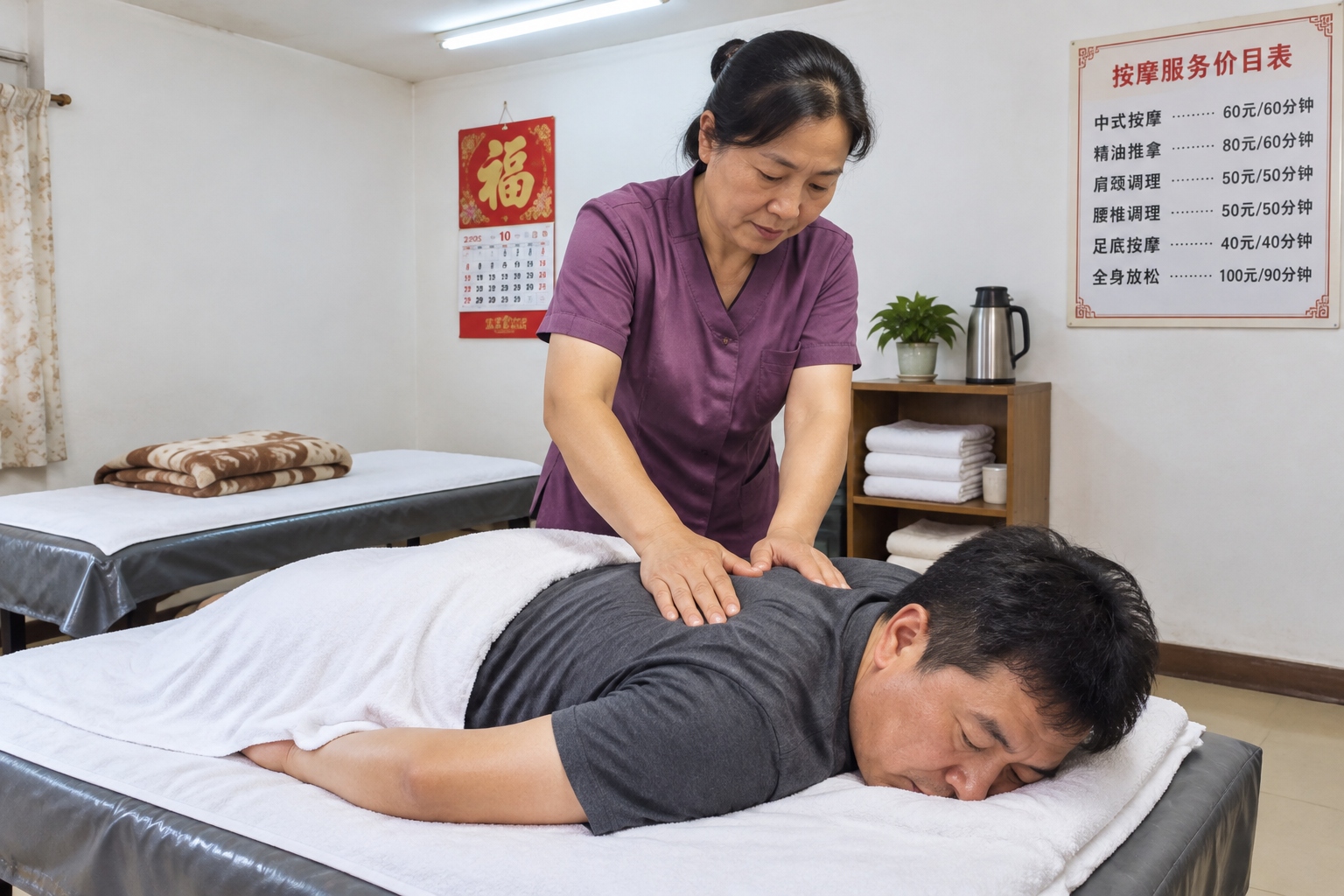
Not gentle. Tuina (推拿) is one of the manual branches of Chinese medicine, alongside acupuncture, and it uses thumbs, elbows, forearms and occasionally knees to work on muscle, fascia and joints. Expect:
- pressure that makes you grip the edge of the bed;
- a few sharp “that’s exactly it” moments;
- soreness the next day, similar to after a hard gym session.
Next-day soreness is normal and should fade within 24 to 48 hours. Sharp, electric pain shooting down an arm or a leg is not normal. Say stop immediately — the phrase is 停一下 (tíng yí xià).
Who it suits
Desk workers with stiff necks and shoulders are the best case for this by a wide margin. So are tight lower backs after a long flight or a lot of driving, and anyone who wants a practitioner to actually work on the problem rather than stroke it.
Who should skip it: anyone with a recent fracture, severe osteoporosis, a disc problem with numbness or weakness, or a bleeding disorder. If your leg is going numb or your grip is weakening, that’s a hospital rehabilitation department (康复科), not a massage shop. Chinese hospitals offer tuina and physical therapy at low prices, and for locals some of it is covered by national insurance.
What it costs: roughly ¥50–120 (US$7–17) per hour in most cities. In Beijing, Shanghai and Shenzhen, good shops run ¥120–220.
Sichuan ear cleaning: the strangest 30 minutes you’ll have in China
You lie back in a softly lit room while a stranger inserts a series of thin metal and bamboo tools into your ear canal. It sounds like something you’d refuse. In Chengdu, it’s a normal Saturday activity that friends do together.
What’s actually in the toolkit
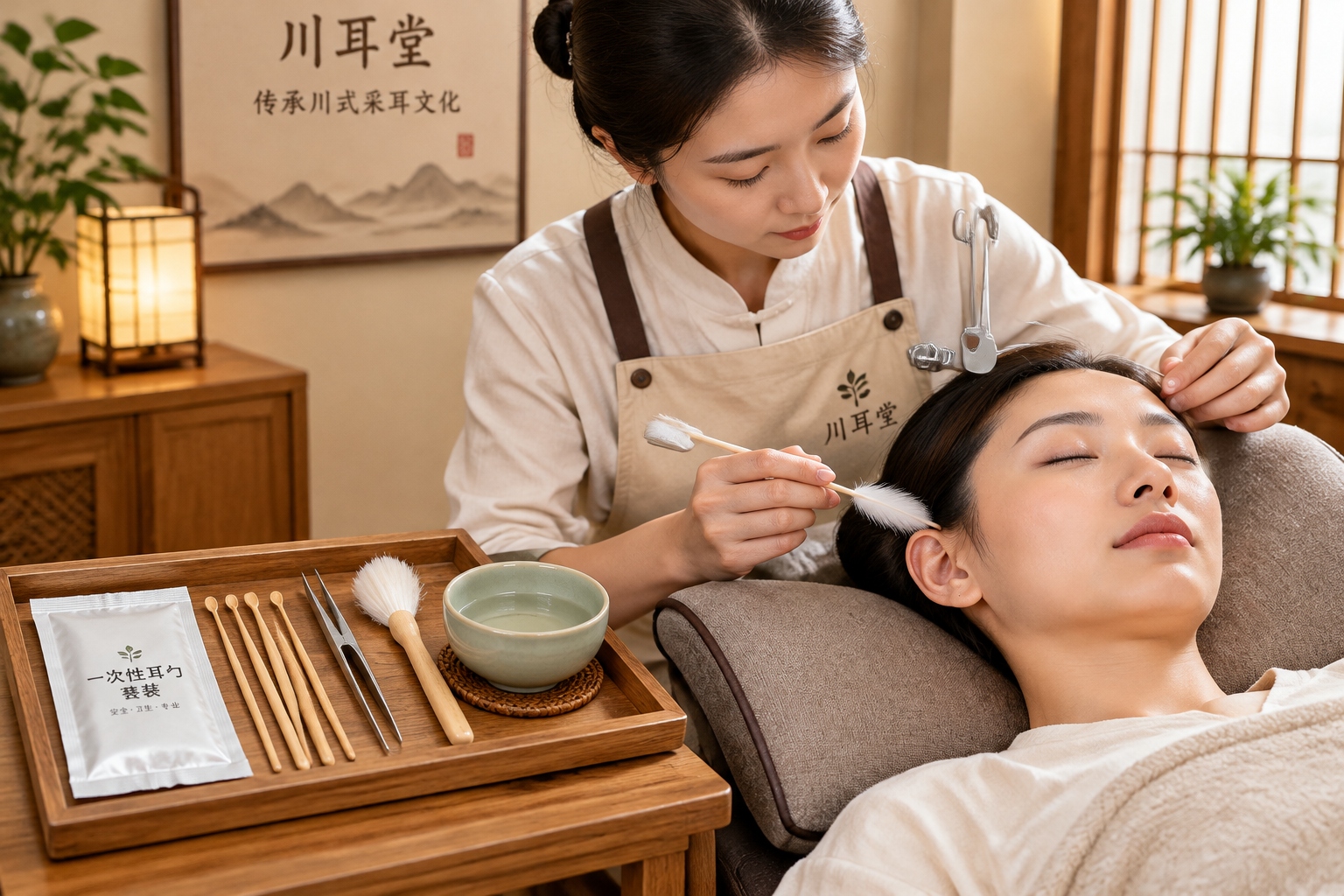
A standard 采耳 set includes a bamboo ear spoon, fine tweezers, a soft brush, a rounded “cloud knife” (云刀) for gently scraping the canal wall, a goose-feather stick, and a small tuning fork. The feather and fork are the finale: the fork is struck, the vibrating feather is brought near your ear, and the sound arrives somewhere inside your skull. It is the closest thing to live ASMR that a physical shop can sell you.
A session usually runs 20–40 minutes, sometimes bundled with a scalp massage and a warm ear wash. Price: ¥50–150 in Chengdu; ¥150–300 in tourist districts and hotel spas.
The hygiene question, answered straight
This is the first thing most Western visitors ask, and the concern is fair: someone is putting tools inside your head. Hygiene at Chinese ear-cleaning shops has improved a lot, and it takes about ten seconds to check.
- Ask for single-use tools. Many shops now open a sealed plastic pack in front of you. The question in Chinese is: 有一次性的吗? (yǒu yí cì xìng de ma?)
- Reusable metal tools should come out of a UV steriliser or a disinfectant bath — ideally where you can see it happen.
- Watch the hands. A professional washes or sanitises before touching your ear, and wears gloves for the wash step.
- Nothing sharp should go deep. The tools work at the opening and the outer part of the canal. If somebody starts digging toward your eardrum, get up.
Skip it entirely if you have an ear infection, discharge, pain, a perforated eardrum, recent ear surgery, or eczema inside the canal. Ear cleaning is sensory and cosmetic — it is not medical treatment. If your ear is genuinely blocked with wax, the right answer is a hospital ENT clinic (耳鼻喉科), which will irrigate it properly for about ¥50–100.
How to choose: two questions are enough
Ask yourself two things. Is there pain, or do you just want to feel good? And do you want a physical result, or a sensory experience?
- Stiff neck, sore shoulders, too many hours at a laptop → blind massage or tuina, 60 minutes, and tell them to focus on the area. Expect to feel beaten up for a day.
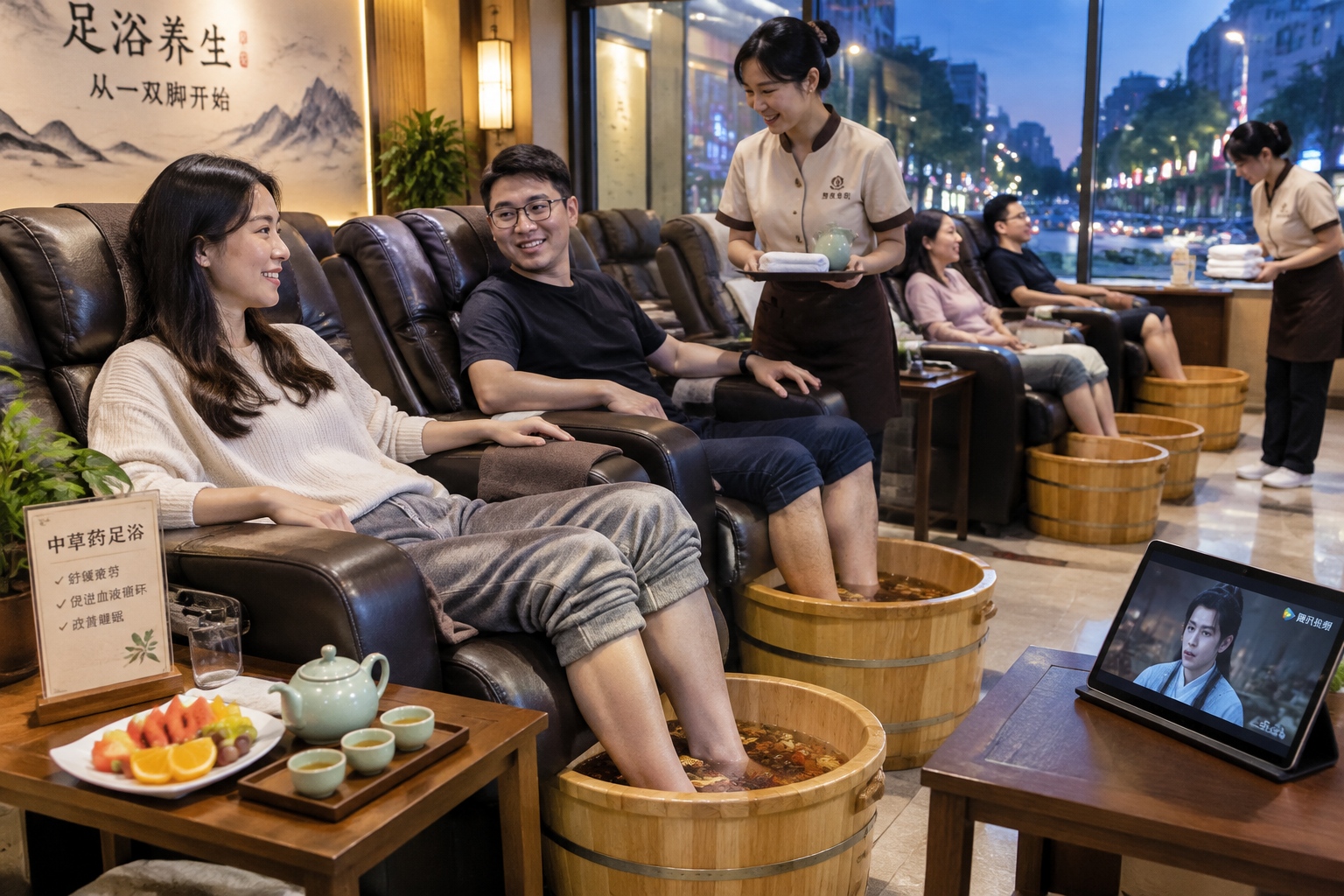
- Tired legs after 15,000 steps of sightseeing → foot massage. A 90-minute session with a herbal soak is the best value in China. Many chains throw in free fruit, tea, and sometimes a bowl of noodles late at night.
- Jet lag, stress, or you simply want to be looked after → a mid-range spa or a foot massage. Not tuina; that’s work, not comfort.
- Curiosity, novelty, ASMR, something to tell your friends about → ear cleaning. Go in pairs. It’s more fun that way.
- Numbness, shooting pain, weakness in a limb → hospital rehabilitation department. Not a shop.
How not to get ripped off
- Street touts near tourist sites (Wangfujing in Beijing, Nanjing Road in Shanghai, old-town Lijiang) are the classic trap: “massage, very cheap, come see.” Walk on.
- No posted price list is a red flag. Legitimate shops put prices on the wall or in the booking app. If the price only appears at the end, you’ll be quoted a tourist number.
- The membership card is the standard hard sell. The pitch goes: charge ¥3,000 today and get ¥4,000 of credit. The discount is real; so is the risk. Prepaid balances are hard to recover if a small shop closes, and refund disputes are not how you want to spend a holiday. Pay per visit unless it’s a chain you’ve used several times.
- “Free” foot soaks and free health checks that suddenly discover a problem are a sales script, not medicine.
- Anyone promising to cure diseases — diabetes, poor eyesight, high blood pressure — is selling, not treating.
- Check 大众点评 (Dianping) or Meituan before you go. Look at review counts, photos, and how many years the shop has been listed. A 4.6 rating with 2,000 reviews is usually a solid bet; a shop with no online presence is a coin flip.
- Pay with WeChat Pay or Alipay so there’s a record, and ask for 发票 (a receipt) if you need one. Tipping isn’t expected — the price on the wall is the price.
One more signal, unscientific but reliable: tinted windows, no visible staff, and no menu near the door usually means the shop is selling something other than massage. Keep walking.
A handful of phrases that make everything easier
- 轻一点 (qīng yì diǎn) — lighter
- 重一点 (zhòng yì diǎn) — harder
- 疼 (téng) — that hurts
- 就是这里 (jiù shì zhè lǐ) — right there
- 有一次性的吗? (yǒu yí cì xìng de ma?) — do you have single-use tools?
Most shops hand you loose cotton pyjamas. Some have showers. Your phone goes on a small shelf beside the bed. Nobody will try to chat much, which is rather the point.
So which one first?
If you only do one, do the blind massage. It’s the most distinctly Chinese of the three, the cheapest, and the one that will actually change how your back feels the next morning. Book the ear cleaning second, in Chengdu if you can, ideally after a long walk and before dinner. Order the foot massage when you’re too tired to do anything else.
None of it will cost more than a mid-range dinner back home, and all of it will tell you more about the country than a museum ticket.
Start the discussion at forum.chinacomes.com