
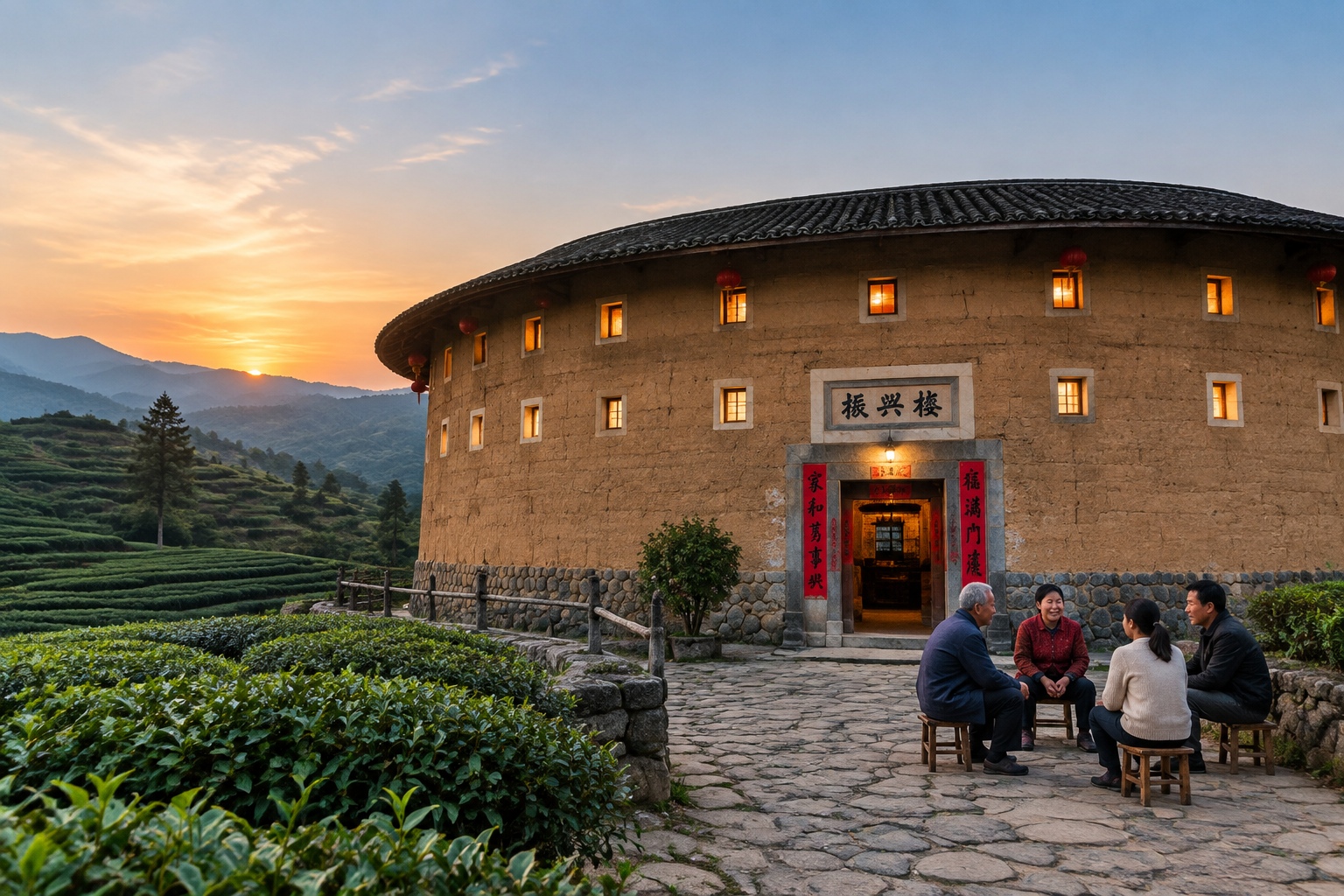

At 6:30 p.m., the last tour bus pulls out of Hongkeng Village, and the round silhouette of the tulou settles into something older. A woman named Lin Huaying is ladling rice wine into small cups on a folding table. Wood smoke from a kitchen on the second floor drifts down into the central courtyard. Somewhere above, a child practices the same three notes on a recorder, over and over. The floorboards, thick fir planks worn smooth by generations, creak under my feet as I carry my bag up to the third-floor room I’ve rented for the night.
I’m staying in one of the hundreds of earthen round houses scattered across the hills of western Fujian. Built between the 15th and 20th centuries by the Hakka and Minnan peoples, these structures—called tulou in Chinese—were designed for defense and community. Some are square, but the most iconic are circular, with walls up to 1.8 meters thick at the base, rising three or four stories around a central courtyard. A single tulou can house dozens of families, sometimes several hundred people, all sharing the same entrance, the same well, the same ancestral hall.
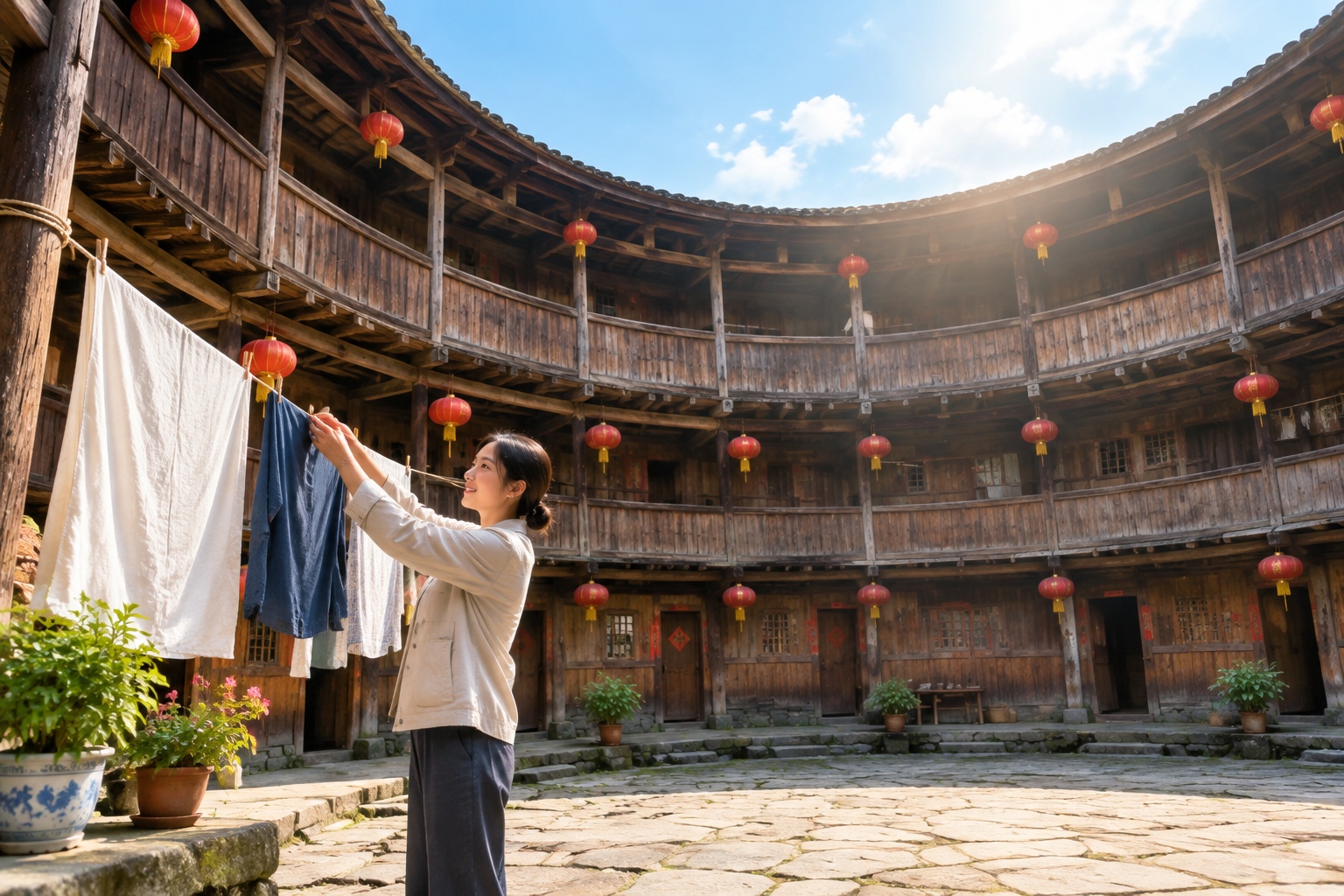
Tonight, I’m one of maybe 120 people sleeping inside these walls. Most are descendants of the original builders. A handful are tourists like me. The experience is not a hotel stay. It’s a lesson in density, sound, and the unspoken choreography of living together.
What to Expect When You Book a Night in a Tulou
Not all tulou accept overnight guests. Many are still private homes, and wandering into one uninvited is not okay. The ones that do welcome visitors usually fall into two categories: family-run guesthouses inside a tulou, or small hotels built next to one. I chose the former—a three-room operation run by Lin Huaying and her husband in a 200-year-old round house in Hongkeng, a village about two hours by bus from Longyan city.
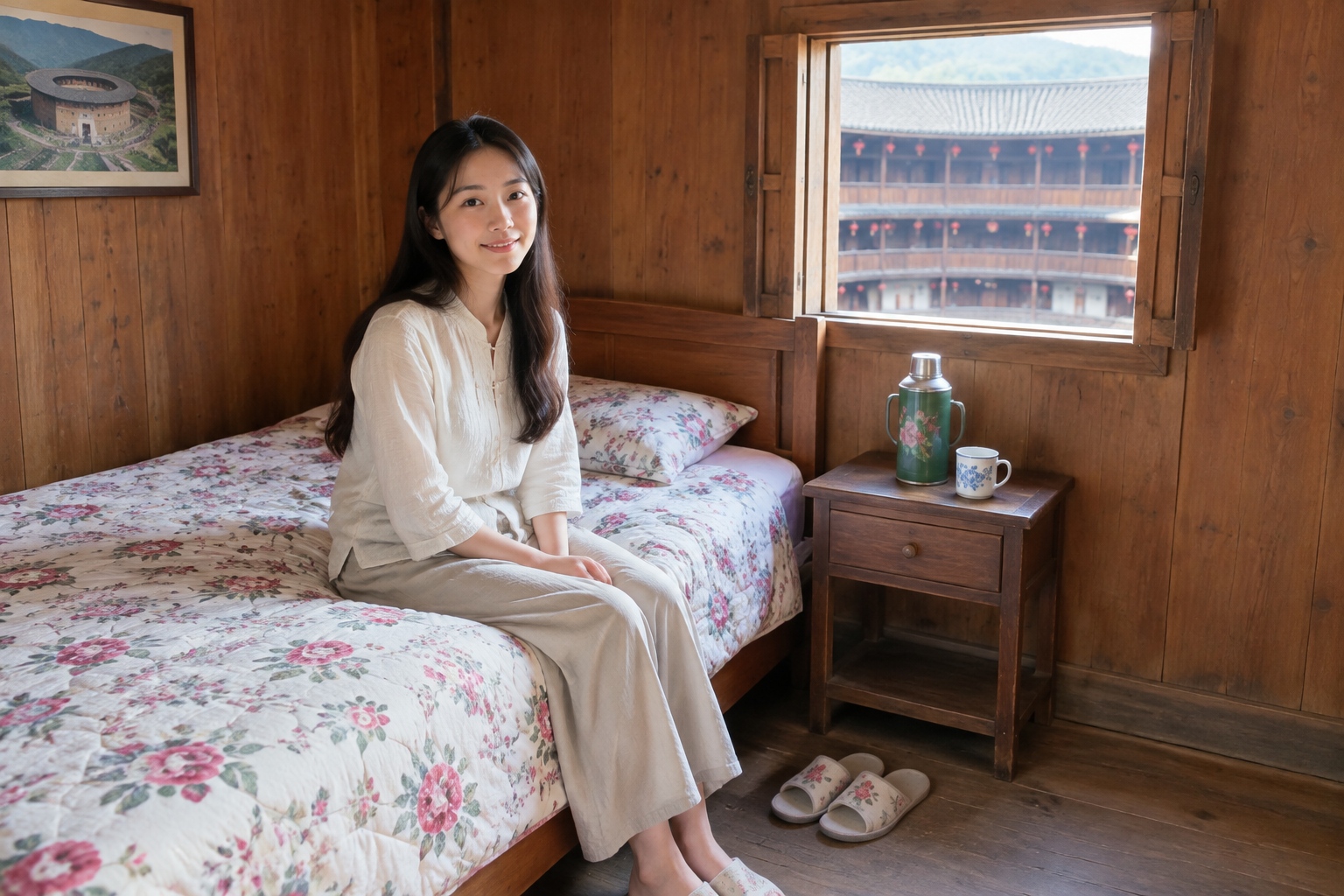
Booking is often done through Chinese apps like Trip.com or Meituan, though some guesthouses have basic English pages. Prices range from 150 to 400 yuan (about $20–55) per night. Don’t expect hotel amenities. My room had a bed, a thermos of hot water, a pair of plastic slippers, and a window that looked out over the courtyard. The bathroom was shared, two doors down a creaking corridor. It had a squat toilet and a bucket for flushing. Hot water came from a solar heater on the roof, which meant a cold shower if it had been cloudy all day.
The Night: Sounds, Smells, and Shared Spaces
By 9 p.m., the courtyard quiets. The tour groups have gone. The souvenir stalls at the entrance are shuttered. What’s left is the rhythm of the residents. An old man walks slowly around the perimeter, a radio pressed to his ear. Two women sit on low stools near the well, sorting green beans into a plastic basin. A dog barks once, then stops.
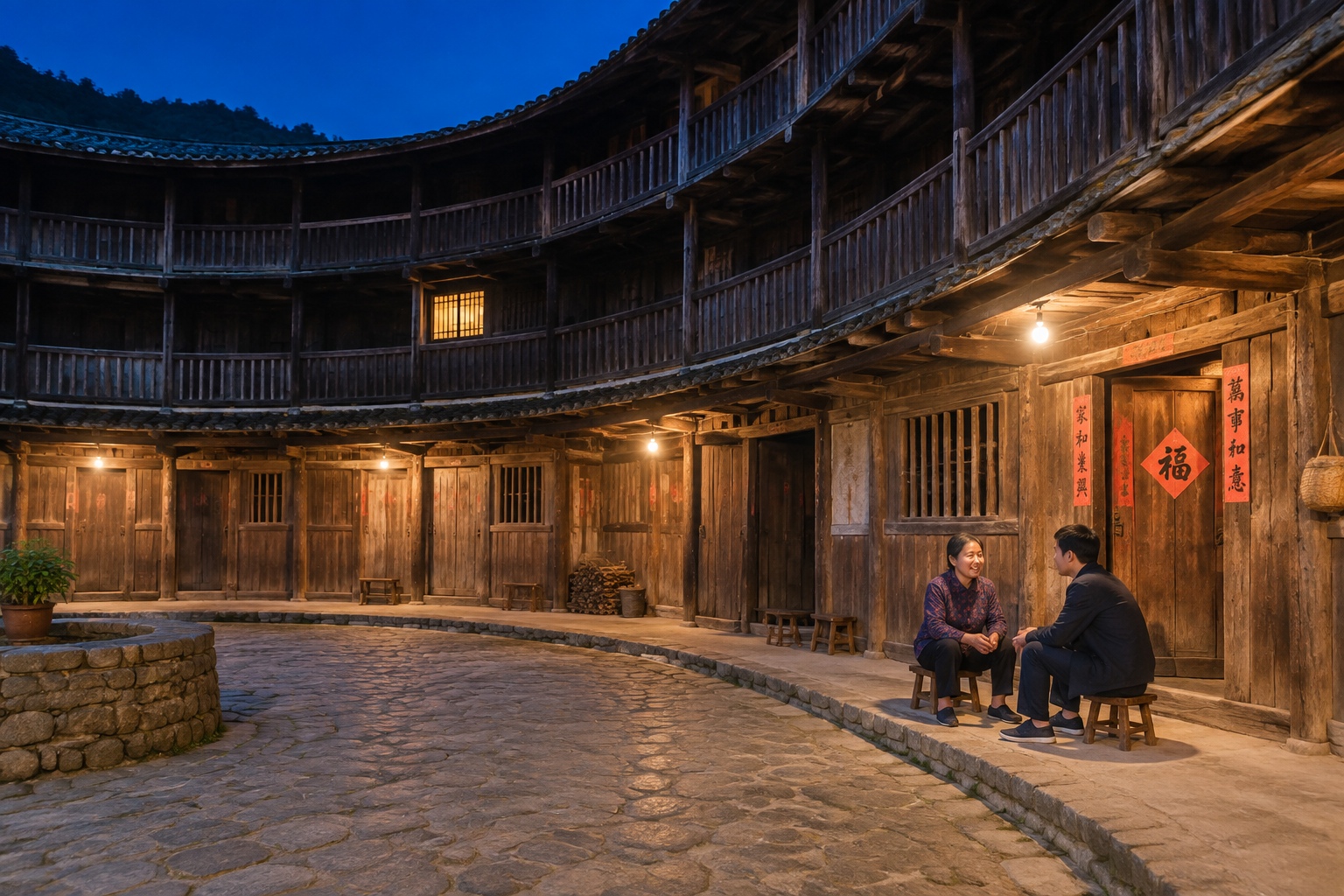
The smell is a mix of wood smoke, dried bamboo, and the faint sweetness of rice wine. Cooking happens in small kitchens built into the ground-floor rooms, each family with its own stove. The smoke rises and lingers in the rafters. At night, the only light in the courtyard comes from a few bare bulbs and the glow of televisions flickering behind wooden doors.
Sleeping here means sleeping with other people’s noises. The walls between rooms are thin—often just wooden panels. I could hear my neighbor’s phone buzzing, a baby crying on the floor below, the occasional flush of a toilet. By 11 p.m., most sounds fade, replaced by the creak of the building itself. Old wood expands and contracts with the temperature. The round shape amplifies every whisper.
If you’re a light sleeper, bring earplugs. I didn’t, and I was awake at 5 a.m. when the first rooster crowed from somewhere inside the building—yes, some families keep chickens in the courtyard.
Morning: Breakfast, Chores, and Conversations
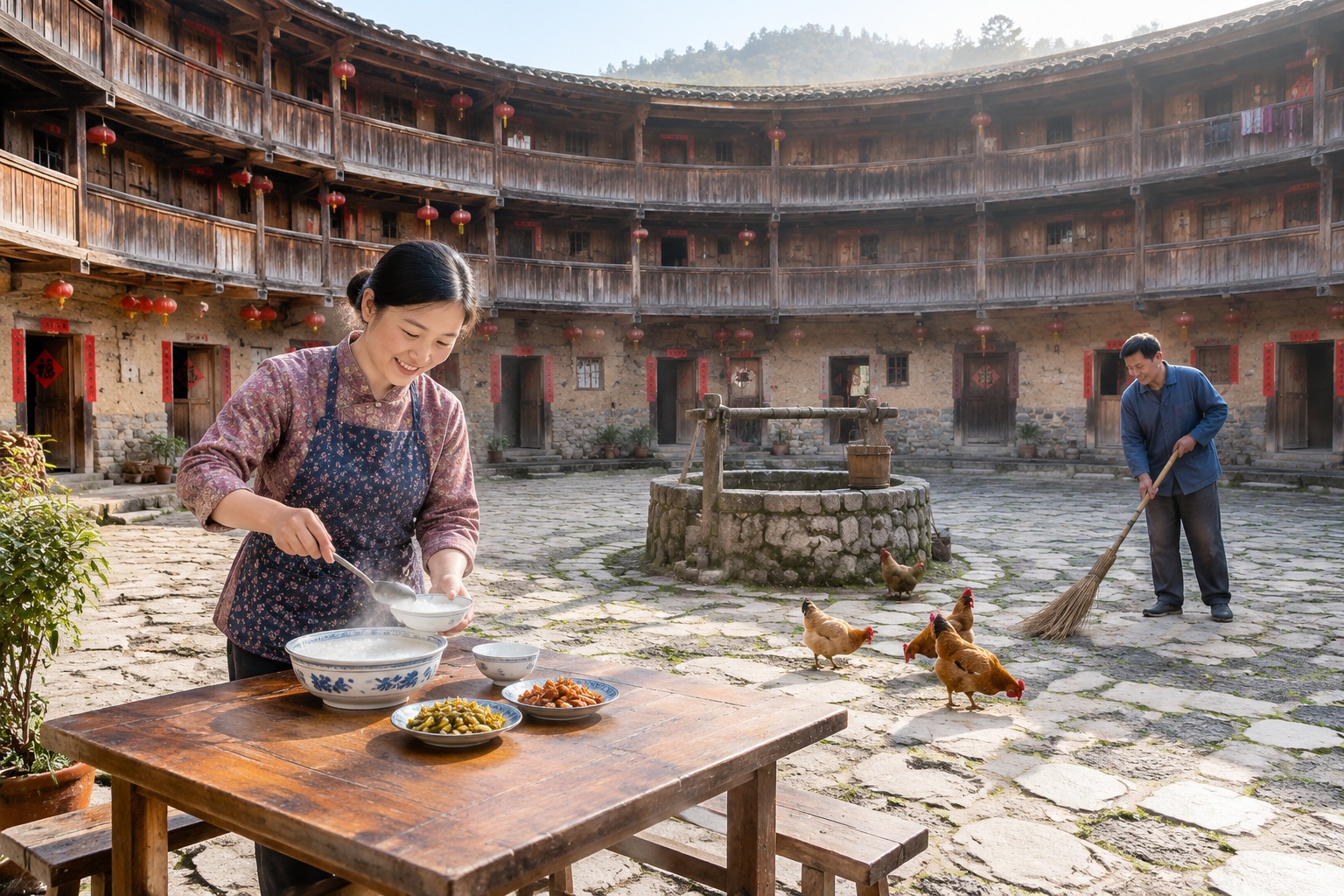
At 6:30 a.m., the tulou is already busy. Women carry baskets of vegetables in from the fields. A man in a blue jacket sweeps the courtyard with a bamboo broom. The smell of frying scallion pancakes drifts from a kitchen on the first floor. Lin Huaying waves me over to a small table and hands me a bowl of rice porridge, a boiled egg, and a plate of pickled radish. “Eat,” she says. “You have a long walk today.”
Breakfast is included in most guesthouse stays. It’s simple, filling, and often eaten with the family. This is the best time to ask questions. Lin tells me that her family has lived in this tulou for six generations. She points to the ancestral hall in the center of the courtyard, a small wooden structure with an altar and faded photographs. “We still burn incense there every morning,” she says. “My grandfather’s grandfather built this house.”
She also tells me about the challenges. Young people leave for cities like Xiamen and Shenzhen. Only about 20 families remain in this tulou, down from 40 in the 1990s. Some rooms are empty, used for storage. The roof leaks in heavy rain. But tourism has helped. The guesthouse brings in extra income, and her son, who works in Xiamen, sometimes comes back on weekends to help.
Practical Tips for Staying in a Tulou
- Choose the right tulou. Hongkeng Village and Yunshuiyao are the most accessible, with regular buses from Xiamen and Longyan. More remote tulou in Hua’an or Yongding’s Chuxi are quieter but harder to reach without a car.
- Book ahead, especially on weekends and holidays. Chinese domestic tourism is booming, and good guesthouses fill up fast.
- Bring cash. Many small guesthouses and food stalls don’t accept foreign credit cards. WeChat Pay and Alipay are widely used, but they require a Chinese bank account or a tourist-friendly setup.
- Pack earplugs, a flashlight, and slippers. Lighting in corridors can be dim, and shared bathrooms are often a short walk away.
- Expect shared facilities. Private bathrooms exist in some upgraded guesthouses, but in traditional tulou, toilets and showers are communal.
- Learn a few words of Mandarin or Hakka. “Ni hao” (hello) and “xie xie” (thank you) go a long way. Older residents may speak Hakka or Minnan, not Mandarin.
- Be respectful. Remember that this is not a museum. People live here. Don’t enter private rooms, don’t take photos of people without asking, and keep noise down after 9 p.m.
Is It Worth It?
If you want a sanitized, quiet hotel experience, no. But if you’re curious about how hundreds of people can share one building—how they negotiate space, sound, and privacy—then a night in a tulou is unforgettable. You’ll wake up to the smell of wood smoke and the sound of a broom on stone. You’ll eat breakfast with people whose families have lived in the same circle for centuries. You’ll understand that a building can be more than architecture. It can be a way of life.
As I left the next morning, Lin Huaying handed me a small bag of dried bamboo shoots. “Come back in winter,” she said. “The rice wine is better then.” I walked out through the main entrance, a thick wooden door that has been opening and closing for 200 years. Behind me, the tulou was already humming with the day’s chores. A few hundred people, one round house, another ordinary morning.
Start the discussion at forum.chinacomes.com