

At 6:40 a.m., the Bamboo Is Still Dripping
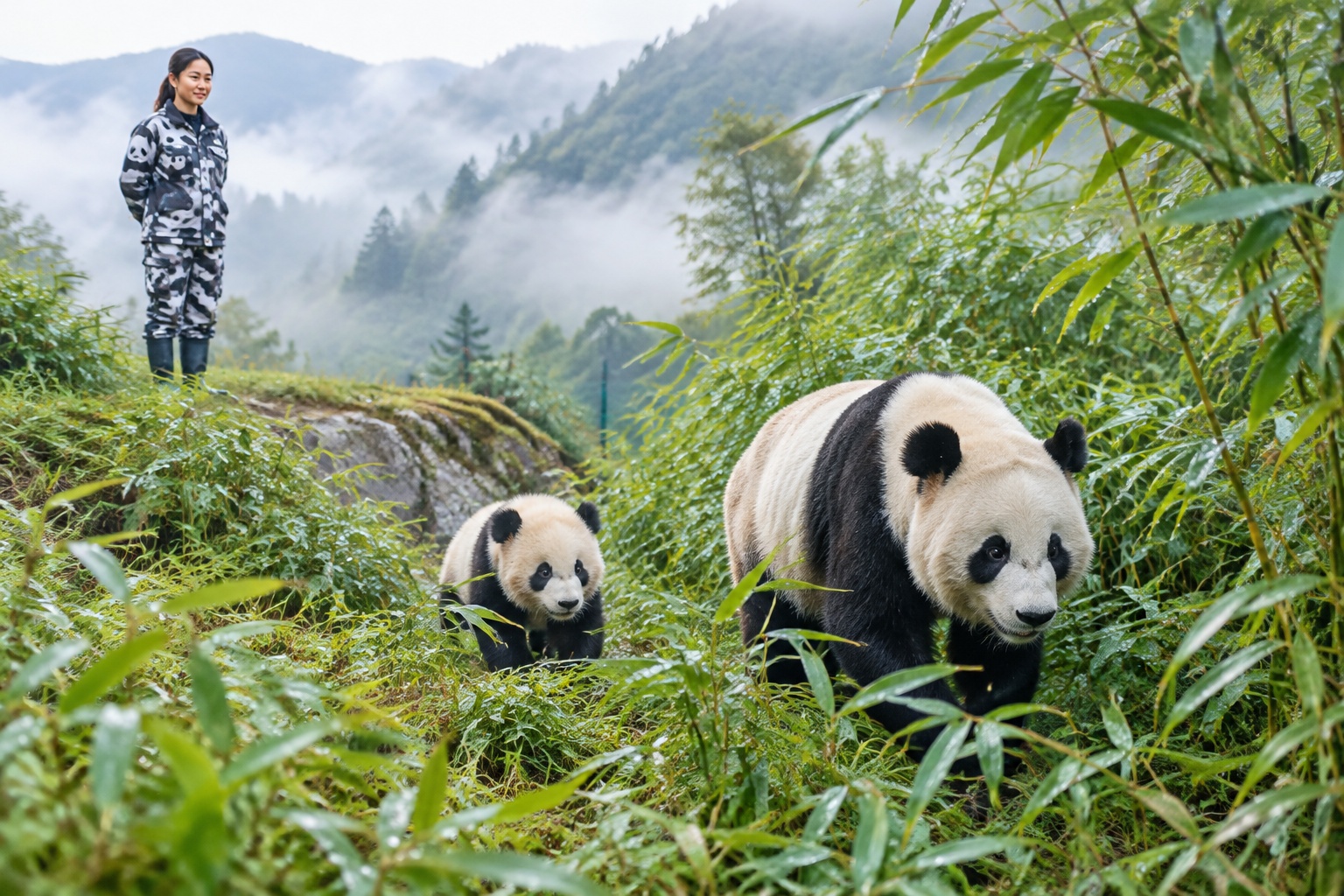
At the Hetaoping panda rewilding base in Wolong, Sichuan, the morning begins with water. Fog sits low over the Qionglai Mountains, bamboo leaves hold last night’s rain, and the path to the semi-wild enclosures smells of wet earth, bamboo sap, and faint disinfectant. A keeper in a black-and-white panda suit stops at a ridge above a fenced slope. He does not wave. He does not speak loudly. Below him, a mother panda is pushing through thick bamboo, and a cub the size of a small dog is trying to keep up.
This is not the Chengdu Panda Base, where visitors crowd around glass and take photos of cubs on climbing frames. Hetaoping is a working station, usually closed to tourists. Its job is not to make pandas comfortable around people. It is to make them forget people exist.
What Panda Rewilding Actually Means
Rewilding is an awkward word. It suggests turning back a clock. In practice, it means preparing a captive-born or captive-managed panda for a life that no zoo can simulate. The goal is not a panda that can survive for a few months in a forest. The goal is a panda that can find food, avoid danger, choose a home range, and eventually reproduce without a keeper nearby.
China has tried different versions. The earliest attempt, in 2006, released a captive-bred male named Xiang Xiang into the wild. He had not been raised by a wild-trained mother in a large mountain enclosure. He died the next year. The failure changed the method. Since then, the dominant approach has been mother-cub training. A female panda with relevant wild or semi-wild experience raises her cub in a large enclosure that looks and feels more like a mountain slope than a nursery.
Humans stay at a distance. To reduce imprinting, staff may wear panda suits treated with panda scent. Food is not handed over on a tray. Keepers monitor through cameras, microphones, and occasional checks. The cub’s first teacher is its mother, not a human.
The training usually moves through stages. First, a protected enclosure with natural bamboo. Then a larger semi-wild area with steep slopes, streams, rocks, and varied vegetation. Finally, if health and behavior allow, a release site in a historical panda range. It can take two to three years, sometimes longer. Nothing about it is quick.
The Curriculum in the Forest
Bamboo, All Day Long
Wild giant pandas eat a low-quality diet. Bamboo is tough, fibrous, and not very nutritious. A panda may spend 12 to 16 hours a day eating, consuming 10 to 40 kilograms of bamboo, shoots, and leaves depending on the season and the species. A cub does not learn this from a manual. It follows its mother, grabs the same stems, and slowly learns which bamboo is worth stripping and which is not.
In the enclosure, keepers plant multiple bamboo species. They watch whether the cub chooses shoots in spring, leaves in winter, or moves to higher ground when the lower slopes dry out. They also track water. A panda that can find bamboo but not clean water will not last long.
Climbing as a Lifeline
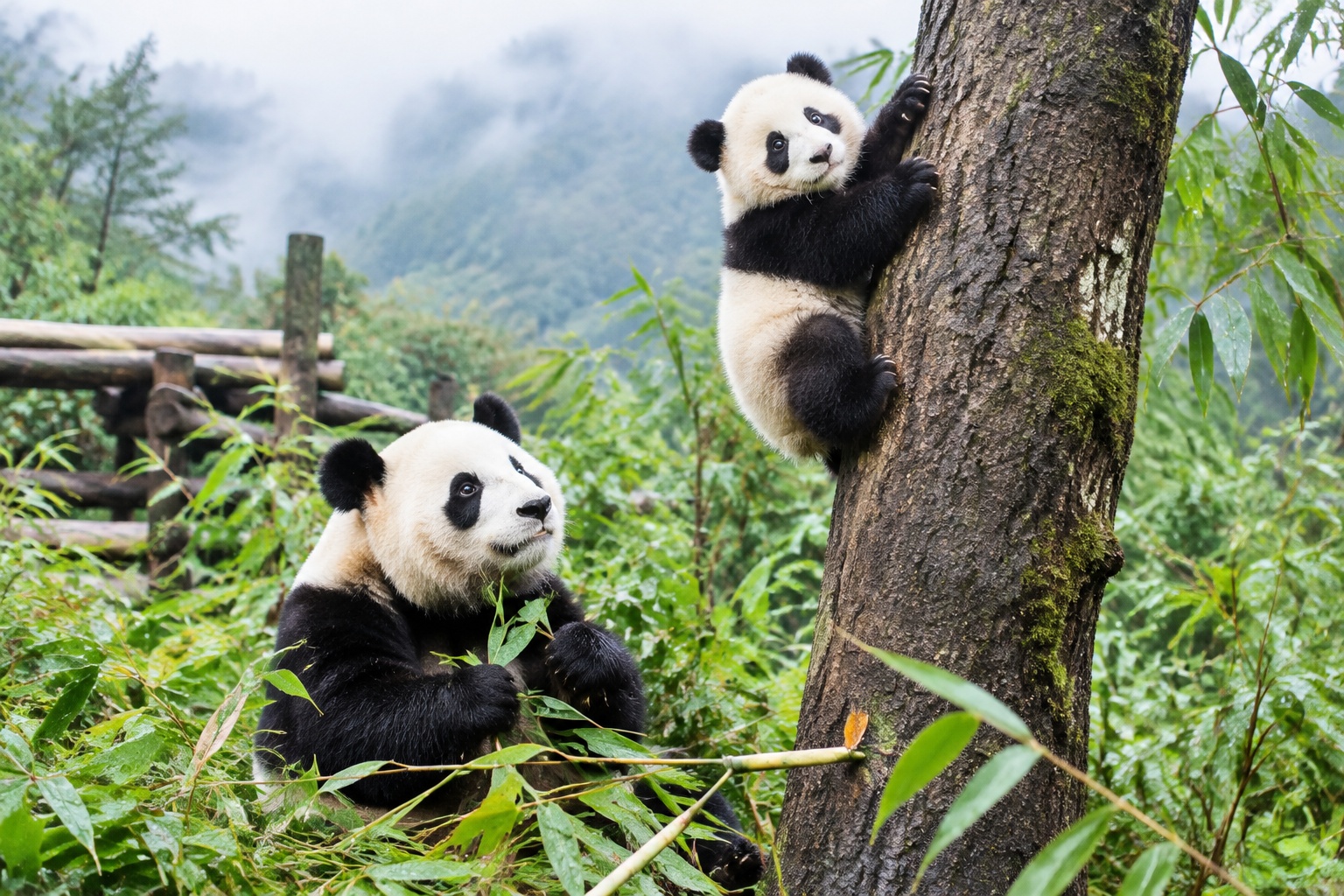
Panda cubs climb early. In a semi-wild enclosure, a tree is not just play equipment. It is a place to rest, a way to escape a startled adult, and a vantage point. A mother may climb slowly, letting the cub follow. If the cub slips, it learns. If it stops, it may whine. The mother does not always rescue it.
Climbing also builds muscle and confidence. On steep mountain slopes, a panda needs to move through fallen logs, rock piles, and dense bamboo. A cub raised on flat concrete may never develop that coordination. A cub raised on a slope learns it every day.
Predators, Sounds, and the Smell of Danger
Adult giant pandas have few natural enemies. A full-grown panda is large, strong, and equipped with powerful jaws. But a cub is different. Leopards, dholes, and smaller carnivores can threaten young pandas. In the past, local hunters and dogs also posed risks. In training areas, staff may expose cubs to the sounds or scents of potential predators, not to frighten them for spectacle, but to see how the mother reacts.
If the mother freezes, sniffs, or moves the cub into dense cover, the cub absorbs the signal. Fear is part of the curriculum. So is silence. A wild panda does not announce its location.
Before Release: Collars, Blood Tests, and a Cage That Opens Once
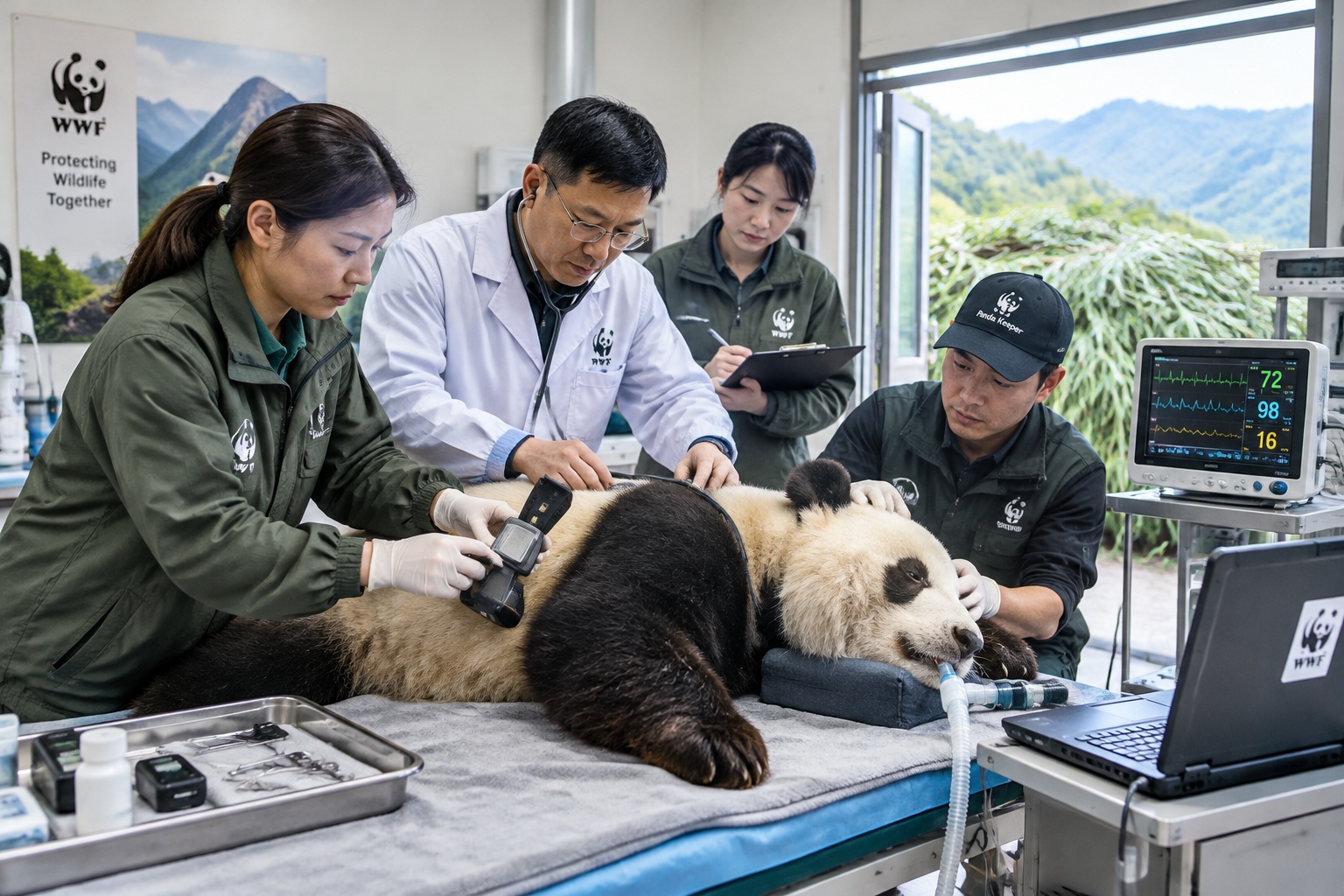
The release itself is the shortest part of a long process. Before a panda leaves, it goes through a health check. Veterinarians anesthetize it, measure weight and teeth, check its heart and lungs, take blood, and test for parasites and disease. They also fit a GPS collar. The collar is designed to be a fraction of the animal’s body weight, usually well under 3 percent, and to drop off after a set period. It sends location data by satellite or radio.
The release site matters as much as the panda. A good site has historical panda presence, enough bamboo, water, and shelter, few people, and ideally a small existing panda population that needs genetic exchange. One of the main sites has been Liziping in Shimian County, in the Daxiangling Mountains of Sichuan. It is not a famous tourist landscape. It is a rugged patch of forest, steep valleys, and scattered villages, exactly the kind of place that rarely appears in postcards.
Transport is practical, not cinematic. A panda travels in a cage by vehicle, then sometimes by carried cage or on foot along a mountain trail. At the release site, it may spend days or weeks in an acclimatization pen, able to smell and hear the forest before the gate opens. When the gate finally lifts, the panda chooses the moment. Some walk out quickly. Some wait until dark.
After the Cage Opens, the Work Gets Harder
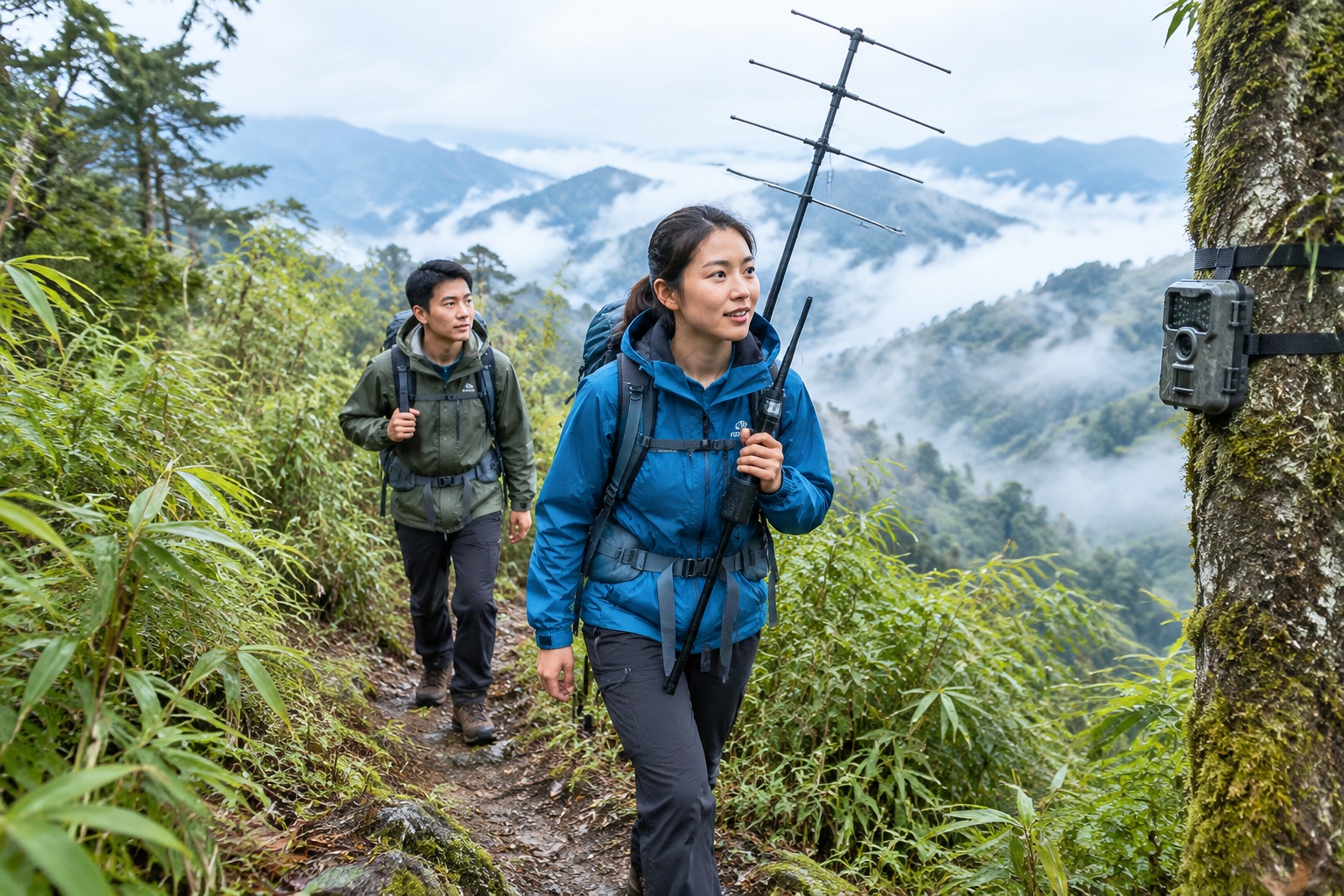
Release day makes a good photograph. The months after make the science. A field team tracks the GPS collar, listens for VHF radio signals, hikes to locations, and collects what the panda leaves behind. Scat is not waste. It contains DNA, hormones, parasites, and bits of bamboo that tell researchers what the panda has been eating and whether it is stressed.
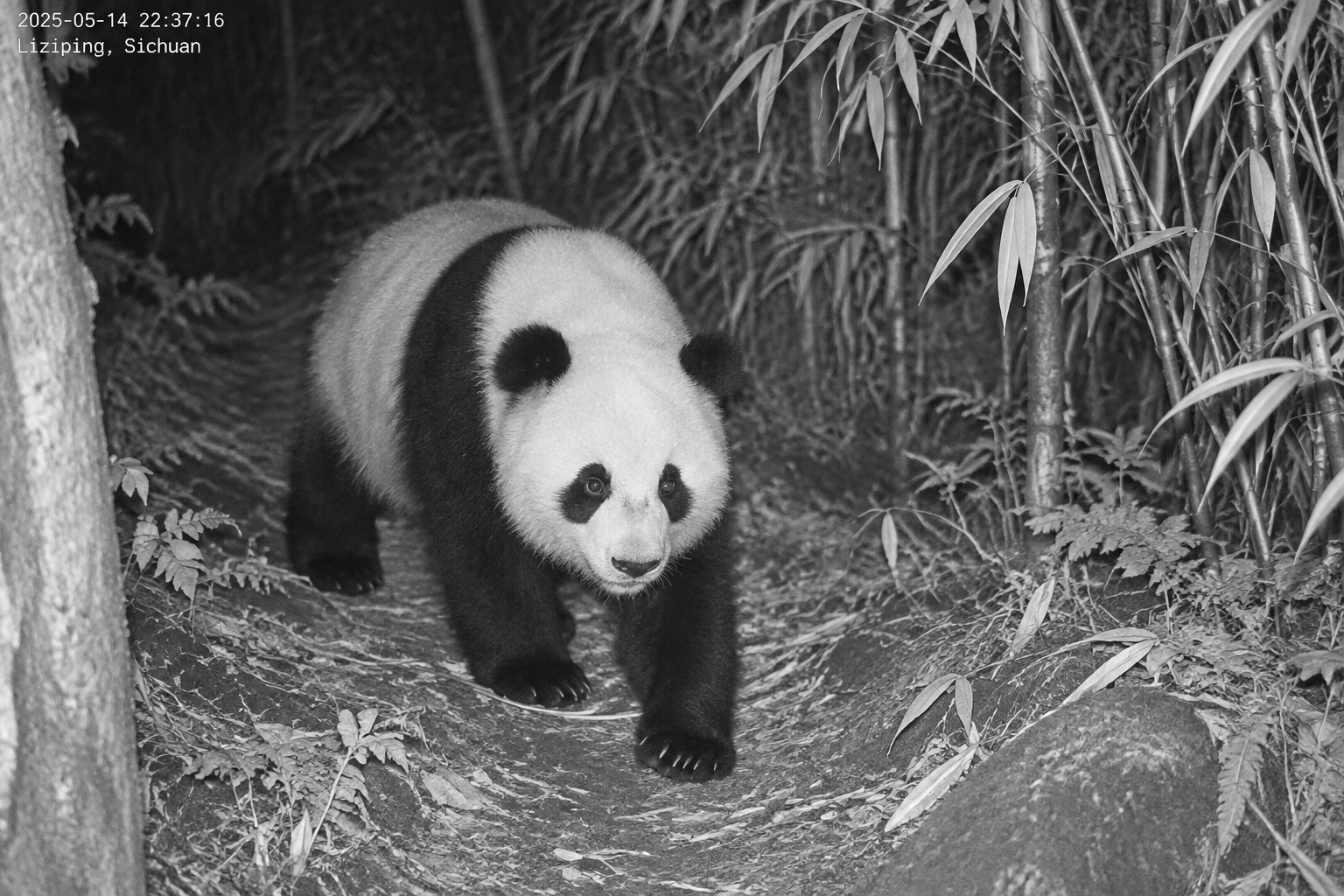
Infrared cameras are set along ridges and trails. They do not need the panda to wear anything. They capture a black-and-white body moving through bamboo at night, a blur that may be the only proof a released animal is still alive.
The challenges are ordinary and relentless. Collars fail or drop off earlier than planned. Signals disappear behind ridges. Snow erases tracks. A panda may cross into a valley with no road access. Disease and parasites are hard to treat in a wild animal. If a released panda is spotted looking thin or sick, the team faces an uncomfortable question: intervene, or let natural selection work?
There is also the human landscape. Released pandas may move near villages, farms, roads, or dogs. A conservation team can ask residents to leash dogs or report sightings, but it cannot remove every risk. Habitat fragmentation remains the deeper problem. A panda can survive a winter. It cannot survive a landscape cut into isolated islands.
Tao Tao and Zhang Xiang: Two Names, Two Unfinished Stories
Tao Tao is one of the best-known successes of the mother-cub method. Born in 2010, he was released in Liziping in October 2012. His GPS collar eventually dropped off, as planned, but monitoring did not stop. Infrared cameras and scat samples confirmed that he was still moving through the forest. For supporters of rewilding, he was proof that a cub raised by its mother in a semi-wild enclosure could cross the line into a wild life.
Zhang Xiang, released in November 2013, was the first female from the mother-cub program to go into the wild. Her movements were followed across high ridges and deep valleys. Eventually, her collar stopped sending a clear signal. The team continued to look for traces, but daily certainty was gone. Her story is often described as a success, a loss, or an unknown, depending on who is telling it. That ambiguity is honest. Wild animals do not file reports.
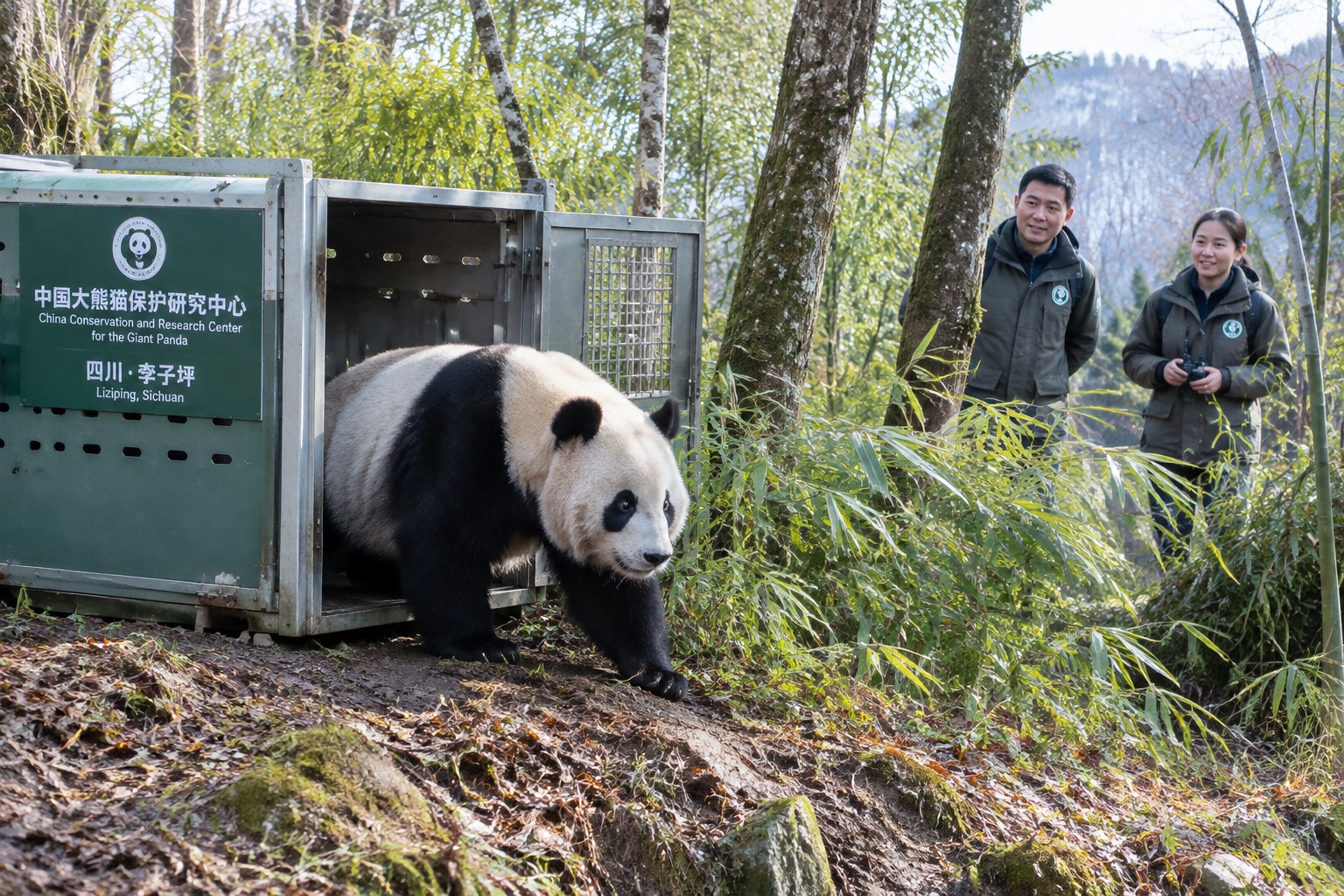
Other releases followed: Xue Xue, Hua Jiao, Hua Yan, Zhang Meng, Ying Xue, and others. Some adapted. Some died. Some simply disappeared from monitoring. Each case added practical knowledge about release sites, collars, health checks, and the age at which a cub is most likely to survive.
Small Numbers, Real Arguments
Since the first attempt in 2006, China has released only a small number of giant pandas, generally counted in the low teens. That is tiny compared with the captive population, which now exceeds 600, and the wild population, estimated at more than 1,800. The small number is not an accident. Rewilding is expensive, slow, and risky. It is also not the only way to protect pandas.
Critics ask whether the money and effort would be better spent protecting and connecting existing habitat. They point out that a released panda can die, while habitat protection helps entire communities of plants and animals. Supporters answer that isolated wild panda populations face inbreeding and local extinction. Without moving genes between small groups, some populations may fade even if the total number looks stable.
There is also the question of what counts as success. Is it a panda that survives one year? Five years? Produces cubs? The standards vary. Some released pandas have been photographed looking healthy. Others have been found dead. The line between conservation and intervention is never clean.
In 2021, China established the Giant Panda National Park, covering about 27,000 square kilometers across Sichuan, Shaanxi, and Gansu. The park is meant to connect habitats that were once fragmented by roads, farms, and logging. It does not solve everything. People still live and work in and around the area. But it changes the scale of the problem. Rewilding is more likely to work when the forest is large enough to hide a panda, and large enough for a panda to find a mate.
What the Forest Says Back
At Hetaoping, the work is not glamorous. It is wet boots, camera batteries, anesthesia records, bamboo surveys, and long drives on mountain roads. The pandas do not perform. They sleep, eat, climb, and disappear into cover. The people who study them spend more time looking at data than at bears.
That is why the rewilding story matters beyond pandas. It shows conservation as a practice, not a slogan. It involves trial, error, and uncomfortable trade-offs. It asks whether humans can teach a wild animal to live without us, and then step back far enough to let it try.
On a recent camera download, a field worker scrolls through hundreds of empty frames: rain, bamboo, a passing deer, a branch moving in wind. Then, at 3:14 a.m., a heavy black-and-white shape crosses the trail. It pauses. Its head turns toward the camera, or perhaps toward a sound. Then it walks on. The next frame is empty again. For the team, that is enough for one morning.
Start the discussion at forum.chinacomes.com