
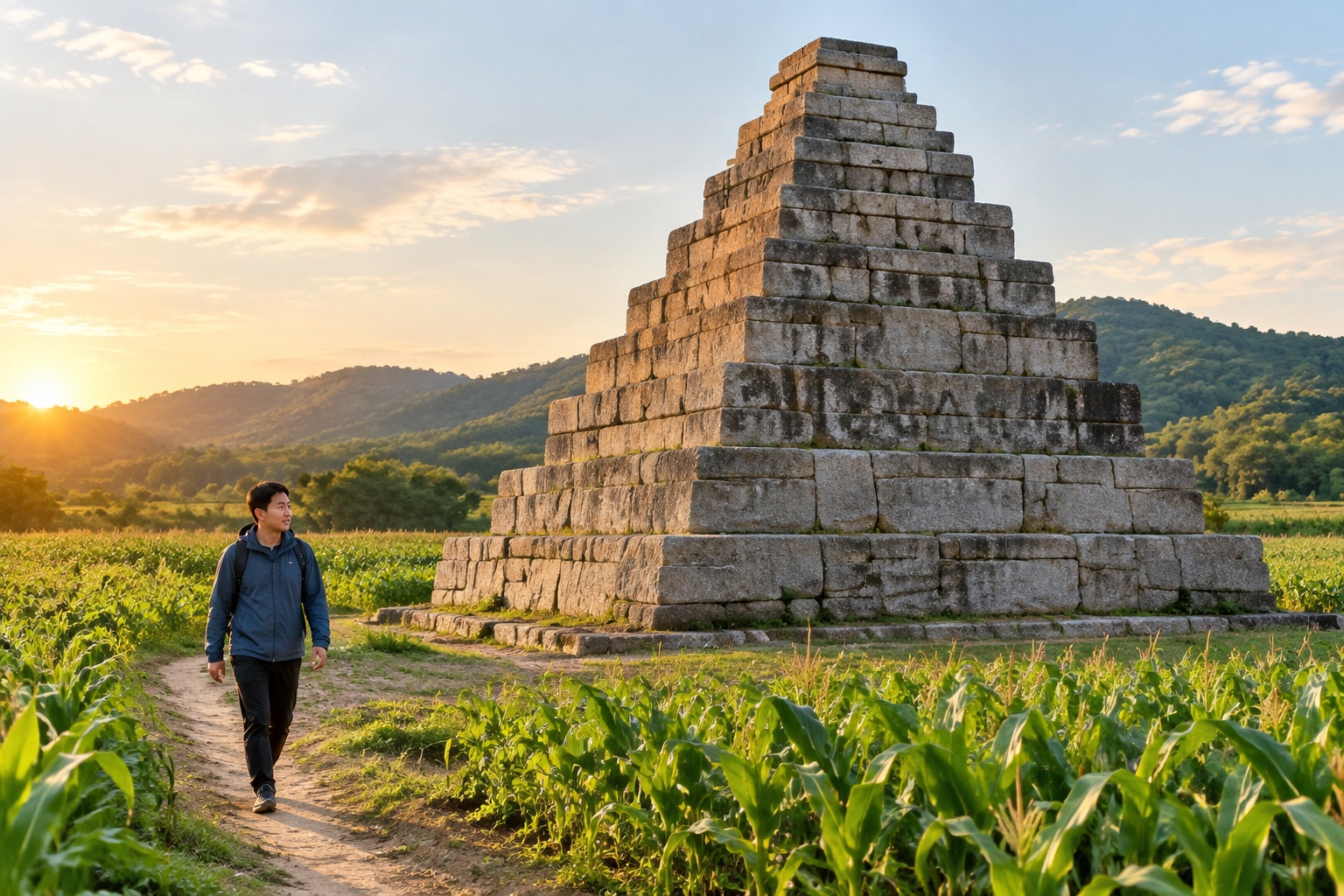

A pyramid in a cornfield
Walk off the paved road about four kilometres east of Ji’an, a small city on China’s border with North Korea, and the corn gives way to something that does not belong in a field: a seven-step granite pyramid, thirteen metres tall, built from more than a thousand slabs of stone. There is no glass case around it. A low fence keeps the cows out. A man with a broom is the only staff on duty.
This is the Tomb of the General, and it is roughly 1,500 years old.
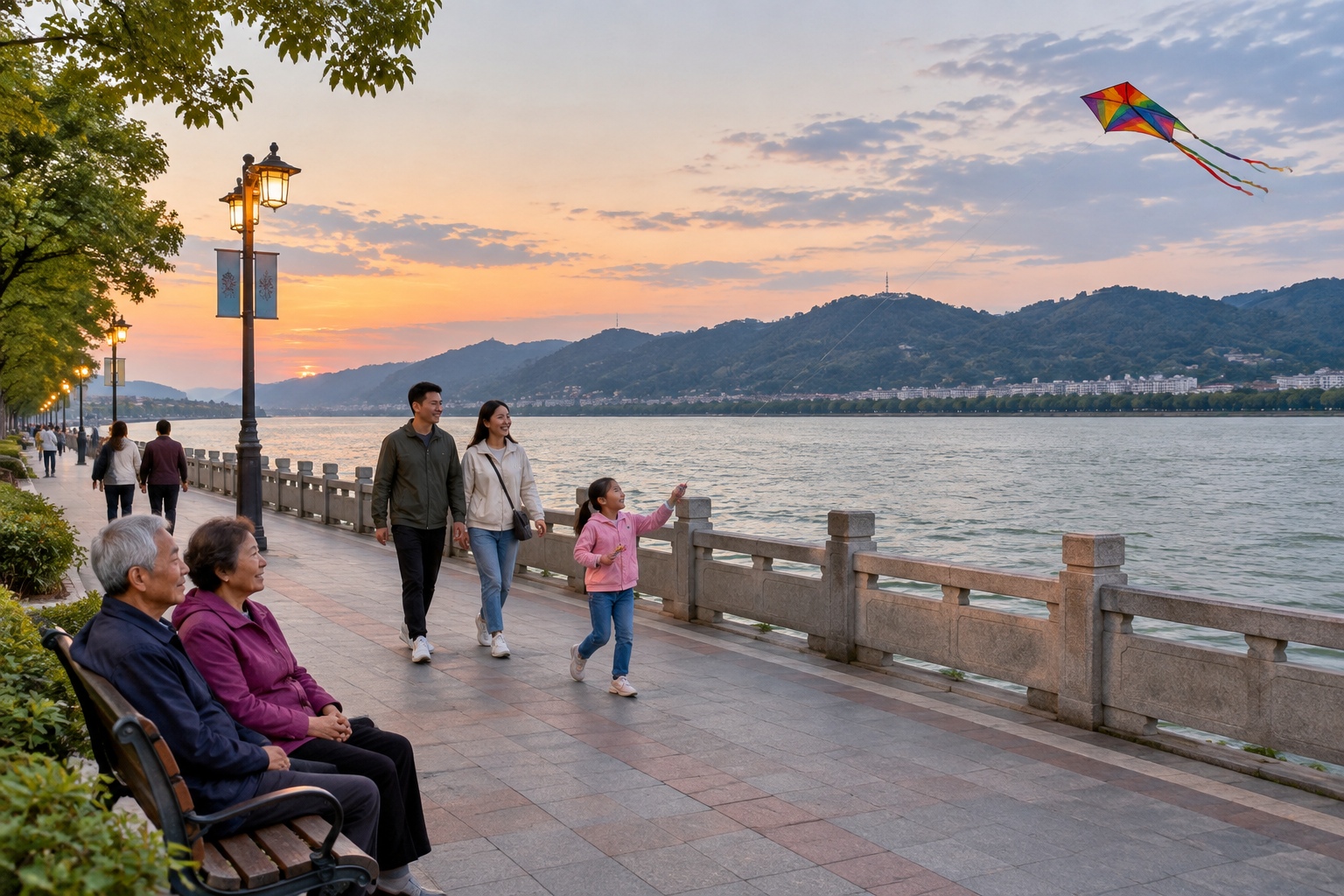
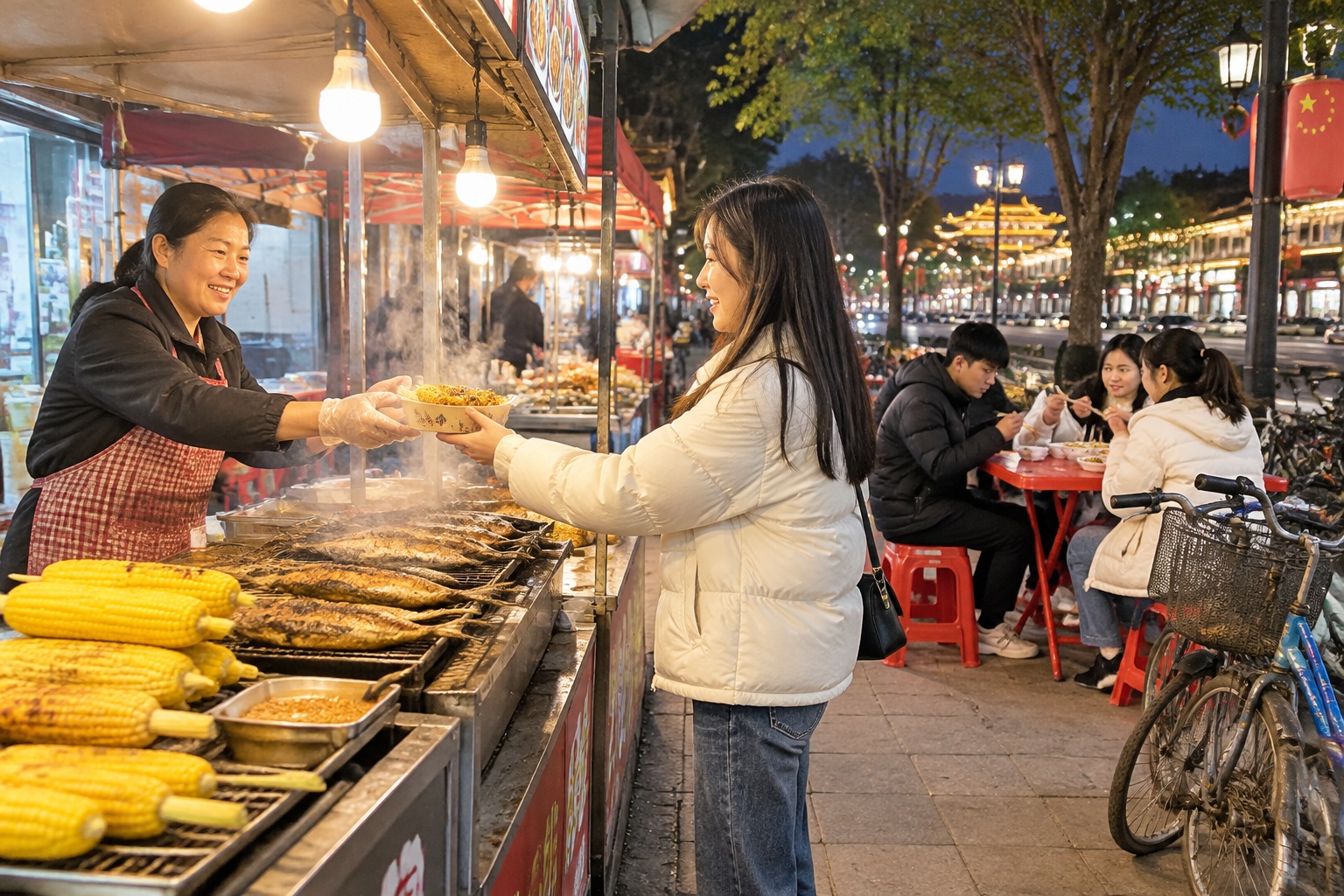
Foreign visitors rarely make it here. Ji’an sits in the far south of Jilin province, in China’s northeast, about a five-hour drive from Shenyang. The city has roughly 200,000 residents, a riverside promenade, and a night market selling grilled corn and fish pulled from the Yalu that morning. Across the water, the hills belong to North Korea.
The kingdom you have never heard of
The pyramid belongs to Koguryo — also spelled Goguryeo, and known in Chinese as Gaogouli — a kingdom founded in 37 BC in the mountains of what is now northeast China and the northern Korean peninsula. At its height it controlled much of Manchuria and the northern half of Korea. It fought off invasions from China’s Sui dynasty, lasted more than 700 years, moved its capital to Pyongyang in 427, and finally fell in 668 to an alliance of Tang China and the Korean kingdom of Silla.
For most of the last century, the kingdom was a footnote outside specialist circles. What changed that was archaeology — and, in 2004, UNESCO.
That year, a group of sites around Ji’an and in neighbouring Huanren county were inscribed on the World Heritage list as the “Capital Cities and Tombs of the Ancient Koguryo Kingdom”: three city sites, fourteen royal tombs, and twenty-six tombs of nobles. The listing made an argument: this was a major East Asian civilisation, and its heartland lies on the Chinese side of the Yalu River.
A stele with 1,775 characters
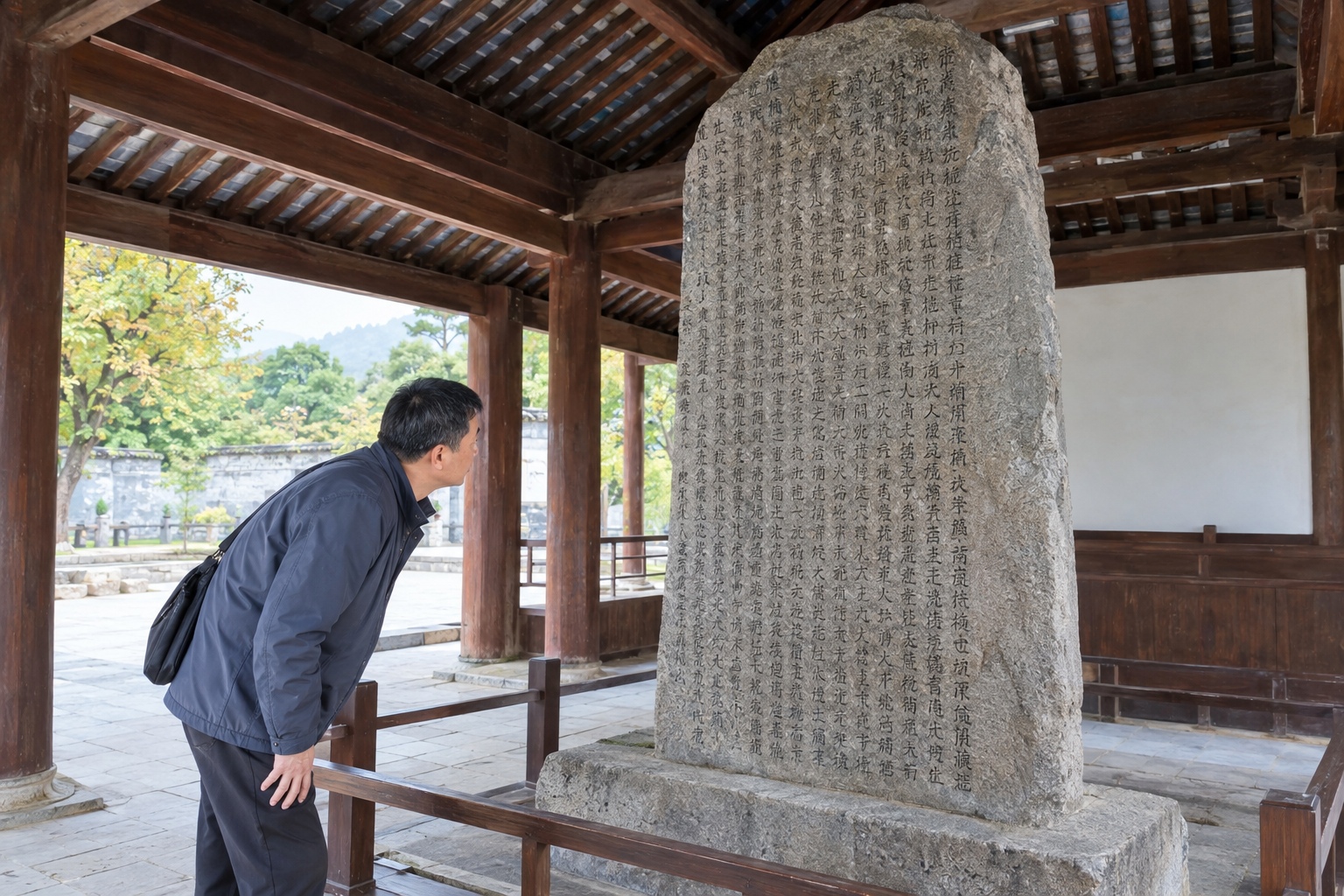
The single most important object in Ji’an is a slab of granite 6.39 metres tall, standing in a pavilion in a quiet park. It was carved in 414 AD on the orders of King Jangsu, in memory of his father, King Gwanggaeto the Great, who had died the year before.
Nearly 1,800 Chinese characters cover its four faces. They record wars, conquests, treaties and tribute — including contact with polities in the Japanese archipelago. It is one of the longest surviving inscriptions from ancient East Asia, and historians have been arguing over its wording for more than a century. In the 1880s a Japanese military officer is reported to have altered characters while making rubbings; the accusation still turns up on Chinese museum labels today.
Standing in front of it, what strikes you is less the politics than the physical fact. Someone cut this text, character by character, into stone in the fifth century, and it is still readable.
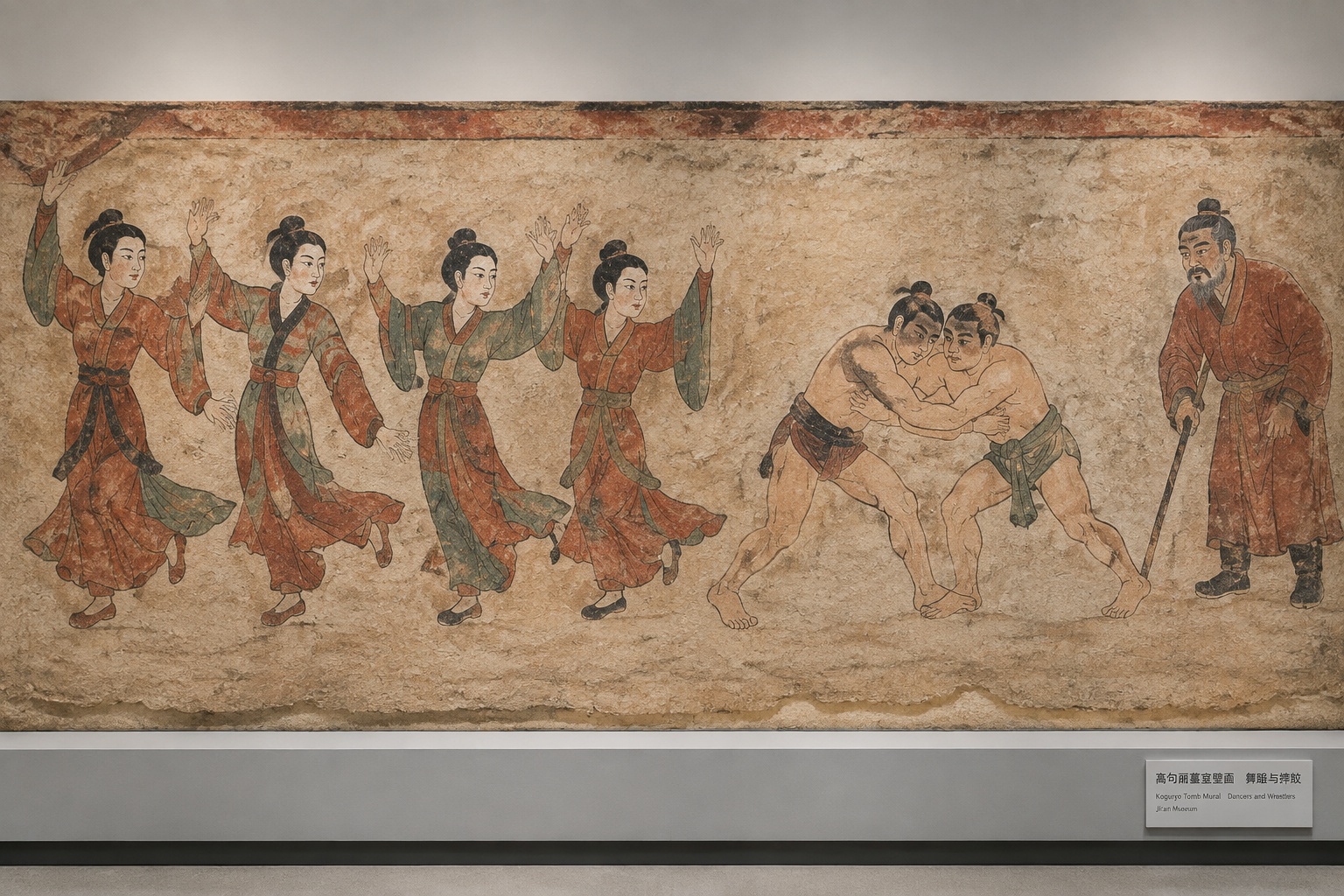
Dancers, wrestlers and four guardian beasts
Koguryo’s tombs were painted. Inside chambers cut into rock and sealed under earthen mounds, artists covered the walls with scenes of daily life: banquets, hunting on horseback, dancers in long sleeves, processions, kitchens.
Two of the best known sit a few kilometres from the city. The Tomb of the Dancers shows a row of figures with arms raised mid-step. The Tomb of the Wrestlers shows two men in loincloths locked together while an older man with a stick stands by — the composition of a sports photograph, and it is about 1,500 years old.
Later tombs shift from daily life to cosmology. Changchuan Tomb No. 1, painted in the fifth century, contains one of the earliest complete sets of the Four Symbols — the Azure Dragon of the east, the White Tiger of the west, the Vermilion Bird of the south, the Black Tortoise of the north — swirling across the ceiling in mineral reds and greens.
Here is the practical catch: pigments that survived fifteen centuries underground do not survive crowds. Most original tomb chambers are sealed, or open only by arrangement, and photography is banned. The Ji’an Museum displays careful reproductions, which is how most visitors actually see the murals. It is not the same as standing inside the tomb. It is still worth the trip.
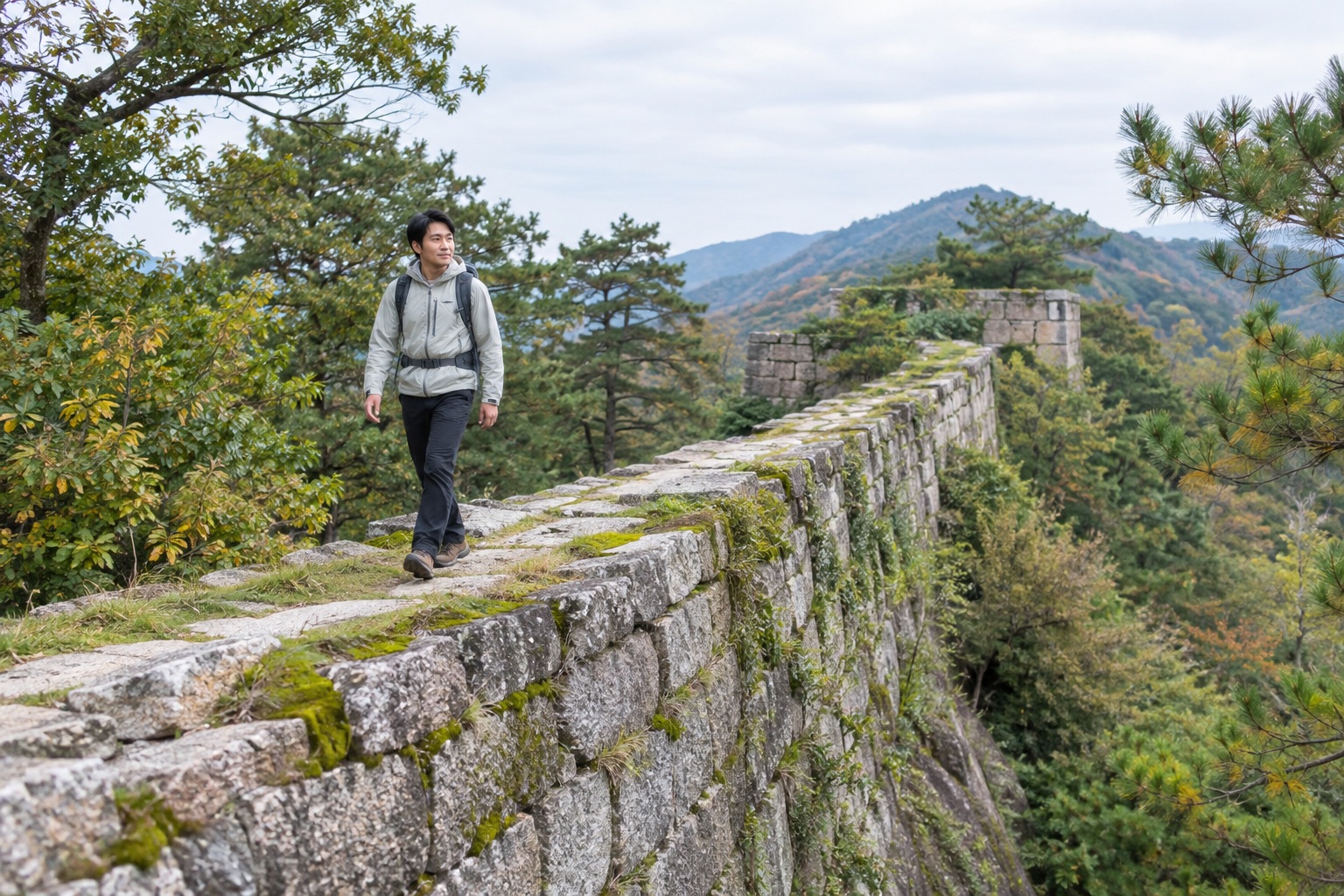
The capital on the mountain
Forty minutes’ drive from Ji’an, a trail climbs through oak and pine to Wandu Mountain City — a fortress whose stone walls follow the ridge for kilometres, with gates, cisterns and platforms cut into the rock. This was the mountain capital, used when the flatland city below was vulnerable. An earlier capital of dressed stone sits on a ridge in Huanren, Liaoning, an hour or two further west; some scholars date its walls to the founding of the kingdom.
What makes these sites unusual is how unmonumental they feel. There are no reconstruction halls, no costumed performers, no escalators. There is a path, a signboard in Chinese and English, and the sound of wind.
Two countries, one history
Nobody in Ji’an will bring this up unprompted, but Koguryo’s past is contested. Both Koreas consider the kingdom one of the Three Kingdoms of Korea and part of the foundation of Korean identity. Chinese historiography places it within the long, multi-ethnic history of China’s northeast. When the World Heritage listing was announced in 2004, South Korea’s government protested; Beijing had launched a research programme on northeast China’s ancient history two years earlier, and the diplomatic friction lasted for years.
You can sense the careful wording at the sites themselves. Signage refers to “the Koguryo people” and to ethnic groups, and tends to avoid the words Korea and Korean altogether. That silence is itself a piece of information about how the past gets administered.
Getting there, and what it costs
Ji’an is about 400 kilometres east of Shenyang, and roughly the same distance from Changchun. Most visitors fly into one of those cities, take a train or bus to Tonghua, then a bus or hired car for the last two hours along the Yalu. Travel agencies in Tonghua run day trips. The final stretch of road follows the river, past border villages and watchtowers, with farm fields on the far bank.
Individual sites charge modest admission — typically 30 to 70 yuan, or about 4 to 10 US dollars — and a combined ticket covers the main ones. They are spread over roughly 20 kilometres, so hiring a car for the day, around 300 to 500 yuan, is the practical option. Plan two nights. Late April to mid-October is the window; October brings yellow poplar and clear light. Winter drops to -25°C and most tomb sites close.
A few things to know: English signage is limited outside the main sites, so a translation app genuinely helps. Don’t photograph military installations across the river. And pack patience — this is a small city, not a heritage theme park.
Why go
We tend to place “ancient” in a handful of famous coordinates: Rome, Athens, Xi’an, Angkor. Ji’an is not on that list, which is exactly the reason to go. A kingdom that ruled half of northeast Asia for seven centuries left its kings in granite pyramids among cornfields, and its painters left wrestling matches on tomb walls that look like they happened last week.
Standing there at dusk, with a farmer walking home along the ridge and the Yalu running grey below, you get a peculiar feeling: history is not always where the crowds are. Sometimes it is simply where nobody thought to look.
Start the discussion at forum.chinacomes.com