
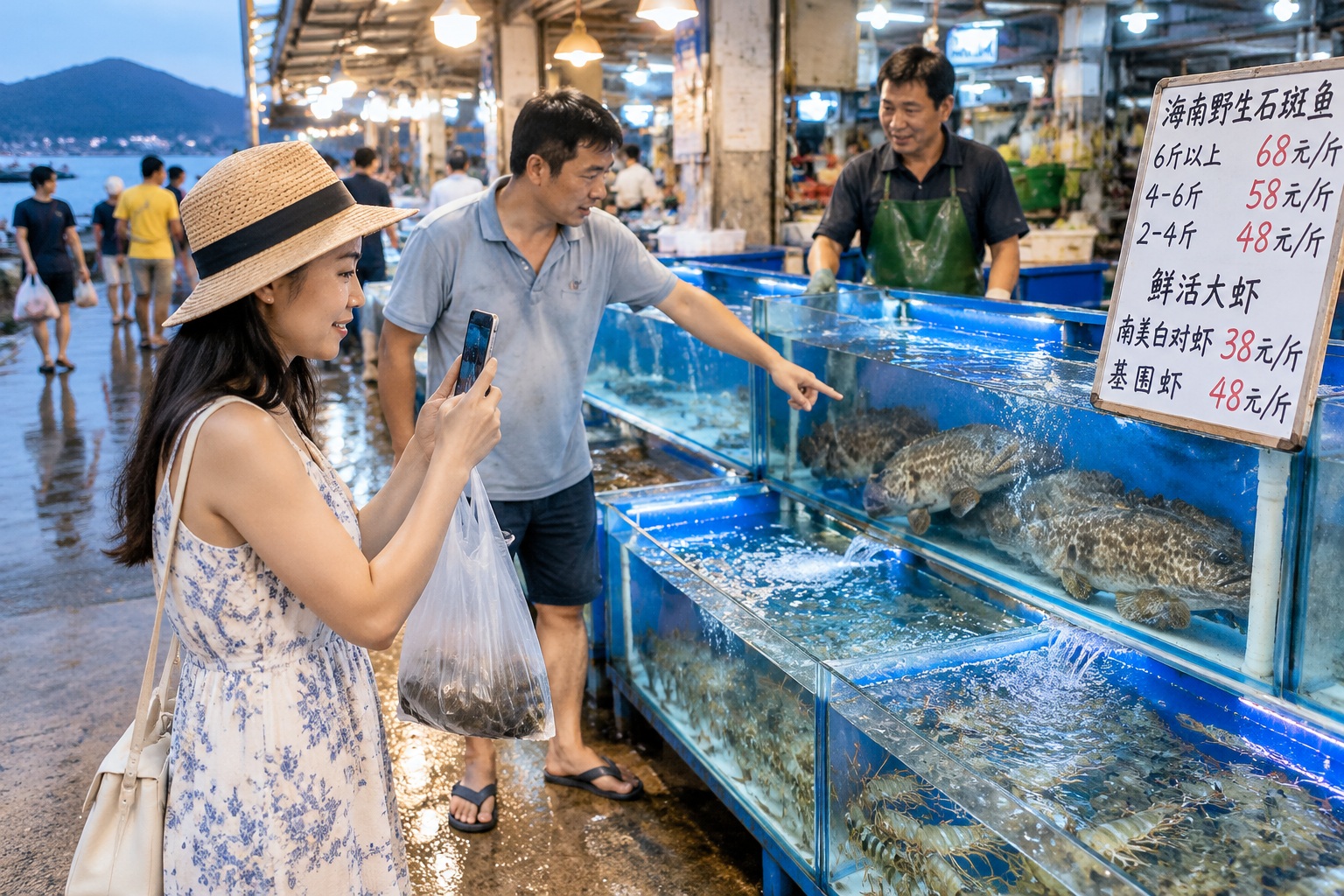

It’s 6:40 on a Tuesday evening, and the aisle between the fish tanks at Sanya’s First Market fits about one and a half people. A woman in a straw hat, with the slightly panicked tan of someone who rented a scooter yesterday, holds an empty plastic bag and photographs a price board: grouper, 68 yuan a jin. She is fairly sure a jin is 500 grams. She is extremely sure she’s about to be overcharged.
Two meters away, a man in flip-flops doesn’t look at the board at all. He nods at a stall he has bought from for eleven years, tilts his chin at a particular fish, and keeps walking — because that fish now needs to get to a cooking shop on Xinmin Street, where it will be steamed with soy and scallion for a fee, and he wants to beat the queue.
Same market. Same species. Possibly very different bills. That gap is what people argue about on the flight home. It’s also, once you slow down and look, a fairly ordinary piece of market mechanics.
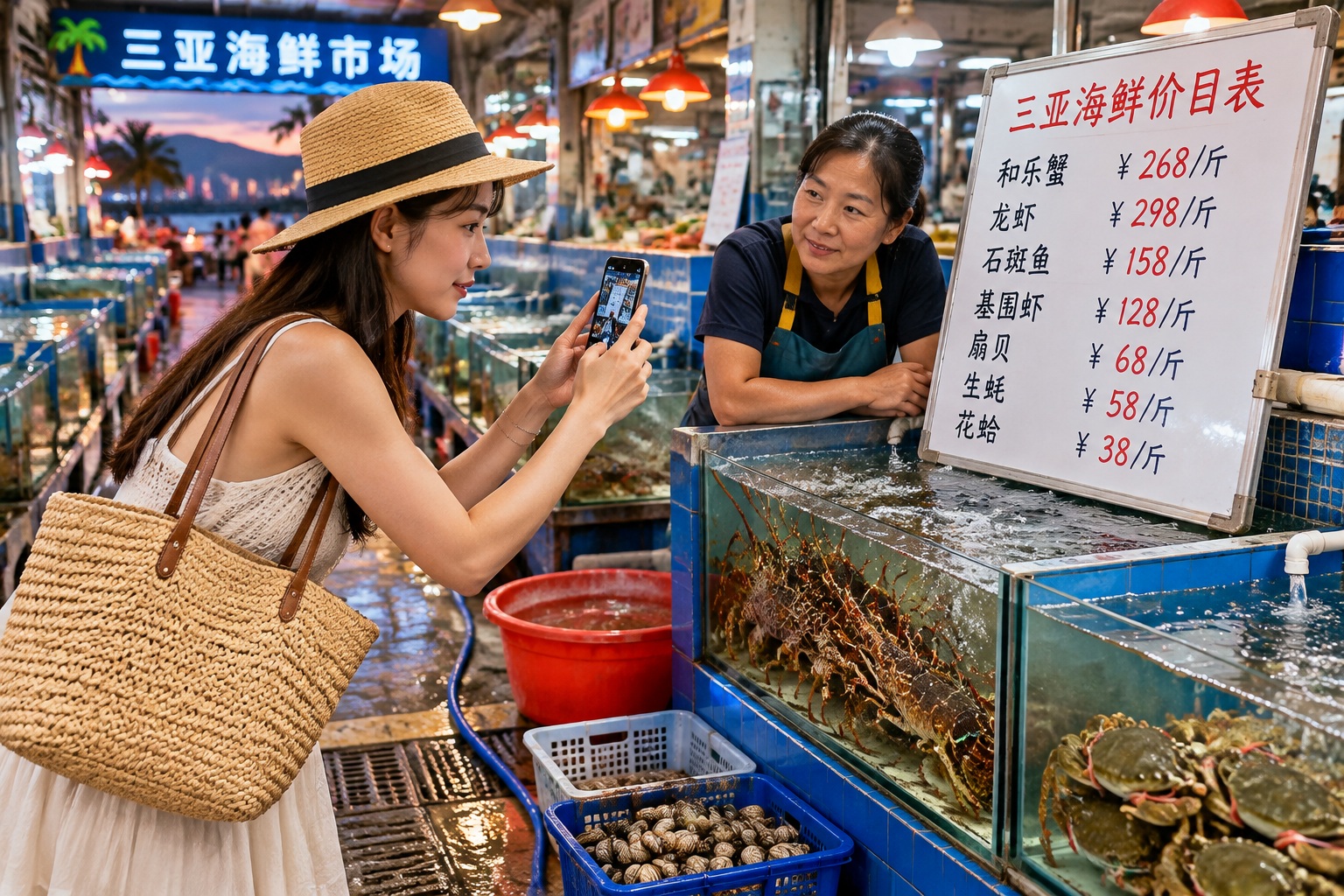
First, How This Market Actually Works
If you’re from a country where you order seafood cooked, the layout is confusing. Sanya’s seafood streets — First Market on Xinmin Street, Chunyuan Square, the big Huochezhan food plaza — are a two-step system.
Step one: you buy raw seafood from a stall with tanks. Step two: you carry it, dripping, to a nearby jiagong dian (加工店), a cooking shop that steams, fries, grills or garlic-steams your purchase for a fee charged by weight and by method. The cooking shop has tables, plastic stools, beer, and a queue at 7pm. It does not have its own fish.
So the price you pay for dinner is split across two businesses, and each one has its own logic. Most tourist confusion — and most of the shouting — comes from mixing those two up.
Why the Number Changes Every Morning
Fish lands at Yazhou Central Fishing Port before dawn, gets trucked to wholesale, then to market stalls that pay rent by size and location. A tank near the entrance costs more than one in the back row, and the vendor knows exactly how much of that rent each grouper has to carry.
Then there’s the calendar. The South China Sea fishing moratorium runs from May 1 to mid-August. Wild-caught supply tightens, prices climb, and certain species nearly vanish from the tanks. Farmed grouper holds steadier; wild grouper does not. A tropical storm parked offshore keeps boats in harbour for three days, and by day two the price of prawns is a different number entirely.
This matters because “yesterday it was 45, today it’s 65” is frequently true rather than a scam. It’s also, occasionally, a scam. The skill is telling them apart, and the tell is usually not the number — it’s whether the number is written down.
The Local Playbook
Watch a Sanya resident buy fish and you’ll notice they barely use sentences.
They ask shijia duoshao — “what’s the current price” — instead of reading the board, because the board is a starting point and the day’s real number moves. They look at the fish, not the sign: is it swimming properly, are the gills red, does the flesh spring back. They buy from the same two or three stalls for years, and that relationship is worth actual money. Regulars get a slightly better number, or a handful of small shrimp thrown in, or the vendor quietly pointing at today’s better-value catch. It isn’t charity. It’s how a stall builds a base that survives low season.
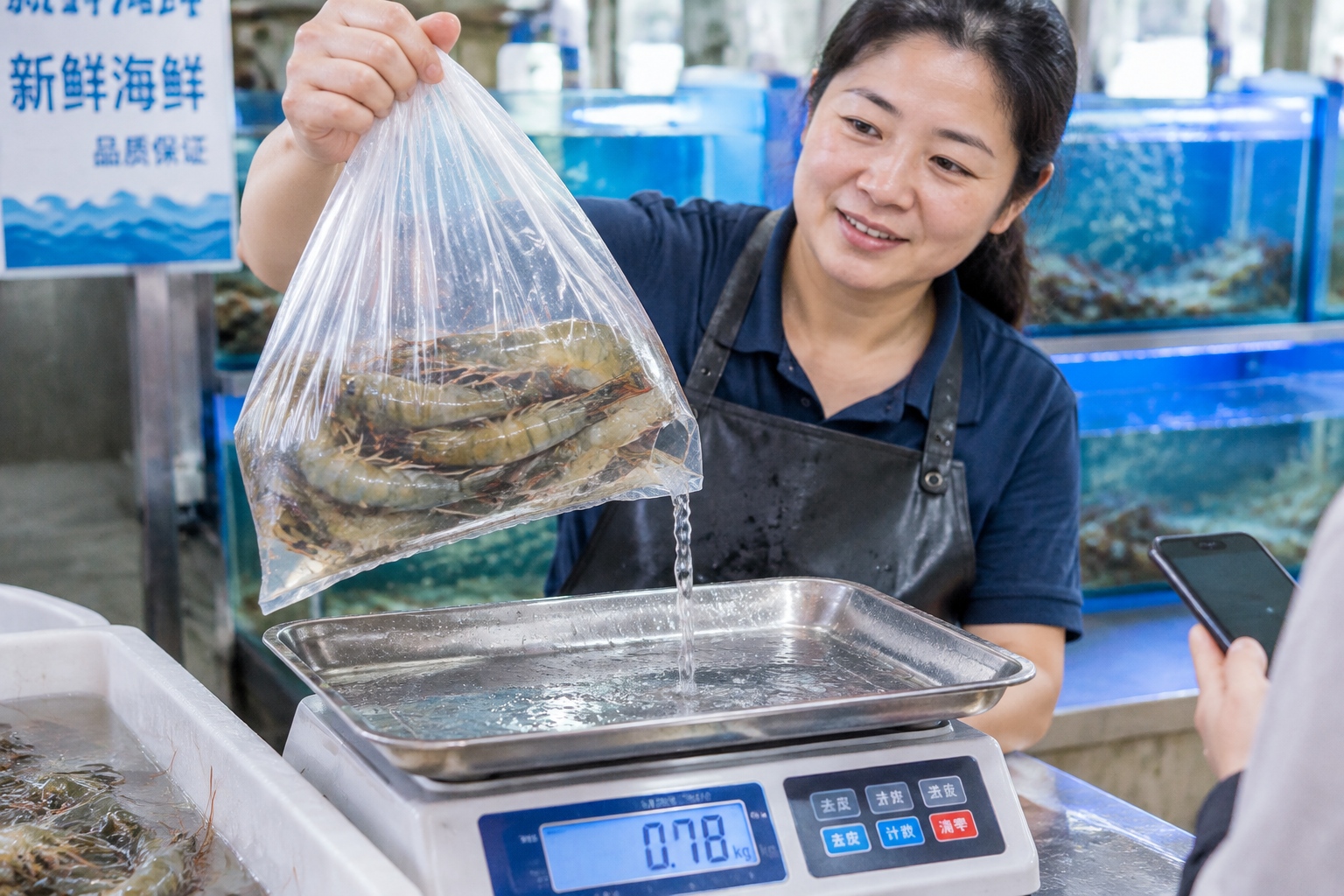
They also know the clock. Around 7:30–8pm, ice is melting, tanks are thinning out, and a vendor would rather sell at a discount than re-ice and hold stock overnight. Locals show up for that window. They buy in the morning for hotpot and in the evening for dinner. They ask the vendor to drain the bag — one poke of the finger, water out — before weighing. And they largely refuse to shop during Spring Festival or the October golden week, when the entire calculation changes and everyone knows it.
The Tourist Playbook
The visitor’s playbook is not stupid. It’s just built on different information.
Tourists arrive with screenshots: a review app rating, a short-video recommendation, a group-buy package advertised at 198 yuan for four people. Those packages exist and are sometimes fine. They also tend to involve smaller grades of seafood, or a cooking fee that isn’t in the headline price, or a set designed around whatever the kitchen has too much of. Read the fine print and the arithmetic usually reconciles.
The genuine risk isn’t a conspiracy; it’s a knowledge gap. Someone who doesn’t know that a large mud crab and a medium one can differ by 80 yuan will accept the first number offered. Someone who doesn’t ask “is the cooking fee included” will find out at the till. Someone who doesn’t look at the scale has no idea what happened on the scale.
The fix takes about three questions, asked out loud, in this order: How much per jin? Can you drain it before weighing? How is the cooking fee calculated? Vendors answer all three without drama. The ones who get irritated by question two are telling you something useful.
What’s Really on the Bill
Take a 400-yuan dinner for three. Roughly half is seafood: a 1.2-jin grouper, a jin of mango snails, a jin of prawns. The rest is cooking fees — typically 10 to 25 yuan per jin depending on method, with garlic-steamed and salt-and-pepper costing more than plain steaming — plus rice, drinks, and a coconut.
The cooking fee is where most misunderstandings live, because it’s charged on the raw weight and the method both. A three-jin fish costs more to cook than a one-jin fish even though it’s the same instruction: steam it. Ordering four dishes means four lots of fees. Nobody is hiding this, but nobody explains it either.
Behind the seafood price sits rent, staff, ice, and the pumps that run twenty-four hours a day to keep a tank of grouper alive in subtropical heat. A stall in a high-traffic tourist market carries a visibly higher rent than one three streets back, and that rent is in every number on the board. It’s the same reason airport sushi costs more than street sushi. Unpleasant, not mysterious.
The Fair Scale by the Door
Here’s the part that has changed most in the past decade. At the entrance of Sanya’s main seafood markets there is a public scale, usually green or blue, bolted to the floor, with a hotline number printed above it.
That scale is the residue of a very public reckoning. Sanya’s seafood scene went through serious scandals and heavy crackdowns, and what came out the other side is a fairly dense layer of everyday governance: price boards that must list the species, grade and per-jin figure; electronic scales with lead seals that can’t be quietly recalibrated; spot checks; complaint lines that actually get answered; and QR codes at some stalls that lead to origin and inspection information.
None of this makes cheating impossible. It makes cheating expensive and conspicuous, which is most of what regulation can realistically do. For a visitor, the practical move is simple: after buying, walk to the fair scale and weigh the bag. Vendors who have been accurate all along don’t mind. The other kind will suddenly remember an urgent errand.
The Quiet Upgrade: Phones, Off-Peak, Repeat Customers
The most interesting shift isn’t regulatory. It’s behavioural, and it’s happening on both sides of the tank.
Younger locals compare prices in WeChat groups before they leave the hotel, and a number of vendors now run those groups themselves: today’s catch, today’s number, who wants two jin held back. Tourists under 35 do a version of the same thing — short videos, price screenshots, a group chat comparing what three different stalls quoted. Twenty years ago, information asymmetry lasted a whole holiday. Now it lasts about forty minutes.
Locals have shifted their shopping to off-peak hours. Some vendors have shifted their business model toward repeat customers, because a full tank at 9pm is a loss and a loyal WeChat group is not. And visitors, slowly, are learning the local grammar: ask the price, watch the drain, check the scale, ask about the cooking fee before sitting down.
Dinner, Eventually
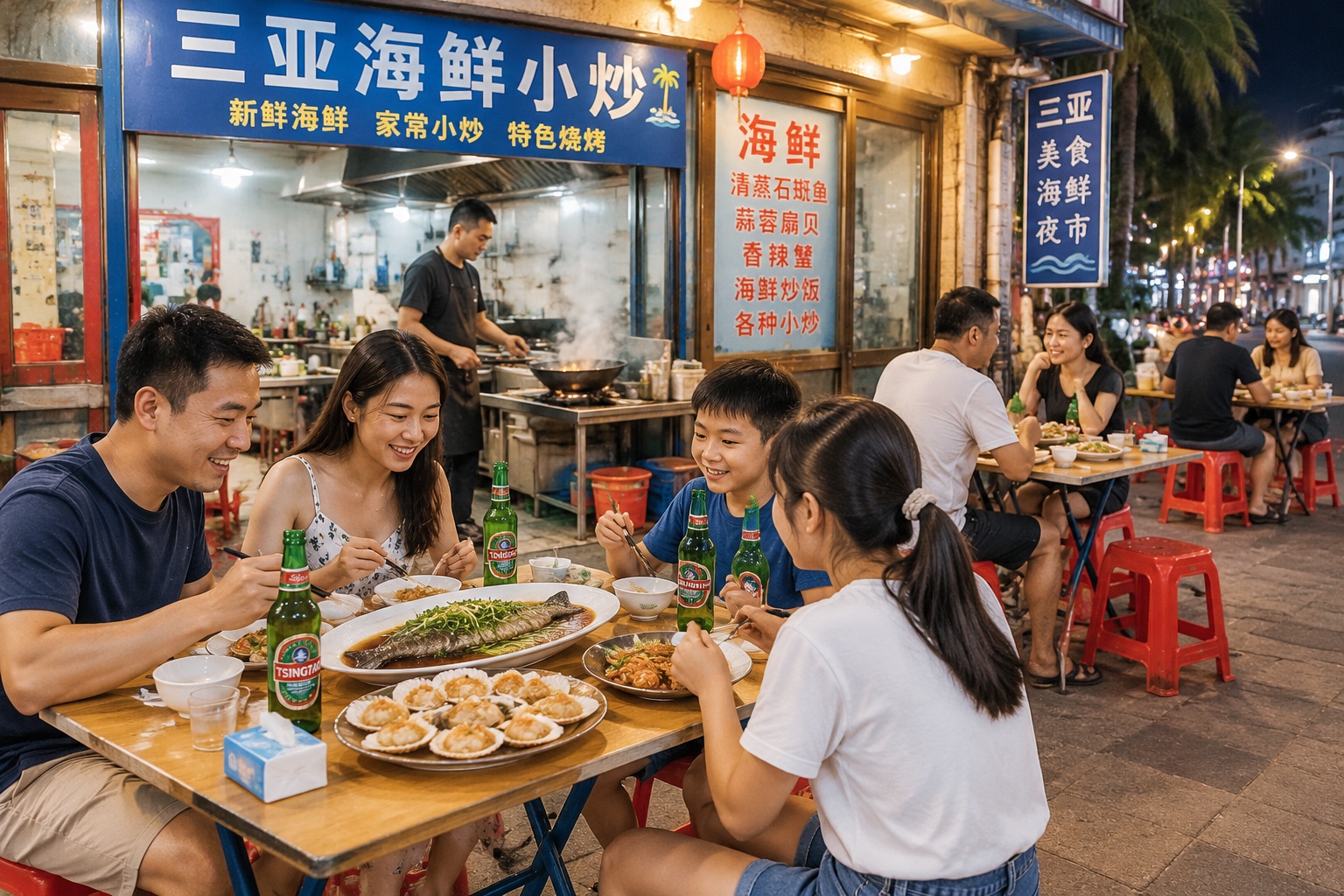
By 8:15, the woman in the straw hat is sitting at a folding table two metres from the man in flip-flops. Both are eating grouper. Her bill is maybe fifteen percent higher than his. She has also, in the past hour, learned what a jin is, what a fair scale looks like, and why the price of prawns went up after the storm.
The most Sanya thing about these prices isn’t that they’re high. It’s that they’re negotiable, seasonal, and legible — if you know which three questions to ask. The market isn’t a trap. It’s a market, with a learning curve, and the curve is short. The only person still guessing is the one who just landed.

Start the discussion at forum.chinacomes.com