
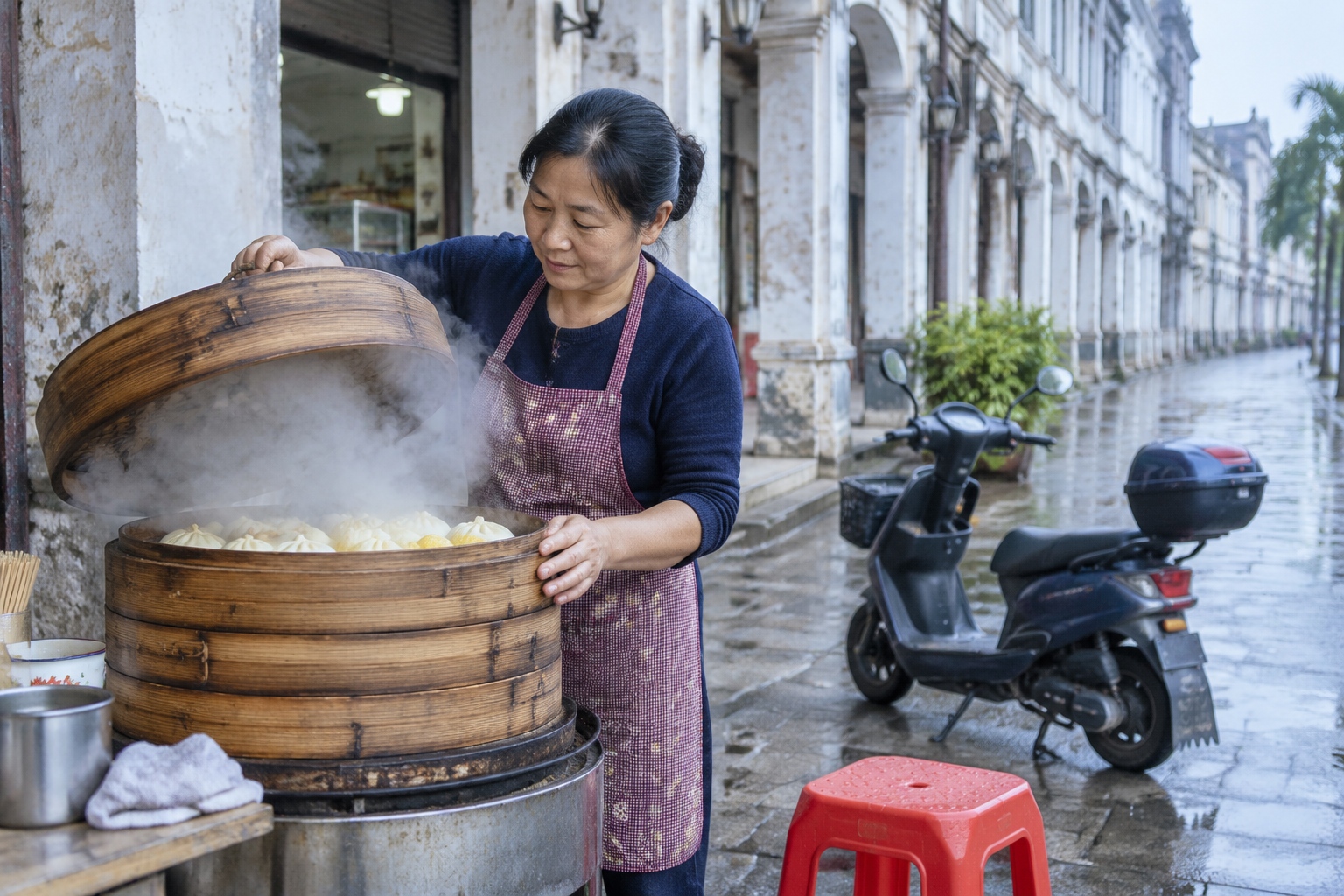

5:50 a.m. on Bo’ai Road
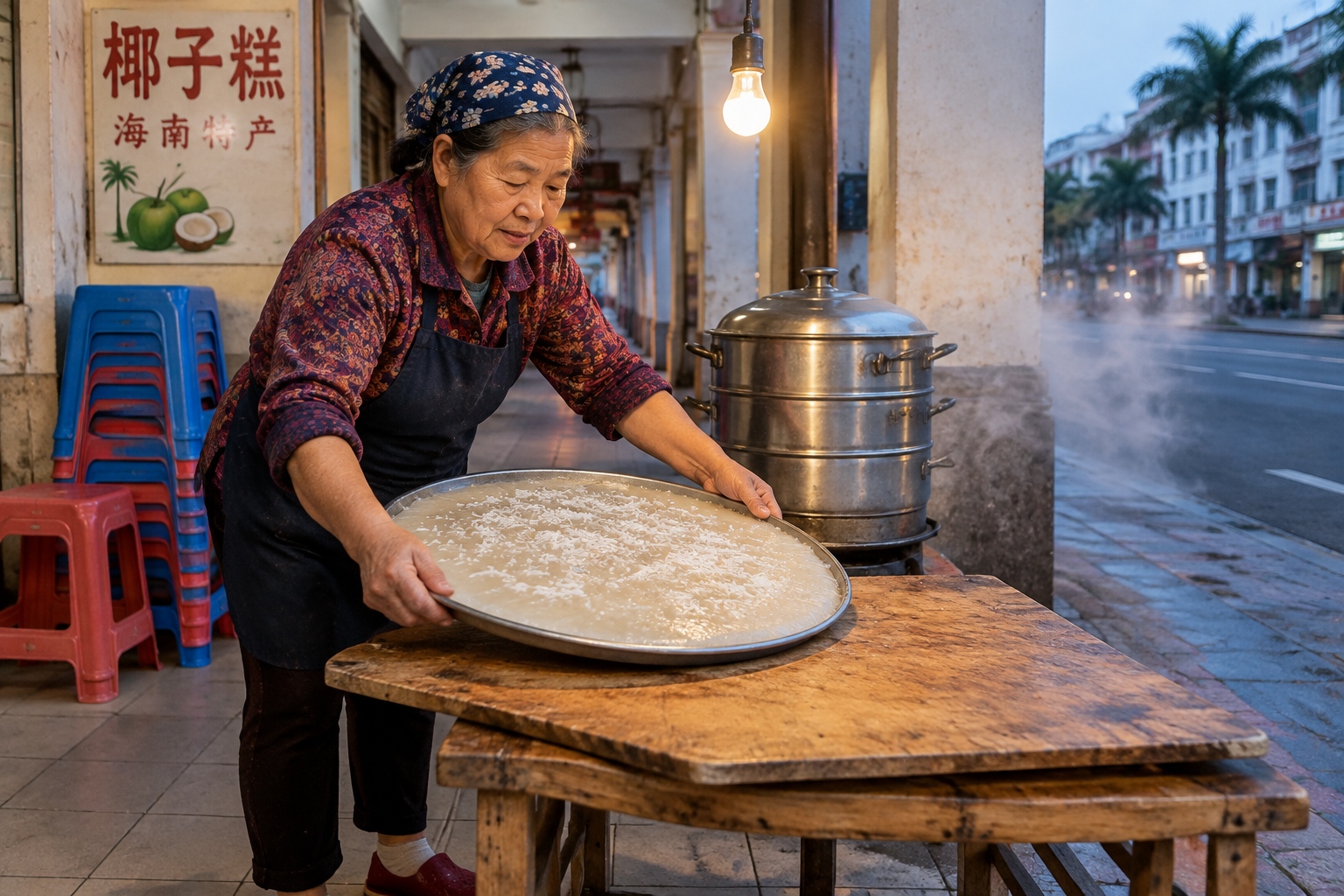
The sky over Haikou is still the colour of wet slate when the lid comes off the steamer. Steam rolls out under the arcade and disappears into the dark. A woman in her fifties — everyone on the block calls her Fen Yi — slides a wide, shallow tray onto a wooden board and sets it down with both hands. Inside is a slab of coconut cake the size of a baking sheet: pale, faintly translucent, still trembling.
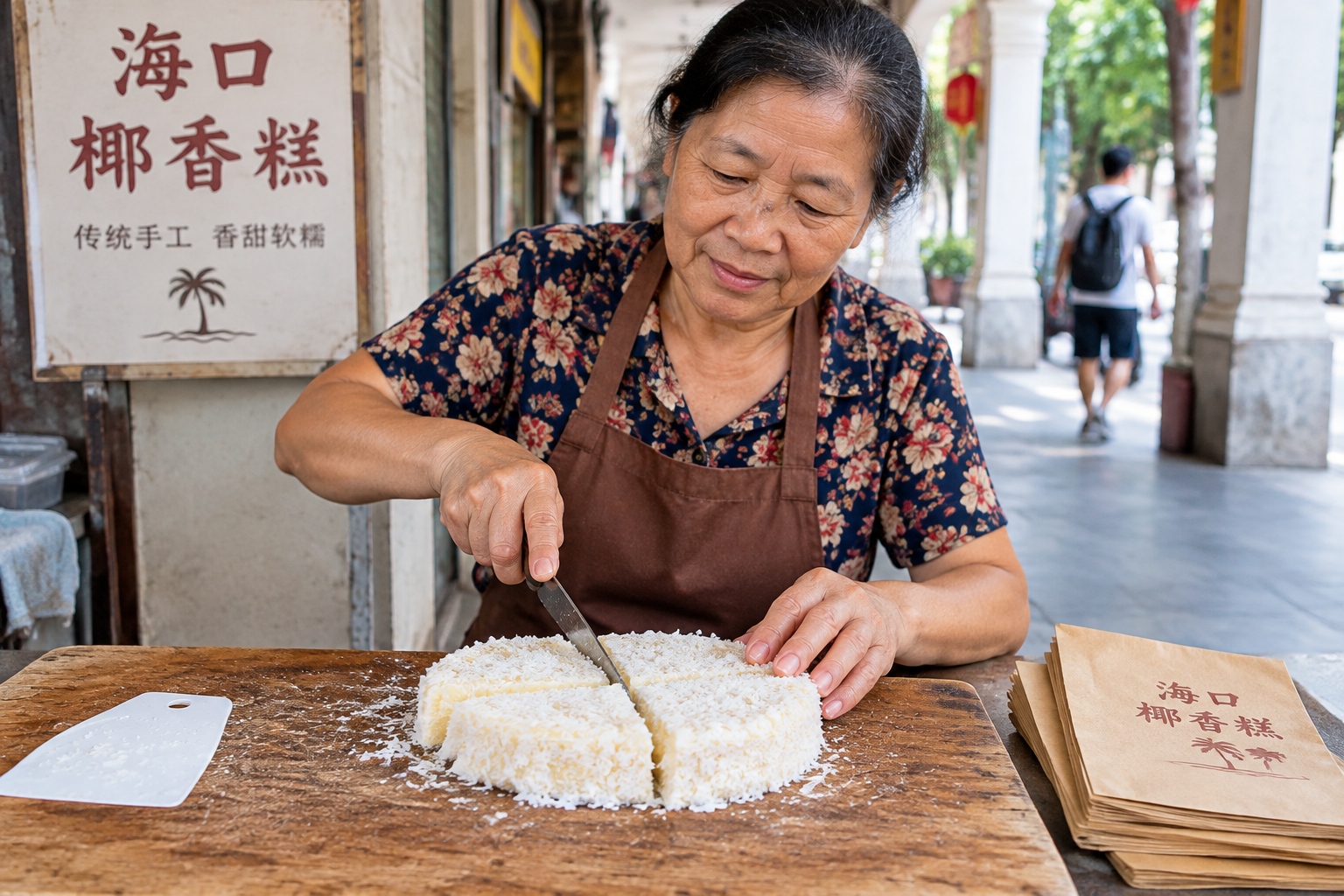
She waits a minute. Then she cuts. A thin knife goes in with a small squeak, comes out, and leaves a diamond behind. Cut, lift, stack. The blade taps the board maybe two hundred times before the tray is empty.
By 6:10 there is a line of three people. By 6:40 there are eleven.
The geography matters here. Haikou sits at the northern tip of Hainan, the tropical island at China’s southern edge, and its old quarter is built in a style called qilou — arcade buildings. The ground floor of each building is pushed back behind a row of columns, leaving a covered walkway three metres deep. In a place that gets 40°C afternoons and sudden rain in any month, that walkway is not decoration. It is shade, shelter and, from about 5:30 in the morning, the largest dining room in the neighbourhood.
What coconut cake actually is
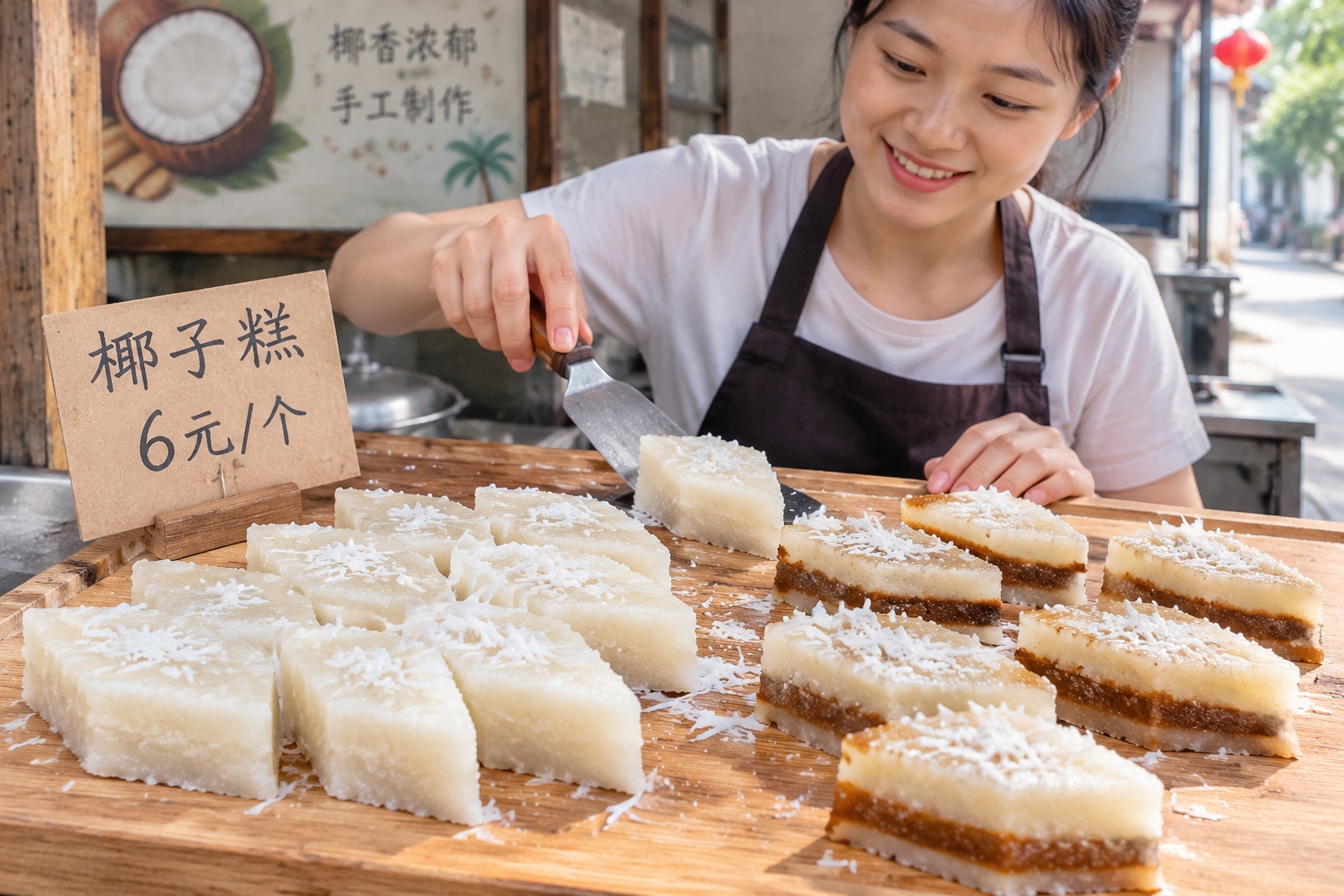
The Chinese name is ye nai gao — literally ‘coconut milk cake’ — though on the street you will also hear ye zi gao. It is not a baked cake, and it is not a pastry. It is closer to a firm pudding.
The recipe is short. Grated mature coconut is squeezed for milk, sometimes twice: the first press is thick and goes into the batter, the second, thinner press loosens it. Rice flour and a smaller amount of glutinous rice flour go in with white sugar and a pinch of salt. Some stalls add a thin brown layer made from palm sugar, which is why you occasionally see a slice with two colours. The mixture is poured into a tray and steamed for about forty minutes, then left to set as it cools. It is sold cold or at room temperature, never hot.
Texture is the point. A good piece sits somewhere between a Vietnamese bánh da lợn and a Japanese mochi: soft enough to yield to the tongue, firm enough to be picked up with two fingers without collapsing. Coconut arrives first, then sweetness, and the finish is clean rather than milky. A slice costs two to three yuan, or about ten yuan for a box of five — roughly the price of a single espresso in most cities where readers of this piece live.
Hainan grows coconuts. That sounds obvious, but it explains a lot. In Beijing a coconut dessert is a novelty; here it is breakfast, in the same way that a croissant in Lyon is not really a ‘French pastry’ but simply what is on the counter at seven in the morning.
Four kinds of breakfast eaters, four clocks
The same two metres of counter serves four completely different speeds.
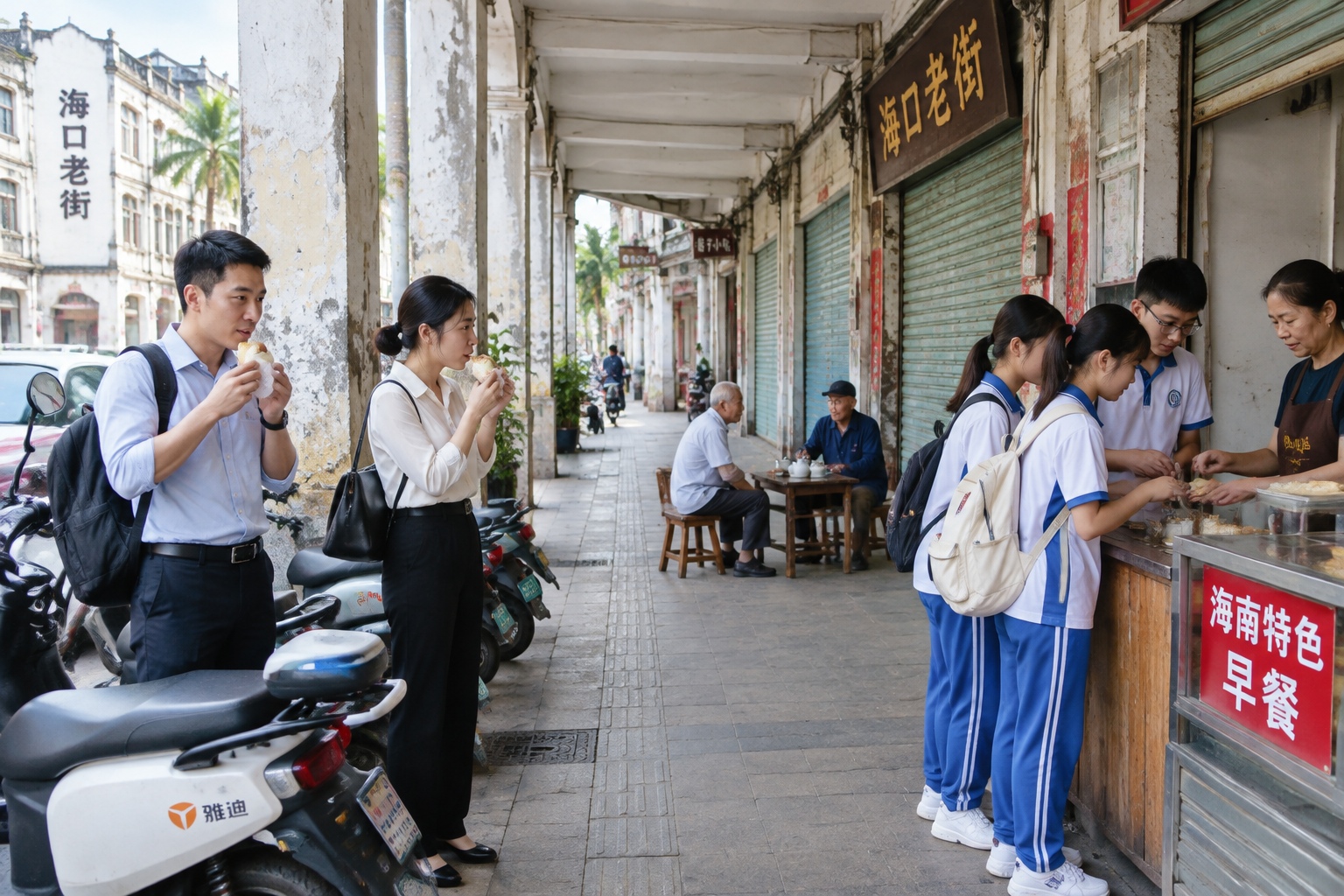
The first customers are retired men, who arrive between 6:00 and 6:30. They buy three or four pieces, wrap them in paper and carry them two doors down to a laoba cha house — ‘old dad tea’, the Hainanese institution where you order a pot of tea for a few yuan and sit for two hours. Nobody hurries them. The tea is refilled. The conversation is about weather, grandchildren, and whose building is being repainted.
The second wave, around 7:00, is shop staff and office workers. They do not sit. They buy a box, tuck it into a bag, and eat it standing at the kerb or balanced on the seat of an electric scooter waiting at the lights. Fen Yi knows most of them by their order: two pieces, no brown layer, one bag.
The third wave is students in white and blue uniforms, from about 7:20. They arrive in groups of four or five, pool their coins, and negotiate over who gets the corner piece, which is always bigger.
The fourth wave turns up at nine, carrying phones on gimbals. They ask what it is, photograph it, and often leave without buying anything, which Fen Yi finds funny rather than annoying.
The interesting thing is not that Haikou has a charming breakfast culture. It is that one cheap counter absorbs the schedules of an entire street: retirees with time, workers without it, children with small money, visitors with questions. Very few institutions in a modern city still do that.
The arcade as a shared living room
The covered walkway does something specific: it blurs the line between inside and outside.
The stall occupies a recess about two metres wide at the front of a shophouse. Chairs migrate outward through the morning — a plastic stool left by a customer, a low bench borrowed from the noodle shop next door, a wooden chair that belongs, technically, to nobody. An elderly woman will sit on that chair for an hour, greet everyone by name, and watch the neighbouring shop’s till while its owner eats.
This is not sentimentality. It is functional urban design. In a tropical city, air-conditioned space is expensive and exclusionary; a shaded arcade is free and open. Haikou’s old quarter has several hundred of these buildings, most put up between the late 1800s and the 1930s by Hainanese families who had made money in Southeast Asia and brought the style home. They have served as shops, warehouses and homes, and during some decades as considerably less than that. The arcades survived because they are useful, not because anyone protected them as heritage — though today they are protected as heritage too.
The clock inside the stall
Ask Fen Yi about her day and the romantic version of street food evaporates quickly.
She is up at 3:40. Rice has to be soaked; coconut has to be grated, or bought pre-grated from a supplier who arrives on a scooter at four. Steaming starts at 5:15 so the first tray is cool enough to cut by 5:45. She sells until about 10:30, cleans, buys supplies and sleeps in the afternoon. Her husband handles the buying; a niece helps at weekends.
On a decent morning she sells around 250 pieces. Do the arithmetic: at two and a half yuan, that is a little over 600 yuan in revenue, before coconut, flour, sugar, gas, the stall fee and the informal arrangements that come with any pavement business. A small shopfront on the renovated stretch of the old street now rents for several thousand yuan a month, which is real money against a two-yuan cake.
The business works at volume, on a narrow margin, and on the fact that Fen Yi has occupied this exact spot for twenty-two years. Her daughter has an office job in Haikou’s new downtown and no intention of taking over the steamer. Fen Yi mentions this without complaint, the way people mention the weather.
When the old street became a destination
The old quarter has changed around her. Zhongshan Road, the most photographed of the arcade streets, was repaved and pedestrianised in stages from around 2010 and now has uniform signage, restored facades and a nightly flow of visitors. Hainan’s free trade port policies have pulled new residents and duty-free shopping into the city; short-video platforms have pulled in everyone else.
For a stall like Fen Yi’s, the effect is mixed and very concrete. Tourist foot traffic means she can sell out by ten instead of eleven. It also means the shop two doors down, which sold rice noodles for thirty years, is now a coconut dessert café charging 28 yuan for coconut jelly in a glass jar with a wooden spoon. Rents on the street have followed. Some neighbours took the buyout and moved; others, like her, stayed and started accepting orders through delivery apps from customers three kilometres away who will never see the arcade.
Whether this counts as decline or adaptation depends on which side of the counter you stand on. What is clear is that the street’s primary function has partly shifted. It used to be where the neighbourhood ate; it is increasingly where the city shows visitors what the neighbourhood used to eat. Both things happen at once, on the same pavement, before nine in the morning.
The city is also fragile in ways that are easy to forget. When Typhoon Yagi hit Hainan in September 2024, it tore roofs and shutters off exactly this kind of old building. For a fortnight, much of the breakfast trade moved indoors or stopped.
What a two-yuan slice keeps
At 9:40 the tray is down to corners and crumbs. Fen Yi scrapes the board with a plastic scraper, folds the last three pieces into paper and hands them to a man in a singlet who has been waiting without saying anything. He pays, sits on the chair that belongs to nobody, and eats them in four bites.
It would be easy to turn this into a story about nostalgia, or about how ‘real’ local life is disappearing. That would be too neat. The coconut cake is not a relic. It is a working product at a working price, made before dawn by someone who has calculated exactly how many pieces she needs to sell, and bought by people who mostly do not think about it at all.
What makes it worth noticing is the combination: a breakfast that costs less than a bus ticket, a shaded public space that costs nothing to use, and a schedule loose enough that a retired man and a hurrying student can share the same counter. Cities usually lose these things quietly, one rent increase at a time. In Haikou, for now, the steamer still comes off the heat at 5:45, and the street still smells of coconut before the sun is properly up.
Start the discussion at forum.chinacomes.com