
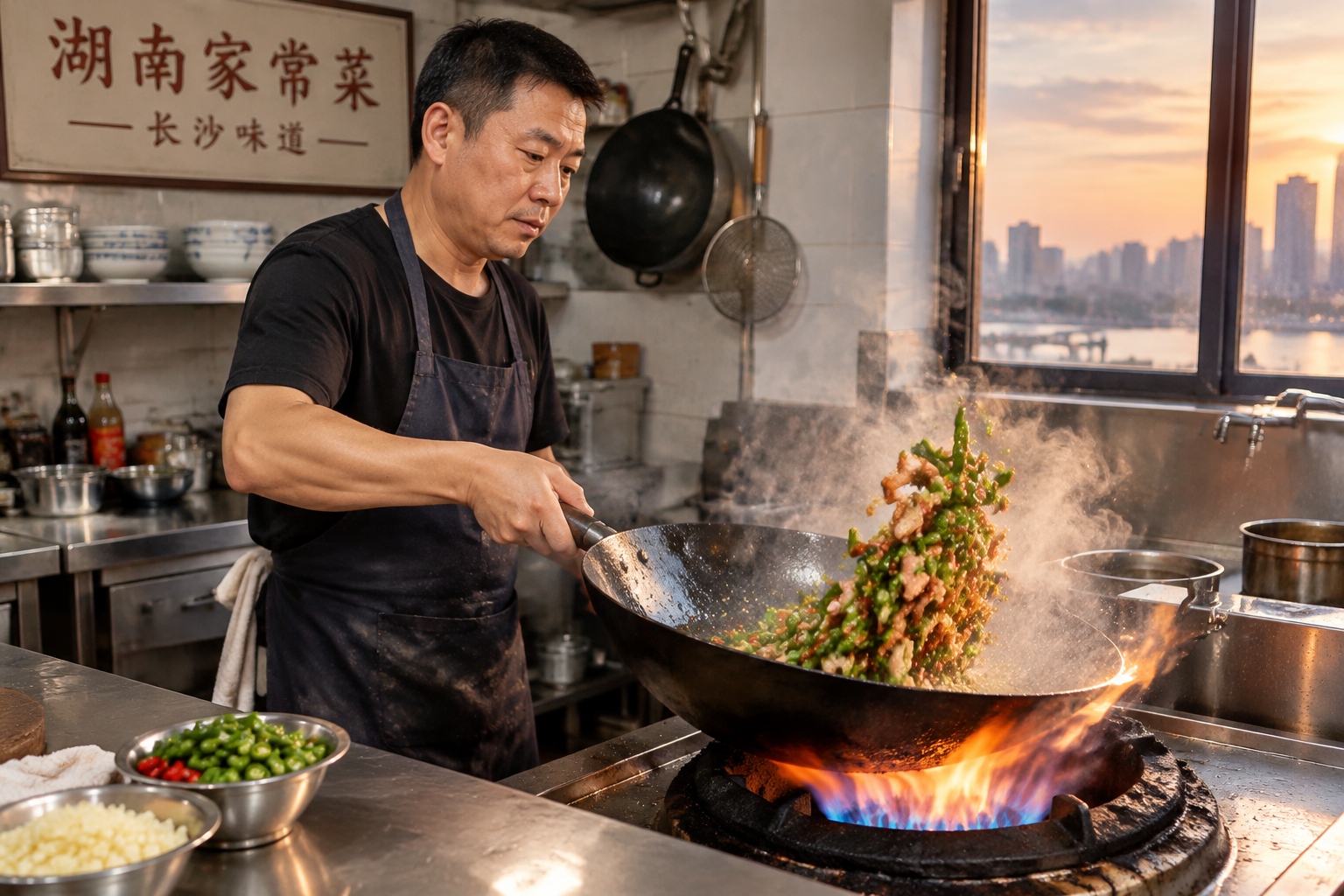

At 6:10 p.m., the Wok Speaks First
On a side street in Changsha, a 28-seat Hunan restaurant is already half full. Chef Liu Jian, 46, stands at a burner in the back. He turns the gas up until it roars like a small jet engine. He waits. Then he flicks water from his fingers into the wok. The drops skitter across the black metal and vanish. He pours a thin ribbon of oil. A handful of green chilies goes in. The sound is not a gentle sizzle. It is a short, angry crackle. Smoke, pork fat and chili hit the dining room before the plate does.
“This is guo qi,” Liu says. In Cantonese it is called wok hei. In Hunan, cooks still use the older phrase. It is not a sauce or a seasoning. It is a moment: hot carbon steel, a little oil, dry food, fast movement. Hunan food, or Xiang cuisine, is often reduced to heat and chilies. It is also sour, fermented, steamed and cured. But the wok is the public face of the cuisine, and wok hei is the thing customers notice first.
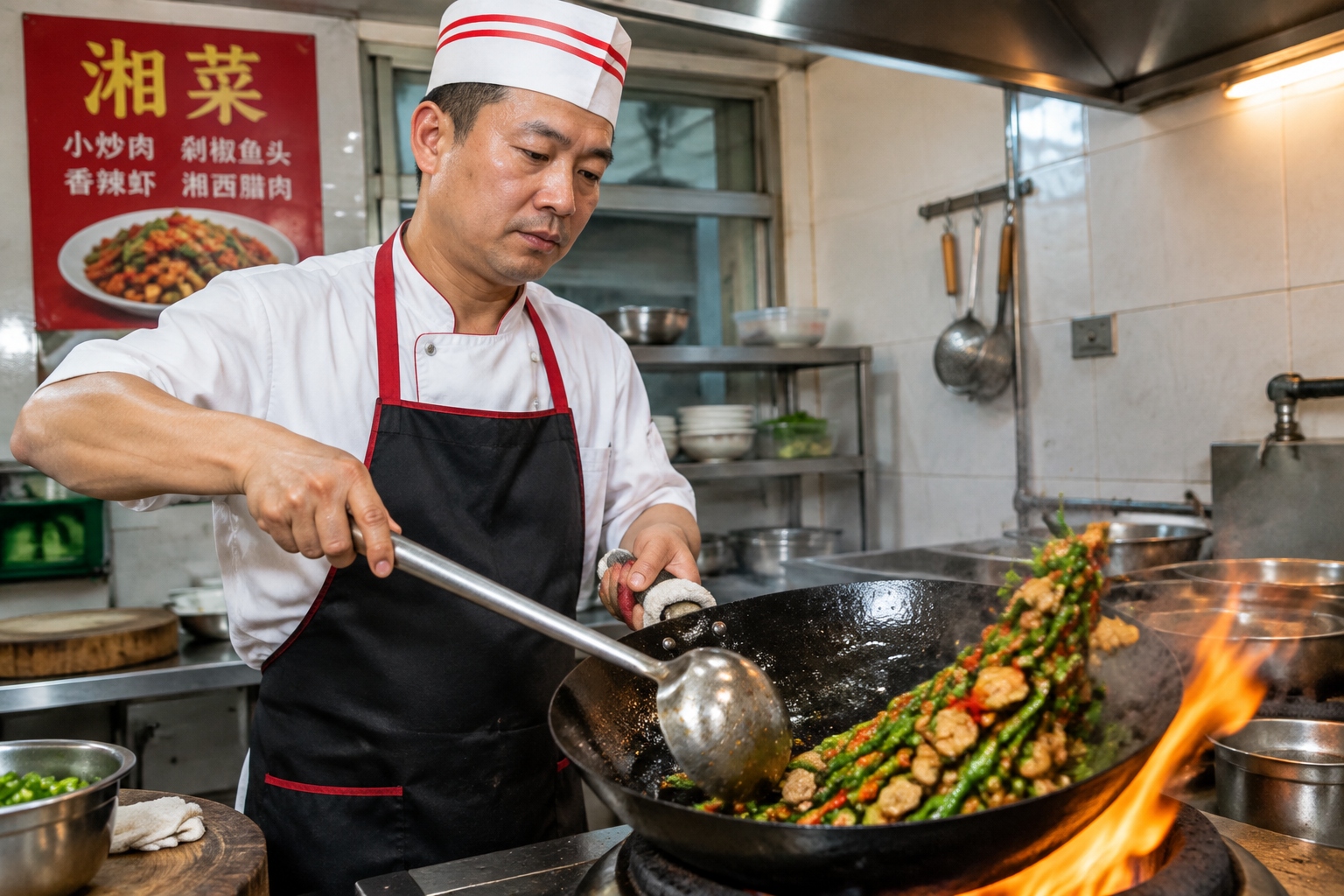
What Does Wok Hei Actually Taste Like?
It is easy to make wok hei sound mystical. It is not. When a carbon-steel wok is hot enough, a drop of water evaporates almost at once. Food hitting the surface loses surface moisture and browns instead of steaming. A thin film of oil carries aromatics and heat. Tiny droplets of oil and volatile compounds become the smoke you smell. The toss is not theater. It keeps the food moving so new surfaces keep touching the metal. Crowd the wok and the temperature drops. The food releases water, the pan cools, and you get a wet stir-fry instead of a seared one.
At home, you can get close: preheat the wok hard, cook in small batches, use a high-smoke-point oil, and do not add too much sauce at the start. But restaurant wok hei comes from a burner built for a restaurant and a cook who knows when to stop. The taste is not one single flavor. It is a sharper edge: the chili still has bite, the pork is tender but not watery, the sauce clings instead of pooling. “You can’t see guo qi,” Liu says. “But your mouth knows.”
The 90-Second Plate: Hunan Chili-Fried Pork
The test dish here is chili-fried pork, or lajiao chao rou. “If a Hunan chef can’t cook this, I don’t care what else he can do,” Liu says. At 6:12, he slices pork shoulder and separates the fat from the lean. The green chilies are long, wrinkled and medium-hot. He smashes them with the side of a cleaver and cuts them into rough strips. Garlic is chopped. There is no cornstarch and no long marinade. A little light soy sauce, salt, maybe a few fermented black beans.
He dry-fries the chilies first, pressing them against the wok with the back of a spatula. Salt goes in. When the skin blisters and the raw edge softens, he removes them. Then the fat goes in. It renders. The lean pork follows and sears. Garlic. The chilies return. A splash of soy. A fast toss. He counts under his breath, though he would not call it counting. The whole thing takes about 90 seconds. He watches the pork edges. When they curl and the sauce coats but does not pool, it is done. “If you wait for the perfect moment,” he says, “it’s already late.”
He does not garnish. The plate goes out immediately. “If it sits, it dies,” he says. It is not poetic. It is fact. The steam softens the peppers, the sauce separates, the wok hei fades.
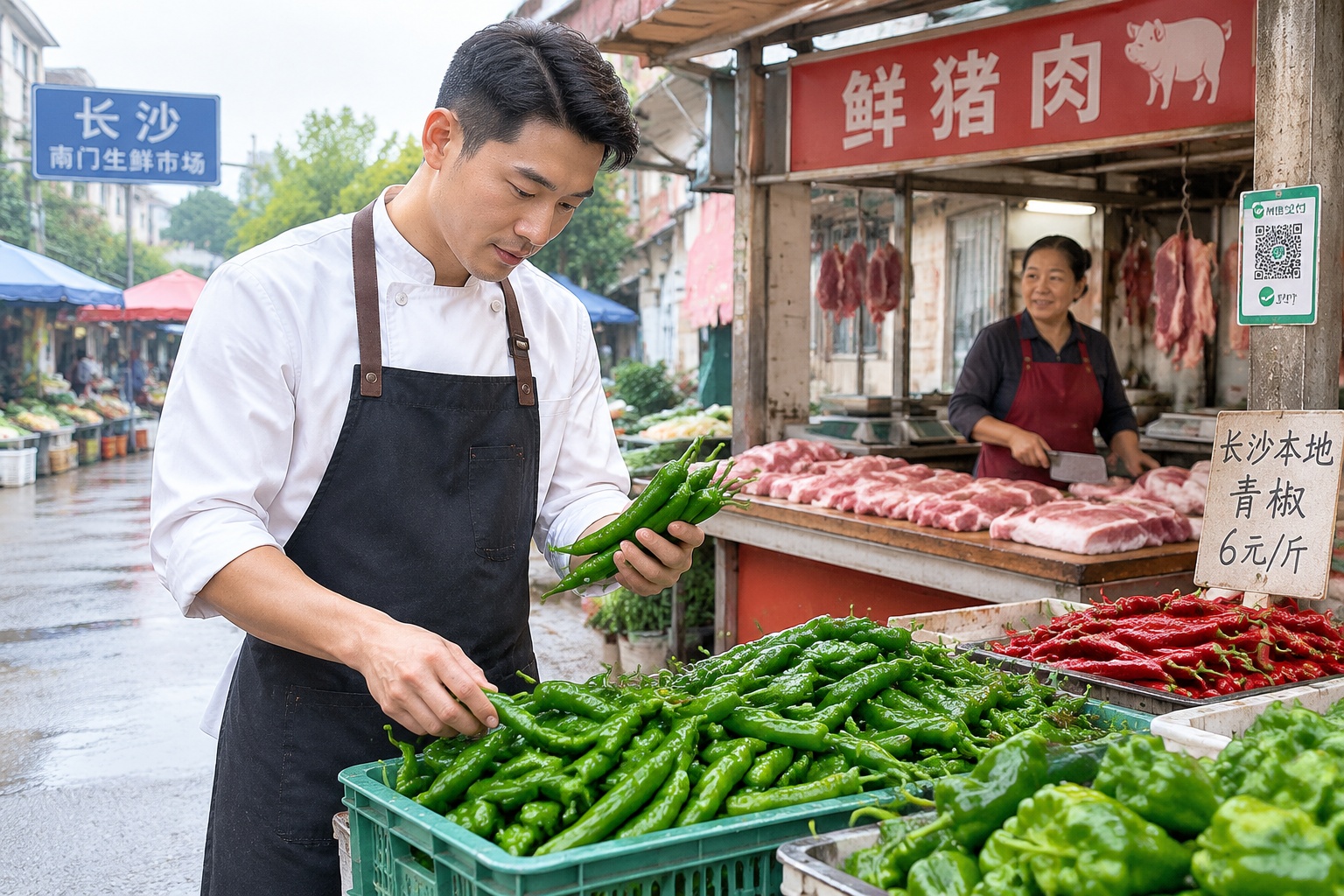
A Chef’s Day, From Market to Last Order
At 7:30 a.m., Liu is at a wet market near the restaurant. He buys green chilies, pork shoulder, garlic and ginger. He breaks the stem of a chili to check for snap. He looks at the pork fat, not just the lean. At 9 a.m., the kitchen becomes a prep line: slicing, washing, stacking bowls. At 11:30, the lunch rush starts. Office workers, delivery riders, a couple of students. At 2 p.m., the staff eat one dish and rice. Prep starts again at 4:30. Dinner runs from 5:30 to 9:30. By 10:30, the kitchen is clean.
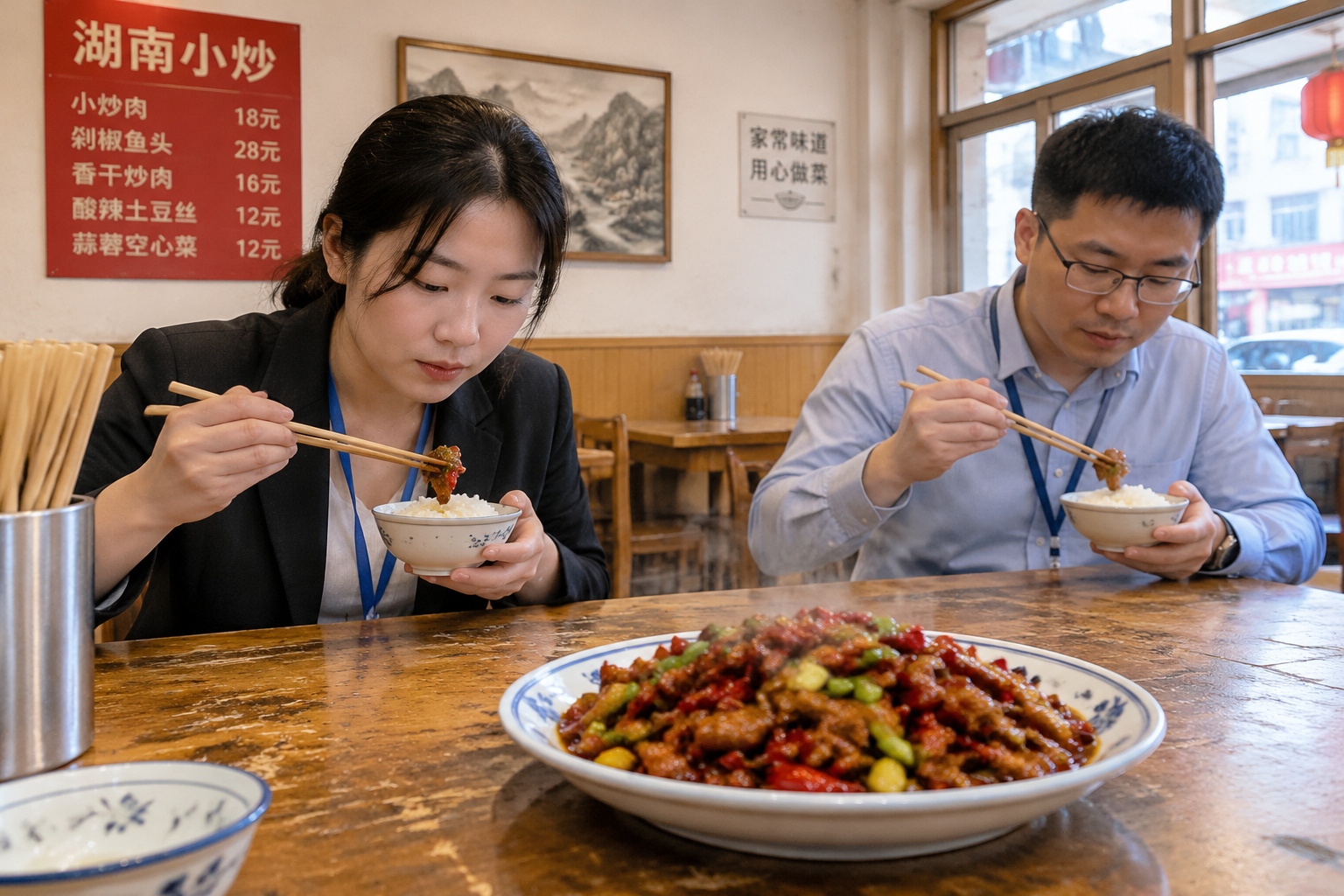
The economics are tight. A plate of chili-fried pork sells for 38 yuan, about $5.30. Rent is in the low five figures in yuan per month. There are two kitchen helpers, one server, gas, and ingredients. A delivery order lists at 42 yuan, but platform commission, discounts and packaging can take a fifth or more. A good weekday brings 120 covers; a rainy one brings 60. Liu uses delivery apps because customers do, but he steers delivery customers toward braised dishes and rice bowls. “Wok hei doesn’t survive a 30-minute scooter ride,” he says.
Heat Is Technique. The Job Is People.
His apprentice, Xiao Zhang, is 23. He can toss a wok without dropping the food. What he cannot always do is read it. “He watches the flame,” Liu says. “I listen to it.” When the wok is too cool, the sound is flat. When it is too hot, the chilies scorch before the pork is cooked. Learning wok hei means learning the sound, the smell, the way the oil moves.
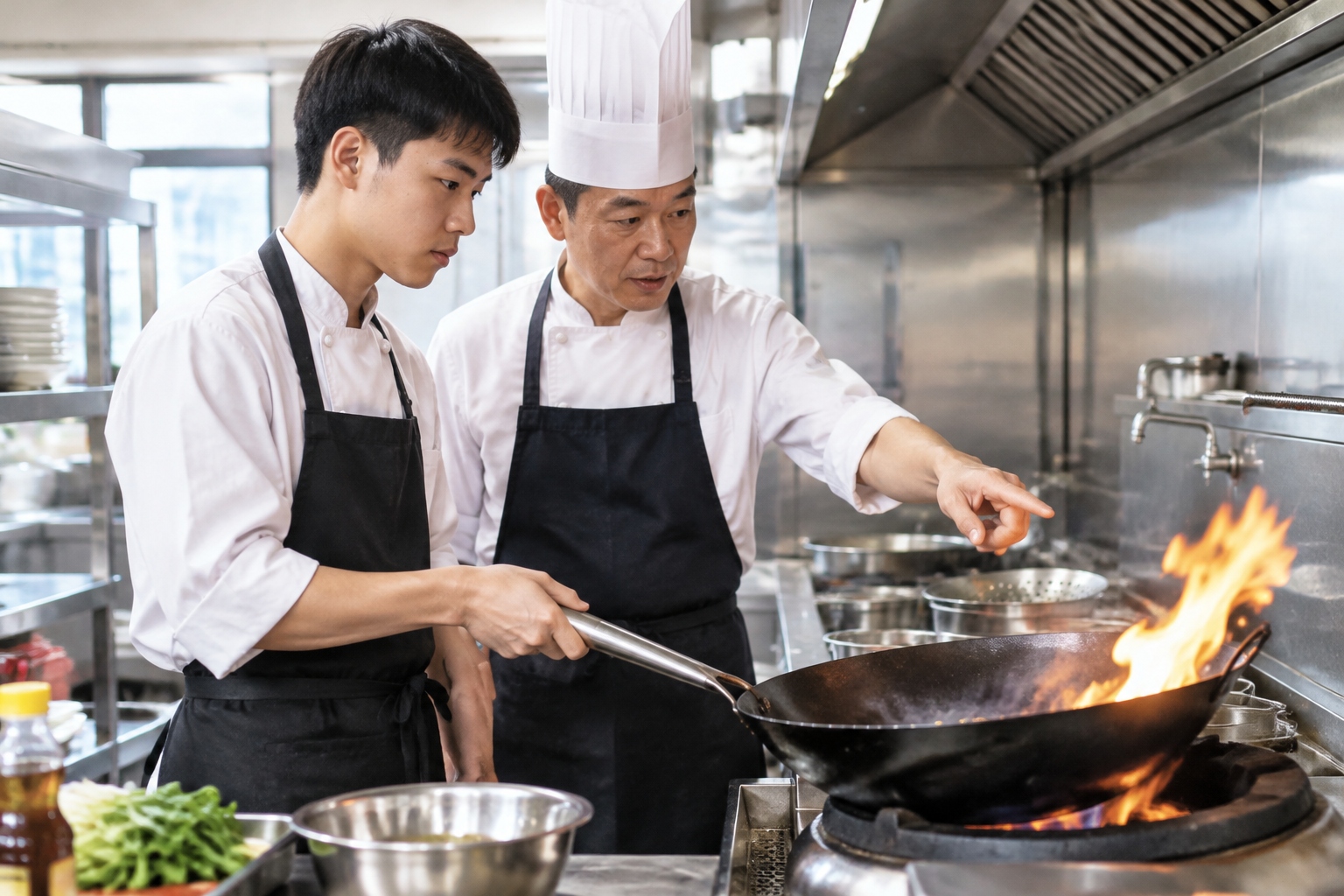
Not many young people want this work. “Twelve hours standing, smoke in your clothes,” Liu says. “The pay is not Silicon Valley.” He laughs. But he keeps one apprentice. “If he stays two years, he can run a station.” The job is also the customers. A regular asks for less salt because of blood pressure. A young couple wants extra spicy. A mother orders a takeout box of chili pork for her son. This is not a grand community. It is small. “The same people come,” Liu says. “If the dish changes, they tell me.” Sometimes he refuses. “If you want no oil and no salt, don’t order this dish. Order the steamed egg.”
How Hunan Cuisine Is Changing
Ingredients have changed. Twenty years ago, chilies were seasonal. Now supply chains bring them year-round. Mostly that is better. But local peppers in late summer still taste different. “A chili that travels three days is still a chili,” Liu says, “but it is tired.” Competition has changed too. Hunan restaurants are everywhere in China, including chains with standardized recipes and bright signs. Liu’s edge is not the word “authentic.” It is the wok. Chains can be consistent, but they cannot reproduce the same char at scale. Customers care about price, speed and air conditioning. His lunch set is 32 yuan; a chain’s is 28. He survives on regulars.
Health habits are shifting. Diners ask for less oil and less salt. Liu uses leaner pork, drains the oil, adds more peppers. “But if you take away all the fat, it isn’t the same dish,” he says. “It becomes a stir-fry, not Hunan food.” He does not pretend otherwise. The balance is practical: keep the flavor, lose some of the heaviness, and do not lie to the customer about what a dish is.
Dinner, After the Fire
At 8:40, a table of four orders chili-fried pork, stir-fried greens and steamed fish head with chilies. A father, mother, daughter and grandmother. The daughter, maybe 10, picks out the pork. The grandmother eats the peppers. They talk over each other. Liu glances from the kitchen pass. He does not go out. He wipes the wok. The burner is off. The kitchen smells of smoke and soap.
Wok hei is not a slogan. It is the 90 seconds when heat, oil, chili and pork meet. It is also the man who has done it for 20 years, the apprentice who is learning, the regular who asks for less salt. The fire is visible. The human part is quieter. That is the real breath of the wok.
Start the discussion at forum.chinacomes.com