
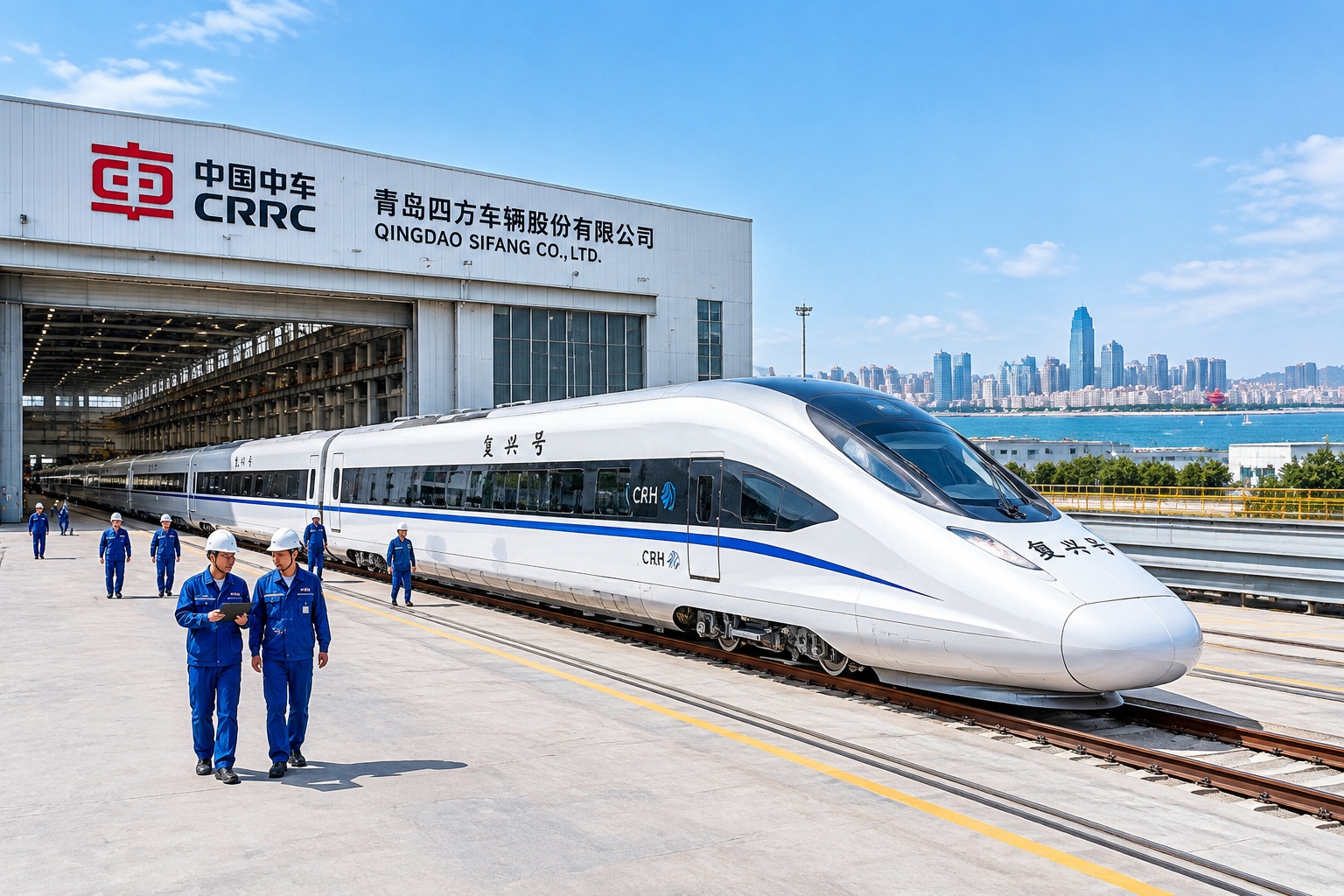

Inside the Factory Where China’s Bullet Trains Are Born
On the outskirts of Qingdao, a coastal city known for its beer and beaches, a sprawling industrial complex covers more than seven million square meters. This is where some of the world’s fastest trains take shape. Every day, workers in blue overalls weld aluminum alloy car bodies, robotic arms precisely install thousands of cables, and engineers in control rooms analyze performance data in real time. The result is the Fuxing (Rejuvenation) bullet train, a machine that carries millions of passengers daily across China at a commercial speed of 350 kilometers per hour.
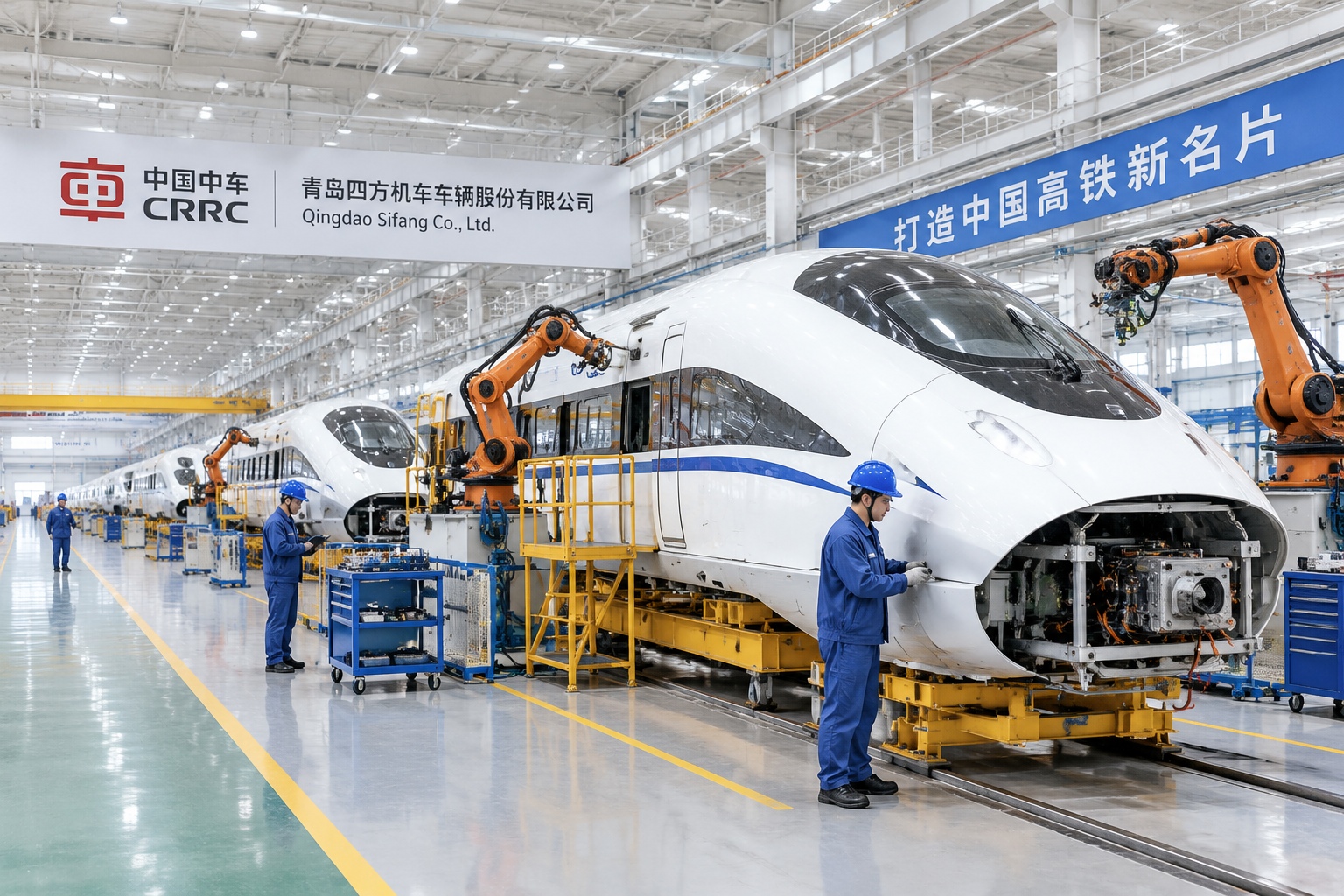
But Qingdao’s involvement in rail is not just about production. The city has evolved into a complete ecosystem for rail technology, encompassing research, design, testing, and maintenance. Understanding how this ecosystem emerged helps explain the broader narrative of China’s modern industrial rise—a story of intentional planning, massive investment, and continuous learning.
Qingdao: A City Built on Rail
Qingdao’s railway heritage stretches back over a century. In 1900, the German colonial administration built a line connecting the city with the Chinese interior. That early infrastructure laid the groundwork for a culture of engineering and manufacturing. Today, the state-owned CRRC Qingdao Sifang (also known as CRRC Sifang) is one of the largest rolling stock manufacturers in the world. According to official company figures, it has delivered more than 2,000 high-speed train sets, including the CR400 series of the Fuxing, which now dominates China’s high-speed network.
The factory itself functions like a small city. It covers 700,000 square meters and employs around 30,000 workers. Beyond the main plant, a network of more than 300 local suppliers has emerged. Aluminum sheets come from a nearby rolling mill in Shandong province; electrical components arrive from specialized industrial parks; even paints and adhesives are sourced from domestic firms. This close spatial clustering allows for just-in-time delivery and rapid iteration of designs. For example, if a component needs to be modified, an engineer can walk to the supplier’s workshop within half an hour.
This level of integration is a hallmark of Chinese manufacturing. It explains why China can develop and produce trains at a pace that rivals from Germany and Japan cannot easily match.
The Fuxing: From Foreign Designs to Homegrown Innovation
China’s high-speed rail program began in earnest in the early 2000s. Initially, it imported train technology from established players such as Siemens, Bombardier, and Kawasaki. The strategy was sensible: buying proven technology to quickly build a vast network. But Chinese engineers were never satisfied with just assembling foreign designs. They absorbed knowledge, modified components, and eventually decided to build a train that was entirely Chinese.
The result, the Fuxing, launched in 2017. More than 90% of its parts are made domestically, and the overall design is owned by Chinese engineers. The train’s distinctive aerodynamic nose, inspired by the Chinese crested tern (a fast-flying seabird), cuts drag and improves efficiency. In tests, the Fuxing has reached 420 km/h; in commercial service, it cruises at 350 km/h, the fastest operating speed in the world at present.
Technical innovations seem small but matter deeply. The Fuxing is fitted with more than 3,000 sensors, monitoring temperature, vibration, and pressure along the entire train. These sensors feed into a predictive maintenance system that alerts crews to potential failures before they happen. Compared to earlier generations, the Fuxing consumes 15% less energy per passenger kilometer. It also uses a modular interior that allows airlines-like reconfiguration—halving the time needed for maintenance checks.
The Toughest Test: Trains for the Qinghai-Tibet Railway
Not every track is a smooth, low-altitude corridor. The Qinghai-Tibet Railway, linking Xining to Lhasa, is the world’s highest plateau railway. It crosses permafrost, passes through tunnels above 4,000 meters, and reaches a peak at Tanggula Pass, 5,072 meters above sea level. At such altitudes, oxygen levels are only about 40% of those at sea level. Temperatures can swing from -40°C in winter to 30°C in summer. Such conditions would incapacitate a normal train.
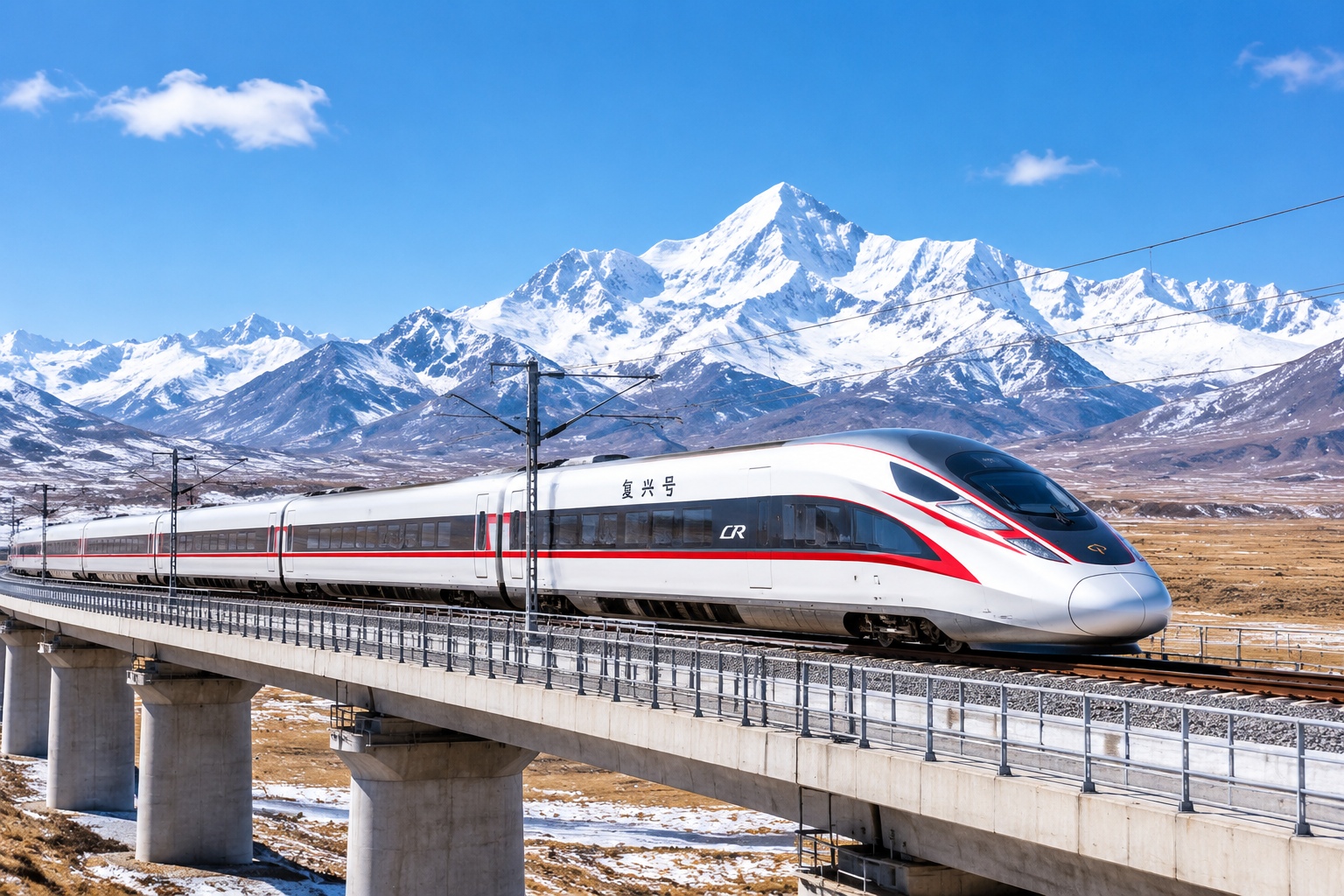
When the Lhasa–Nyingchi line opened in 2021, it was the first electrified railway in Tibet, and it required a new breed of rolling stock. The Fuxing EMU designed for high altitudes features sealed cabins that deliver supplemental oxygen automatically if levels drop. Windows block 95% of harmful UV rays, and a modified braking system accounts for thinner air. The train body itself uses a higher-strength steel alloy, and the roof is insulated against extreme cold.
The impact has been enormous. In its first year, the Lhasa–Nyingchi train carried more than one million passengers, according to China Railway. Travel time between the two cities dropped from six hours by road to just three and a half hours by rail. For local residents, this means better access to hospitals, schools, and markets. It also opens up tourism, bringing visitors into a region that was once extremely difficult to reach.
The Hands Behind the Machines: Workers and Engineers
Behind every high-tech train is an army of skilled people. Li Wenliang, a 32-year-old technician from Qingdao, joined CRRC Sifang in 2012 as an apprentice. Today, he leads a team responsible for installing the complex wiring that powers the train’s control systems. ‘On some models, we have over 50,000 separate cables,’ he explains. ‘Each one has to be routed exactly right. A single mistake could cause a failure at 350 km/h.’
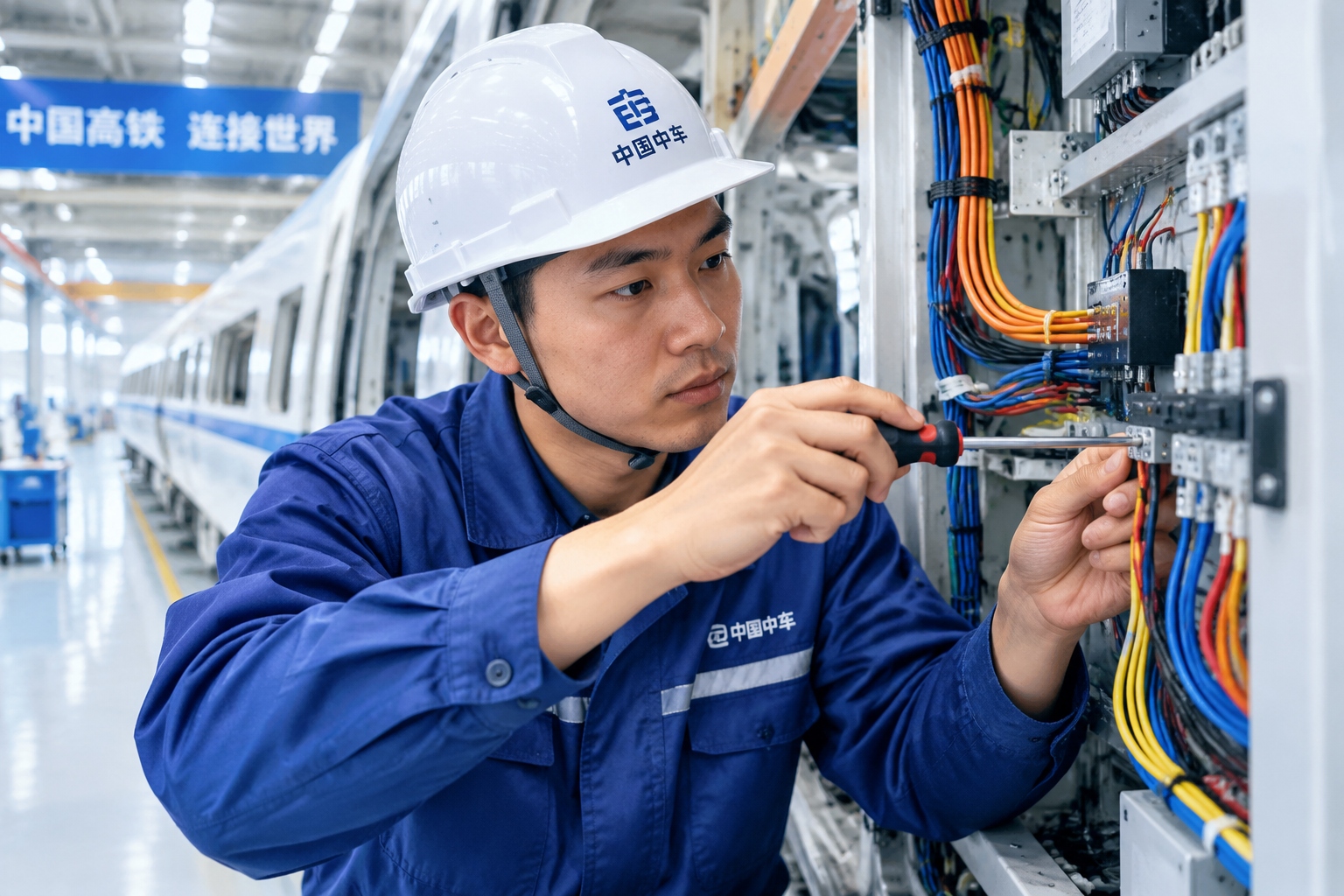
The company invests heavily in education and training. CRRC Sifang runs its own technical college and partners with local vocational schools to produce a steady pipeline of skilled workers. In the factory floor, apprentices shadow experienced masters for years before they work independently. As automation increases, jobs are shifting from manual handling to quality inspection. The plant now uses AI-based camera systems to detect tiny flaws in welding seams, and collaborative robots lift heavy components. But human judgment remains central; many final assembly steps are still done by hand.
Workers like Li embody a new generation of Chinese industrial labor: educated, meticulous, and proud of their craft. Their quiet professionalism is what keeps the trains safe and on time.
Going Global: Qingdao Trains Around the World
China’s rail ambitions now extend well beyond its borders. In 2023, the Jakarta-Bandung high-speed rail in Indonesia opened to passengers. It is the first high-speed railway in Southeast Asia, and its train sets were built in Qingdao. The project used a mix of Chinese and Indonesian track systems, but the rolling stock is pure CRRC product. Since then, China has signed export contracts with Turkey, Serbia, and Cambodia, and is negotiating projects in Hungary, Laos, and even Thailand.
These exports are not just about selling metal boxes on rails. For each contract, China includes a package of technical standards, signaling hardware, maintenance procedures, and training. This is how a country builds influence in the modern world—by becoming the default provider for a crucial technology. Compared with German and Japanese rivals, Chinese trains often offer significantly lower price tags and faster delivery times. A European transport analyst, speaking on condition of anonymity, said: ‘China gives you more train for the dollar. You have to look at the total cost of ownership.’
But there are hurdles. Some countries worry about debt risks and dependence on Chinese technology. Trade disputes and quality certifications also complicate exports. Still, Qingdao’s factories are busy, and the global market for high-speed rail is expanding, especially in the developing world.
More Than Machines: What This Means for China
In Qingdao, the rail industry is embedded in the fabric of daily life. Near the CRRC complex, new residential districts have sprung up, filled with workers’ apartments, supermarkets, and small restaurants that serve late-night noodle bowls to shift workers. At lunchtime, engineers crowd into walk-up cafes, often discussing software tweaks or test data. The company is so large that its presence shapes the local economy—from kindergartens to high-end hotels.
Passengers on Qingdao North Station may not know it, but many of the trains they board were built only kilometers away. The Fuxing has become a symbol of Chinese aspiration: fast, reliable, and stylish. For the Chinese government, it is a flagship of industrial policy, demonstrating how sustained investment in R&D can turn an importing country into an exporting innovator.
Yet the deeper significance lies in what it says about China’s ability to mobilize resources, organize complex engineering projects, and improve incrementally over years. The bullet train is not a miracle; it is a result of processes—both technical and human—that can be replicated across other industries. In that sense, Qingdao’s story is a lens through which to understand China’s new development model, one that prioritizes technological self-reliance, massive infrastructure, and a skilled workforce. And it is a story that is still being written, as new lines open, new trains roll out, and new markets call.
Start the discussion at forum.chinacomes.com