

6:40 a.m., by the Li River
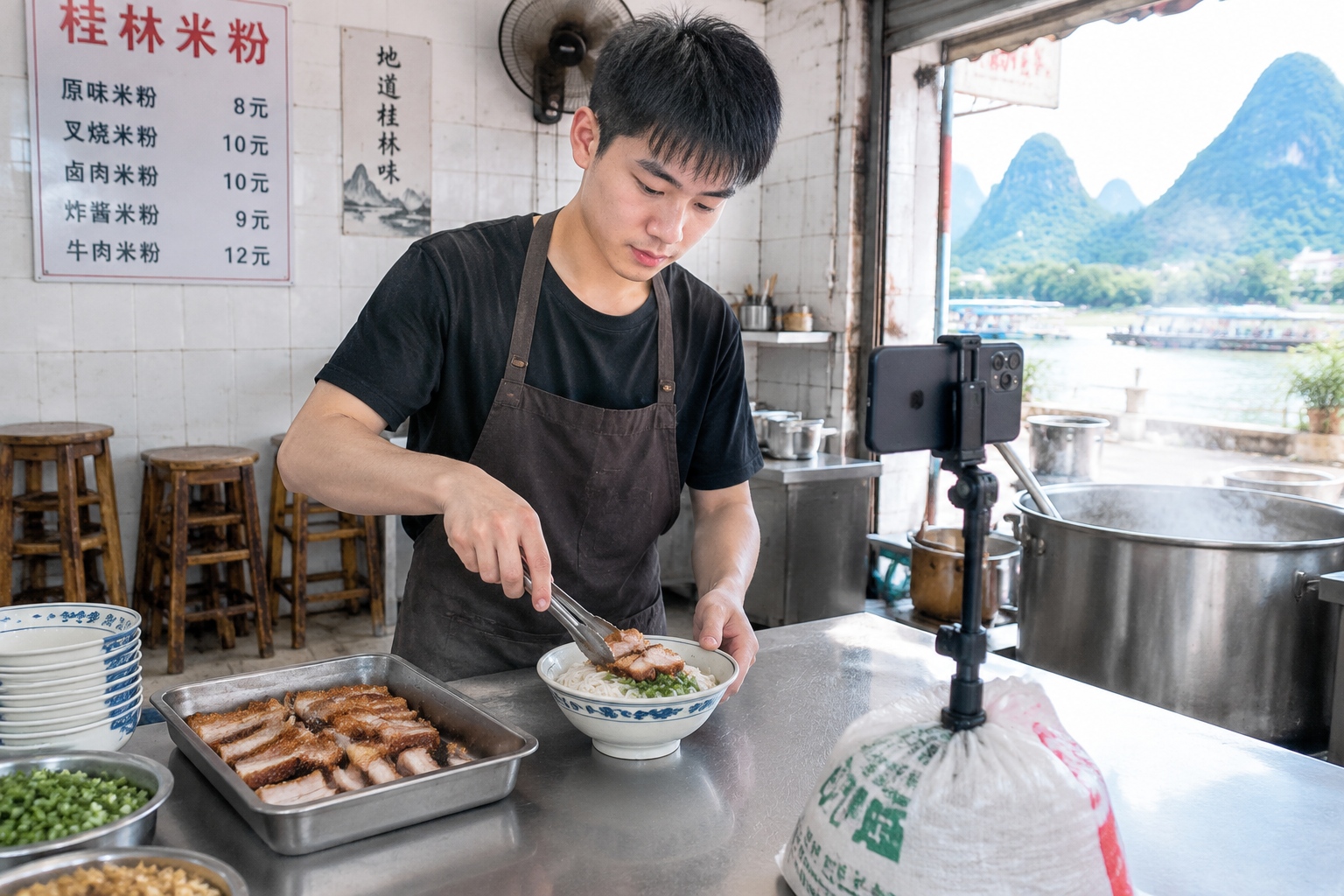
The mist hasn’t lifted off the Li River yet, but the noodle shop in Guilin’s Qixing district is already lit. Xiao Mo lifts the lid off the steamer. Steam billows to the ceiling. On the stove, a stock pot has been simmering for three hours — pork bones, luo han guo, a few Sichuan peppercorns. He pulls a phone from under the counter, mounts it on a tripod, and points it at his hands.
The knife lands on the cutting board. He is slicing guo shao — pork belly fried until the skin turns golden and crisp. The phone picks up the sound of blade meeting crackling skin. Later, he will add a line of text over the video: “The ritual of a Guilin breakfast.”
Xiao Mo is 23. In China, his generation is called “00后” — the post-2000s, roughly the equivalent of Gen Z in the West. His family’s noodle shop has been open for more than two decades. His grandmother sold rice noodles from a street stall in the 1980s; his mother later rented this storefront. Xiao Mo studied e-commerce at a vocational college. After graduating, he didn’t go to Shenzhen or Guangzhou. He came back.
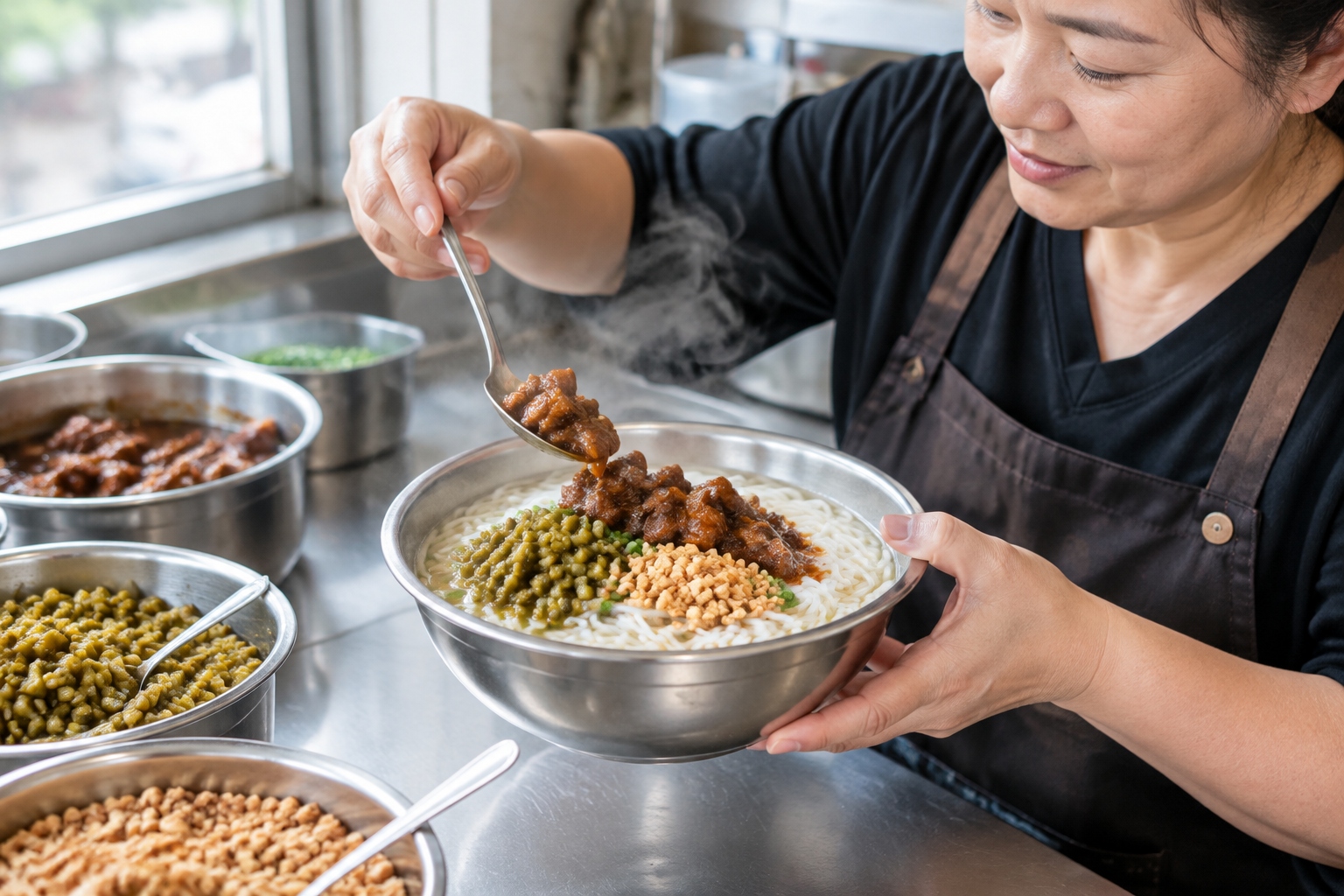
“My mom thought I was crazy,” he says, arranging sliced pork over a bowl of fresh rice noodles, then adding a ladle of braised broth, pickled green beans, and crushed peanuts. “She spent twenty years making this shop stable, and I come back and start filming the pot.”
A noodle shop learns to go viral
Guilin rice noodles are a staple of the morning diet in southern China. A bowl of lu cai fen — noodles with braised meat — typically costs five to eight yuan, roughly one U.S. dollar. It is the default breakfast: rich broth, tender meat, slippery noodles.
For decades, a noodle shop didn’t need marketing. A good location, consistent taste, and regulars from the neighborhood were enough. Xiao Mo did something different.
First, he replaced half the wall facing the street with glass — not a full renovation, he didn’t have the budget — so passersby could see the whole process: slicing meat, blanching noodles, ladling broth. The idea came from a noodle shop in Chengdu he saw on Douyin, China’s most popular short-video platform, similar to TikTok but run independently.
“Before, customers only saw a bowl arrive at the table,” he says. “Now they see how it gets there.”
Then he started filming. The first video was shaky, shot at 4 a.m. of his mother tending the stock pot. It got a little over 200 views. The third video — him pulling noodles from boiling water with long chopsticks, narrated in the Guilin dialect — reached 40,000.
By the summer of 2023, his account had more than 60,000 followers. On weekends, a line formed outside the shop. Young people came from other parts of Guilin, some riding electric scooters from Yangshuo, twenty kilometers away.
“Before, my customers were all neighbors,” he says. “Now someone comes from across town just to take a photo of a bowl of noodles.”

What the camera sees
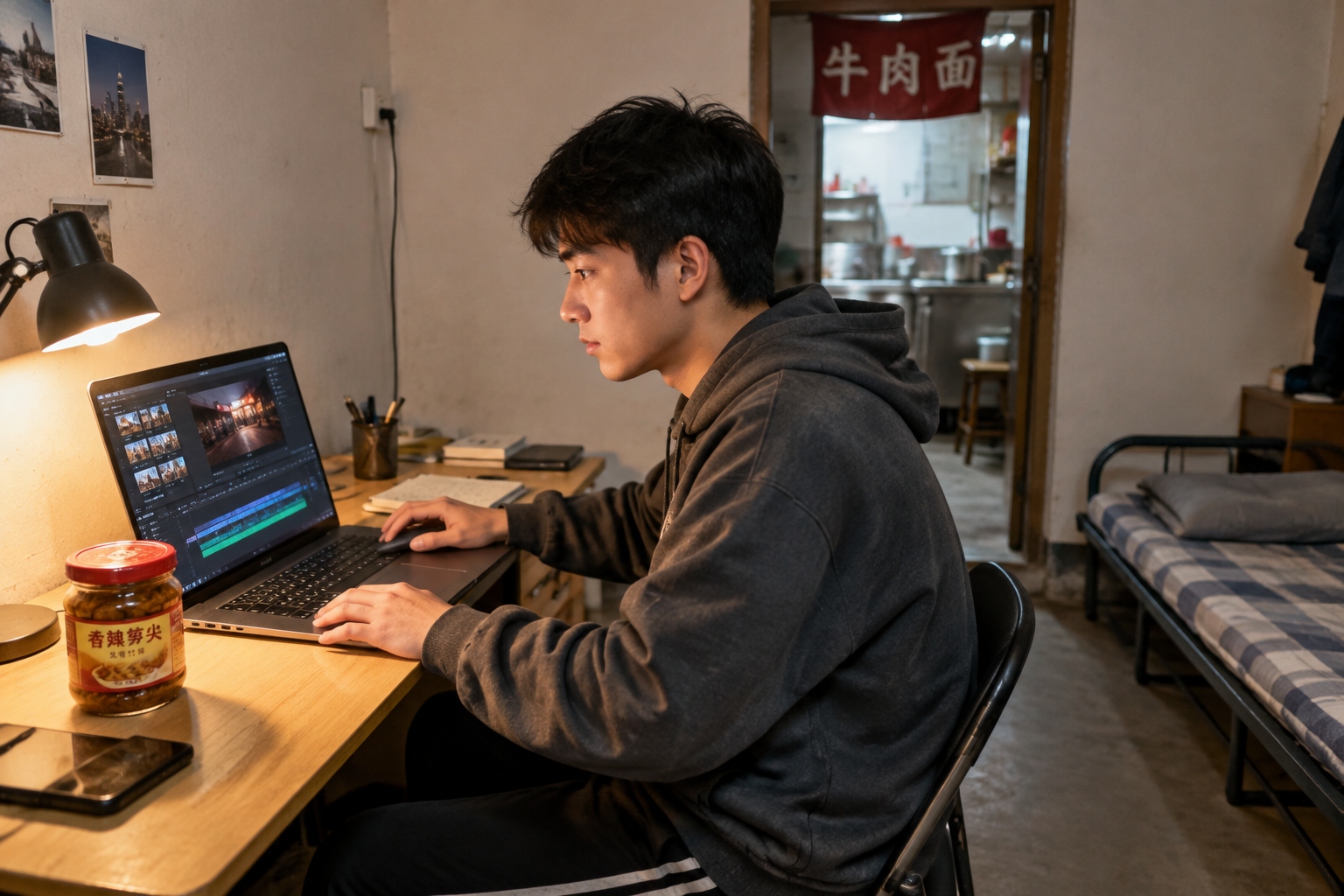
Traffic sounds great, but Xiao Mo has done the math. A bowl sells for seven yuan. After rent, ingredients, and platform fees, the profit is about 1.2 yuan. The extra customers from video bring in maybe thirty to fifty more bowls a day. “It’s not that you don’t make money,” he says. “But you have to film every day, think of new angles. After closing, I edit until eleven or midnight.”
He lives in a small room behind the shop: a folding bed, a desk, a laptop. On the desk sits a jar of suan sun — fermented bamboo shoots, the signature topping of Guilin rice noodles. It has a powerful smell. People either love it or move away from it.
Short video has made his craft visible to more people. A clip of him lifting bamboo shoots from the jar with long chopsticks got over 100,000 views on Douyin. Comments asked what it was. Others asked where they could eat it.
But traffic brings a different kind of pressure. A friend of his sells oil tea — a local drink made from pounded tea leaves, ginger, and peanuts, mixed with hot water — near Guilin’s Dongxi Alley. Her account has more followers than his, yet fewer people are coming into her shop. “People watch the video and feel like they’ve already experienced it,” Xiao Mo says. “A video can make someone want to come. It can also make someone feel they don’t need to.”
So he changed his approach. He stopped chasing polished shots. He left in the imperfect parts: oily hands, a stained pot, his mother in the background telling him to hurry up in the Guilin dialect. “People can tell what’s staged,” he says. “Dialect and arguing — that’s what gets watched.”
From Guilin to the world
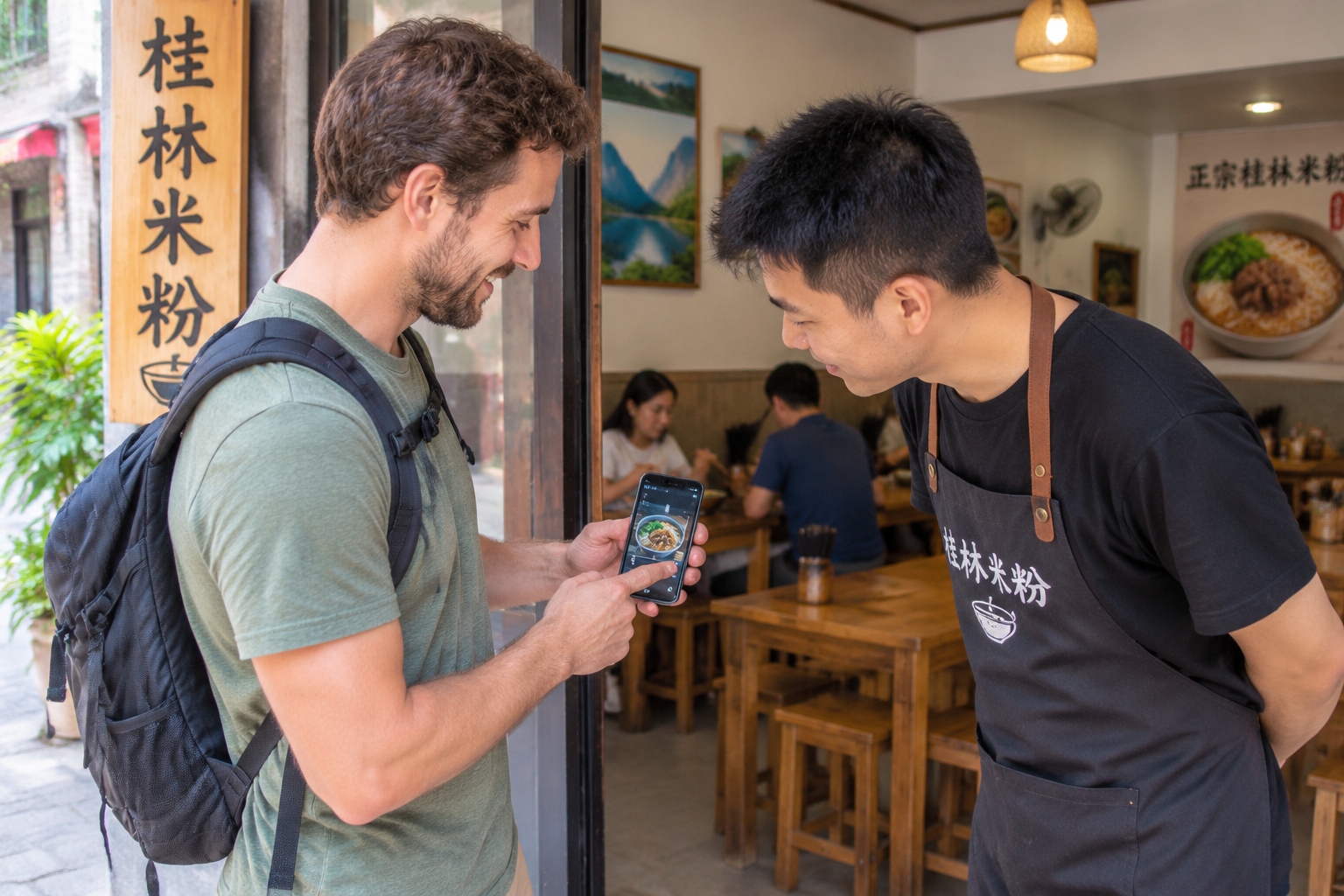
In the spring of 2024, an Australian tourist walked into the shop holding his phone. On the screen was the video of Xiao Mo slicing guo shao. The tourist didn’t speak Chinese. He pointed at the screen, then at the noodles, and smiled. Xiao Mo gave him an extra ladle of broth.
Guilin is one of China’s oldest tourist cities. The Li River karst landscape, Yangshuo’s West Street, Elephant Trunk Hill — the region draws millions of visitors a year. After the pandemic, inbound travel is recovering, but the way people travel has changed. More foreign visitors search short-video platforms in advance for “what locals in Guilin actually eat.”
Xiao Mo started adding English subtitles. His English isn’t great. He uses translation software, then asks a friend studying in Guilin to fix it. One video — him pulling bamboo shoots from a jar — has the English title “The smell that divides China.” It passed 200,000 views. Comments came in English, French, and Spanish. Someone said it looked like blue cheese. Someone else said it looked like kimchi.
“An American asked me what it tastes like,” he says, laughing. “I told him, you have to come here.”
One bowl at a time
By nine in the evening, the last pot of broth is down to the bottom. Xiao Mo takes the phone off the tripod and scrolls through the day’s footage. His mother wipes down a table and says something in the Guilin dialect. He answers. They both laugh.
The scene is not grand. No funding rounds, no expansion plans, no slide deck for “brand upgrading.” Just a young man, a phone, and a cleaver, reorganizing a family business. Tomorrow at 6:40 a.m., the shop will open again. The stock pot will simmer. The phone will go back on the sack of rice.
In Guilin, traditional snacks haven’t been “disrupted” by short video. They have simply been seen by more eyes — including people who never thought they would walk into a noodle shop.
Start the discussion at forum.chinacomes.com