

6:40 a.m., Jianshe North Road
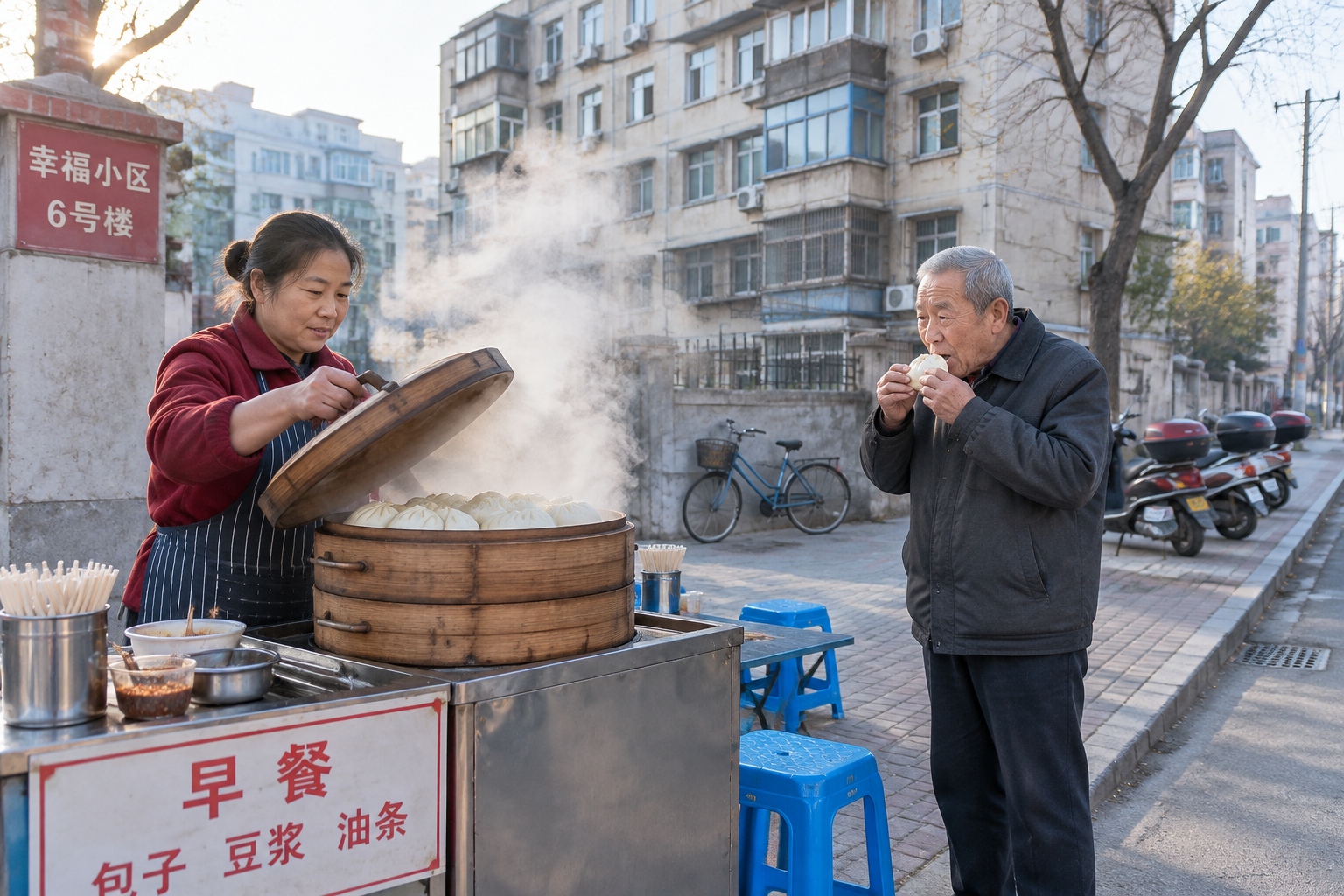
At 6:40 on a cool October morning on Jianshe North Road, a breakfast stall outside an old residential compound lifts the lid off its steamer, and steam swallows the vendor’s face. A man in a dark grey jacket puts three yuan on the counter, takes two pork buns, one vegetable bun and a bowl of soy milk, and eats standing up. He sets the bowl back in a plastic crate, wipes his hands, and walks south.
His name is Zhang Jianguo. He is 71 and spent 34 years as a furnace operator at a Tangshan steel plant before retiring in 2014. His route has barely changed in a decade: breakfast stall, Nanhu Park, one loop around the lake, home.
“When I was young, you could tell whether it was a good day for drying laundry just by looking at the sky,” he says. Back then, he says, the air had a taste — iron dust and coal ash. Most mornings now, he can see the low ridge of hills on the far side of the water.
Tangshan was not built to be clean, and it has not turned itself into something fake. It has just moved a few things around.
The City That Was Built on Coal and Steel
Tangshan sits on the coast of Hebei province, about 150 kilometres east of Beijing, with roughly seven million people. In 1878, the Kaiping mines here became one of China’s first modern coal operations, and the city spent the next century turning coal into steel, cement and ceramics.
On 28 July 1976, an earthquake measuring 7.8 destroyed almost everything. More than 240,000 people died. The city rebuilt itself around the same industries, and by the 2000s Tangshan was producing more crude steel than any other city in the country.
Then came the pressure. From around 2013, national policy pushed to cut excess steel capacity and clean up the air. Plants closed, merged or moved outward. Tangshan’s skies, long famous for being thick, began to matter politically as much as its output.
The phrase “rust belt to lifestyle boulevard” (工业锈带到生活秀带) came out of that shift. It is partly a slogan and partly something residents can point to on a map. The clearest example is Nanhu Park.
Nanhu: A Lake Where There Used to Be a Hole
For most of the twentieth century, the land south of downtown was a mining subsidence zone — ground that had collapsed after coal was pulled out from underneath it. Spoil heaps, slag, illegal dumping. Residents avoided it; the wind carried it into their windows.
Work on turning the area into a lake and park started in the late 1990s and ran for years. Today the park covers almost 30 square kilometres, most of it water, with a cycle path, a boardwalk and a small artificial beach. The 2016 World Horticultural Exposition was held here, which also brought the wider roads and the bus routes.
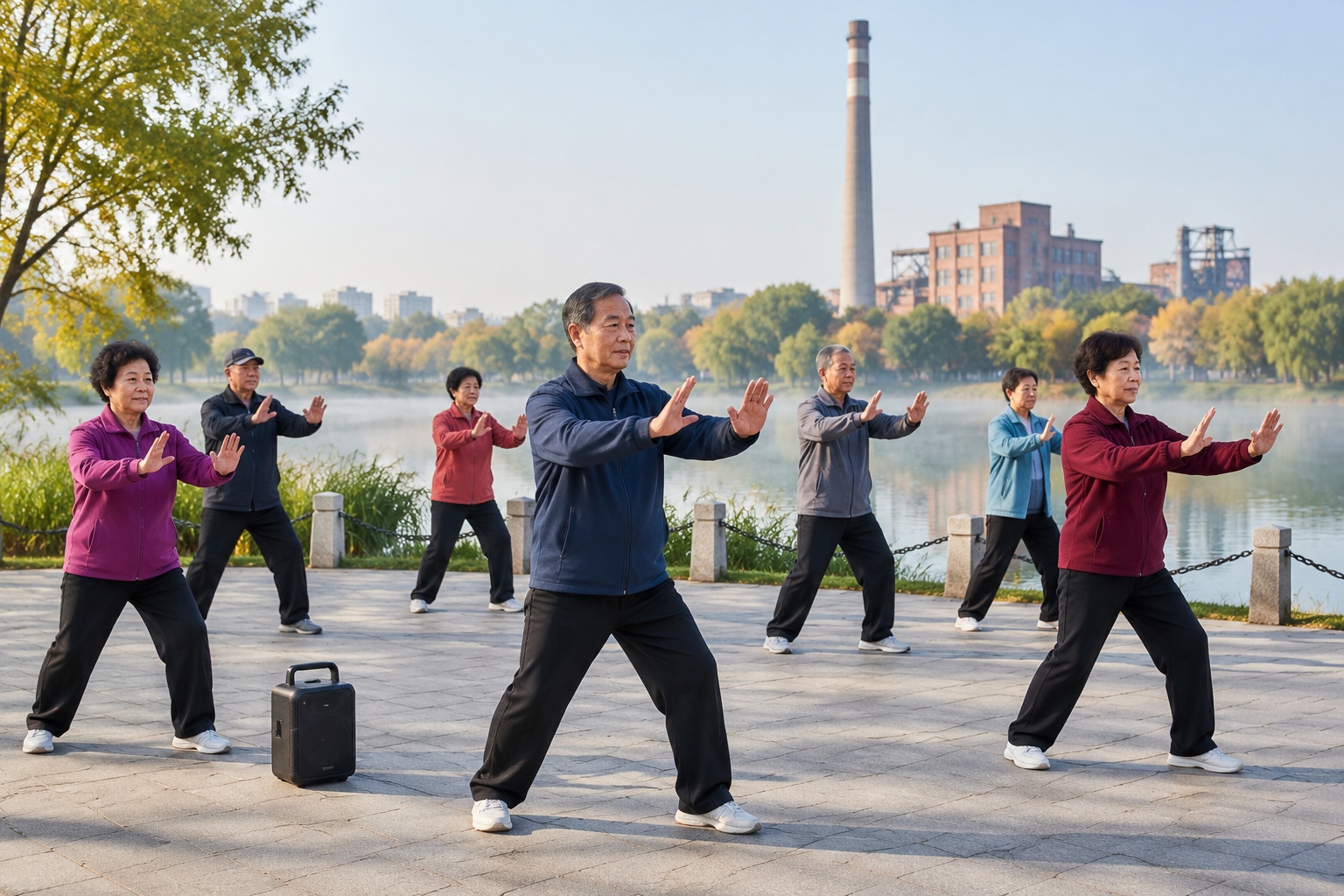
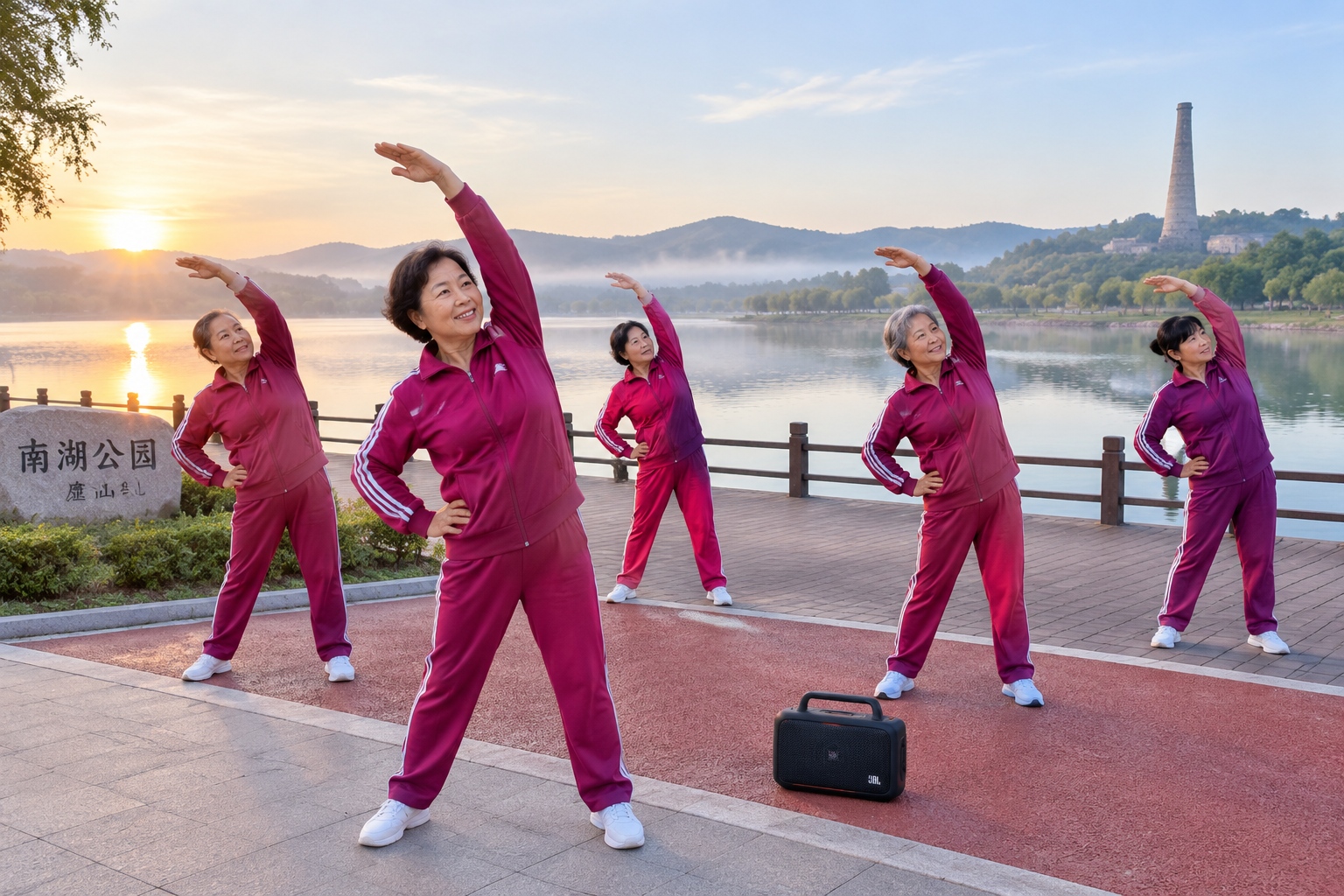
Zhang goes there most mornings. On the path near the east gate, a group of retired women move in slow unison, following a speaker the size of a suitcase. Behind them an old kiln chimney has been kept and painted pale grey. It looks like a museum piece that wandered into a park.
“I used to walk past that chimney every day at work,” he says. “Now I walk past it for fun.”
Family One: A Pension, a Market, and a Fixed Routine
Zhang and his wife live in a six-storey walk-up built in the 1990s: two rooms, about 62 square metres, no lift. His pension comes to a little over 3,000 yuan a month (around $420); hers is slightly less, after years at a textile mill.
The money goes to the vegetable market, medicine and grandchildren. “There’s not much left over, but we’re not short,” he says. Their biggest splurges are not holidays. They are taxi fares to hospital appointments and red envelopes at Spring Festival.
What he misses about the plant is not the wage. “The canteen food was bad. But the sound in the workshop — I don’t know. You get used to a loud place, and then it’s quiet.”
He is careful about praising the city too much. “Nanhu is good. My daughter’s generation has somewhere to go. But the big factories are further out now, in Caofeidian and Fengnan. People take the bus at five in the morning.”
Family Two: Two Commutes, One Child, One Budget
Li Ming, 34, works at a steel trading company in Fengnan, south of the centre. His wife, Wang Fang, 33, is an accountant at a small logistics firm. Their daughter is seven and attends a state primary school a ten-minute walk from their apartment in Lunan.
They bought that apartment in 2021: 85 square metres, a 30-year mortgage, and a down payment that both sets of parents helped fund. “Nobody in this city does it alone,” Wang Fang says. “That’s normal here.”
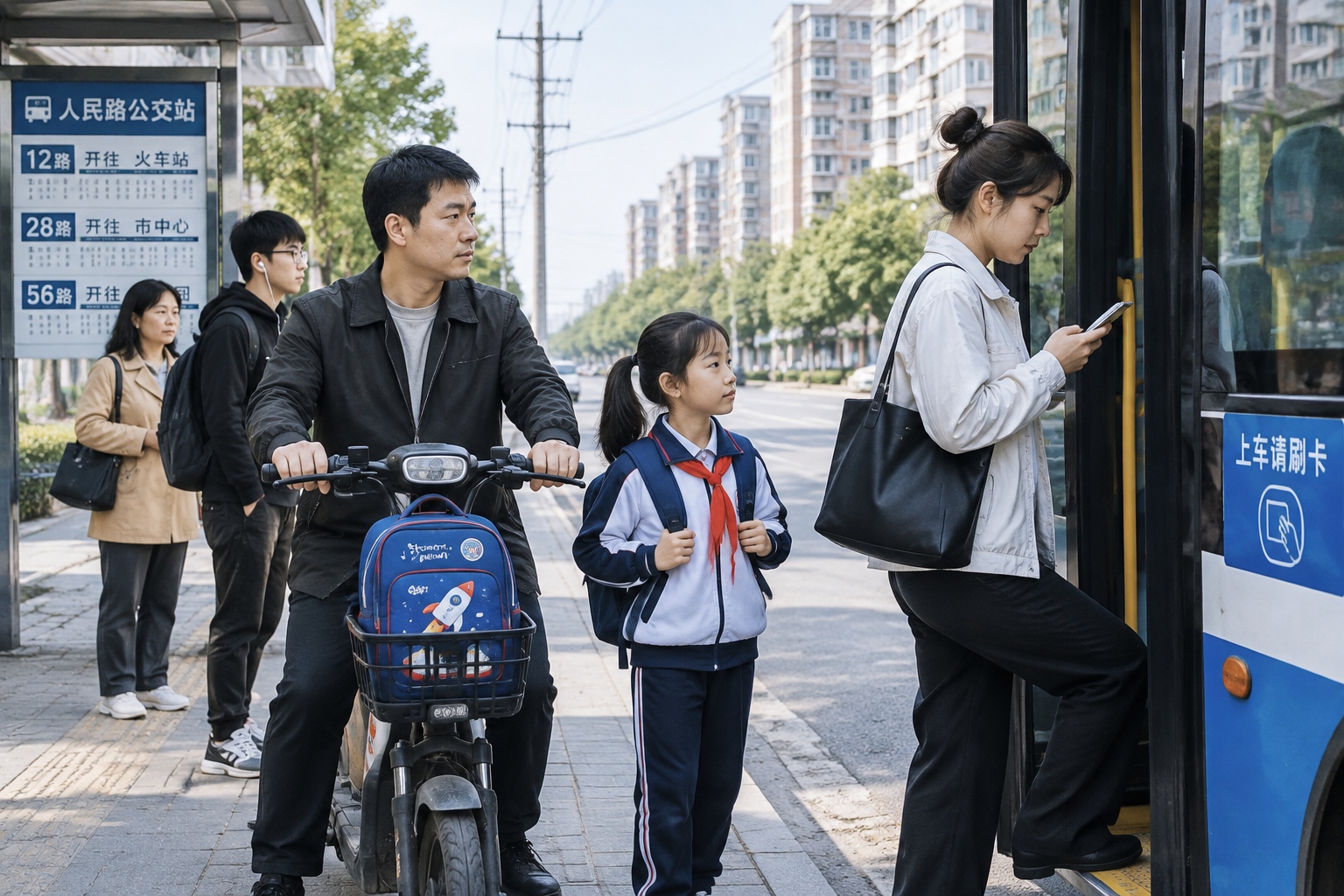
Weekdays are tight. Up at 6:30. Their daughter is at school by 7:15. Li rides an electric bike for 25 minutes. Wang takes a bus, about 40 minutes, and reads on her phone.
The mortgage takes roughly 40 percent of household income. Tutoring — English, and swimming — takes another slice. On Saturdays they go to Nanhu in the morning and a shopping mall in the afternoon, where a family lunch runs about 150 yuan.
They have talked about Beijing or Tianjin. “My salary would be higher. The rent would eat it,” Li says. “And we would lose the grandparents.”
He is also not certain his job will exist in ten years. Steel trading has thinned out, and the company has already let two colleagues go. “Nothing dramatic. It just gets a little quieter.”
Family Three: The Noodle Shop That Watches the Neighborhood
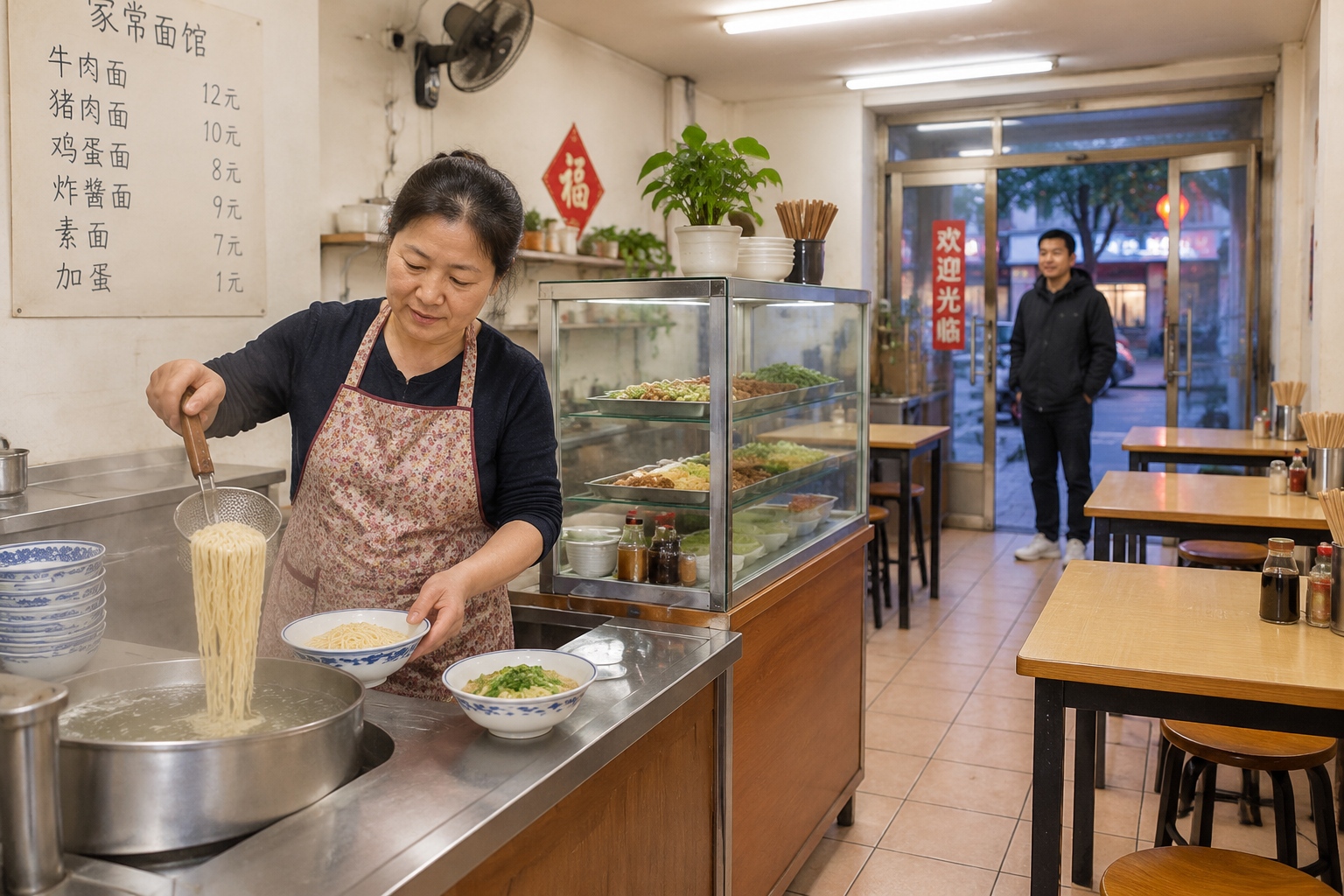
Chen Xiuying, 48, runs a noodle shop near the east gate of Nanhu. It is perhaps 15 square metres: four tables, a glass case, a baby portrait on the wall. She used to work at a ceramics factory that closed; in 2016 she took over the lease.
The first two years were poor. The park was unfinished and the road outside was mud. “In summer I could count the customers on one hand.”
Weekends are busy now. On a good Saturday she sells more than a hundred bowls — hand-rolled noodles with pork and vinegar, eight to twelve yuan each. Her sister-in-law has been hired. She starts prepping at 5:30 and locks up around nine.
She is also the person who notices the neighbourhood: the new pavements, the shared-bicycle rack, the film crew that came in June, the older residents who moved into renovated buildings and the ones who left. On weekday evenings the shop gives way to a dozen women in their sixties dancing outside to a portable speaker. “They come in for tea afterwards sometimes,” she says. “It’s nice. But it’s still hard money.”
What Actually Changed, in Practice
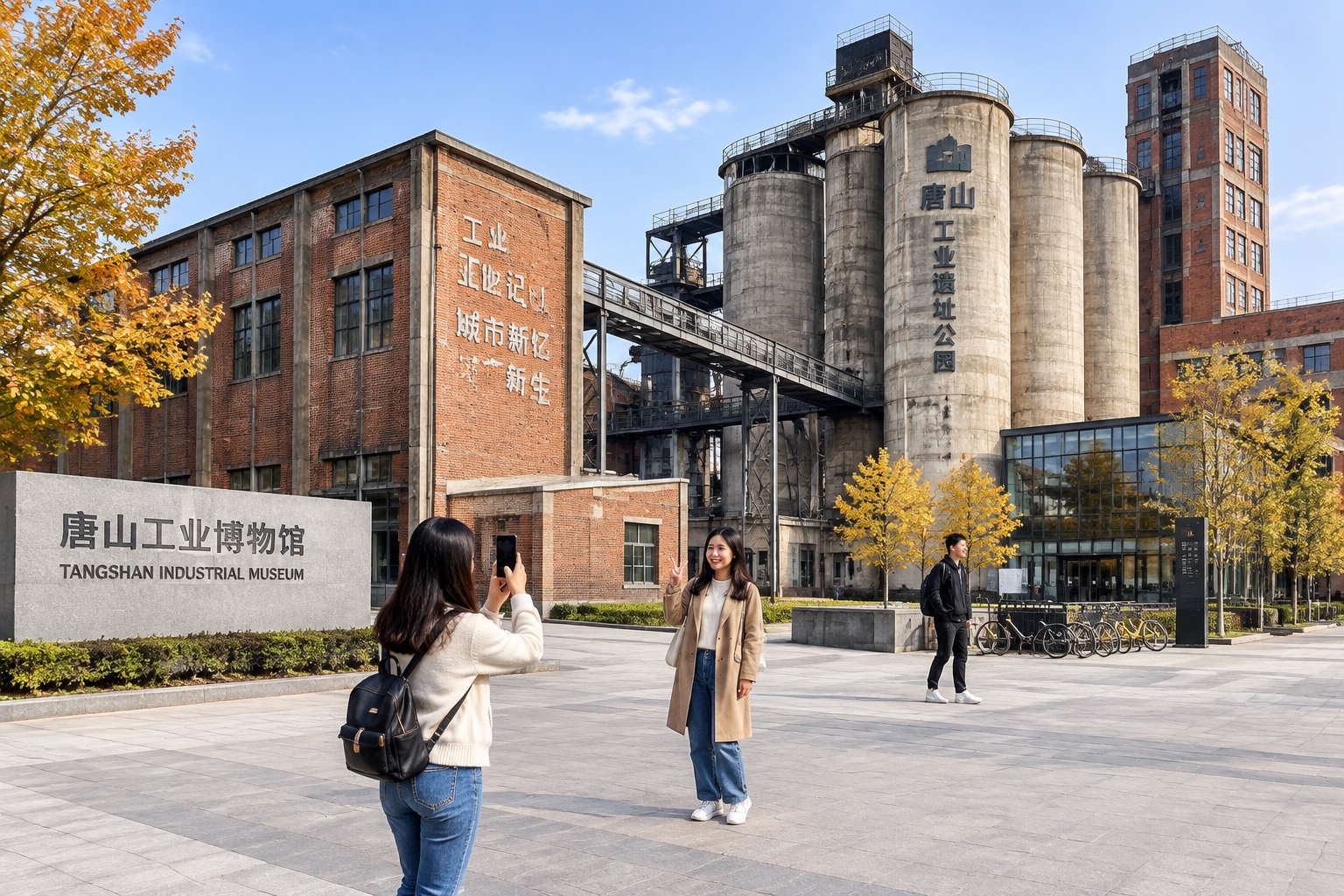
Follow Zhang’s route on a map and the changes appear as a sequence of surfaces. The old Qixin cement works, founded in 1889, is now a museum and creative park; visitors can walk into the kiln rooms. A tram line opened in 2018 along the northern edge of the city, about 13 kilometres long, and bus routes now reach places that once required a car.
Air quality is the number residents cite most. Tangshan’s annual average PM2.5 concentration has fallen from well above 100 micrograms per cubic metre in 2013 to roughly 40 by 2023 — still above the national standard, but far from the grey afternoons of a decade ago. Steel capacity was cut, and the plants that remain are cleaner and sit further from the centre. The figures are real, and they are not the whole story.
The Part That Is Still Hard
The jobs that replaced plant jobs do not always pay the same. A worker with twenty years at a mill might earn 5,000 to 6,000 yuan a month including overtime. A security, delivery or restaurant job in the same neighbourhood often pays 3,000 to 4,500. People take them, but they feel the gap.
Young people leave. A graduate in software or design usually ends up in Beijing, Tianjin or Shenzhen. The local economy is stronger than its reputation suggests, but it is still an industrial economy.
Older neighbourhoods are the other issue. Buildings from the 1980s and 1990s were designed for a different population, and many have no lifts. Retrofits happen, slowly, with arguments over who pays. In one Lunan compound repainted last summer, residents still carry bicycles up four flights because the stairwell is too narrow to store them.
Chen puts the economics plainly: “Rent went up after the park got famous.” She pauses. “You pay more to live somewhere nice.”
Closing: The Walk Home
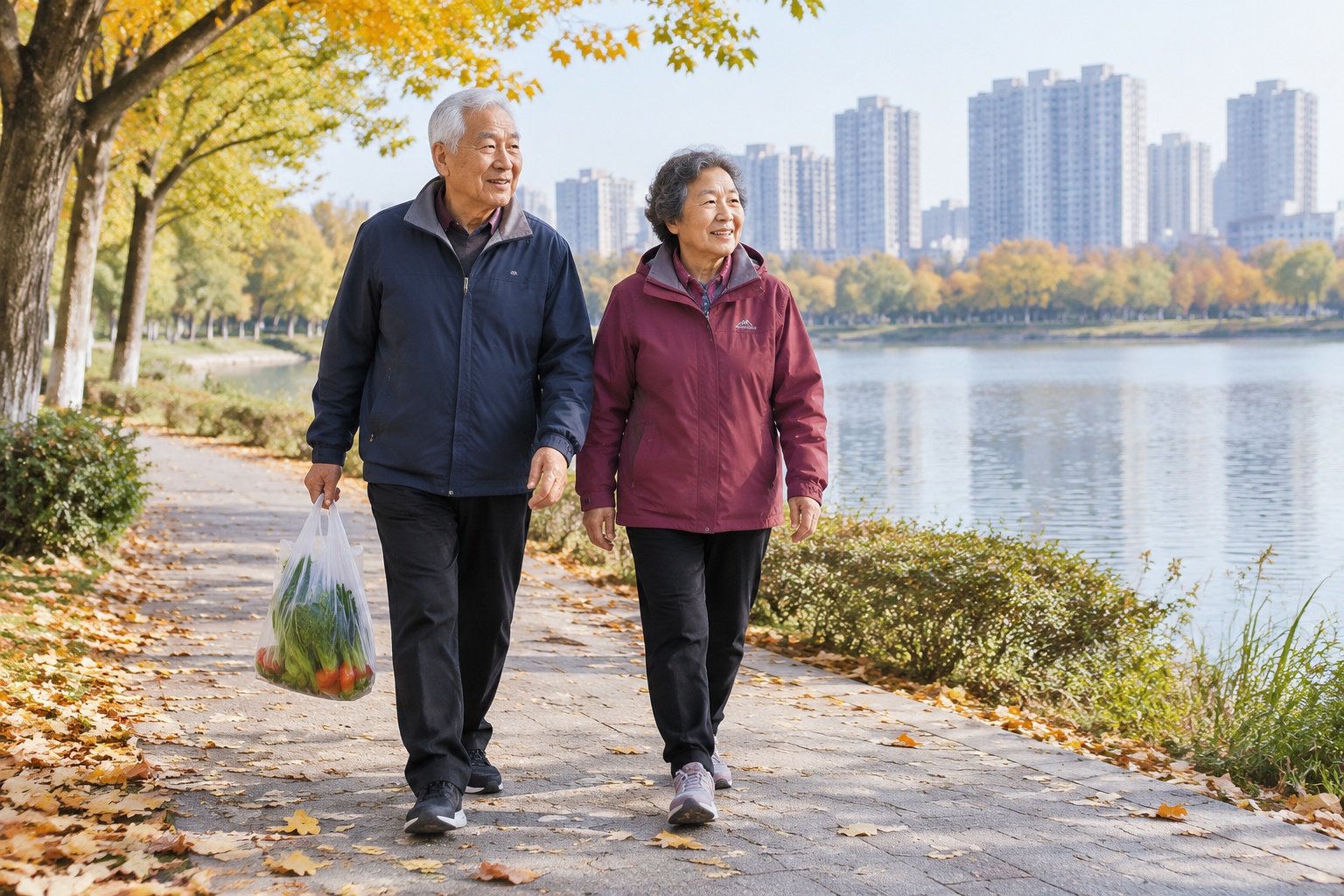
At a quarter to seven in the evening, Zhang walks home along the lake path with a plastic bag of tomatoes. The lights come on along the boardwalk. Somewhere behind him, the speaker starts up again.
His daughter calls from Tianjin every Sunday. She asks about the air and his knees. He tells her about the tomatoes, and the price of pork.
That is what a city’s transformation looks like from the inside: not a slogan, but a shorter walk to the water, a cleaner window, a different job, and a daughter who might or might not come home.
Start the discussion at forum.chinacomes.com