

The Garlic Field That Became a TV Studio
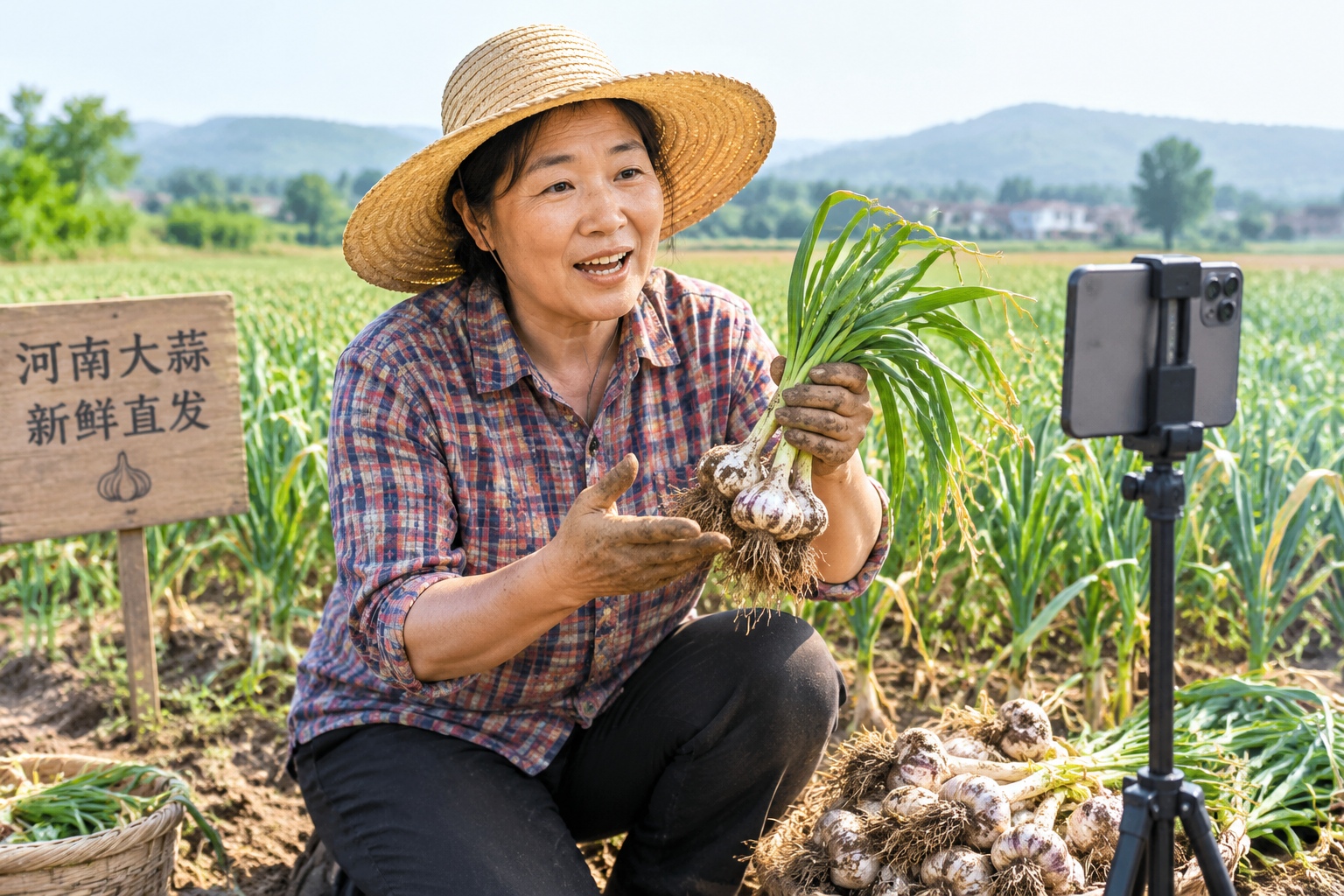
It’s 7 a.m., and Zhang Jie, a 46-year-old farmer in Qixian County, Henan Province, is already talking to her phone. She kneels in the moist soil, pulling out garlic bulbs and shaking off clumps of dirt. “These are today’s harvest,” she says into the phone, her voice a little breathless. On the screen, 400 people watch. A viewer asks if the garlic is spicy. Zhang holds one bulb close to the lens and squeezes it. “You see this firmness? This one is definitely hot.” She laughs and tosses it into a basket. In the next two hours, she will sell 2,500 kilograms of freshly dug garlic.
This scene is now common in Henan, the largest garlic-producing province in China. The province grows roughly 40 percent of the country’s total garlic output, and much of it comes from a cluster of counties around Kaifeng, including Qixian. Traditionally, farmers hauled their harvest to wholesale markets, where a handful of dealers set prices. But today, a growing number are choosing a different route: livestreaming.
Why Farmers Turned to Livestreaming
The problem with traditional garlic sales is the price squeeze. Dealers know that garlic rots, and farmers don’t have good storage or a broad network of buyers. So they often bargain down to a price that barely covers costs. In bad years, when the market is flooded, some farmers simply let garlic rot in the fields because the cost of harvesting is higher than the selling price.
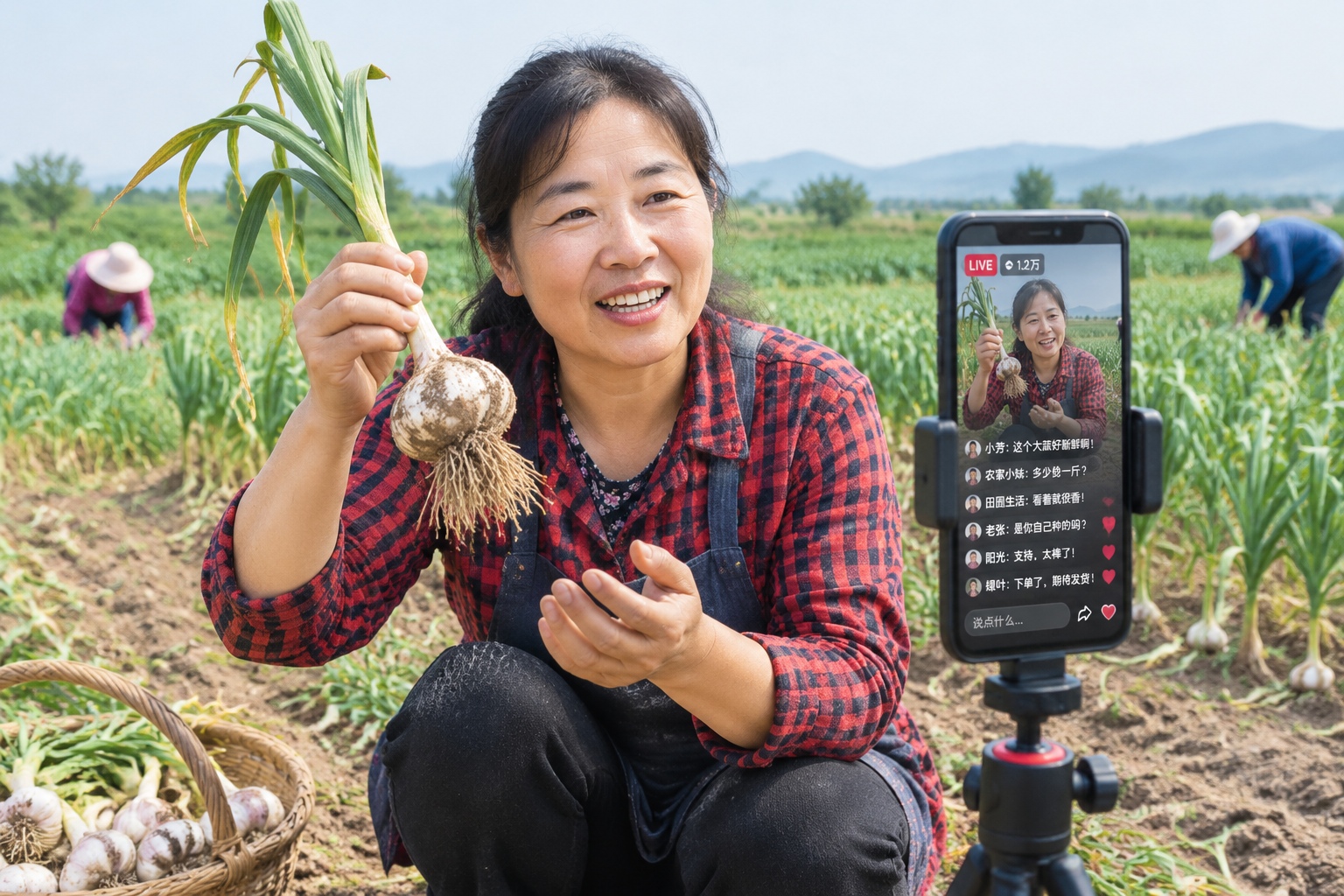
When smartphones and high-speed networks arrived, the tables turned. By 2023, China’s rural areas had achieved near-universal 4G coverage, and short-video platforms like Douyin and Kuaishou had become the new town squares. Some farmers started posting short clips of themselves in the fields. A viral video of a garlic harvest could bring dozens of enquiries. Gradually, they discovered that livestreaming could do something even better: sell in real time.
Li Fei, a 30-year-old who returned to his hometown from a factory job in Guangdong, was among the early adopters. He had seen factory bosses sell machine parts on Douyin and wondered if he could do the same with his father’s garlic. His first livestream in May 2021 was crude—a phone propped on a bucket, a shaky view of two rows of garlic. Yet he sold 300 kilograms that day. “I was stunned,” he recalls. “People in Shanghai were asking why my fingers were so muddy.” In his second year, he sold the entire output of his family’s three-acre field online and started buying garlic from neighbors.
Meet Zhang Jie: A Garlic Farmer Turned Streamer
Zhang Jie, the farmer we met at the start, didn’t grow up with technology. She used a basic phone until 2020. When her youngest son left for college, he taught her to use a smartphone and showed her a few livestreaming accounts. “I thought it was magic,” she says. Her first attempt was terrifying. “I opened the app, saw the camera on my face, and my mind went blank. I didn’t say a word until my husband walked by and asked, ‘Are you talking to that thing?’”
Now she livestreams twice a day: at 7 a.m. in the field and at 7 p.m. in her storage room, where she cleans and packs. She has developed a routine. In the morning, she walks down rows of garlic, pausing to pick one and crack it open to show the white cloves. In the evening, she operates a small packing line, with her husband weighing and her sealing bags. She answers questions from viewers about cooking, storing, even home remedies using garlic. “Some viewers become friends,” she says. “They ask about my grandchildren.”
Her success is modest but meaningful. In 2023, her livestreams brought in orders for 10 tonnes of garlic—more than her field could produce. She bought the surplus from neighboring farmers. The average selling price on her channel was 5 yuan per kilogram, compared with 1.8 yuan offered by dealers. Her income from garlic more than tripled.
The Logistics Behind the Live Show
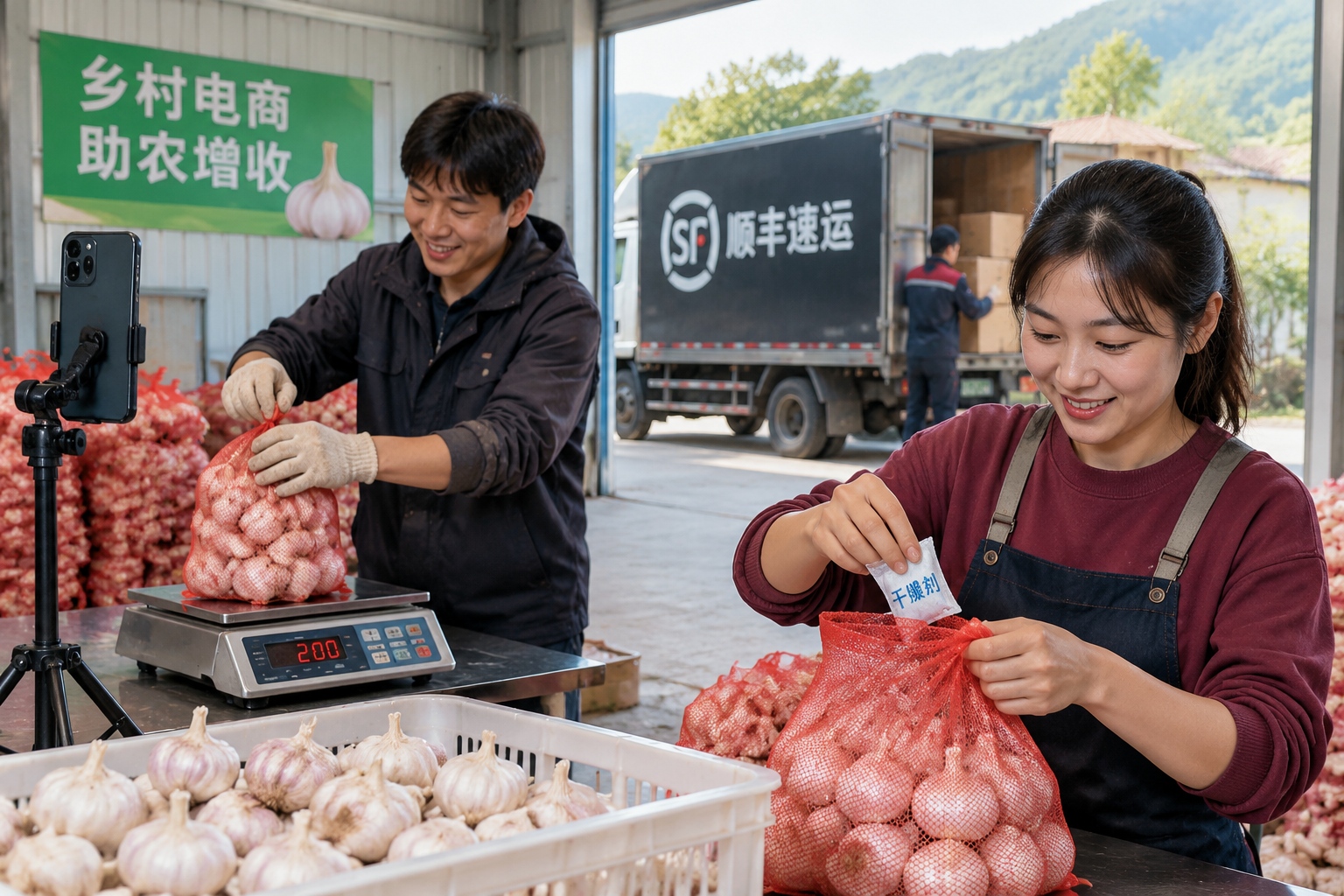
Livestreaming solves the demand problem, but shipping fresh garlic across China is the real test. Garlic is durable, but it needs drying and ventilation to prevent mold. Farmers in Qixian have adapted. After digging, garlic is dried for at least two days in open-air racks. Then, each bulb is trimmed, cleaned by hand, and packed into mesh bags of 5–10 kilograms. A small desiccant packet goes inside to absorb moisture.
Cooperation makes it work. Local cooperatives negotiate bulk shipping rates with express companies and set up pickup points at the village entrance. Li Fei says a typical order reaches Beijing or Shanghai within 48 hours. “The courier truck comes at 4 p.m. every day. If we finish packing by 3 p.m., it’s on the truck today.” The county government also provides free training at an e-commerce service center. Zhang Jie attended a one-week course on how to describe products and handle returns. “I didn’t understand anything at first, but the instructor sat with me until I could do it in my sleep.”
In addition, some villages have built small cold-storage facilities to hold garlic during peak harvests. This allows farmers to wait for better prices instead of selling everything immediately.
Not a Fairy Tale: The Real Challenges
For every farmer like Zhang Jie, there are many who struggle. The livestreaming market is crowded. In the season, dozens of garlic streams compete for attention. Platform algorithms decide who gets seen, and that can change without warning. Li Fei experienced this when his account’s recommendation traffic plunged for two weeks because his sales-to-view ratio fell below 1 percent. “It’s frustrating. You’re doing everything right, but the algorithm doesn’t care.”
There’s also the risk of returns. Some viewers may order 10 kilograms to test quality, but if they feel the garlic is smaller than promised, they ask for refunds. Liu Feng, a 38-year-old farmer in a nearby village, learned this the hard way. He promised “large bulbs” in his live stream, but his harvest was inconsistent. He had dozens of refunds and negative reviews. “My account was basically ruined for a season,” he says. Now he measures the bulbs with a caliper on camera and says, “If it isn’t this big, don’t buy.”
Age adds another layer of difficulty. Farmers over 60 often lack the digital skills or confidence to go live. Many rely on grandchildren to set up the equipment. In some cases, younger relatives run the account and split the income. But that means the elder’s knowledge of farming isn’t fully showcased. “My grandfather knows everything about garlic,” says Li Fei, “but he can’t type a single sentence. So I talk and he answers my questions off-camera.”
What This Means for Rural China
Livestreaming isn’t a guarantee of wealth, but it has already reshaped the garlic business in Henan. Farmers are no longer passive sellers at the mercy of intermediaries. They can build a brand, communicate directly with end consumers, and capture a much larger share of the final price. This new economic power is changing lives at the household level—more children stay in school, houses get repaired, and some families can afford new appliances.
It’s also changing migration patterns. Chen Lin, a 24-year-old who studied e-commerce in Zhengzhou, moved back to her village after seeing her uncle’s livestream business grow. She now manages orders for three families. “In the city, I was just another clerk. Here, I feel like I’m building something,” she says. Local officials have noticed the trend and are investing in better internet infrastructure and training hubs.
Wang Xiu, a 62-year-old widow, is perhaps the most heart-warming example. She was initially too shy to appear on camera, but her daughter encouraged her. Now she livestreams every morning, walking through her small plot, naming each variety of garlic. She once sold out a 500-kilogram harvest in a single session. “When I’m on the phone, I don’t feel lonely,” she says. “And when the delivery man comes, I know I’ve done something real.”
The garlic fields of Henan have become a live backdrop for a new kind of rural entrepreneurship. The internet hasn’t replaced farming—it has amplified it. Farmers are still up early, kneeling in the dirt, but now they’re also talking to the world. And that makes all the difference.
Start the discussion at forum.chinacomes.com