
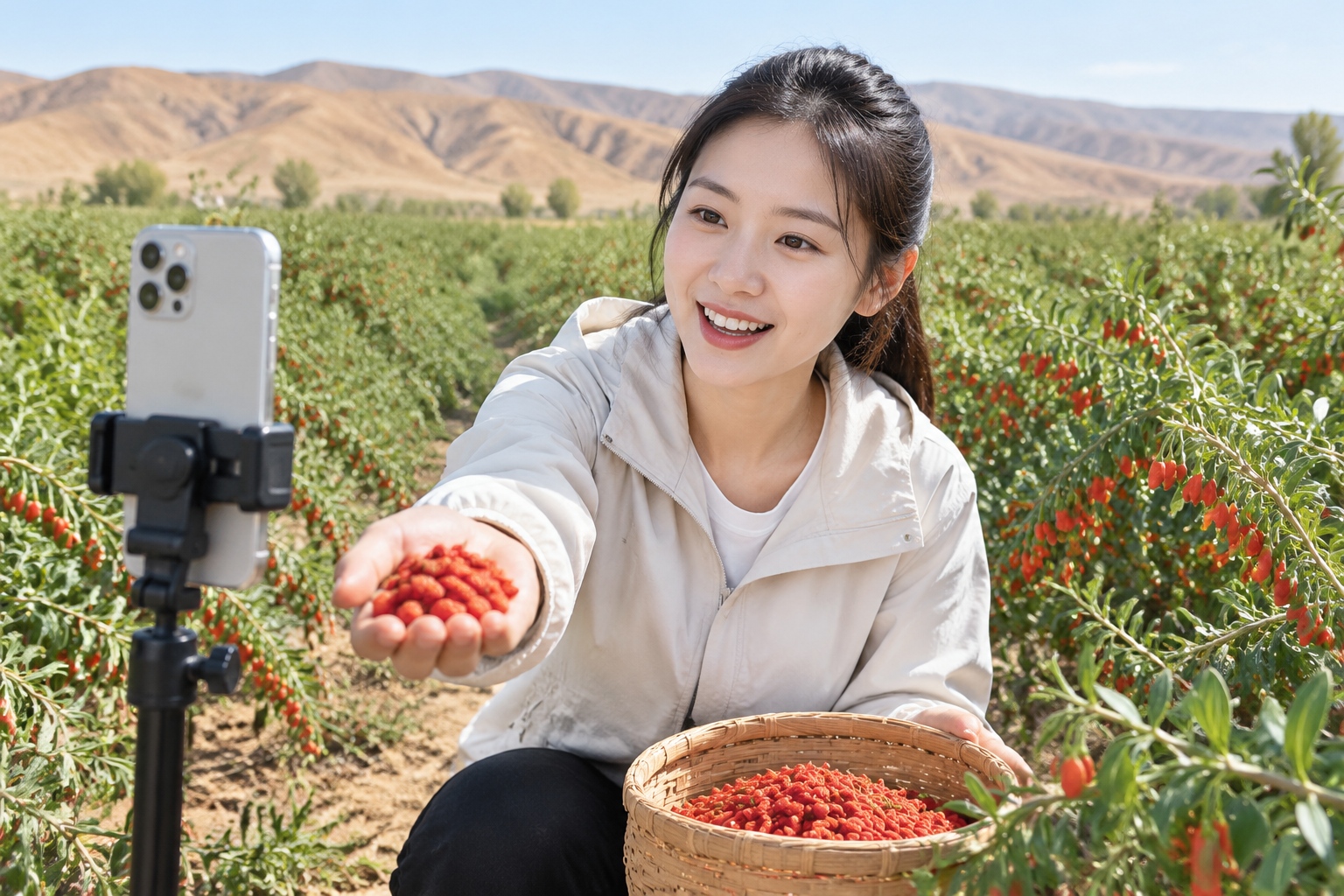

Opening: A Field as a TV Studio
On a late-summer morning in Zhongning County, Ningxia, a 47-year-old farmer named Ma Rui balances her phone on a tripod at the edge of a goji berry field. She is not a professional broadcaster. Her hat is faded, her fingers are stained purple, and the wind occasionally blows dust onto her screen. But none of that seems to bother her viewers.
“I’m going to eat one right now,” she says, holding a glossy red berry to the camera. “You see? Sweet, juicy, no chemical smell.” A viewer in Guangzhou types: “Is it crunchy?” Ma answers. A viewer in Shanghai asks if she can mix the berries into tea. Another asks about delivery speed. Within twenty minutes, 200 kilograms of dried goji berries have been ordered — far more than she used to sell in a week.
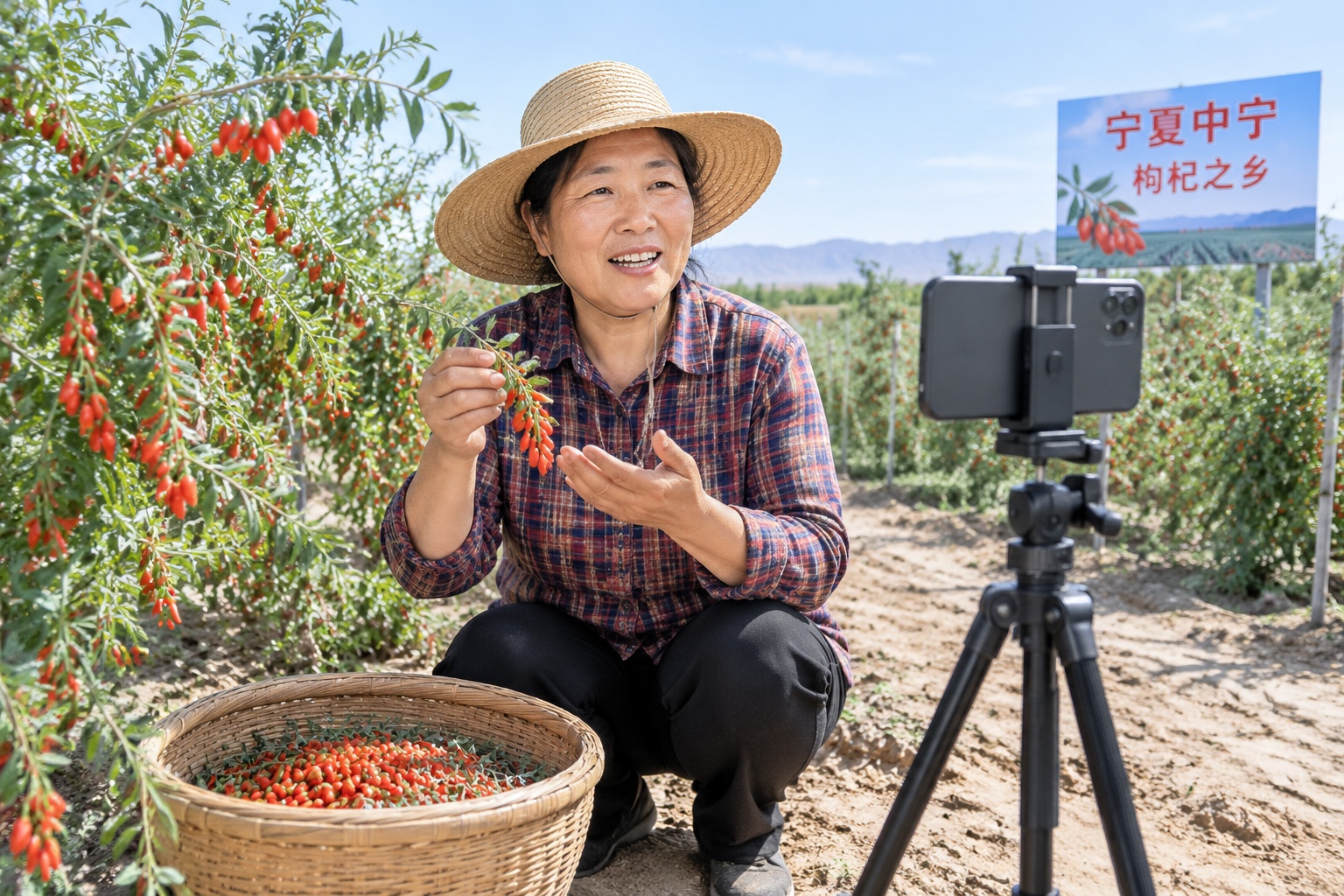
Why Ningxia? A Flat, Dry Land With Two Big Stories
Ningxia is a small autonomous region in northwest China. It doesn’t usually appear in overseas headlines, but inside China’s e-commerce world, it has become a familiar name because of two products: goji berries and wine.
Goji berries — known in Chinese as gǒuqǐ — have been grown here for centuries. The best-known area is Zhongning, the “hometown of goji berries.” The dry climate and mineral-rich soil produce small berries with a dense, balanced flavor. Farmers used to sell the harvest to middlemen, who resold it to supermarkets or traditional Chinese medicine shops. That meant low margins and no direct connection to the people who ate the product.
Wine is a newer story. Since the 1980s, winemakers realized that the eastern foothills of the Helan Mountains share key traits with famous wine regions in France: high altitude, strong sunshine, big temperature swings, and well-drained soil. Today, dozens of wineries in Ningxia produce bottles that have won gold medals at international competitions. But at home, the challenge was the same as with goji berries: how do you get customers to notice a small region on a huge map?
Livestream shopping became the answer. And the same trick works for a cheap snack and for a premium bottle of red wine.
Not TV Shopping. It’s a Conversation.
If you have watched a Western shopping channel, you might think livestream selling is something similar. Forget that. Chinese livestream shopping is more like a live social media video where a host talks, viewers send comments, and a small shopping cart icon sits at the bottom of the screen.
When the host says “ready, link is up,” viewers tap the cart, hit buy, and pay without leaving the app. On Douyin, the Chinese version of TikTok, a successful livestream can move thousands of orders in an hour. The key is trust plus speed. People watch because they want to see the real product, hear real questions, and feel like they are in the room. Live content also gets pushed by the platform’s recommendation feed. If viewers stay, comment, or buy, the algorithm sends even more traffic. That makes livestreaming a marketing machine, not just a sales channel.
For goji berry farmers, this changes the economics. They no longer need to rent a shop or depend on a wholesaler. A phone, a tripod, and a strong signal are enough to reach millions of shoppers.
Inside a Goji Berry Live Room
Goji berry live rooms usually start in the field. The host may be a farmer, a local official, or a trained e-commerce graduate. The camera moves through rows of bushes, pauses on a branch heavy with red fruit, and then the host picks a berry and eats it. Questions arrive: “Does this have added sugar?” “Can it be delivered to my city?” “Is this fresh or dried?” The host answers each one and reminds viewers of the order link every few minutes.
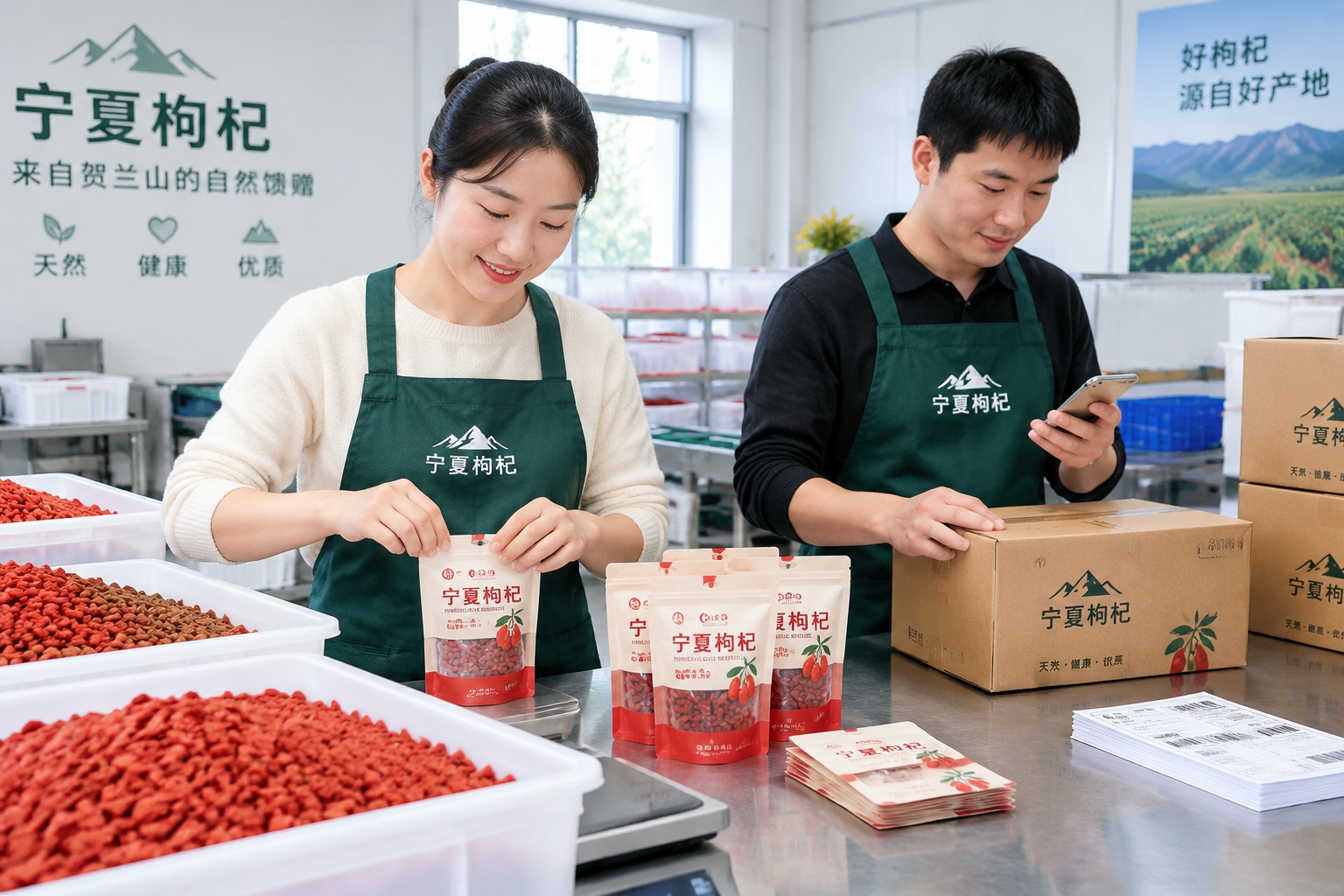
Fresh berries are sold in cold packs, but dried goji berries are the backbone. Dried berries are easier to ship and store, and they have a longer shelf life. Hosts often show how the berries are dried in enclosed drying rooms, not outside in the open, to reassure buyers about hygiene.
Wine Is Harder, But It’s Working
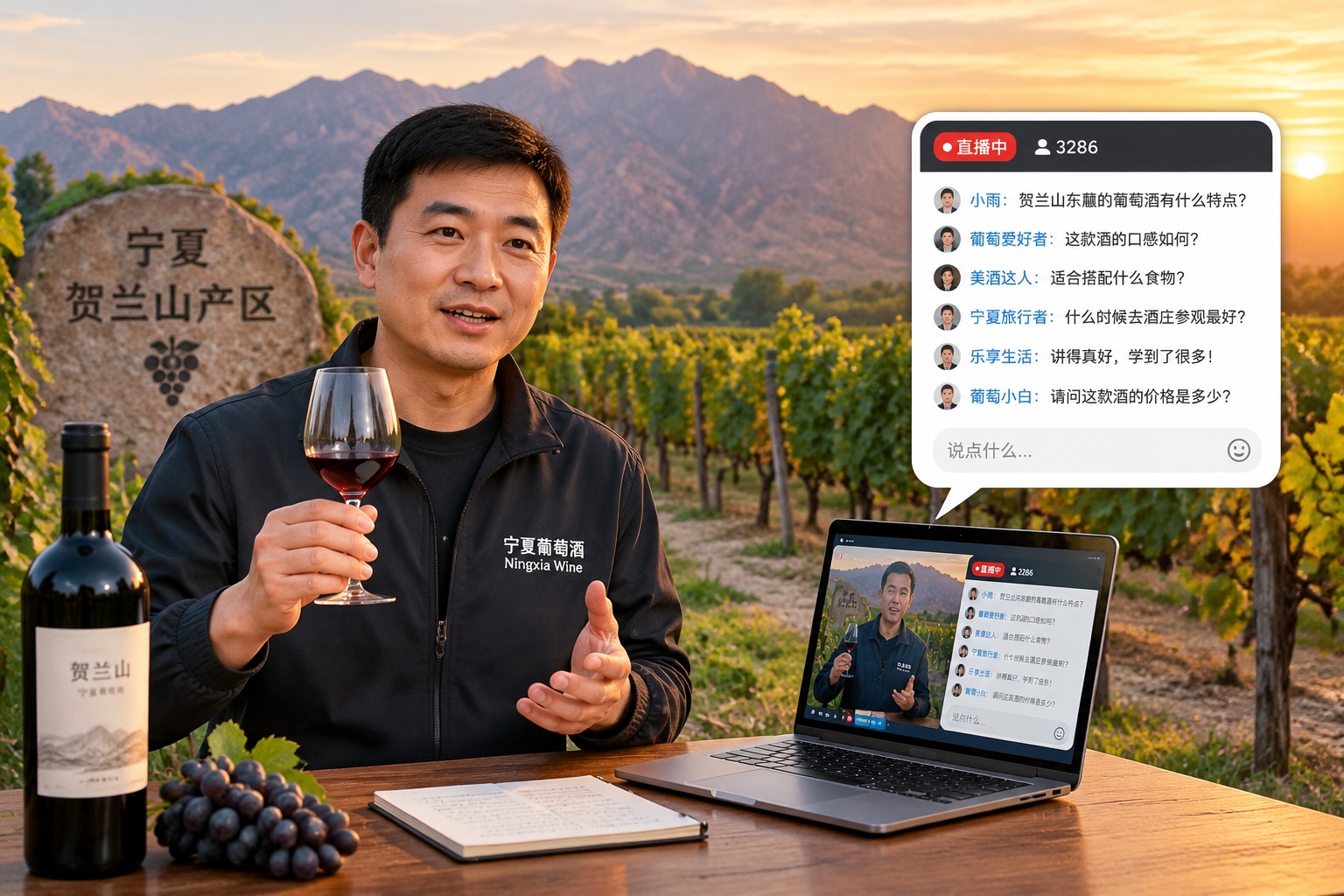
You can’t taste wine through a phone. So Ningxia wineries use a different trick: storytelling plus strong visuals.
Hosts describe the purple-red color, the aroma of dark fruit, and the dry finish. They show the vineyard, the oak barrels, and the awards. Some invite a winemaker or sommelier to answer technical questions. Others use a “château tour” format, with a camera moving from a drone shot of the vines into the cellar, ending at a tasting table. One sales hook is region pride: “You don’t need to spend a fortune on imported wine. Ningxia wines are made in China, by Chinese growers, with world-class results.” This message has convinced many first-time wine drinkers who feel confused by imported bottles.
The Playbook: Four Lessons From Ningxia E-Commerce
If you want to understand why Ningxia e-commerce took off — or if you are wondering how a small region can sell to the whole country — these are the mechanisms worth paying attention to.
1. Give a Place a Personality
Today, Chinese shoppers don’t just buy brands; they buy places. “Ningxia” has become a brand. The name once sounded dry and remote, but dry is actually an advantage: less rain, fewer pests, more concentrated flavor. Every livestream repeats this story. It is simple and memorable, and it gives buyers a reason to choose one bag of goji berries over dozens of competitors.
2. Cut Out the Middleman With a Short Supply Chain
For decades, farmers waited for wholesale prices. Livestreaming allows them to sell directly to consumers, but only if delivery is reliable. In Ningxia, the government has invested heavily in logistics. Cold-chain trucks move fresh berries to airports, while dried berries and wine travel on mainstream express delivery networks. Village-level pickup stations now operate like mini post offices. An online order is a promise: “you will receive it in two days.” If delivery fails, the trust disappears.
3. Use the Platform’s Appetite for Rural Content
Chinese platforms like Douyin, Pinduoduo, and Taobao have launched dedicated programs for rural e-commerce. Why? Because videos from farms and villages get high engagement from urban users tired of polished ads. The platforms often give extra traffic to farmers and local officials on livestream, reducing the need to pay for advertising. The rule is simple: create honest, interesting content and the platform brings the viewers.
4. Turn Farmers Into Hosts, Not Celebrities
You don’t need a famous influencer to sell goji berries. Local governments and e-commerce associations have organized training courses where farmers practice holding a phone, talking to a camera, and handling orders. Many start by selling to people in their own network, then grow from there. A farmer-host is more convincing than an outsider because they live with the product every day.
What Overseas Buyers Should Know
If you are outside China, you probably can’t join a Chinese livestream and expect quick international delivery. But you can still taste the result of this e-commerce boom.
Dried goji berries are now sold on cross-border platforms such as Tmall Global, JD Worldwide, and AliExpress. Look for “Ningxia” or “Zhongning” on the label, as these are the most recognized regional names. Some Chinese supermarkets abroad also sell fresh goji berries as a snack. For wine, search for “Helan Mountain Foothills” or “Ningxia wine.” Wine producers in Ningxia export to Europe, North America, and Southeast Asia. If you can’t find one locally, ask a Chinese restaurant or a specialty wine shop.
One practical tip: dried goji berries are not medicine. They are a snack with a subtle, slightly sweet flavor that works well in tea, porridge, yogurt, or baking. In Chinese home cooking, they are added to soups for mild sweetness and a red color. Start with a small packet.
Challenges Behind the Glow
Ningxia e-commerce is not a fairy tale. Competition is brutal. Some sellers, pressured by the price race, lower quality. Others make exaggerated health claims, which has caused regulators to punish fake health-food advertising in recent years. Platforms have also removed livestream accounts that break the rules.
The price race is real: a 250-gram bag of dried goji berries can sell for as little as 10 yuan during sales, which leaves farmers with thin profits. The smarter operators focus on premium quality, organic certification, and region branding. They build long-term customer lists rather than chase one viral moment.
For a buyer, the takeaway is simple: read the label, look for traceability, and be skeptical of miracle cures.
The Takeaway: The Farm Is Now a Storefront
Livestreaming has not changed the weather in Ningxia. The soil is still dry, and the winter is still cold. What has changed is how growers connect with consumers. A bag of goji berries or a bottle of wine that once traveled through several hands can now go from the field to the customer in a day. That is a big shift for a region that used to depend on middlemen.
The next time you see “Ningxia” on a label, you will know what it means: a small place that used to be overlooked, and has now learned to tell its own story through a phone camera.
Start the discussion at forum.chinacomes.com