

A Landscape That Used to Move
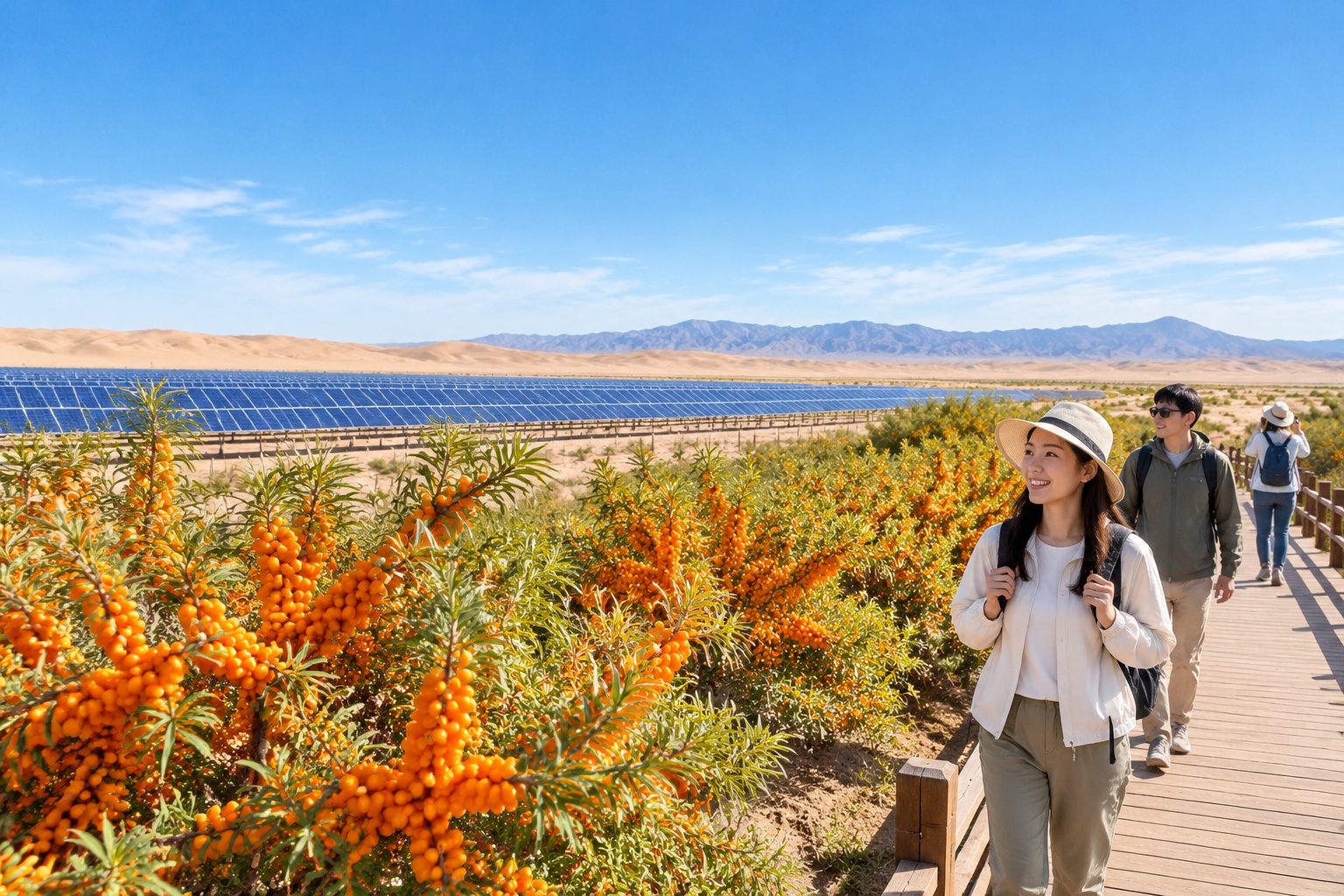
In northwest China, sand moves. For centuries, dunes along the Tengger Desert traveled with the wind, burying fields, roads, and sometimes entire homes. But stand today on the viewing platform at Baijitan National Nature Reserve, near the city of Lingwu, and the view is a lattice of green — a patchwork of sea buckthorn, poplars, and grasses that now holds the sand in place.
The transformation didn’t happen by accident. Since the 1950s, local sand-control workers, supported by national programs like the Three-North Shelterbelt Forest Project, have used straw checkerboard barriers and carefully selected native plants to slow the desert down. But only some plants survived the heat and drought. Sea buckthorn turned out to be a natural survivor, and today it has become the region’s most unexpected economic engine.
Sand Control That Became a Cash Crop
A thorny bush with surprising chemistry
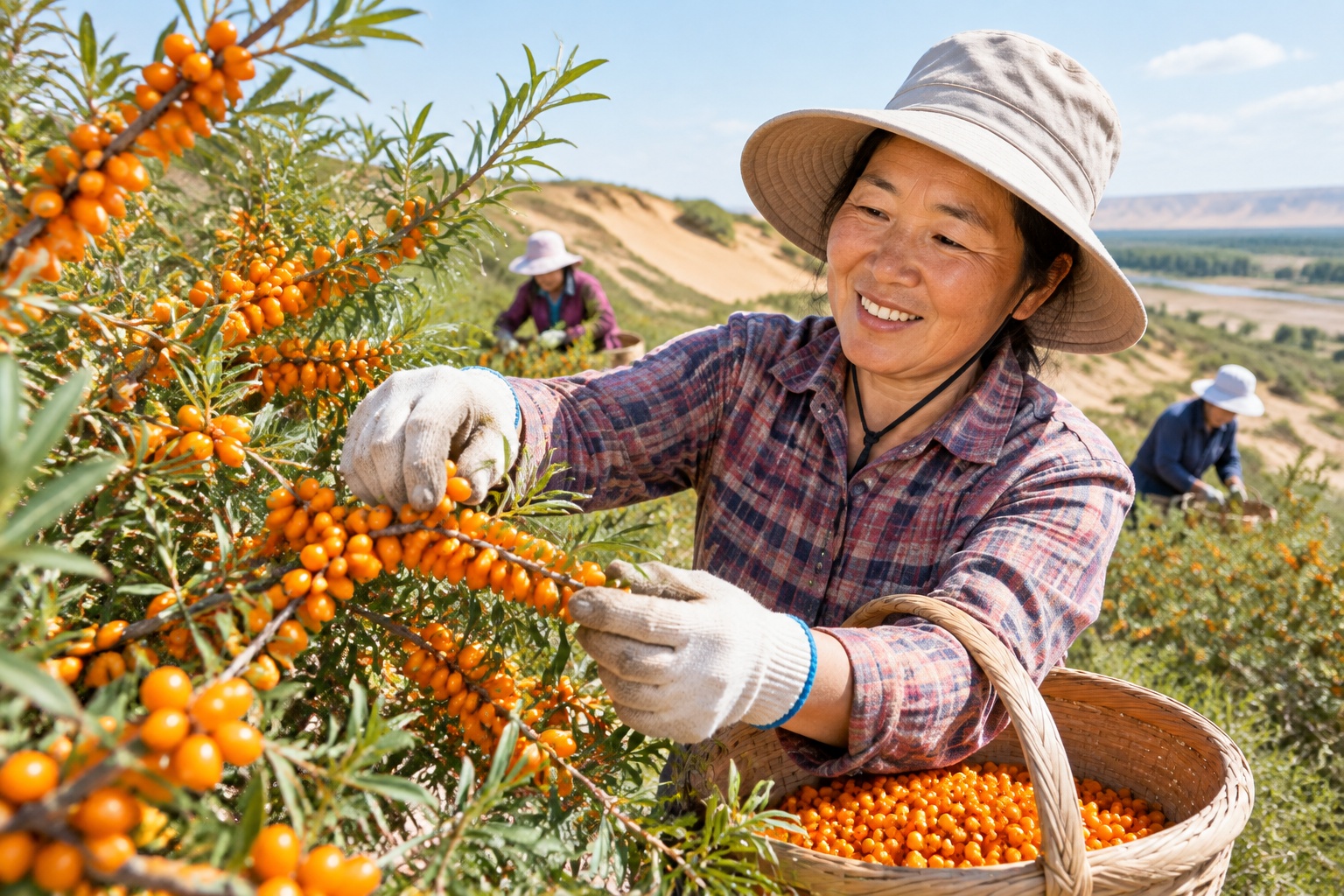
Sea buckthorn is not a glamorous plant. It is thorny, low-growing, and thrives in poor soil where almost nothing else will live. Its roots reach deep into the sandy ground and fix nitrogen, which enriches the soil for other species. Its leaves trap wind-blown dust. And its bright orange berries, after decades of scientific research, turned out to be a nutritional treasure: they are high in vitamin C, plant oils, and antioxidants.
“In the 1990s, we planted it for the government, for the soil. Nobody thought the berries were special,” says Li Hua, a villager who has worked in Baijitan for more than 20 years. Today, the same villager carefully collects berries by hand, wearing specially made gloves to protect against the thorns.
The local businesses built on berries
The berries follow a short but busy route from bush to bottle. Small refrigerated trucks carry them to nearby processing facilities, where they are pressed into juice, freeze-dried into powder, or distilled into oil for cosmetics and health products. In a country that imports a large share of its sea buckthorn from Finland and Russia, Ningxia is one of the few places that has built an entire chain close to the source.
The economics are modest but real. A farmer can earn between 10 and 20 yuan per kilogram of fruit, depending on quality, and a skilled picker can gather 30 to 40 kilograms per day in the early autumn season. That may not sound like much — roughly 400 to 800 yuan a day — but in villages outside Lingwu, it often triples the income of a farmer who otherwise depends on wheat or corn. Local beverage companies sell bottled sea buckthorn juice for about 20 yuan, marketing it as a “desert superfood” to Chinese city shoppers.
Solar Panels, Sheep, and the Desert Grid
Why Ningxia became a solar hotspot
About 150 kilometers southwest of Lingwu, near Zhongwei, the desert landscape gives way to a different kind of harvest: rows of blue photovoltaic panels that stretch to the horizon. This is the Tengger New Energy Base, one of China’s first large-scale solar parks built on previously unproductive sand.
The location is ideal in several ways. Ningxia receives roughly 3,000 hours of sunlight a year, and the flat, open desert means low land costs and few shadows. Engineers also point out that the panels themselves help reduce wind speed near the ground, which keeps dust clouds from forming.
Under the panels: a second harvest
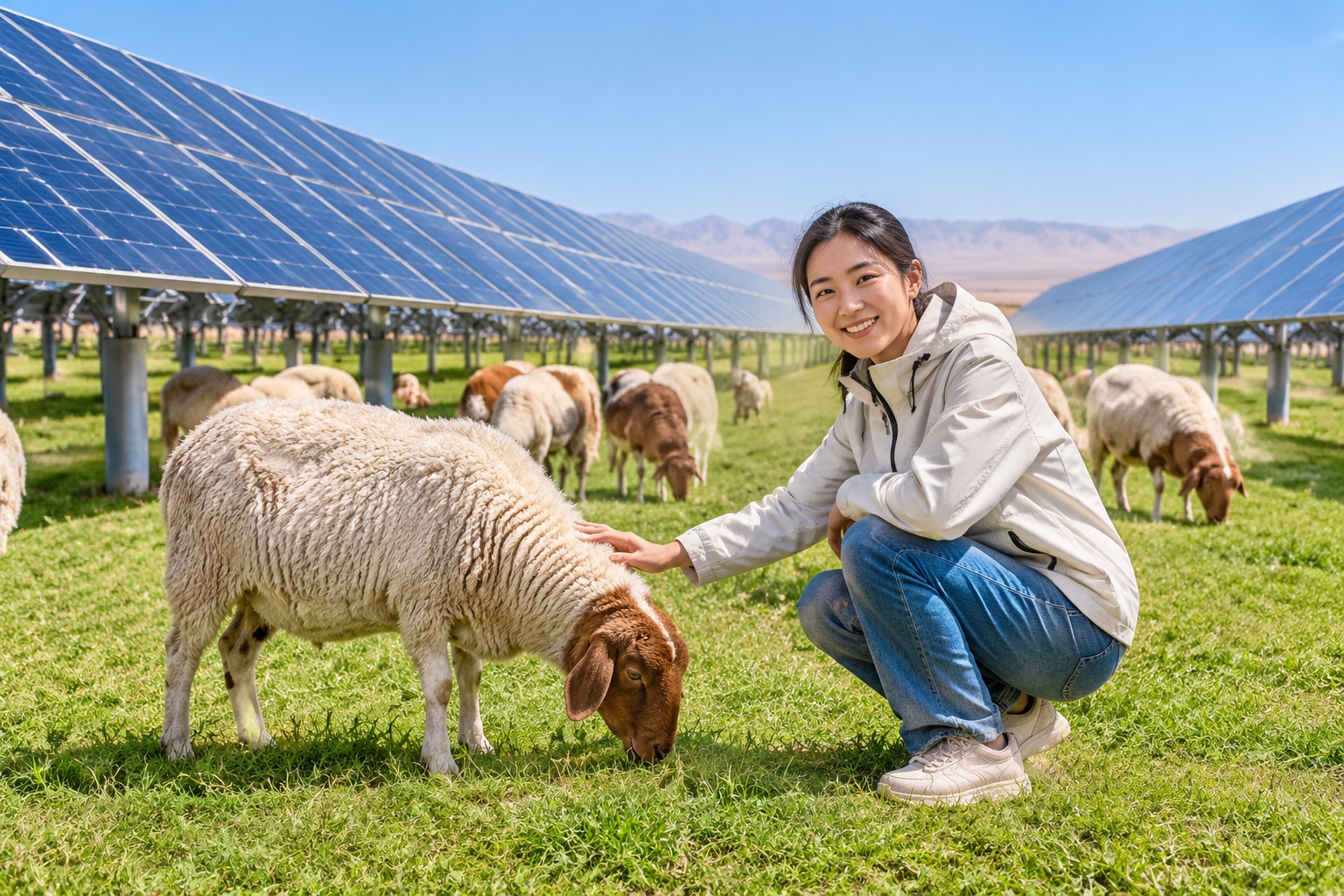
The most striking detail, though, is not the panels on the skyline. It is the flock of sheep moving between them. In a practice that has become known locally as “photovoltaic grazing,” the solar arrays are raised high enough for grass to grow beneath them. The shade reduces water evaporation and keeps the ground cooler in summer, allowing vegetation to thrive in otherwise barren strips. Herders are invited to bring sheep onto the site, where the animals mow the grass and naturally fertilize the soil.
Ma Zheng, a herder who has kept sheep in the solar park for five years, describes the relationship without romance: “The grass here is greener, and the panels stop the worst of the wind. In winter, the sheep don’t get frozen. That alone is enough reason.”
Desert Tourism: The Third Leg of the Oasis Economy
Shapotou from sand slides to smart cabins
Tourism is the most visible part of Ningxia’s desert economy. The Shapotou scenic zone, located where the Yellow River bends past the edge of the Tengger Desert, has been attracting visitors since the 1980s. But the new generation of travelers expects more than camel rides. Today, Shapotou offers cable-car rides across the river, sand surfing down steep dunes, and “desert camping” in modular cabins with blackout curtains and air conditioning.
Online travel platforms such as Ctrip and Meituan show that weekend rooms at Shapotou’s desert hotels often sell out during summer and national holidays. Some packages now include night-sky observation, sand art workshops, and guided bike tours through restored wetland zones.
How tourism pays for environmental upkeep
The tourists do more than fill local pockets; they help fund the verdant landscape itself. Park admissions and activity fees are partially channeled into replanting programs and maintenance of the straw-checkerboard grids that hold the sandy slopes in place. Local guides often come from nearby towns and have personal memories of childhood sandstorms. “When I was young, winter meant getting sand in your rice no matter how careful you were,” says guide Yang Jun. “Now we spend the winter counting the bookings for next summer.”

The Workforce Behind the Green
Baijitan’s restoration is often described as a number of hectares, but locals experience it through their hands. Villagers in surrounding towns are hired for seasonal work: tying straw into grids, pruning sea buckthorn bushes, collecting seeds, and guiding visitors. Women have found a particular niche in the berry harvest, where careful hands and patience matter more than physical strength.
In the solar sector, new jobs are also appearing. The Tengger base requires technicians who can climb up to clean panels, inspect cables, and monitor weather data. Local technical schools in Zhongwei now offer courses in photovoltaic installation and maintenance, filling a gap that existed a decade ago.
Strains and Realities
No one here pretends the desert is gone. Water is still a scarce resource. Sea buckthorn yields depend on the weather, and a cold snap or rainless spring can cut production sharply. Solar panels need regular washing, and in a dry region, every wash uses valuable water. Tourism is seasonal, with most arrivals between May and October. And although the green buffer has expanded, climate change has brought more intense heat waves and occasional storms that can still toss sand into the air.
There are also limits to how far these experiments can scale. The photovoltaics-plus-grazing model works on flat, state-managed land, but persuading individual herders to coordinate with energy companies is not easy everywhere. The sea buckthorn market is growing, but it remains a niche product compared to mainstream fruit industries. Even Shapotou, popular as it is, relies heavily on domestic tourists and can feel half-empty on weekdays.
The Takeaway
What makes Ningxia interesting is not that it has found a silver bullet. It has instead built a web of small, connected incentives that make retreat better than advance. The berries pay for the bushes. The kilowatts pay for the panels. The tourists pay for the park staff and the tree-planting crews. Each layer of the “hidden economy” reinforces the rest.
For outsiders, a visit to Baijitan, the Tengger solar base, or Shapotou is a reality check about what ecological restoration can look like when it is allowed to be self-interested. It is still a young economy, with all the rough edges that come with it. But it is proof that a green landscape can also be a profitable one — and that “desert” and “market” are no longer opposites.
Start the discussion at forum.chinacomes.com