
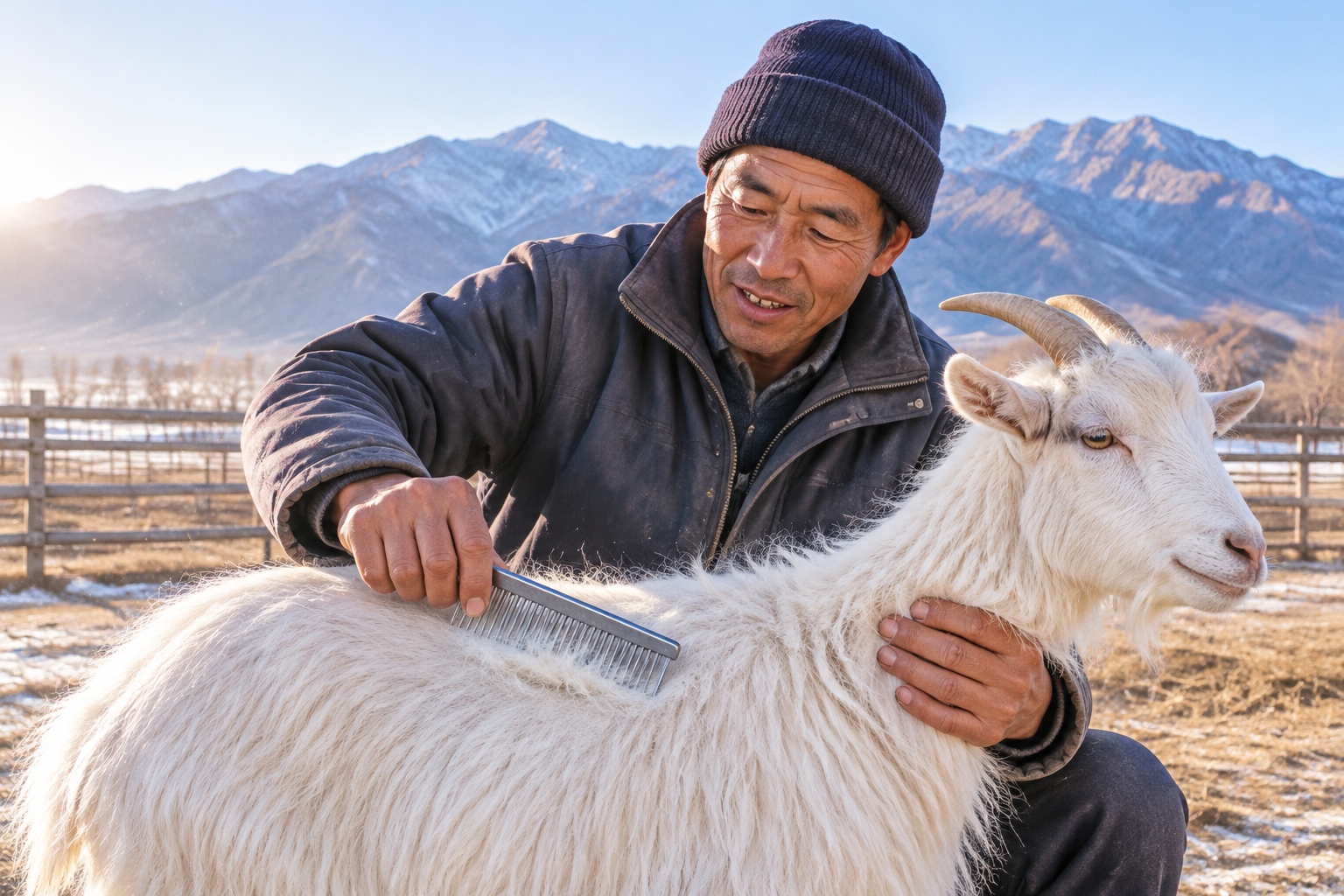

On a cold April morning at the foot of the Helan Mountains in Ningxia, Ma Wenqiang kneels beside a white goat. He runs a steel comb across the animal’s chest, and soft, pale fibers curl in his palm like morning mist. He holds them up to the light. “This is the good stuff,” he says. “Each goat gives only about 200 grams a year. That’s why your sweater costs so much.”
This is the beginning of a journey that ends thousands of kilometers away, in a clothing store in New York or a boutique in London. Inside that simple woolen garment is a story of grassland, machines, and the hands of people most buyers will never meet.
A Short History of Cashmere in Ningxia
Cashmere—called shan yang rong in Chinese—comes from the soft undercoat of goats, not sheep. It is harvested in early spring, when goats shed naturally. For centuries, herders in inner Asia have combed it by hand. In China, the industry has boomed in the northern provinces. Ningxia, a landlocked region about the size of Portugal, sits in the dry northwest. Its mountains and plains provide harsh but ideal conditions for a particular breed: the Zhongwei goat, known for its fine, curly wool.
In the 1950s, the Chinese government began to develop the region’s livestock economy. But it was in the 1980s and 1990s that Ningxia transformed from a raw-material producer into a processing and trading center. Yinchuan, the regional capital, and Lingwu, a smaller city nearby, now host hundreds of mills and workshops. Together with neighboring Inner Mongolia, Ningxia plays a major role in the world’s cashmere supply chain. Today, China supplies roughly 70% of the planet’s raw cashmere and about 90% of the finished cashmere products. Ningxia is a critical part of that story.
Morning on the Grassland
Ma Wenqiang is 39 years old. He has raised goats for most of his life. His family’s herd numbers around 300, all grazing on pastureland that runs along the eastern foot of the Helan Mountains. In April, the air is still sharp, but the sun rises fast. He and his wife, Wang Lifang, move from pen to pen, catching each goat and setting it on a low bench.
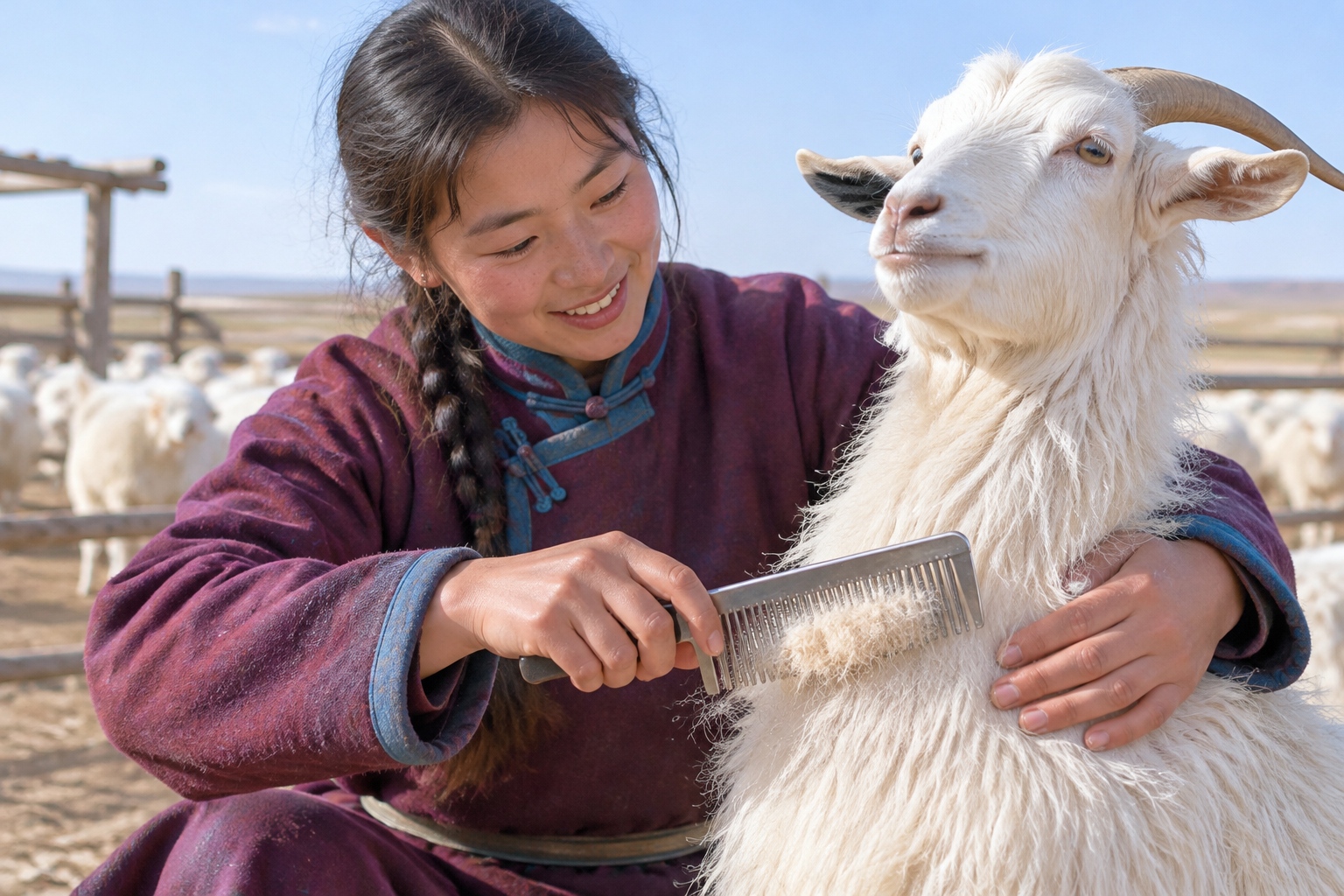
The combing technique has not changed much over the decades. A herder uses a coarse steel comb to remove dust and outer hair first, then a finer comb to gather the soft down. Each stroke must be gentle, because the goat’s skin is delicate. On a good day, one skilled person can comb five or six goats. A single goat may yield only a small handful of fleece.
“You have to be patient,” Ma says. “If you pull too hard, the goat gets frightened and won’t give you good fiber next year.” In China, goats are not usually shorn like sheep; the down is combed out to preserve its length and quality.
After combing, the cashmere is weighed and loosely packed into canvas bags. The weight and color determine the initial price. White is the most valuable, followed by light gray and brown.
The Traders Who Decide a Year’s Worth
A few weeks later, a green pickup truck rattles into the village of Caiyuanhu. The driver, Yang Dejun, has been trading cashmere for more than twenty years. He visits herders across Ningxia and Inner Mongolia during the spring harvest. He buys bags of raw fiber, then resells them to the washing and sorting plants in Lingwu.
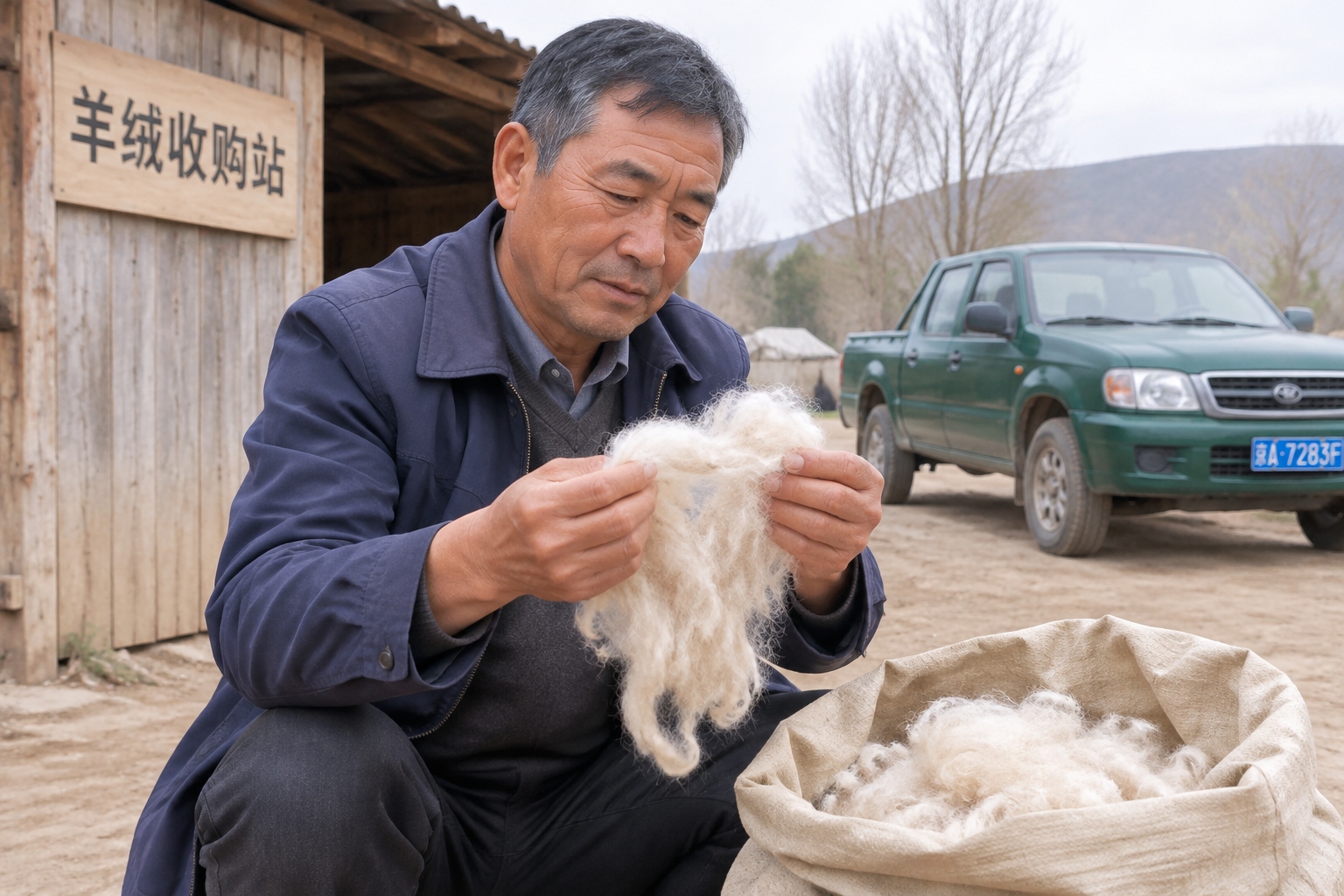
Yang is a familiar figure. He greets Ma Wenqiang by name and walks to the shed where the bags are stored. He raises a handful of fiber, pulls it apart, and holds it against the sky. He checks for length, cleanliness, and the amount of short broken fibers. Then he looks at the color in the sunlight.
“The market changes every week,” he says. “Last week, prices were stable. This week, some buyers are paying more for superfine fiber because European orders have grown.” The negotiation, conducted over tea, does not last long. The two men agree on a price per kilogram. Yang pays in cash, as he always does, and loads the bags into his truck.
For Ma, this transaction settles a season’s work. The income pays for feed and medicines for the herd. But it does not tell the whole story. He knows the cashmere will be sold many times over before it reaches a knitting factory. “They will turn it into a little sweater,” he says, “and it will sell for a lot more than what I got. But that’s business.”
Inside the Washing and Sorting Plants
In the industrial zone on the outskirts of Lingwu, rows of low concrete buildings house washing, drying, and dehairing operations. The raw cashmere arrives in large bags, dusty and smelly. Trucks roll in and out all day.
In the first step, workers feed the fiber into a large washing tank with warm water and a mild detergent. Then it is dried in a spinning cage and moved to a dehairing machine. This machine, made in China, separates the long, smooth fibers from the short, coarse ones. The process is repeated several times to remove remaining foreign matter.
Only about forty to fifty percent of the original raw weight remains after cleaning and dehairing. This is the clean cashmere that will be sent to the spinning mills. The rest, including coarse hair and waste, is discarded or used for lower-quality products.
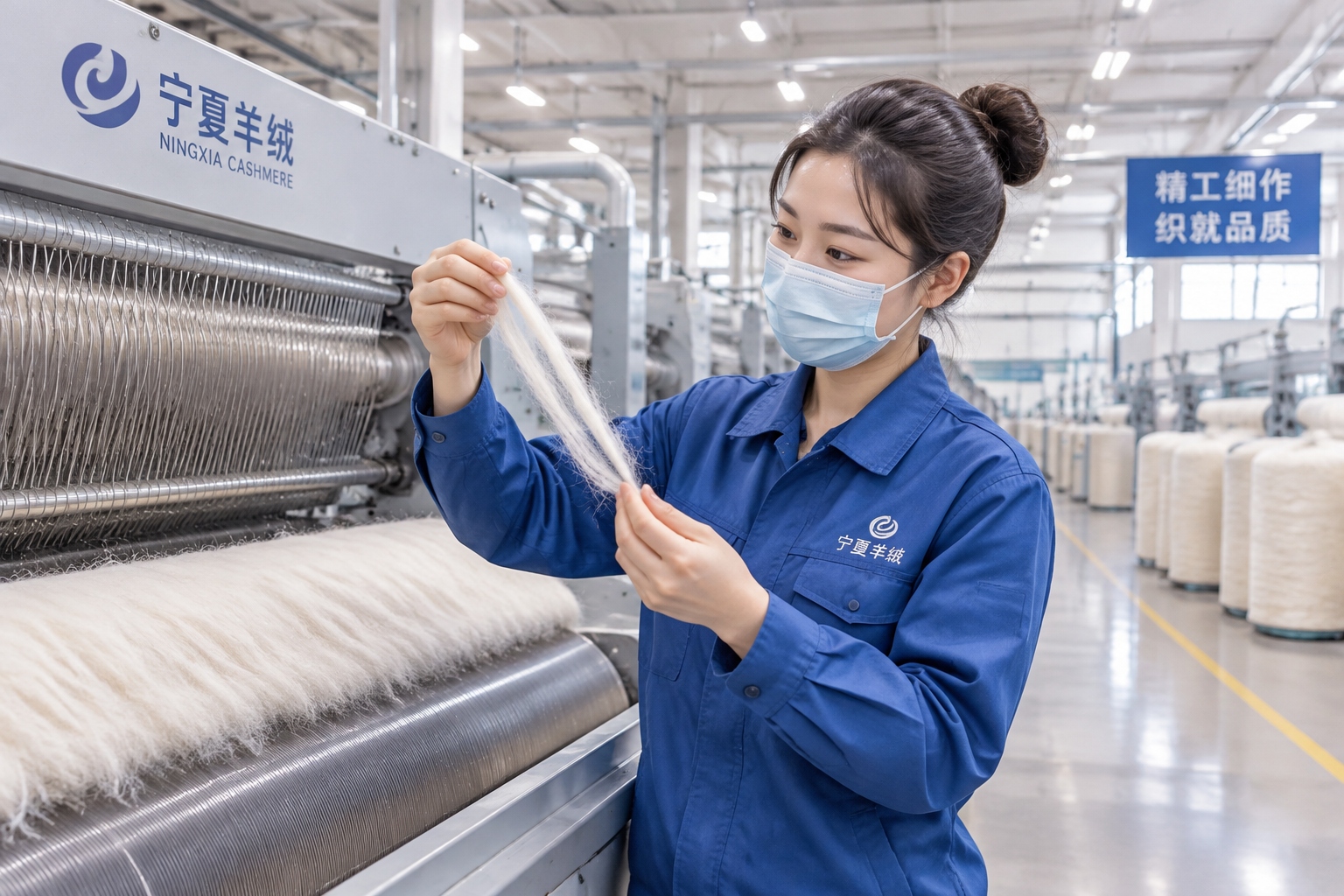
The workers here are mostly local women. They wear blue uniforms and face masks. Some have been at the same plant for over a decade. Huang Xiaomei, who operates a sorting table, says the job demands sharp eyes. She picks out short fibers and brittle ends left over from the combing. “You have to be careful,” she says, “because a small mistake can lower the whole batch’s grade.” She earns about 3,500 yuan per month, a stable income that allows her to support her family.
The Spinning Mills: Converting Fiber into Thread
The next step takes place in Yinchuan’s high-tech industrial park. Here, a company called Ningxia Xiyuan Textile Co. runs one of the largest cashmere spinning mills in the region. The plant is surprisingly quiet. Large machines hum as they comb, card, and twist the fiber into yarn.
In the carding room, cashmere is blended with a small amount of synthetic fiber to reduce static and breakage. The mixture passes through a series of rollers covered with fine pins. These pins straighten the fibers and remove remaining bit of vegetable matter. The resulting soft web is condensed into a rope-like sliver, which is then drafted into a fine strand.
The spinning machines operate around the clock. Each spool of yarn can be more than ten kilometers long. Workers check for imperfections using touch and under bright lights. A single broken thread can stop the entire line, so machines are designed to be easy to repair and reset.
Today, Ningxia’s spinning mills are pushing beyond raw yarn. They are developing blends that combine luxurious cashmere with synthetic fibers for stretch, or with silk for a glossy finish. Some are even experimenting with recycled cashmere, pulling old sweaters apart and re-spinning the fiber. This innovation responds to environmental concerns, since cleaning and dyeing cashmere can have a significant water footprint.
Knitwear Factories and the Final Product
Once the yarn is ready, it is shipped to knitting factories, many of which are also in Ningxia. On the outskirts of Yinchuan, a factory run by Ningxia Zhongmao Cashmere Products Co. employs around 300 workers. Most are young migrants from surrounding villages.
The factory floor is organized into lines of computerized knitting machines. Each machine clacks quickly as it shapes the sleeves and body of a sweater based on a computer program. A skilled worker watches several machines at once, checking for dropped stitches and making sure the fabric patterns match.
After the pieces are knitted, they are washed again to soften the fiber and remove oils. Then they are steamed and stretched into the correct shape. Workers sew the parts together, add buttons or zippers, and finish the edges by hand. The final products are inspected piece by piece for defects before being folded and packed.
The making of one sweater takes about three to four hours of machine time and thirty minutes of handwork. In a busy month, this factory produces over fifty thousand garments. Most are exported to Europe and Japan, where they carry brands like Max Mara, Armani, and Uniqlo. But a growing part stays in China, sold under domestic labels that are gaining popularity among younger consumers.
Challenges and Changes
Cashmere is a luxury product, but the industry faces real difficulties. For herders, income is vulnerable to market prices and to climate change. Droughts in the grassland can reduce the quality of the grass, which affects the goats’ fleece. In recent years, the Chinese government has introduced herding quotas and grassland restoration programs to prevent overgrazing.
Factories, too, wrestle with water consumption and chemical waste. To address this, many companies are investing in closed-loop water recycling systems and more eco-friendly dyes. “Our factory recycles about 80% of the water,” says a production manager in Lingwu. “Cashmere is a natural, renewable fiber. If we handle it right, it can be one of the most sustainable materials in fashion.”
But there is also the human concern: the future of the young people working in these plants and herding communities. Many young workers in the factories spend their days staring at machines, and some say they would prefer jobs in cities. Yet the cashmere industry provides livelihoods for hundreds of thousands of people in a region where job options are limited.
A Global Thread
In the evening, Ma Wenqiang walks out near his pasture and looks at his goats. The spring combing is nearly finished, and the animals have already begun to grow a short new coat. He pulls out his phone and shows a photo of a cashmere sweater his daughter bought in Yinchuan. “I can’t tell which goat it came from,” he says with a laugh. “But it’s warm, and my daughter says it’s comfortable.”
That sweater is now one of many pieces hanging in wardrobes around the world. Perhaps the buyer in London or New York has never heard of Ningxia. But inside the fiber are traces of a place, a morning, and a set of hands that made it all possible. From the comb to the sweater, the distance is long. The chain is fragile, and yet it holds. It connects a goat herder in the foothills of the Helan Mountains to a stranger on another continent, all through the thread of a simple garment.

Start the discussion at forum.chinacomes.com