

At the Check-In Counter, the Souvenir Has Changed
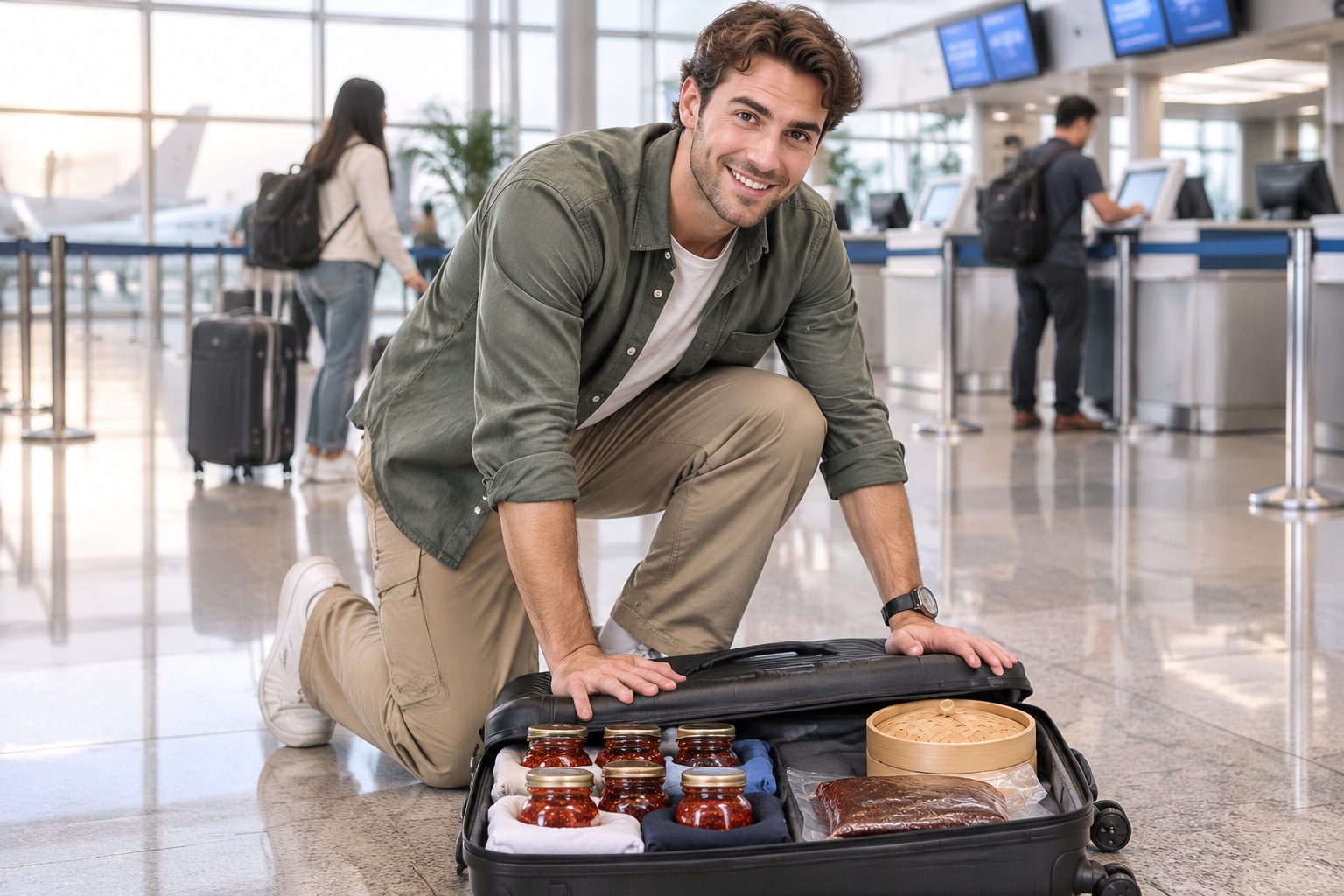
Six in the morning at Chengdu Tianfu International Airport. The line for the Bangkok flight is barely moving, and the reason is one suitcase. A man in his fifties is kneeling on the floor, sitting on the lid, trying to get the latch to catch. Between two sweaters sit four glass jars wrapped in T-shirts. Next to them, a vacuum-sealed block the colour of dark chocolate. Jammed into the corner, a bamboo steamer that takes up more space than his shoes.
Ten years ago, a suitcase on this route would have held silk scarves and a tea set in a red cardboard box. Those things still exist, and people still buy them. But the items that now travel home look different: cheap, edible, slightly messy, and built for a Tuesday night rather than a shelf in the living room.
That shift is worth paying attention to. It says something about how foreigners are meeting China now — not through museums and ceremonies, but through the supermarket aisle and the kitchen.
The Gateway Is a Jar of Chili Crisp
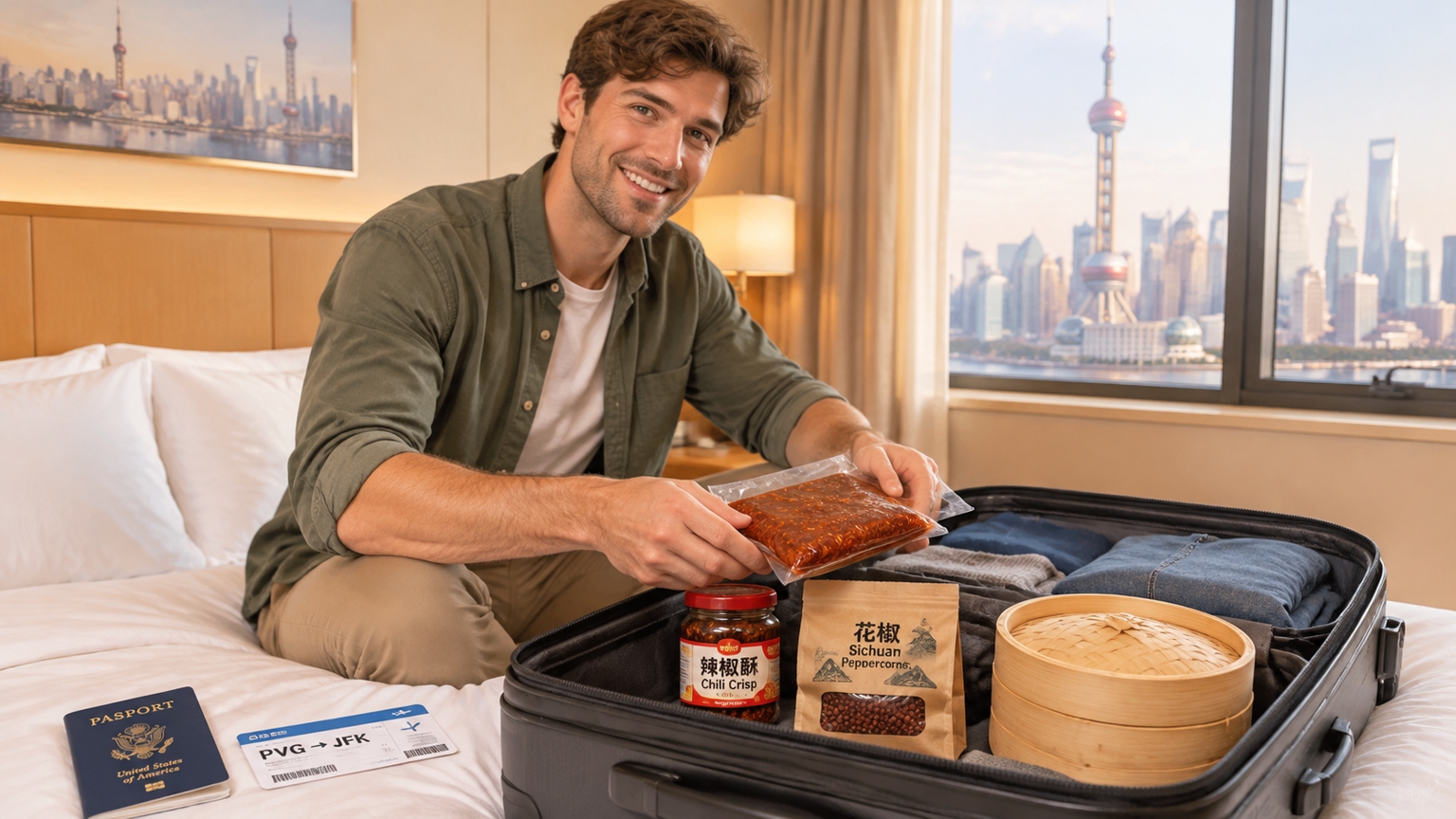
Ask almost any recent traveler what they packed, and the answer starts with food. Often it starts with Lao Gan Ma, the chili crisp in a squat glass jar with a stern-faced woman on the label. In a Chinese supermarket it costs around 12 yuan, a bit over a dollar and a half. In a Chinese grocery in London or Sydney, the same jar can run six or seven times that.
It is the cheapest souvenir in the country and the one most likely to be finished within a month. That is exactly the point. A keychain lives in a drawer. A jar of chili crisp goes on eggs, on noodles, on rice, into a bowl of plain soup at eleven at night. Every time someone twists the lid open, they are briefly back in a noodle shop in Xi’an.
Food is the only souvenir that gets a second life. Everything else is a memory of a trip; a condiment becomes part of how you eat.
Peppercorns, Sold by the Scoop
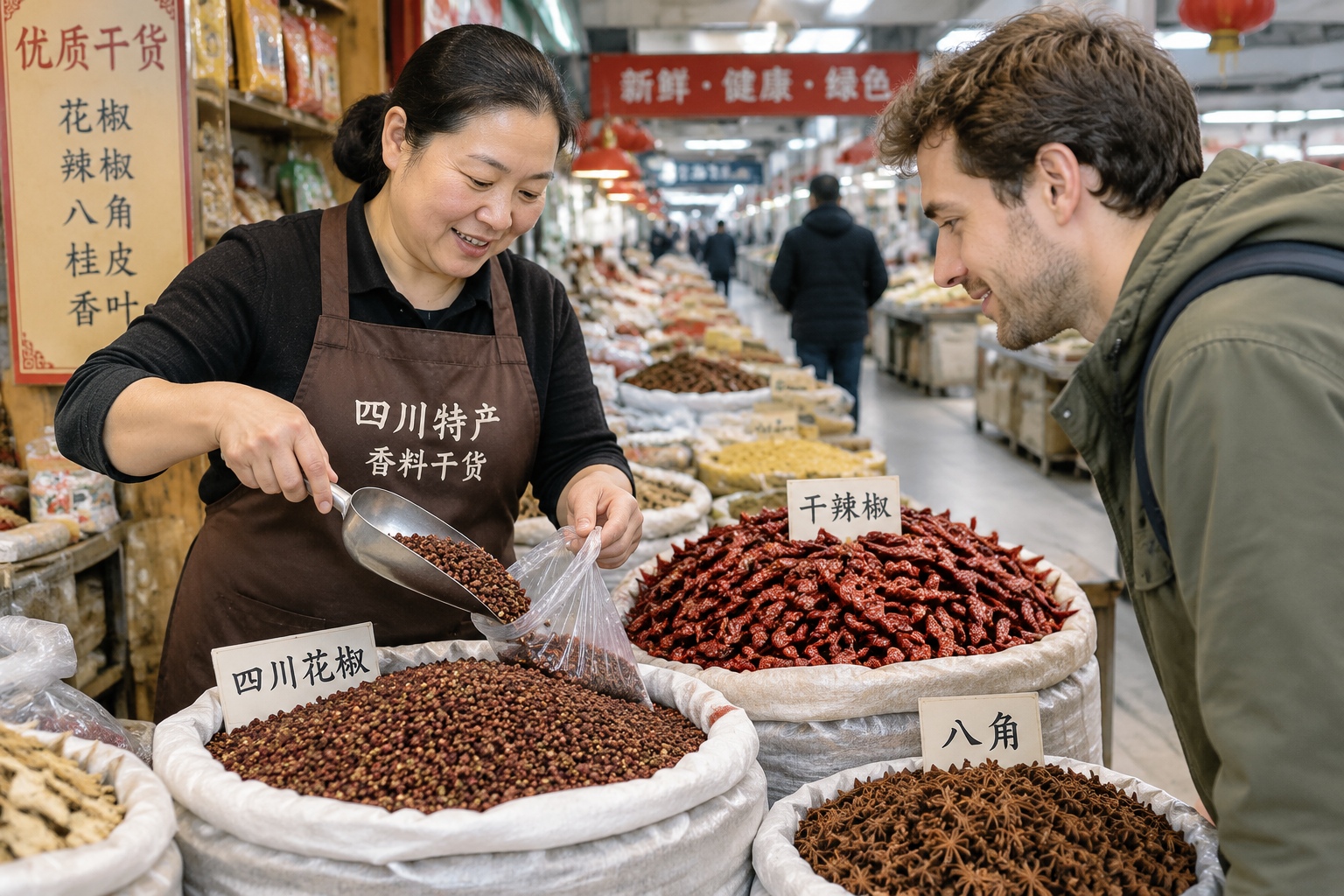
Walk into a dry goods stall in any Chengdu market and you see the same scene: open sacks of star anise, dried chilies and Sichuan peppercorns, and a vendor holding a metal scoop. Nothing is pre-packaged. You point, they weigh, you pay by the gram.
For a visitor, this is a small revelation. Sichuan peppercorn — the tingle that is not heat, the reason a good mapo tofu makes your mouth feel like it is vibrating — costs almost nothing here and a small fortune abroad, where it usually arrives in a 30-gram jar with a brand name on it. Travelers buy a bag for the price of a coffee and photograph it on the way out.
The vendor usually enjoys it. At a stall off Qinghua Road, the owner keeps a laminated card with the English names of four or five spices, mainly so she can stop repeating herself. She says foreigners almost always buy peppercorns and dried chilies, and almost never buy the expensive birds’ nest or ginseng that gift shops push. They want what people actually cook with.
That is the quiet difference between a souvenir and a supply. A supply implies you plan to keep cooking.
The Hotpot Block Is a Social Machine
Then there is the brick. Hotpot seasoning — beef tallow, chili, fermented beans and a dozen aromatics pressed into a solid block — sells for 15 to 25 yuan in any supermarket. It weighs almost nothing, survives a long flight, and turns into a party.
This is the item that changes behaviour. A hotpot is not a dish; it is a format. One pot in the middle, raw ingredients around it, everyone reaching in. There is no individual portion, no correct order, and no way to be a spectator. For a foreigner who has spent two weeks watching Chinese families eat this way, taking the block home is an attempt to import the arrangement — and it usually works, because the format is easy to copy even when the flavours are not exact.
One German couple I met in an airport queue had six blocks in their bag, destined, they said, for a flat in Leipzig where Sunday dinners had become a standing invitation. The instructions were on the back of the packet, in Chinese. They had photographed and translated them once, and never needed to again.
It Is Not Only Food
Look inside the average suitcase and you find a second category: objects that carry a habit.
- A bamboo steamer, about 20 yuan, which weighs nothing and ends up being used more than most kitchen gadgets bought at home.
- A thermos. Visitors find the Chinese habit of drinking hot water slightly baffling, then adopt it in winter.
- Florida water — the green, cologne-like liquid sold everywhere for a few yuan and used for mosquito bites, heat rash and general summer misery.
- A one-switch rice cooker, or a folding umbrella from a convenience store that somehow survives a year of Berlin weather.
- For younger travelers: a hanfu top, a canvas tote with a Chinese slogan on it, a plastic blind-box toy that becomes a desk ornament.
None of these belong in a museum. All of them get used. That is the test these buyers are applying, whether they say it out loud or not: will this thing still be doing something in my kitchen six months from now?
Why the Shopping List Changed
Part of the answer is practical. China has widened visa-free entry and extended visa-free transit to ten days for citizens of dozens of countries. Ten days is long enough that a trip stops being a checklist of landmarks and becomes a stretch of ordinary life: supermarkets, breakfast stalls, a friend’s kitchen, a market where nobody speaks English.
Part of it is the vlog economy. Someone films a spice stall, a viewer in another country books a flight, and the loop closes. Short videos have made specific brands and specific stalls famous in a way no tourism campaign could manage.
Part of it is policy meeting shopping: departure tax refunds are now easier to claim in many cities, which quietly encourages people to buy more than a magnet. And part of it is that Chinese shops have noticed. Cashiers in tourist-heavy neighbourhoods have learned to read the basket — chili oil, peppercorns, a steamer — before the customer reaches the counter. Some spice vendors now vacuum-seal bags for the flight home. The trade has become ordinary enough that nobody treats it as exotic anymore, which is probably the most interesting part.
Chinese friends often find the list funny. Why would anyone fly nine hours with a steamer? The honest answer is that the steamer costs a tenth of what it does at home and works better. Practical affection, not exoticism.
What Does Not Survive the Flight
Not everything makes it. Australia and New Zealand confiscate meat products at the border, which means beef tallow hotpot blocks disappear into a bin in Sydney. Some travelers learn this the hard way and switch to the vegetarian version.
More often the problem is the cooking. A Sichuan dish made in a Berlin kitchen, on a domestic stove, with local water and supermarket meat, tastes flatter than the version someone remembers. Chili crisp is a shortcut, not a substitute. A few travelers find this disappointing. Others find it clarifying: the taste they were chasing was never only in the jar. It was in the wok, the noise, the twenty-minute wait at a plastic table.
What Actually Goes Home
The suitcase that closes with a knee at Tianfu Airport is not carrying China in any grand sense. It is carrying groceries. But groceries are how habits travel — more reliably than slogans, and much more slowly.
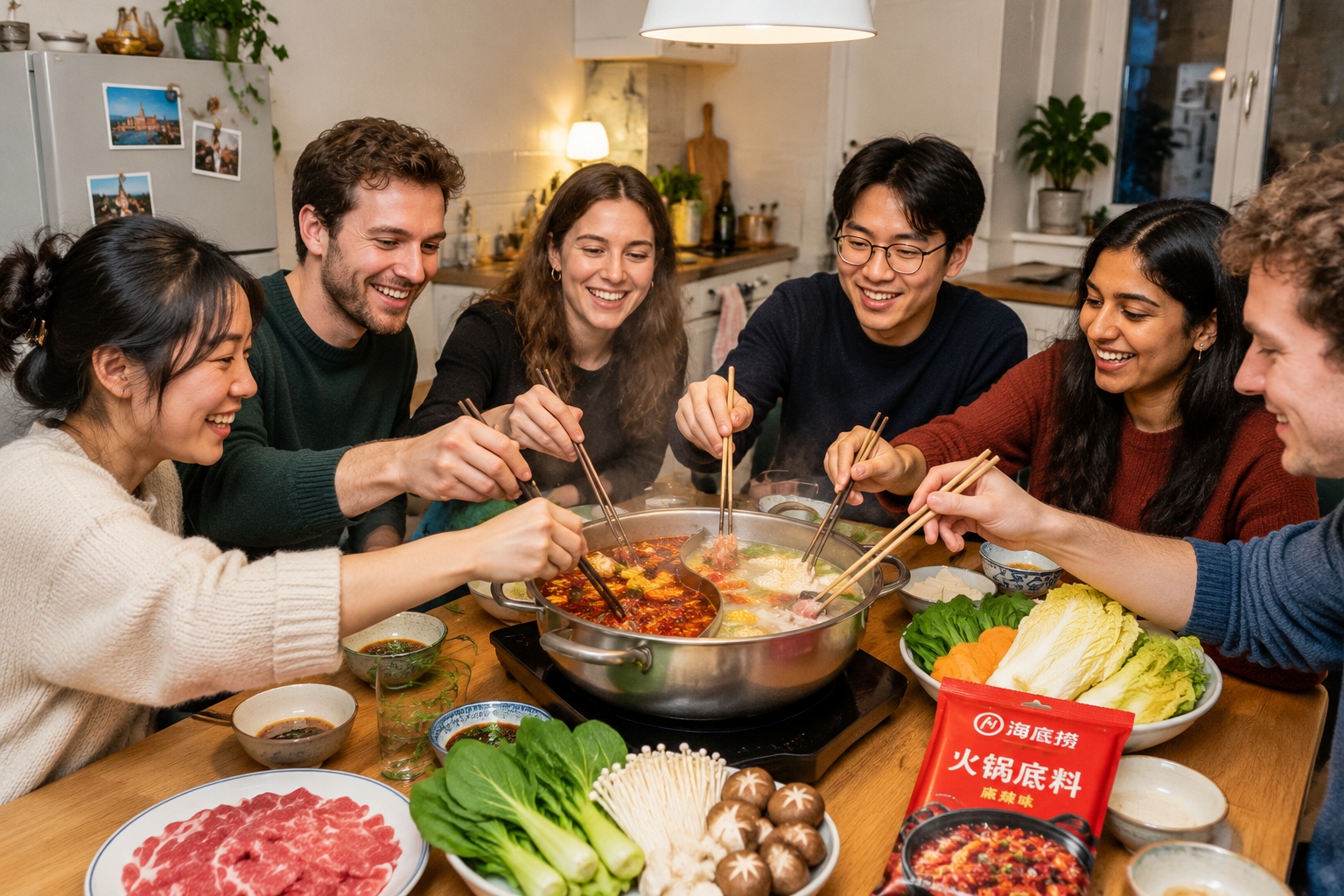
A bamboo steamer gets used on a Sunday. A jar of chili crisp empties. Six friends sit around one pot and argue about how long to cook the potato slices. Nobody in that room is thinking about cultural exchange, which is exactly what makes it one.
Years from now, most of these objects will be gone. What stays is a small change in how someone eats — and that is a fairly durable thing to bring home from a holiday.
Start the discussion at forum.chinacomes.com