
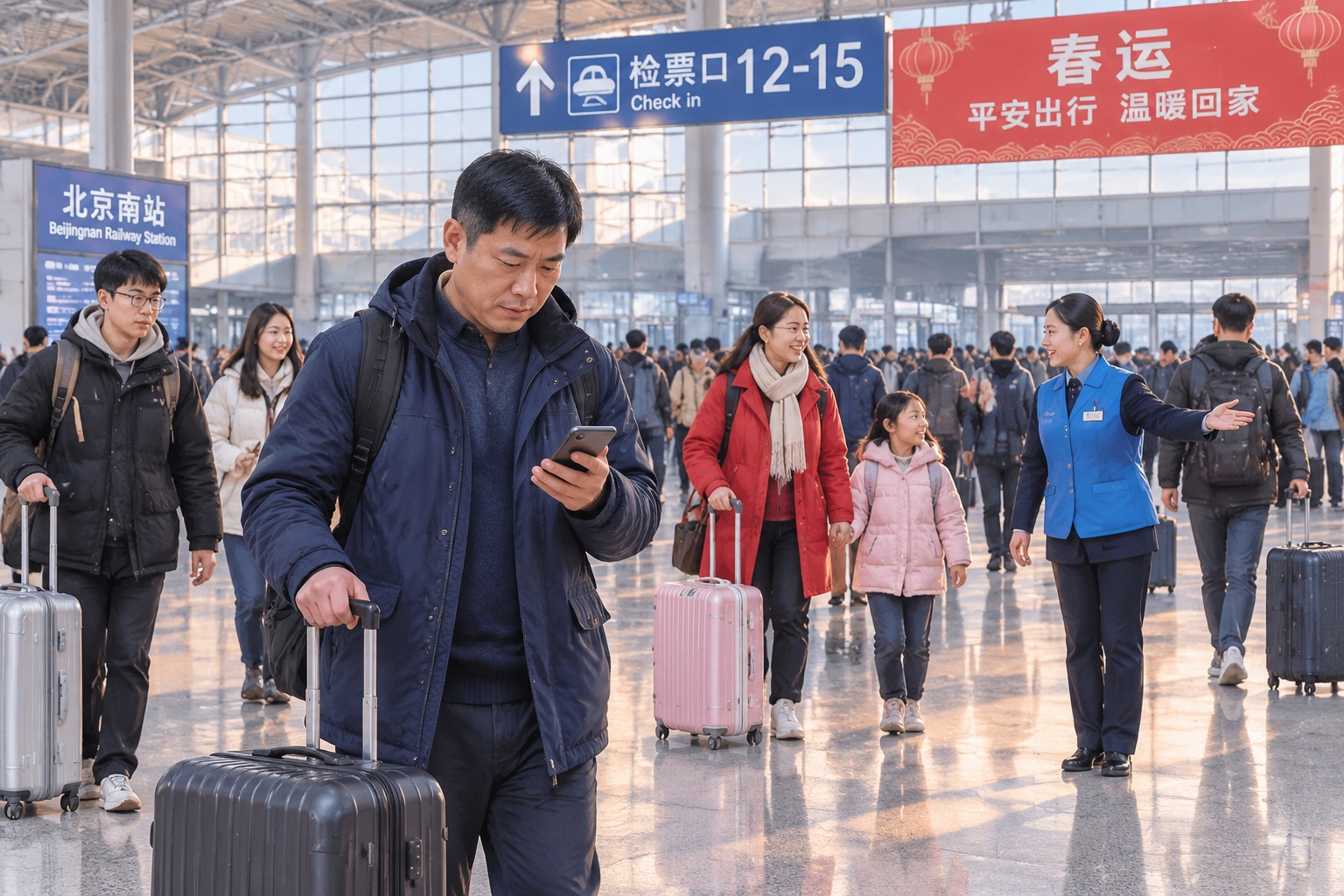

5:30 a.m. at Guangzhou South Railway Station
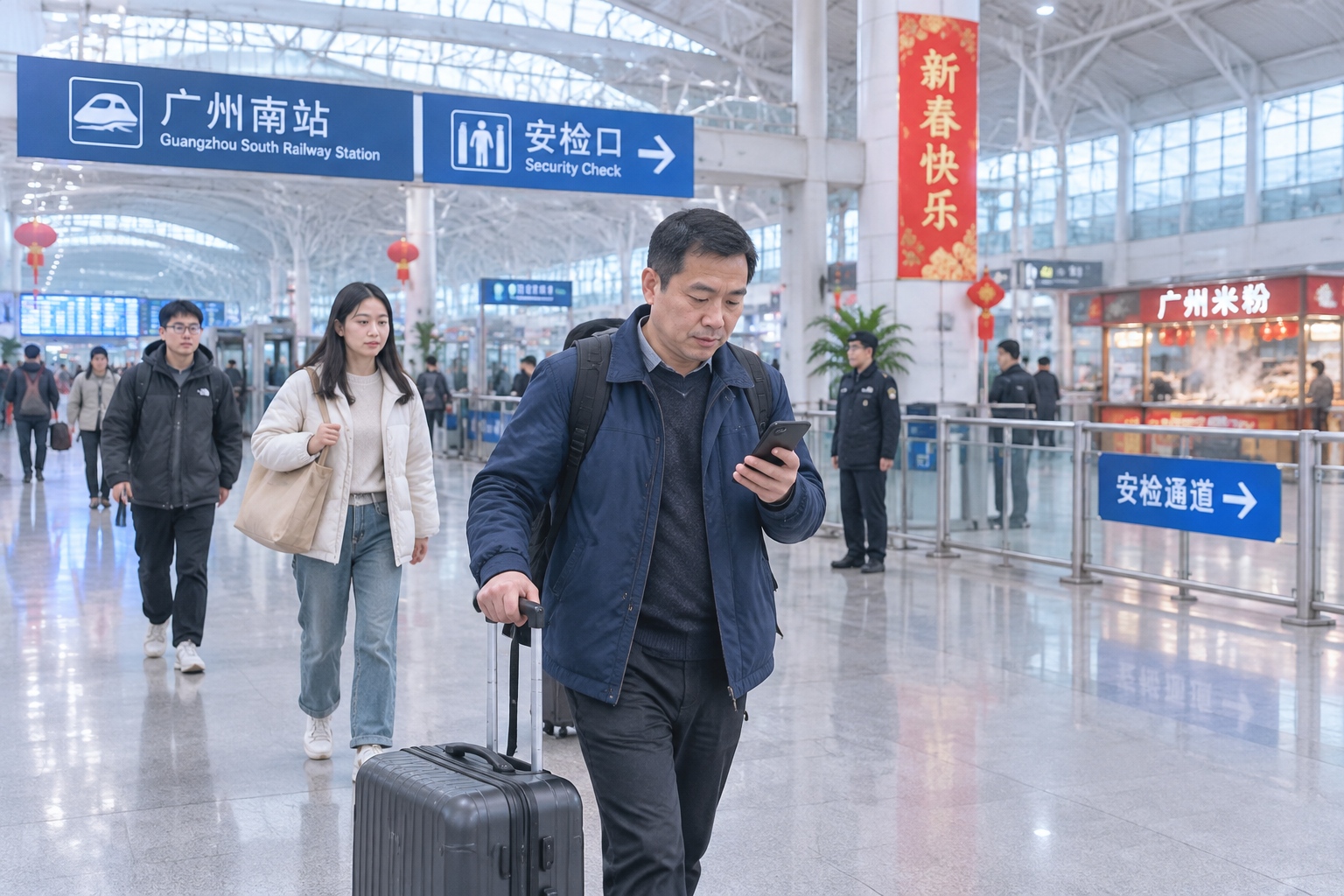
At 5:30 a.m., beneath the curved steel roof of Guangzhou South Railway Station, the air is damp and loud with rolling suitcases. It is the day before Chinese New Year’s Eve. The city should be winding down, but instead, tens of thousands of people fill the waiting hall, in thick jackets, gray sweaters and nylon backpacks.
Wang Qiang, 45, from a village near Zhoukou in Henan, just passed security. He carries two objects: a small pouch with his ID card, and a thick red plastic bucket with rope tied through the handle. Inside the bucket are gifts: chocolates for his daughter, dried longan for his mother, candy and sunflower seeds for hometown friends. “It is also a stool in case I have to sit overnight,” he says. This is his twelfth Spring Festival trip home from the electronics factory where he works in Dongguan.
Twelve years ago, he stood in line for three hours at an old railway station to buy a paper ticket. This morning, his face has been scanned, baggage passed through an X-ray, and his phone holds a QR-code boarding pass. Around him, blue-uniformed workers and volunteers answer questions. The flow is massive but orderly.
A Migrant Shift That Defies Geography
Every lunar year, China mobilizes for Chunyun, the Spring Festival travel rush—the largest annual human migration on earth. In the forty-day window in early 2025, authorities expect about 9 billion passenger trips by rail, air, highway, ship and private cars. On the busiest rail day, more than 15 million people travel by train alone, double the population of New York City.
To ordinary Chinese, Chunyun is not an abstract statistic. It decides when tickets go on sale, how factories celebrate the holiday, and which apps must be recharged before the journey. The need comes from a fundamental fact: since the 1990s, over 200 million rural workers have left home to live in coastal cities.
One Man’s Ticket: An Overnight War
Getting home means first getting a ticket. Wang began booking on the official railway app, 12306, exactly fifteen days before departure. The direct high-speed train from Guangzhou South to Zhoukou East sold out within eight seconds during the first-choice class. He then clicked the “waitlist” function—候补—which automatically watches for canceled tickets. Five days later, at 11:17 p.m., his phone lit up: his ticket had been secured.
It was not always this way. In 2003, Wang took two days off to wait at the county station for a hard-sleeper ticket. When he reached the counter, the only seats left were on a slow train that took 23 hours to reach Henan. He stood in the aisle most of the way, dozing upright near a bathroom. That kind of memory has faded for many young travelers, but Wang’s generation remembers.
The modern system is not perfect: ticket supply on popular routes still disappears quickly, and regular tickets require a lot of mobile-selection skills. Yet China’s rail network has grown to more than 45,000 high-speed kilometers. Last year, the national railway carried nearly 400 million passengers during the forty days, and almost every ticket now requires digital identity, not paper.
Inside the CR400: Speed, Order, Snacks
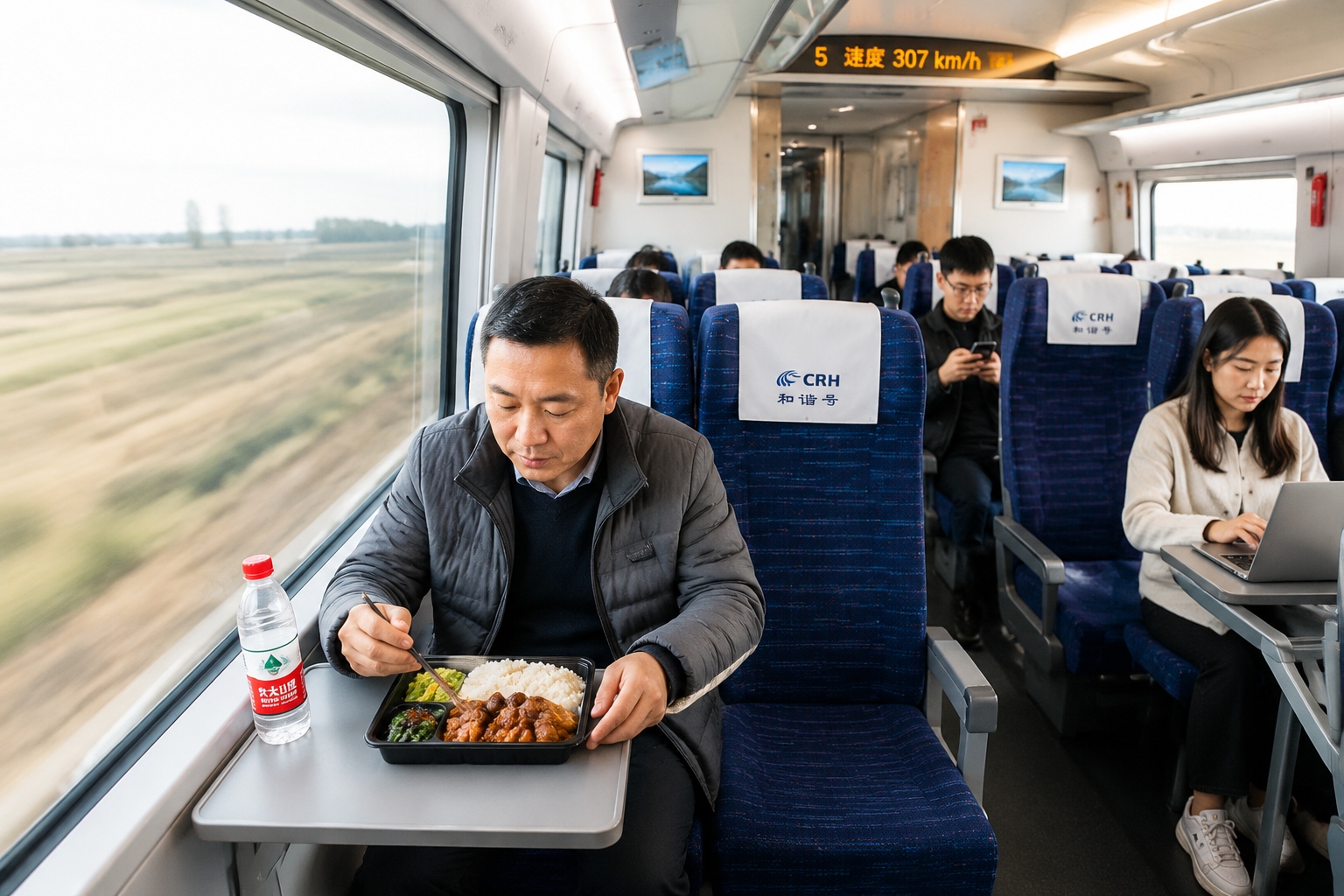
At 6:40 a.m., the white-and-blue nose of a CR400F pulls away, exactly on time. Wang sits in a window seat in a second-class carriage. The train hits 350 km/h on the way through green hills. It will arrive in Zhoukou East Station in 4 hours and 12 minutes.
On his first trips, the slow green-skin trains forced people into the aisles. Now, seats have reserved numbers; overhead bins are closed before departure. Signs glow with outside temperature. A quiet voice announces the next station in two languages.
Wang scans a QR code from the seat armrest and orders braised chicken with rice. A server arrives with a hot tray four minutes later. Beside him, a university student pulls out a laptop to finish a semester report before arriving in Wuhan. Across the aisle, a toddler watches cartoons on a phone. Every now and then, Wang looks up at windows: the familiar concrete houses and river bridges of Henan replace the southern factories.
The Last Fifteen Minutes
The train pulls into Zhoukou East Station at 10:52 a.m. This station did not exist when Wang first started working away from home. Its floor is polished; the queues at taxi stands are watched over by staff.
Wang’s younger brother is outside, waiting beside an electric tricycle. The trike is a common workhorse for the final leg to villages. They drive through a smoothed country road lined with plastic greenhouses and solar lamps. “New toilets were built in the village last summer,” his brother says, as the vehicle rattles over a small bridge. A basketball court now sits by the clinic.
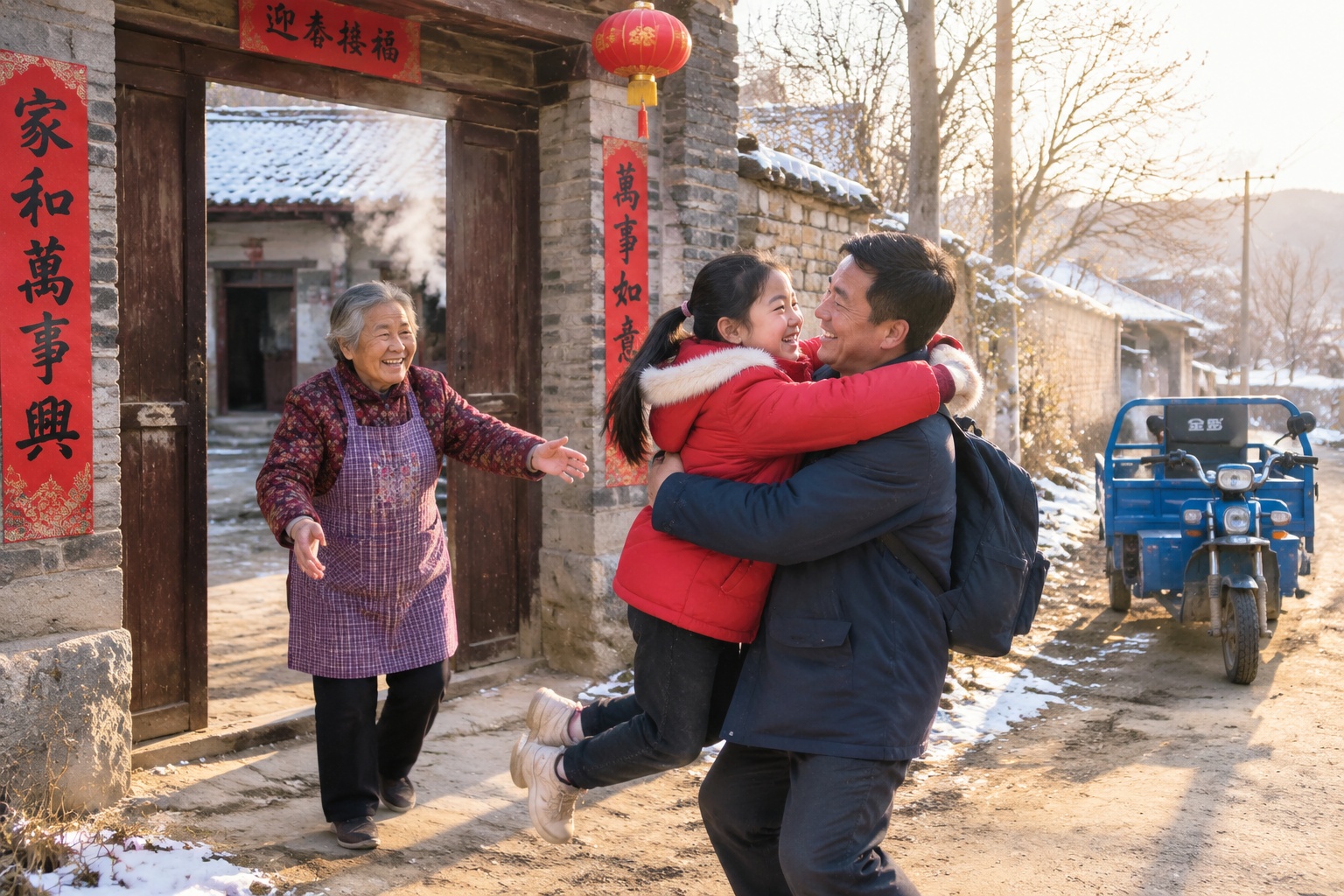
Then the trike slows at a grey gate covered with red spring couplets. Before Wang lifts the bucket from the carrier, a child’s voice cries “Dad!” from the courtyard.
The Reunion That Outlasts Statistics
His daughter, Xinxin, runs out and hugs his leg, then steps back to show him a paper-cut she made in school. His mother waits at the door, wiping her hands on a worn apron. She looks at him and says what she always says: “You’ve lost weight.” Then she hurries back to the kitchen to reheat the hand-rolled noodle soup that she started before sunrise.
Wang lifts the red bucket onto the table. Out come the chocolates, the dried longan, the packets of snacks. His mother laughs at him for buying the same sweets each year. His daughter keeps the chocolate hidden under her shirt like a winter secret.
The rural home is very different from the factory dormitory: cold wooden stools, a smoky oil stove, photos of old family members above the bed. But this is the axis around which Spring Festival still turns.
Changing Migrations vs. Longing for Roots
Among China’s new generation, the migration is changing. Some families now perform “reverse Spring Festival travel”: parents fly to big cities to reunite with their adult children. Others quietly decide to book a hotel for the holiday and travel abroad instead. Yet these choices are still limited to a smaller, younger and wealthier group.
For many workers, a reverse ticket and a rented house in a strange city would feel like a broken promise. The Spring Festival dinner must be eaten in the old house, with the old stove lit, and the family name hanging over the gate.
Wang’s mother fills a bowl with broth and slides it to him. “In the city I eat in the factory canteen,” he says, “but no matter how many years I live in Guangdong, home is where I eat this.”
The Longest Queue Is Still Homeward
Will next year be smaller? Will China’s shrinking rural population reduce the 9-billion figure? Perhaps gradually. But in any village, on that day, the only remaining meaning of the number is: I woke up at 5 a.m., I searched a seat, I put old feet on a fast train, and I returned.
As Wang finishes his soup, the kitchen grows warmer. In 12 months, alarms, counts, and timers will reset. And somewhere in a dormitory in Dongguan, Wang Qiang will again open the 12306 app, stare at the countdown, and press the button with the same held breath as he does today. This is Chunyun—a giant system moving nearly a billion people, searching for a small bowl of soup.
Start the discussion at forum.chinacomes.com