
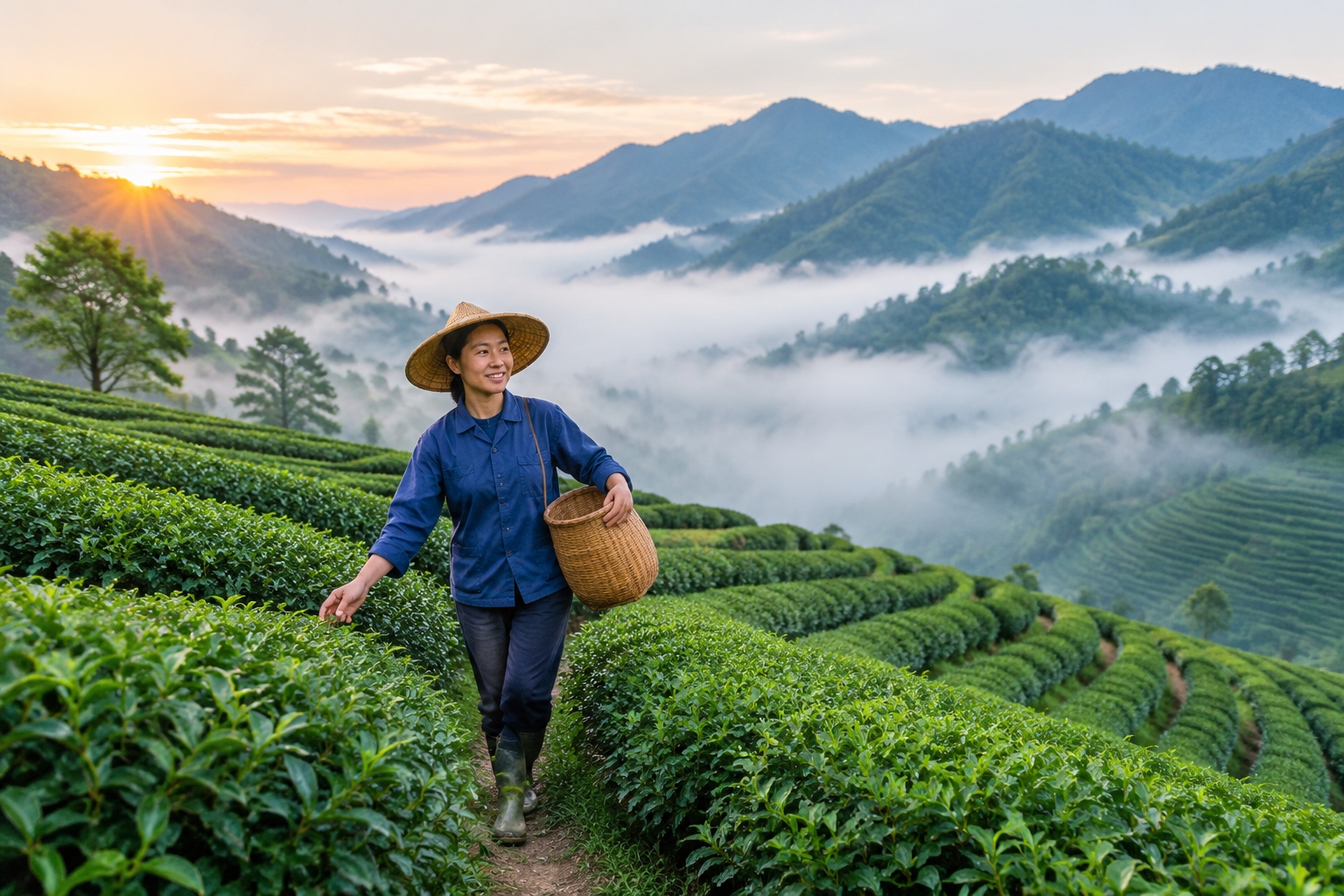

It is half past six on a spring morning in Gaoma’erxi village, hidden in the mountains of Anhua County, Hunan Province. Liu Zhenghua, a tea farmer in his fifties, bends over a low bush and pinches off a shoot with three leaves. The air is wet and cool; river mist from the Zishui River clings to the terraces. “The leaves have to be small enough to see the light through,” he says, holding one up between his fingers. “But not so small that there’s nothing to drink.”
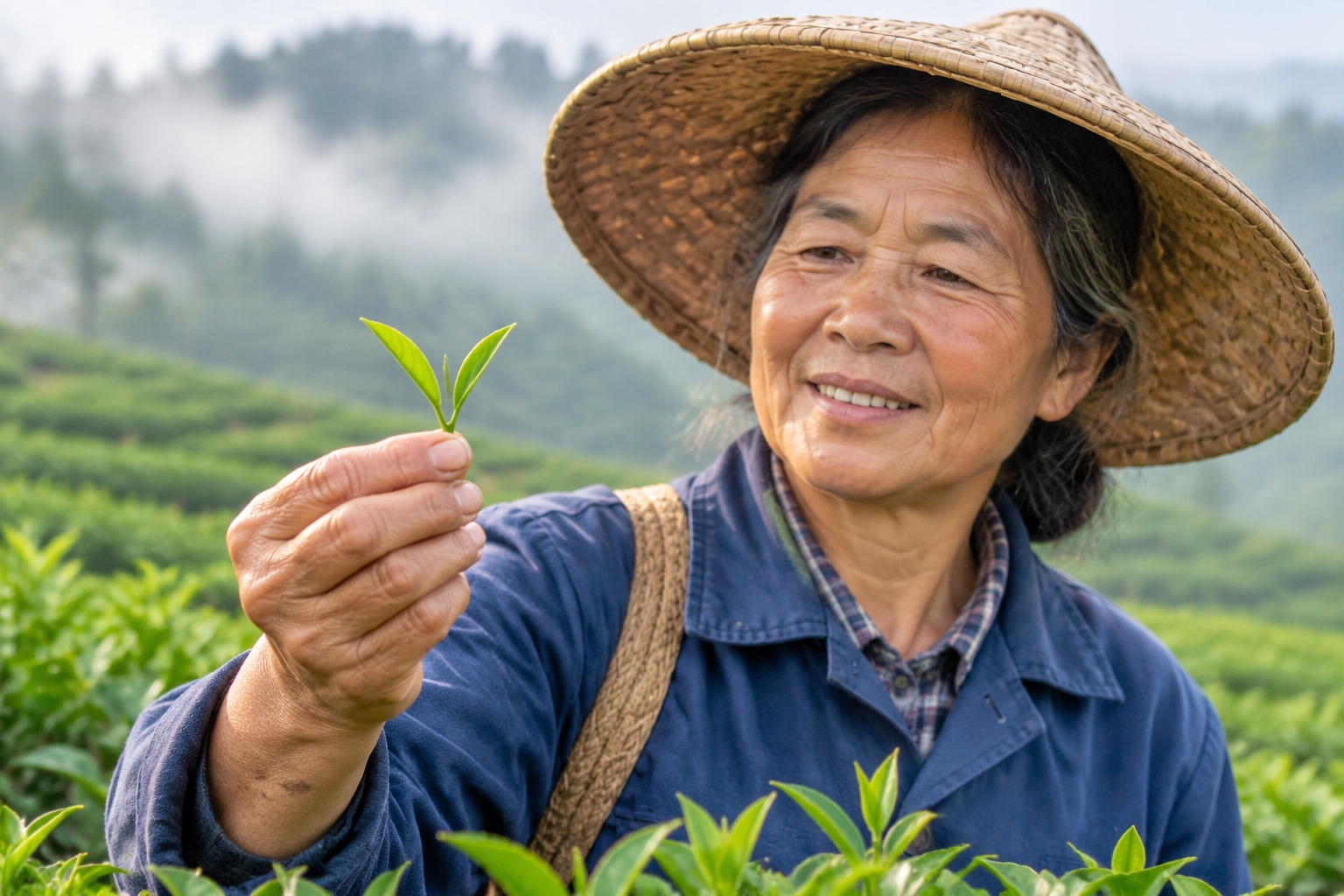
An Unlikely Tea from a Mountain County
Anhua is not a name most travelers know, even in China. It sits in the middle of Hunan, a county of rolling hills and narrow valleys, with steep mountainsides covered by bamboo and old pine. The soil is a rare mix of ice-age boulders and silt, studded with quartz, which drains quickly and forces tea roots to go deep. That natural stress, locals will tell you, is what makes the leaves tough and interesting.
The tea that comes from these hills is not the green tea most people picture in China. It is a type of fermented tea known as heicha, or dark tea, pressed into dense brick shapes. For centuries, Anhua dark tea was the fuel of trade along the Tea Horse Road, a network of mountain trails connecting China’s central plains to Tibet, Mongolia, and Siberia. Horses carried the bricks because they were easy to pack, nearly indestructible, and improved with years on the road.
Ancient Craft, Modern Hands
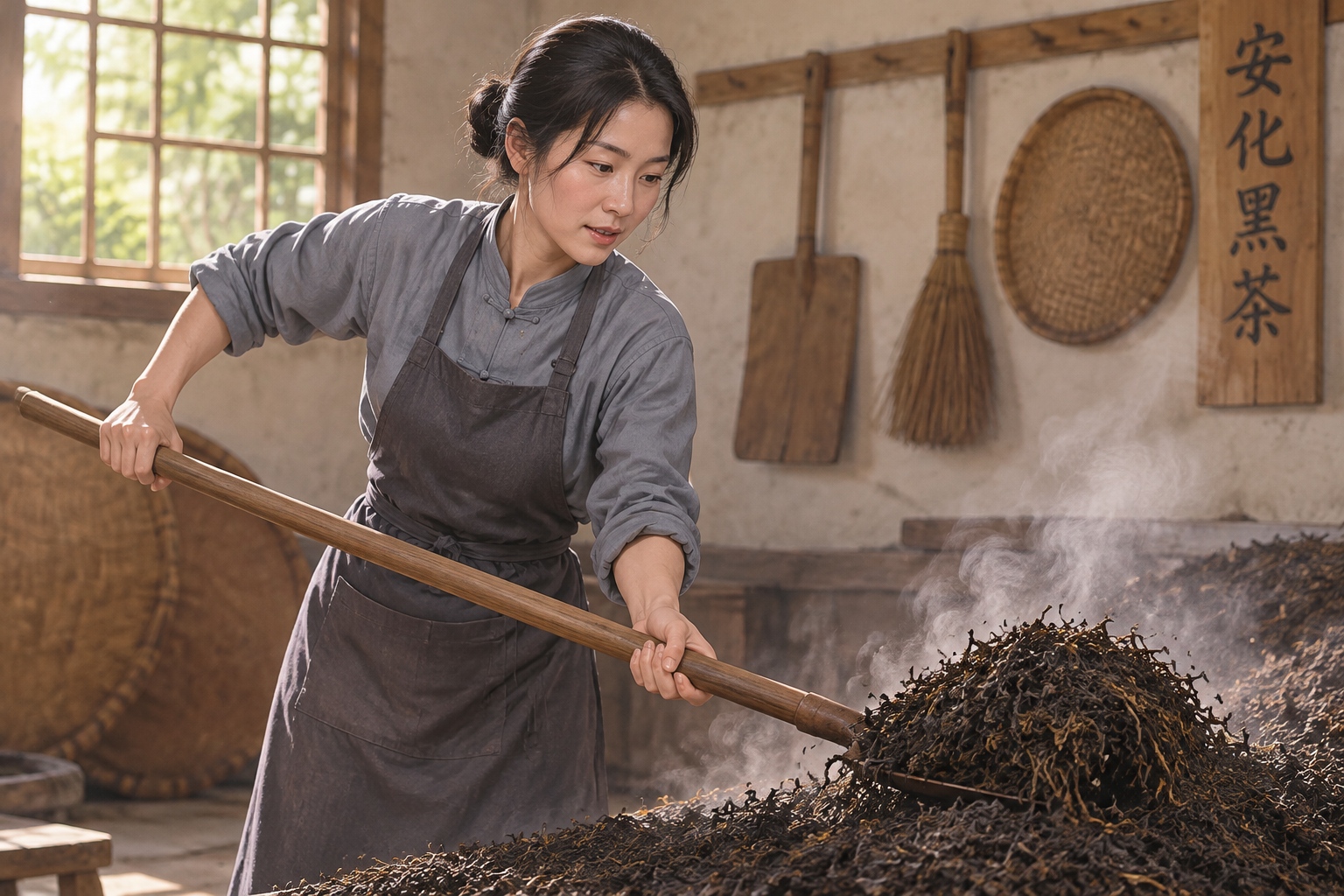
Making dark tea is a slow, physical craft. Fresh leaves are first stir-fried in massive iron woks over pine flames, then rolled and twisted until the cell walls break. The key moment arrives after that: piles of leaves are stacked, sprinkled with water, and left to ferment. In Anhua dialect this is called wodui — a kind of wet piling. The temperature inside a good pile can climb to 60 degrees Celsius, and a skilled master knows exactly when to turn the leaves by pushing a hand into the middle.
The Fermentation Factor
For many batches, another step is added. Leaves are packed into wooden frames and pressed into bricks, then moved to a damp curing room where a golden fungus, jinhua, will spread through the tea. Those yellow specks are a sign of quality. Older workers describe them as “the spirit of the tea.” It took centuries to learn to coax them out.
Now technology is giving those workers a little help. In a workshop on the edge of Anhua’s county town, 26-year-old Wang Siyuan pulls out his phone and checks a graph. Sensors buried in a fermenting pile send temperature and humidity readings every five minutes. If the heat rushes too fast, he knows before the tea turns sour. He also knows that his father, who has been making tea for forty years, still trusts his bare hand more than the data. So Wang runs tests, comparing batches, and keeps both systems in use.
The New Generation Takes Over
Wang is part of a small wave of young tea engineers, agronomists, and marketing graduates who have returned to Anhua to update an old industry. Many, like Wang, grew up here and left for college, but came back when they realized the tea economy was changing. They use lab microscopes to identify good fungus strains, 3D-printed molds for small-batch artisan bricks, and e-commerce platforms to find buyers overseas. “My father thought I was going to become a tech engineer,” Wang says, laughing. “Now I explain oxidation curves to a livestream audience in California.”
However, the old ways are not simply discarded. “The sensor doesn’t tell you when the pile smells sweet enough,” Wang says. “That needs a nose.”
The People Behind the Brick
The economic shift is measured directly in the living standards of tea farmers. Liu Zhenghua used to carry bags of freshly picked leaves to a market town, where a buyer would sniff, squeeze, and name a price. “Sometimes I walked all night with a load,” he remembers. “If the buyer didn’t like the color, I walked back with almost nothing.”
One Farmer’s Life
Now his tea garden of 10 mu (about 0.66 hectares) is part of a cooperative that sets a minimum price based on quality. He is paid more for organic, pesticide-free leaves, and the cooperative does the processing and selling. His income has nearly doubled in five years, though it depends on the year. “Last spring there was frost. I lost a third of the first flush,” he says, shrugging. “But at least I don’t get bullied by a single buyer.”
From Local Market to World Market
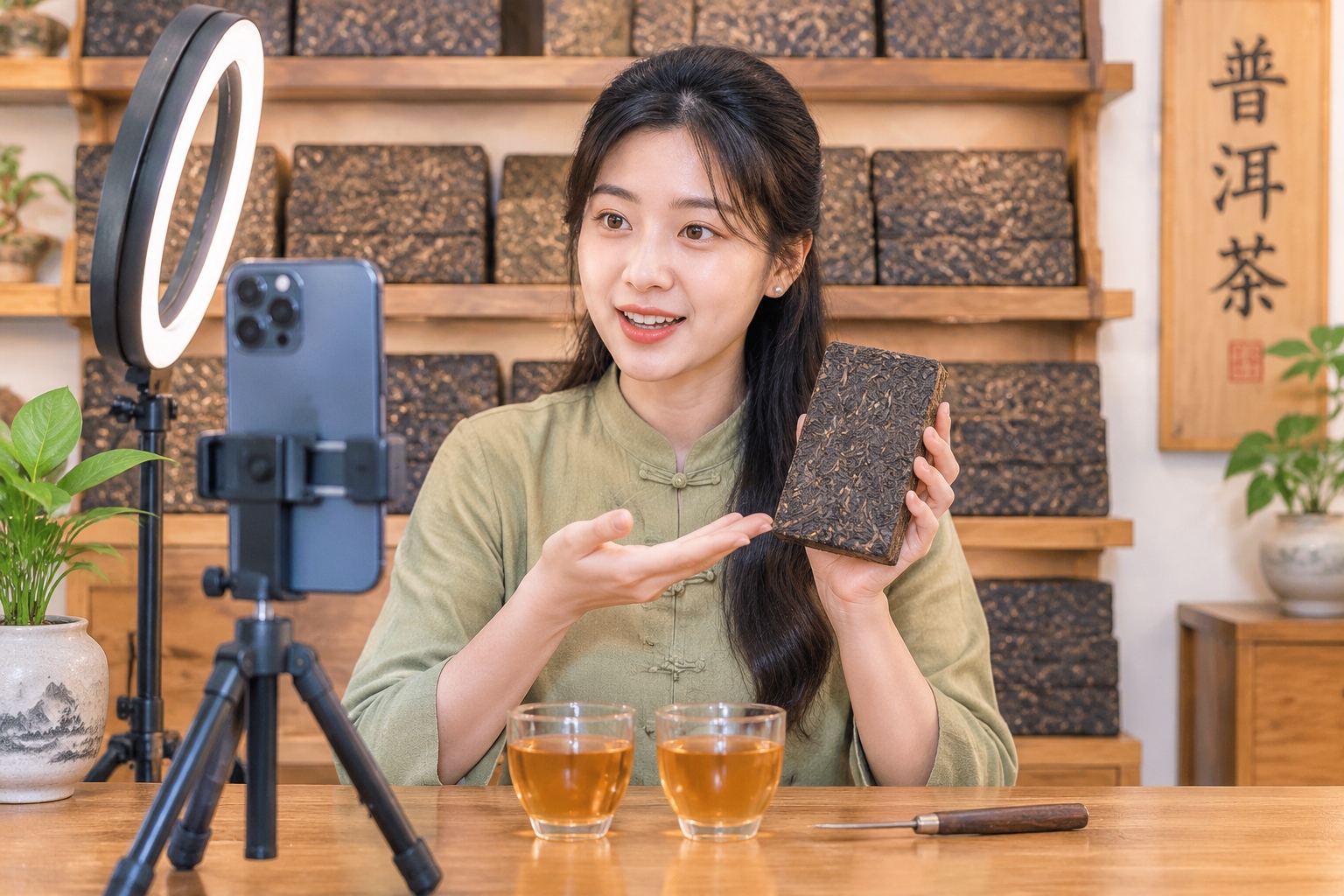
His daughter Liu Mei works in a livestream studio in the county town. On weekdays she sits in front of a bright ring light, with a wall of brick tea behind her. She pours a glass of amber liquor, explains the smell of old bricks, and answers basic questions: “Is it tea or something else?” “It’s tea, fermented darker than black tea.” “Do we sell to your country?” “Yes, we can ship to 30 countries.” On a recent Tuesday, she had 800 viewers, and twenty orders came in from North America and Malaysia. One order was for a single 2-kilogram 2005 brick that sold for 12,000 yuan (about $1,700).
The whole county is moving in that direction. According to the local tea association, more than 200 tea companies now operate in Anhua, and about a third of the total tea revenue comes from direct online sales. The official overall industry output for 2023 was reported at 23.8 billion yuan, though independent economists treat such figures with caution. Still, the physical evidence is visible: new warehouses, packing lines, and a small parcel-sorting center on the edge of town, where trucks load boxes of brick tea for every province in China.
The Old Road Reopens
Not all the growth is digital. The ancient Tea Horse Road that got Anhua’s name out into the world is now drawing people back to it. A restored section of the route leads through forests and over rocky ridges, passing the Yongxi Bridge, a covered wooden arcade bridge built in 1876, and the cobblestone streets of Dongshi, a market town that once served caravans.
Walking the Tea Horse Route
Local officials and tourism companies have mapped a 40-kilometer hiking trail with signs, benches, and water refill points. It is not a Disney-fied version; the trail remains narrow and wet in places, and hikers thread past gnarled tea trees and scattered farmhouses. On a clear morning, you can spend four hours without seeing a car. We were twenty-seven, walking in a line up a stone staircase that was probably laid by forced labor in the Qing dynasty.
Villages Rebuilding
Along the path, villagers are turning old stables into guesthouses and building small tasting rooms. A noodle shop owner, Huang Fuxiang, now sells tea-smoked tofu and handmade tea biscuits to hikers. His son, He Jian, 24, returned to the village after college in Changsha and built a small campsite with four tents. “My parents used to tell me to leave the mountains as soon as I could,” he says. “Now they are arguing with my uncle about investing in a second bathroom.”
But not all change is smooth. Along the river near Dongshi, a developer planned a modern hotel complex, but residents objected, fearing it would ruin the old street’s quiet. The plan was put on hold. Local planners say they try to balance growth and preservation, but the pressure is real, and some of the new guesthouses have already imitated each other’s whitewashed walls and lanterns. “It looks like every village in China,” one hiker complained. “It used to be genuinely untouched.”

A Cup That Carries a Country’s Pulse
In the late afternoon, back in Liu Mei’s studio, the phone has stopped ringing for the moment. She pours a fresh cup of a 2018 Fu brick. The tea is dark, not black; translucent amber in the cup, with a soft smell of wood and a faint note of dried jujube. She sips it and says, “This only goes smoother with age.”
Anhua dark tea is not a trendy new invention. It is one of the oldest production systems in China, still tied to a landscape, a family, and a route. But it is being remade now by young hands and digital logistics, by old roads walked for tourists, and by farmers who argue about the price of their leaves. In that way, a brick of dark tea is a small measure of the country today: earthy, complex, and changing.
If you ever come to Anhua, walk up into the mountains at dawn, when the mist begins to lift and the tea rows appear like dark green waves. Stop at a cooperative workshop, taste the new pressing against a ten-year-old brick, and listen for the chime of a phone notification somewhere in the shed. The old road is still moving.