
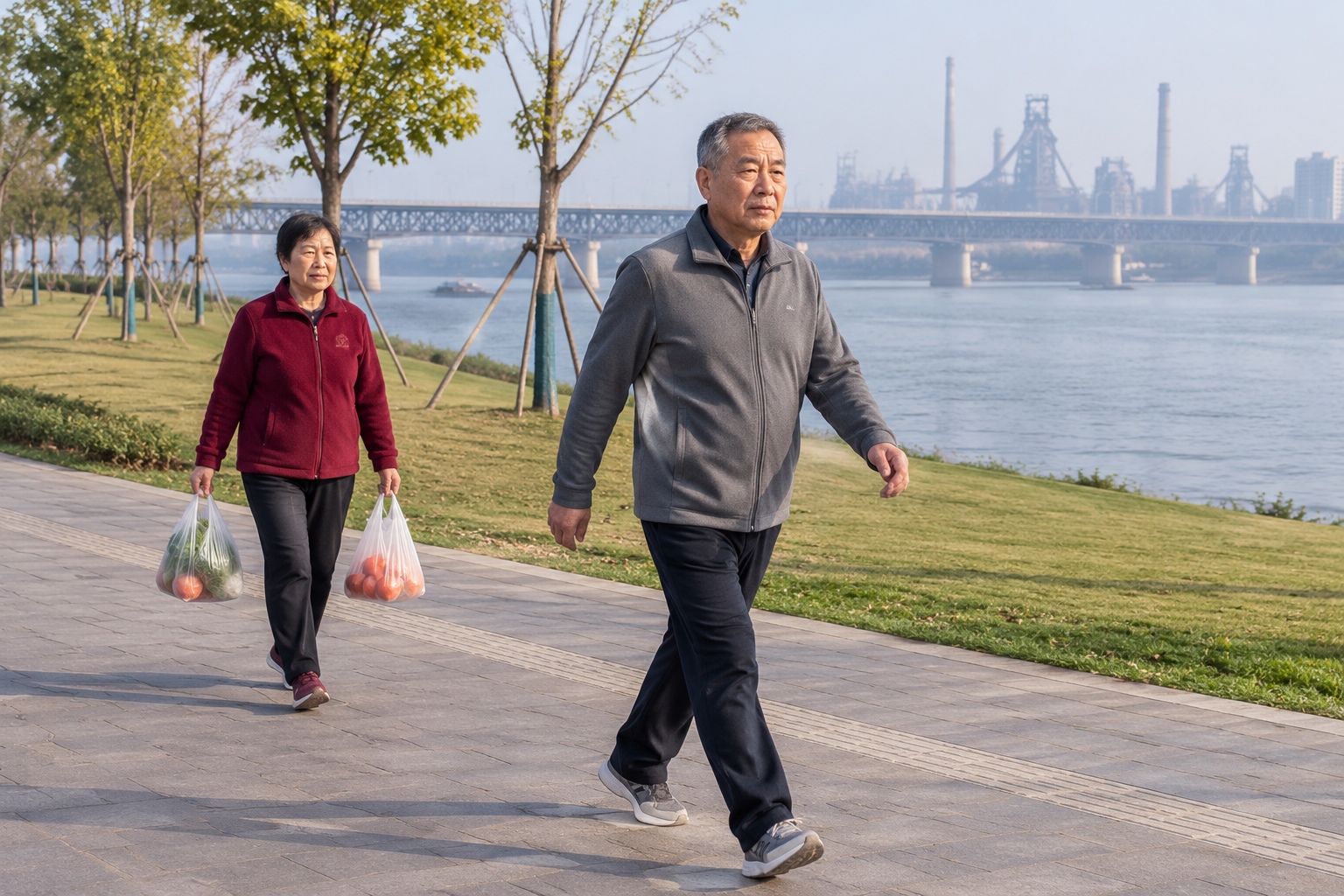

6:40 a.m. on the Yangtze
The sky is already bright. On the Qingshan riverfront in eastern Wuhan, a handful of people are out walking: a man in a grey jacket swinging his arms, an older woman shifting her grocery bags from one hand to the other, two schoolkids in uniform running past with backpacks bouncing.
The man in the grey jacket is Mr Zhou, fifty-seven, who spent more than thirty years in the maintenance workshops of WISCO, the Wuhan Iron and Steel Corporation. The bank under his feet used to belong to the plant — docks, coal rails, ore yards. Now it is a park, with paving, grass slopes and a short section of old track fenced off as scenery.
“We didn’t dare open the windows,” he says, flatly, the way someone recites a number. “Leave one open overnight and there’d be a layer of dust on the sill. On rainy days it was red. Furnace red.”
Now there is ordinary dust, sometimes none. To the east the outlines of the blast furnaces are still there, the chimneys, the white steam. What has gone is the yellow-brown haze that used to sit over the district at night. Qingshan is the clearest example in China of a district built entirely around a steel mill — and of what happens when the mill has to change.
A district that grew with the plant
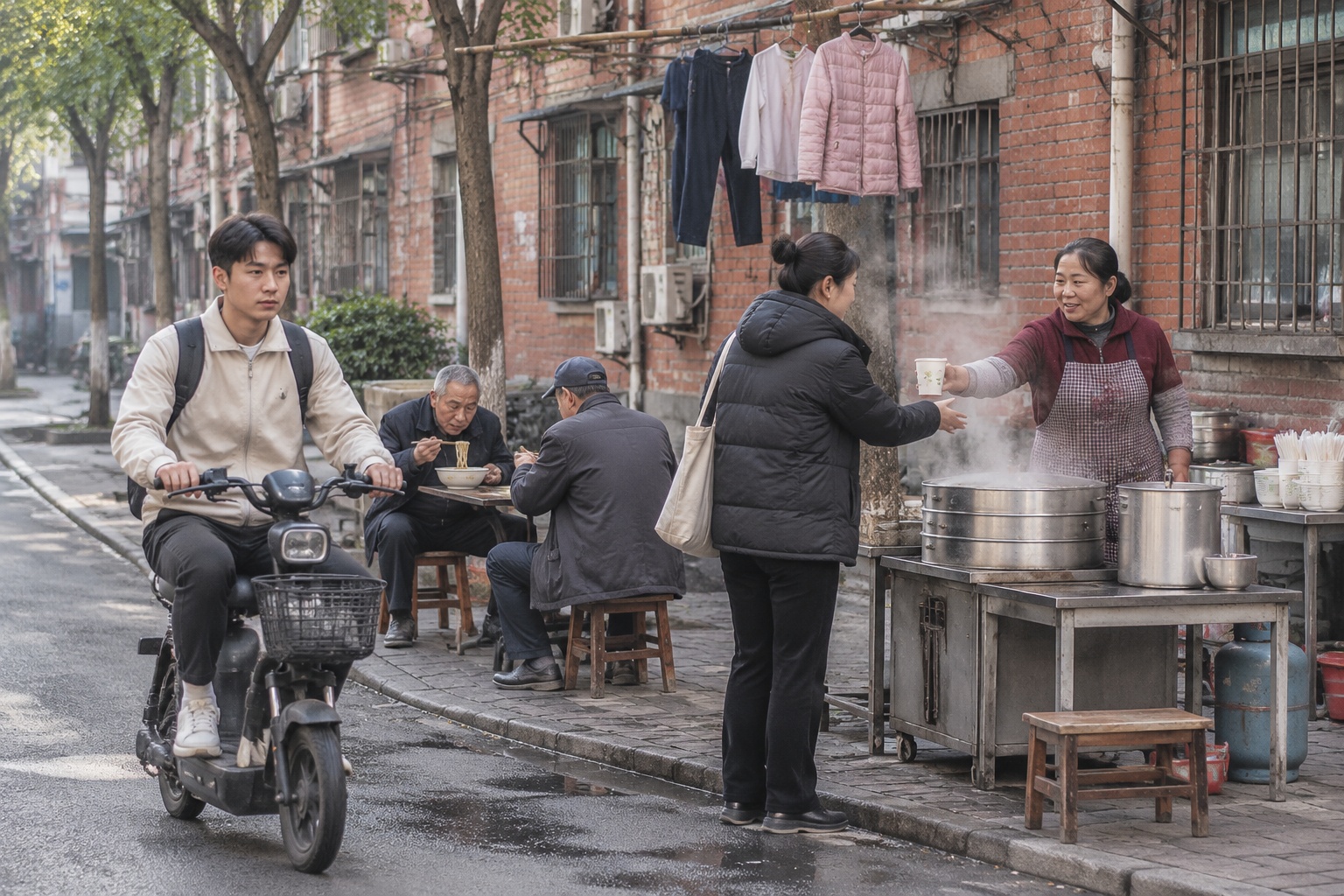
In the 1950s, the new state picked Wuhan as a heavy-industry base, and WISCO was one of its flagship projects. No.1 blast furnace tapped its first iron in September 1958. To make it run, tens of thousands of workers were transferred in from the northeast, Shanghai, Hunan and the surrounding countryside. They settled on the riverbank, among hills and ponds, and built the red-brick dormitory blocks that gave the area its nickname: Honggangcheng, Red Steel City, laid out like a company town.
For generations of Qingshan families, the plant was not just an employer. “In my parents’ time, several people in one family worked there. Your neighbours were your colleagues, and your kid’s classmates were your colleagues’ kids,” Zhou says. Life had a different rhythm from the commercial streets across the river in Hankou; at six in the morning the street was full of bicycle bells, not coffee shops.
Where the pressure came from
Steel went into a long downturn in the early 2010s: falling prices, overcapacity, mills cutting output nationwide. In 2016, Baosteel and WISCO announced a merger to form China Baowu, the country’s largest steelmaker. The same year, Beijing launched a five-year campaign that retired more than 150 million tonnes of crude steel capacity across the country.
For Qingshan, the more immediate push was air. Engineers who monitored emissions around the plant remember the winter readings a decade ago, when particulate levels near the perimeter were poor and complaints came in through the hotline: why is the sky grey? Then there was the river. After 2016, protecting the Yangtze became a hard constraint along the whole corridor: docks, sand yards and discharge pipes were told to clean up or move, and Qingshan’s shoreline was on the list.
What residents can actually see
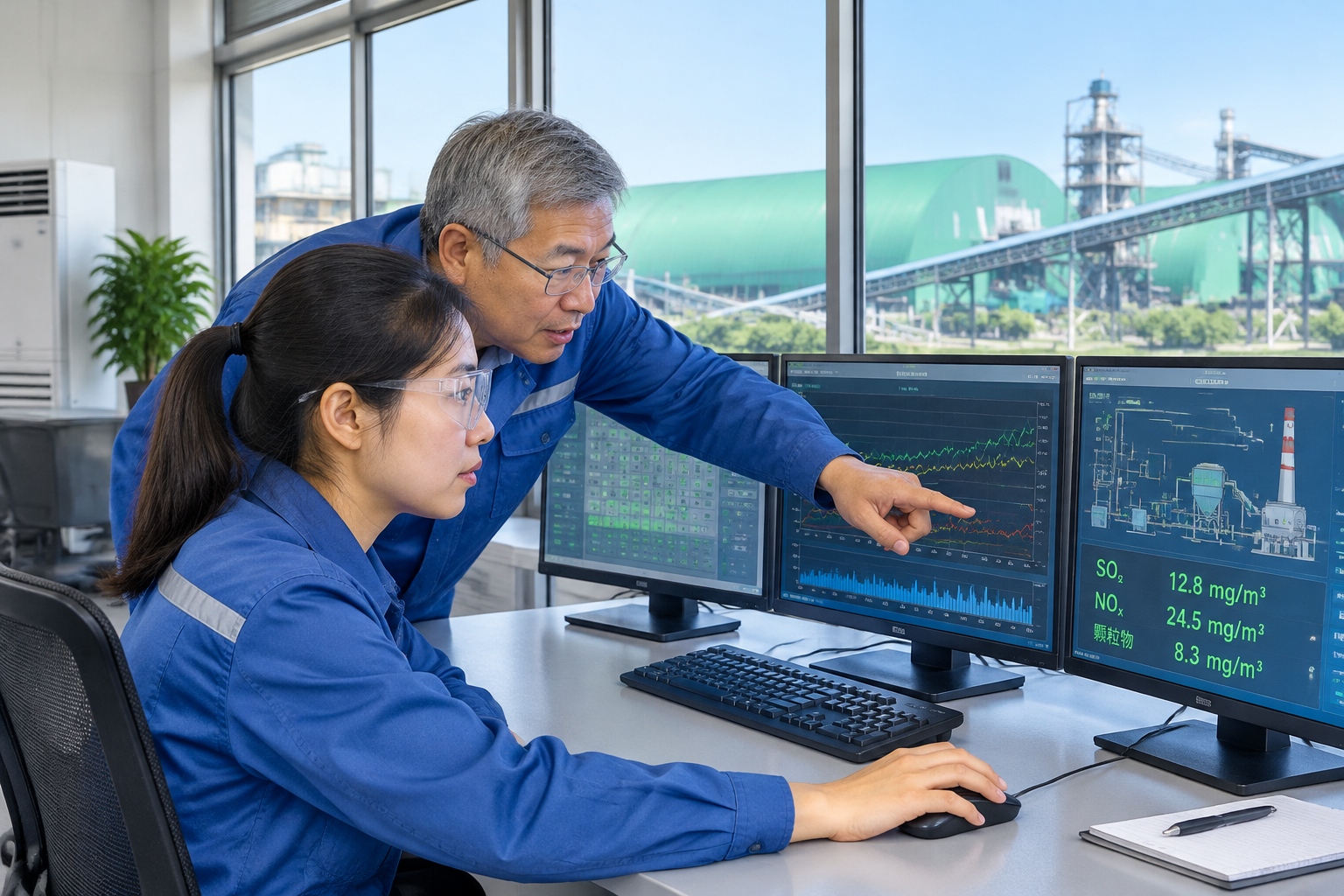
Inside the plant, the changes are mostly engineering. Ore yards were covered with enclosed sheds. Conveyor belts got dust covers. Sintering machines were fitted with desulphurisation and denitrification units, and the readings feed into an online monitoring system. The company’s published environmental spending has risen year after year. From outside, the most visible result is one less layer of yellow light at night.
Beyond the fence, some land simply changed use. A lake east of the plant, Daijia Lake, spent decades as a dump for pulverised coal ash; residents took detours around it. It was dredged, capped, replanted and reopened a few years ago as a park where people run and fly kites. Along the Yangtze, cargo docks have retreated section by section, replaced by running tracks and steps down to the water.

Residents measure all this by their own test. Ask them and they don’t quote an air-quality index. They say the washing can stay out longer. They say they open the windows on summer nights now. They say their grandchildren are willing to come and cycle by the river.
The other side of the plant gate
The hard part was never the equipment. WISCO at its peak employed tens of thousands of people. After output cuts and the merger, some jobs disappeared and others were redefined. Workers of Zhou’s generation either took early retirement or trained into equipment maintenance, environmental monitoring, logistics and safety. It was not a one-off course: men in their forties learned to read data curves on a screen.
Younger people are coming in, but into different roles. Control rooms now hold more screens than consoles; environmental protection, energy management, automation and data analysis are the new job titles. Outside the gate, Qingshan has added industrial software firms, testing labs and logistics companies, like much of the rest of Wuhan.
Pay is the part nobody avoids. In Qingshan, people say that after reassignment many workers earn less than in the best steel years, but far more than if the plant had simply shut. The word “stable” carries particular weight here.
Old neighbourhoods, new uses
The red-brick dormitories are the district’s most recognisable image. Once the mark of a work unit — housing upstairs, canteen downstairs, bathhouse behind — some blocks are now listed as historic buildings, their facades repaired, courtyards opened to the street, ground floors rented to bookshops, noodle places and small galleries.
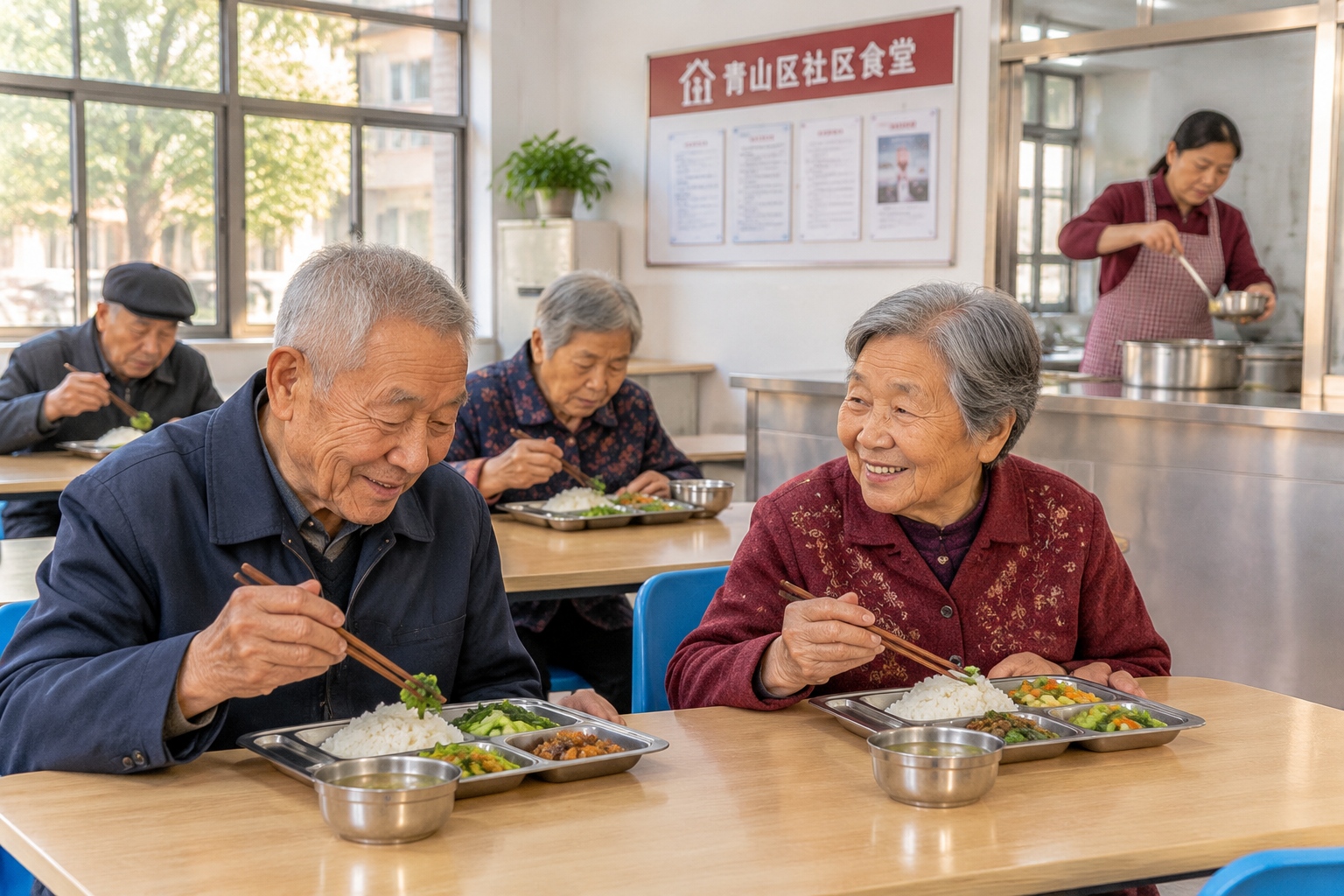
Community canteens are another shift. Qingshan has one of the older populations in Wuhan; many retired steelworkers’ children live in other cities. Some neighbourhoods have converted unused rooms into canteens where an elderly resident eats for around ten yuan: soft vegetables, hot soup, and a queue at 11:30 where people greet each other and compare notes on whose children are coming home.
This is not deindustrialisation
Set Qingshan beside Pittsburgh or the Ruhr and some similarities appear: a heavy-industry peak, a painful contraction, a turn toward services, education and health care. The differences matter too. In Pittsburgh the mills largely closed and workers were pushed by the market. In Qingshan steel stayed — cleaner, more automated, employing fewer people.
That makes it less a story of leaving industry behind than of upgrading it while cleaning the air and reallocating city space, with the state, the company and the neighbourhood all involved. The gains are visible: blue sky, parks, a working plant. The costs are visible too: jobs that no longer exist, skills that lost value, young people whose options look nothing like their parents’.
6:30 p.m., back at the river
By half past six the waterfront is busy. Runners, dog walkers, children on bicycles, a cart selling shaved ice at the bottom of the steps. Zhou walks more slowly than he did in the morning and stops now and then to look at the water.
Is it better now? He thinks for a moment. “The air is better. That’s real.” Then he adds that his son works in software in Optics Valley and does not come back to Qingshan. “What would he do here?”
There is no tidy answer. Cleaner air and more parks are things you can touch. Whether a district’s green transition also delivers for ordinary people — income, work, a reason for the next generation to stay — is a question Qingshan is still answering.
Some names have been changed at the request of the people interviewed.