
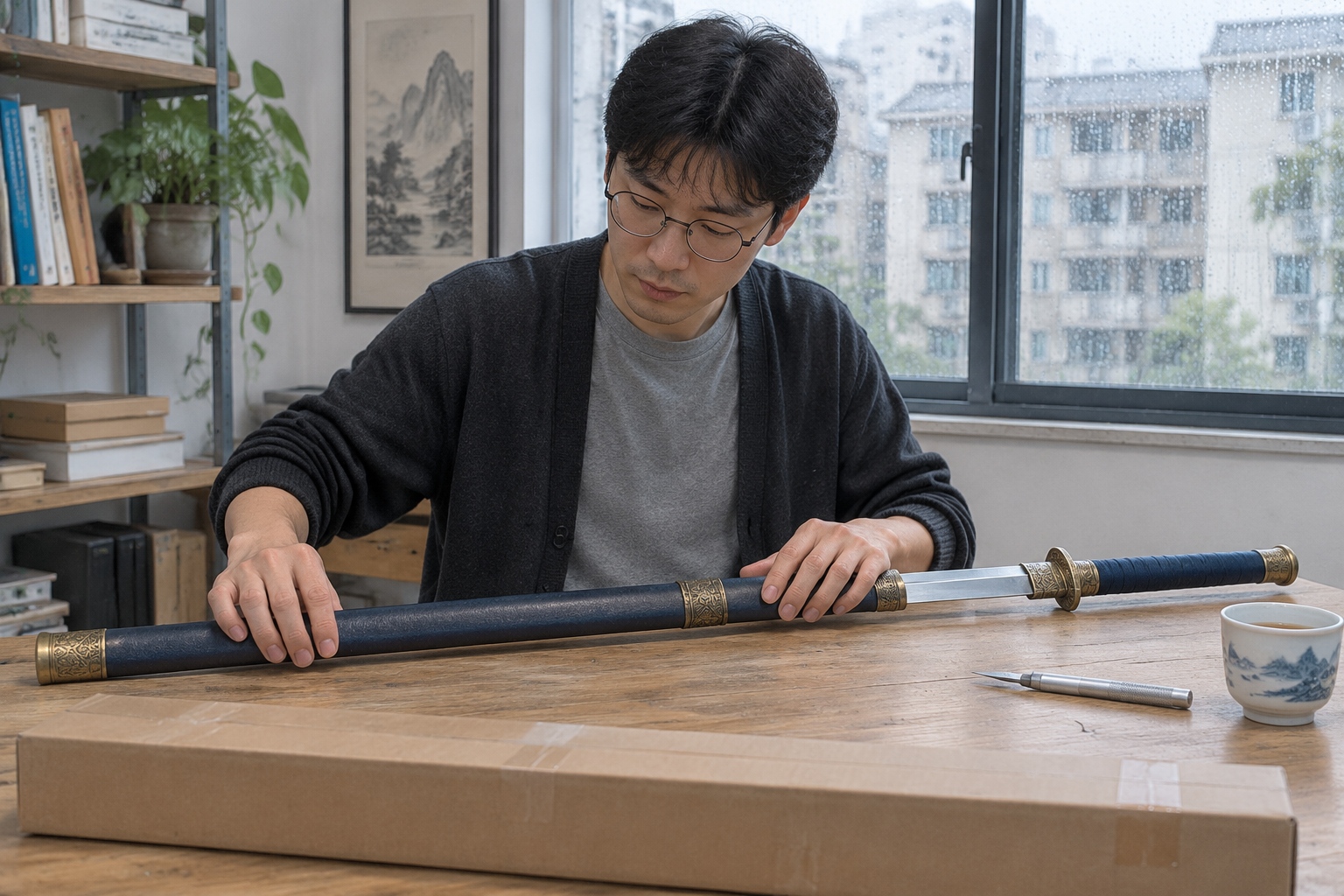

A long cardboard box arrives
It arrived on a rainy afternoon in Hangzhou, when the parcel lockers downstairs were slick with water. The box was about ninety centimeters long and very narrow, wrapped in tape, printed with a barcode and a courier logo. Upstairs, Xiao Tang cut the seal with a kitchen scissors. Inside was a slimmer box wrapped in bubble wrap, with the silhouette of a sword printed on the lid.
The sword itself was not heavy, around 700 grams. The scabbard was deep blue, almost black in some light, with brass-colored metal fittings along both sides. She gripped the handle and pulled. The blade slid out with a dry metallic rasp. A groove ran down the center of the blade, and two characters were etched near the guard, barely visible under the lamp. She had read the small print on the product page before buying: wei kai ren. Not sharpened. The tip was blunt. She ran a thumb along it, then slid the sword back in and thought about where to put it.
This is a “Yitian Sword” — more precisely, a replica of one. A product with a deliberately dulled edge, shipped from a handful of workshops around China, priced between 60 and 400 yuan. It is not a film prop. No production crew will ever use it. It is designed to sit on a desk, in a display cabinet, or on a folding table at a comic convention. To understand why it exists at all, you need to know where it comes from in people’s heads.
Why a sword, and why this one
The Yitian Sword comes from Jin Yong’s wuxia novel The Heaven Sword and Dragon Saber, first serialized in 1961. Plot aside, the sword sits in Chinese popular culture roughly where Excalibur sits in the English-speaking world, or the lightsaber in America — a shared reference, though people meet it in different ways. Older readers know it from the books and the 1980s and 2000s TV adaptations. Younger ones know it from remakes, games, memes, and T-shirts.
“A sword is instantly recognizable, but making a replica weapon carries risk,” said Lin Yifan, a product manager at a small design studio in Hangzhou. “What we wanted was a desktop object. Something you can look at, touch, photograph — but not something that can hurt anyone.”
That framing shaped most of the decisions. The product had to be recognizable enough that a fan would know it at a glance, but small and safe enough that a parent might buy it for a teenager, or a young office worker could keep it on a desk without an HR conversation. In the novel, the Yitian Sword pairs with the Dragon Saber — heavier, more famous — but a saber is harder to turn into a desk object. A sword has a simple outline, cuts easily, and the scabbard gives the whole thing a finished shape.
From a 3D file to a blunt blade
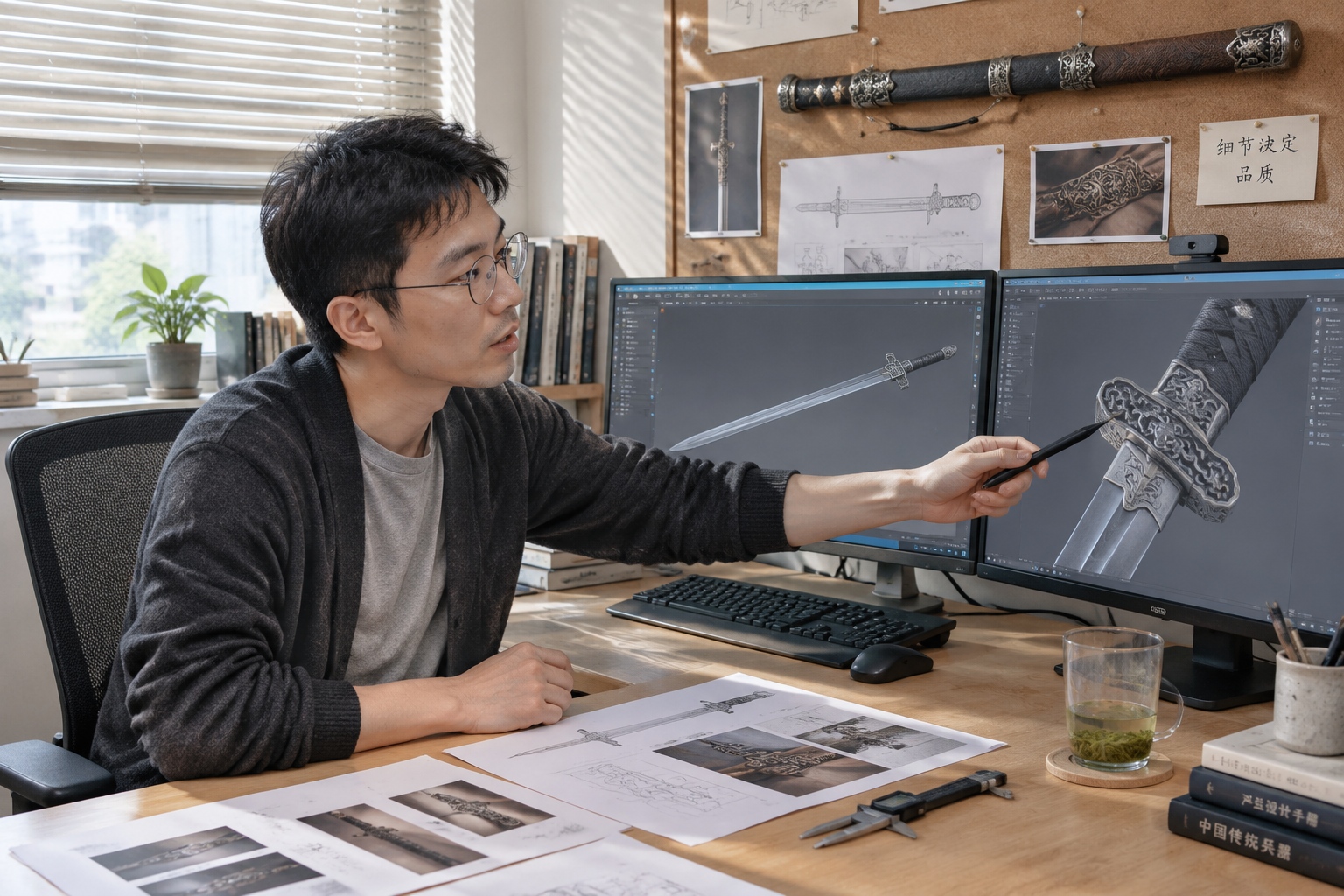
At first the product existed only as a 3D file. The designer combed through the novel for every description he could find, then watched several screen adaptations — not to copy any single version, but to find what they had in common, because that is what most people “remember.”
“The proportions were the hard part,” Lin said. “If you follow the screen props exactly, the blade gets too wide, and it looks like a toy. Too thin, and it stops reading as a sword. The guard and the grip went back and forth too. We went through about eleven versions.”
Material choices were practical. Stainless steel for the blade, though aluminum alloy was considered — lighter and rust-resistant, but more expensive. Solid wood for the scabbard, chosen from species less likely to split. Brass or zinc alloy for the decorative fittings. The edges were chamfered so the blade would not cut even if swung hard. Weight and balance came from the internal construction, not from anything stuck on the outside.
Then came cost. The factory quoted tiered prices: one rate for a hundred units, another for five hundred, another for two thousand. For a small studio, a first order of a thousand pieces was reachable but not trivial. At that stage, the conversation between designer and workshop foreman became granular: make a line two millimeters thicker because the steel tends to flex there; soften the tip slightly because it chips in packaging; shave a little off the scabbard lining so the sword slides in with the right amount of resistance. The product was tuned until it felt like something in the hand, fit on a desk, and still made sense at the price.
In the workshop, a hundred at a time
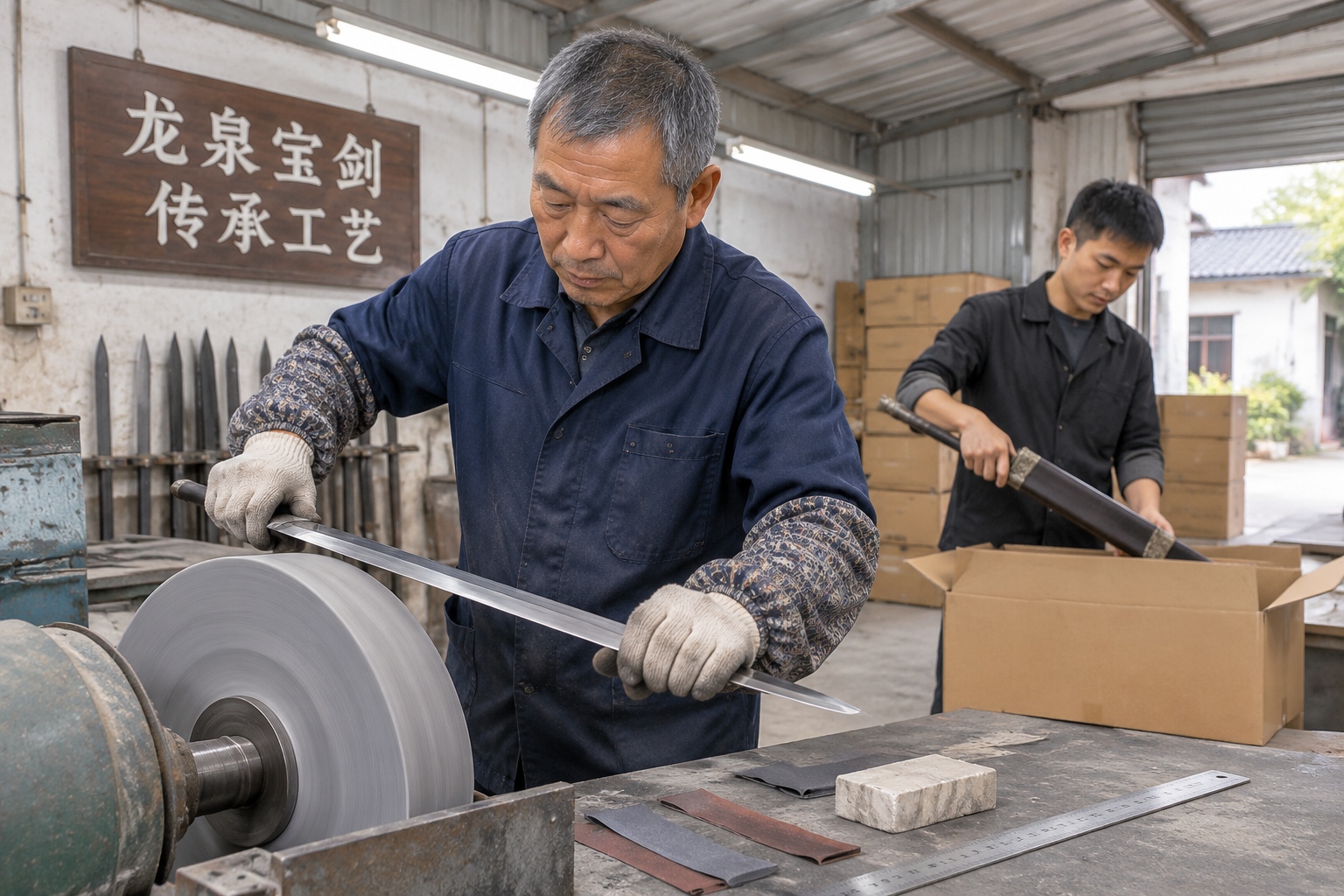
Much of the production happens in and around Longquan, a small city in Zhejiang province known for a long tradition of sword-making. The scale is modest. Some workshops employ a dozen people under a corrugated metal roof.
The process runs in stages. The design file becomes a cutting file, and the steel goes onto a laser cutter, which produces the blade’s outline — straight, but rough. Grinding and polishing follow: coarse wheel, then finer, then finer again. Some steps are still done by hand, because a machine polish rounds the edges and changes how the blade feels. The scabbard is cut, shaped, sanded, then oiled or lacquered. The aging process is its own job: wiping on pigment, waxing, wiping again, until the metal looks like it has been handled for years.
Assembly is where everything meets. A worker fits the blade into the guard, checks the gap, then attaches the handle and wraps it with cord or faux leather. Someone else fits the scabbard’s metal fittings and tests the draw. Quality control tends to fall to the oldest worker in the room, who checks for burrs, cracks, wobble, and whether the etched characters line up with the sample. Faulty pieces are reworked or stripped for parts.
“When the order comes in, we make it. When there’s no order, we make something else,” said Master Chen, who runs a small processing workshop in Longquan. “Small orders are fine. A hundred pieces, we’ll do it. One model at a time.”
This is the less-told side of Chinese manufacturing: you do not need to order tens of thousands of units to start. A workshop of fifteen people can run a batch of a hundred and do another if it sells. E-commerce and logistics have made the selling side just as light — a two-person brand can handle design and content while outsourcing production, storage, and shipping. For small-batch cultural products, that is the underlying infrastructure.
The product page, the short video, and what “unsharpened” actually means
On the product page, the details are handled carefully: blade material and finish, wood grain on the scabbard, the seam where the guard meets the blade, the sound of the sword leaving the scabbard. Short videos amplify this — a fifteen-second draw, slowed down, with the metallic rasp turned up, then a cut to the object on a desk. In livestreams, the host turns the sword in hand, states the weight and length, and answers the question that appears in every chat: can you ship it here, and is it legal?
“Unsharpened” is both a product description and a legal one. China has defined standards for controlled knives that consider blade length and tip angle, and platforms and couriers each layer on their own rules. Cross-border sales are messier: the UK, Germany, Canada, Australia, and some US states all regulate blade products differently, so many sellers either exclude certain destinations or ask buyers to confirm they can receive the item. Packaging has to survive the trip — a rigid box, foam holding the blade and the scabbard separately, then an outer carton. Most orders move by standard courier and arrive within days.
Price tracks craftsmanship. The cheapest tier, around 60 yuan, uses basic materials and simple finishing. The 200 to 300 yuan tier looks and feels noticeably better. Above that, some studios produce limited or handmade runs at 400 yuan and up. A large share of buyers purchase these as gifts — the object has a name, has size, and is easy to hand over. Others buy for themselves, for a desk, or to take to a convention.
Who buys it
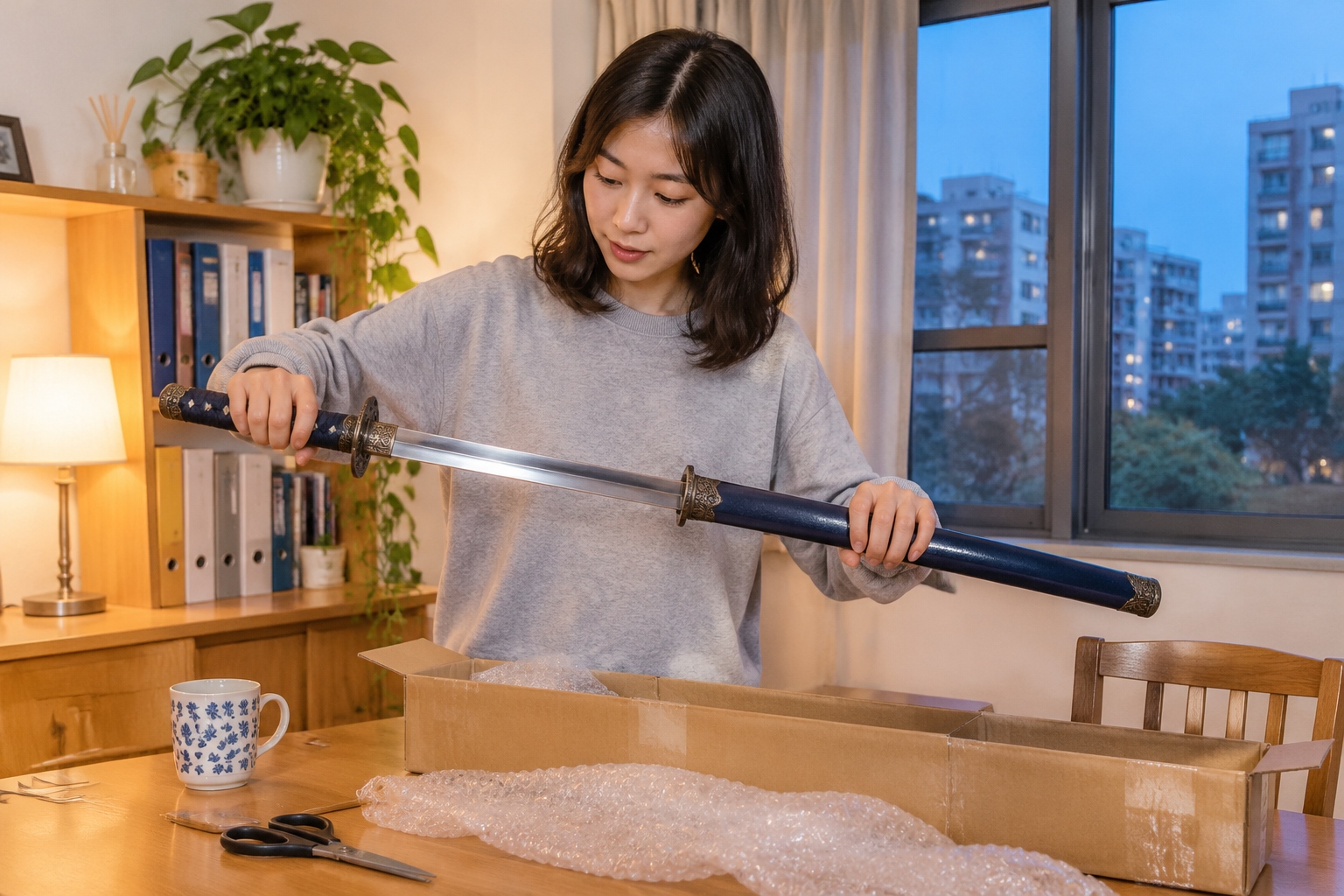
“I bought mine for my desk,” Xiao Tang said. She is 26 and works in operations at an e-commerce company. “Mostly because it looks good. And every time a friend comes over, they ask what it is.”
That is the most ordinary kind of buyer: not necessarily a reader of the novel, but someone who knows the name and finds the object interesting. One layer in are the wuxia fans who care about details — proportions, whether the etched characters match a line from the book, whether the scabbard color matches a particular TV adaptation. Another layer is the convention crowd: cosplayers who need props, gamers who want merchandise. Overseas Chinese buyers form a visible group too, often for very concrete reasons — they want something in the house that connects to a memory.
Pull back and the interesting part may not be the sword itself but the arrangement behind it: a design studio in a city, a few workshops in small towns, e-commerce platforms and courier networks, and a group of buyers arguing about details in the comment section. That combination is what allows a fairly niche product — not a game, not a film, not a mass-produced toy — to exist and stay on a shelf.
It also changes something subtler. Wuxia culture is no longer only read and watched; it is bought, displayed, photographed, and discussed. Younger people reuse it in their own way — not inheriting it so much as selecting from it. They pick the shapes they find beautiful and the lines they remember, and turn them into objects that fit into daily life. None of this is grand. It happens one small order at a time.
Back on the desk
Back in the apartment, Xiao Tang slid the sword into its scabbard and set it on a shelf next to a row of folders and a pot of pothos. The scabbard caught a little light. You would not notice it unless you looked. It is not sharp, not useful for anything, but it has a name, an origin, and a story that has been told many times.
Look out from this one object and more comes into view: a small studio’s product judgment, a foreman’s hands, a delivery route, and the few seconds someone hesitates before tapping “buy.” All of that is real and checkable. The open question is this — if this sword appeared on a shelf in the English-speaking world, would anyone pick it up? A Chinese cultural product tied to a specific story, safe to keep on a desk, and easy to talk about: does that appeal to readers who have never read a wuxia novel?
The answer will probably shape the next batch.