
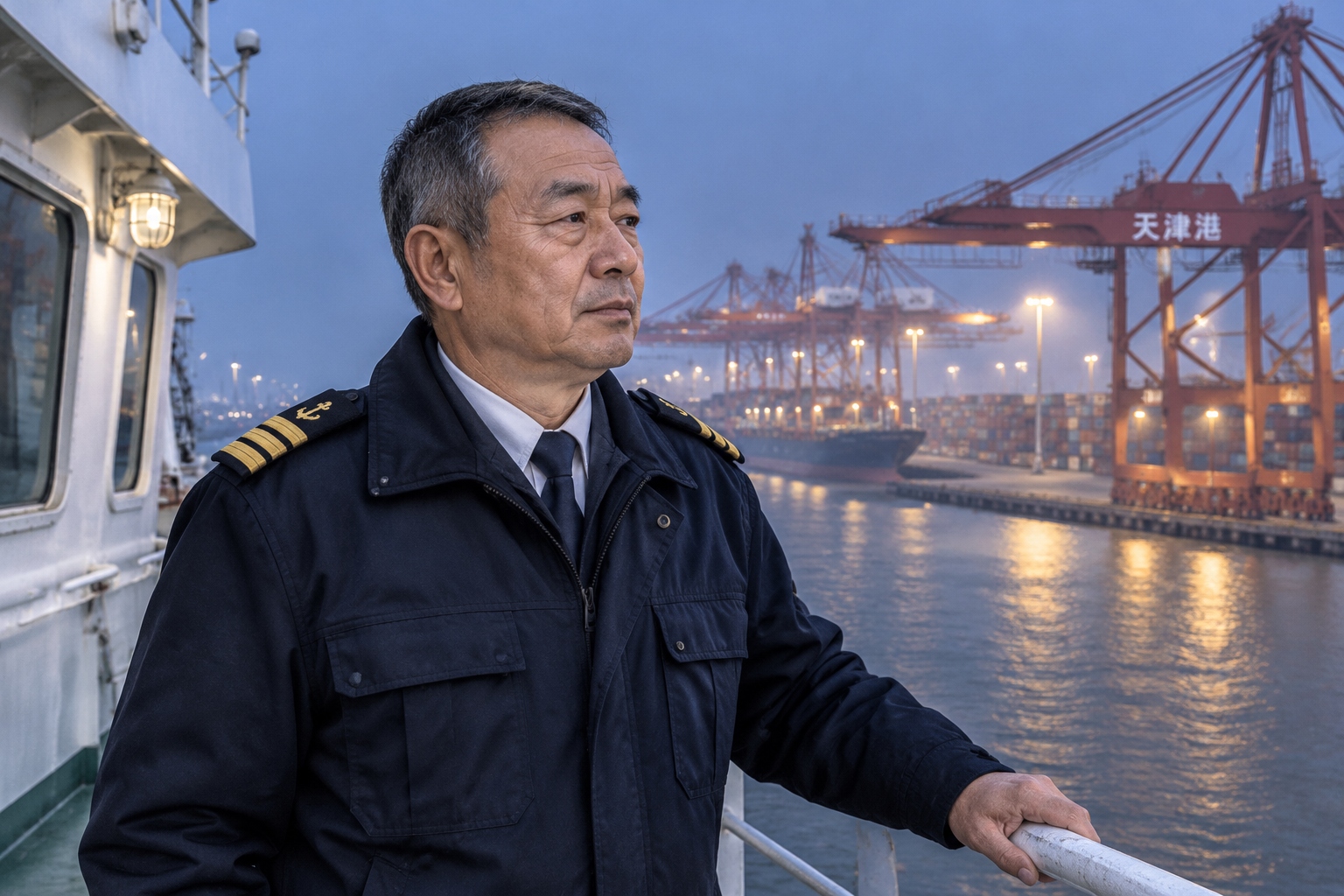

5:40 a.m. at Tianjin Port
It is still dark. The container yard at Tianjin Port’s Beijiang terminal is lit row on row, and two gantry cranes are working a feeder ship. You hear the box land before you see it: a dull thud that rolls across the water, then the crane motor winding up again.
I am standing on the starboard bridge wing with my collar turned up. Early December, around eight degrees, a wind off the bay that smells of diesel and salt. My name is Li Guoqiang. I am 52. Twenty-seven years at sea, twenty-one of them in the Bohai Bay.
Before the pilot comes aboard, there is a list. Main engine test. Steering gear — hard over one way, then the other, and listen to how it sounds. AIS transponder. Two VHF sets. The logbook. A short word with the chief officer about the mooring plan and which lines go out first. The second mate brings coffee up and says visibility is about two nautical miles, and may drop later.
Today’s run is short: Tianjin to Caofeidian, a little over sixty nautical miles. Containers on deck, coiled steel in the hold. If the berth is free and the fog holds off, we will be alongside before midnight.
I mention all this because a route like ours sounds remote from ordinary life. It is not.
Why we work the Bohai Bay
The Bohai Bay is northern China’s inner sea, enclosed by the Liaodong Peninsula to the northeast, the Shandong Peninsula to the south and the Hebei plain to the west. It is shallow — mostly under 30 metres — with a mud bottom and a tide that runs two to three metres. It gives you fog in winter, and from late December into February it gives you ice.
What it gives you most of all is ports. Tianjin, Qinhuangdao, Tangshan with its Jingtang and Caofeidian terminals, Huanghua — and outside the bay, Dalian, Yantai, Qingdao. The distances between them run from 50 to 200 nautical miles. For a ship, that means one thing: you spend your working life manoeuvring.
An ocean crossing is mostly open water and a great deal of waiting. Here, a normal voyage is twelve hours of steaming and then a berthing. Twelve hours, and then another berthing. Colleagues on deep-sea ships call what we do a ferry service, and they are not entirely wrong.
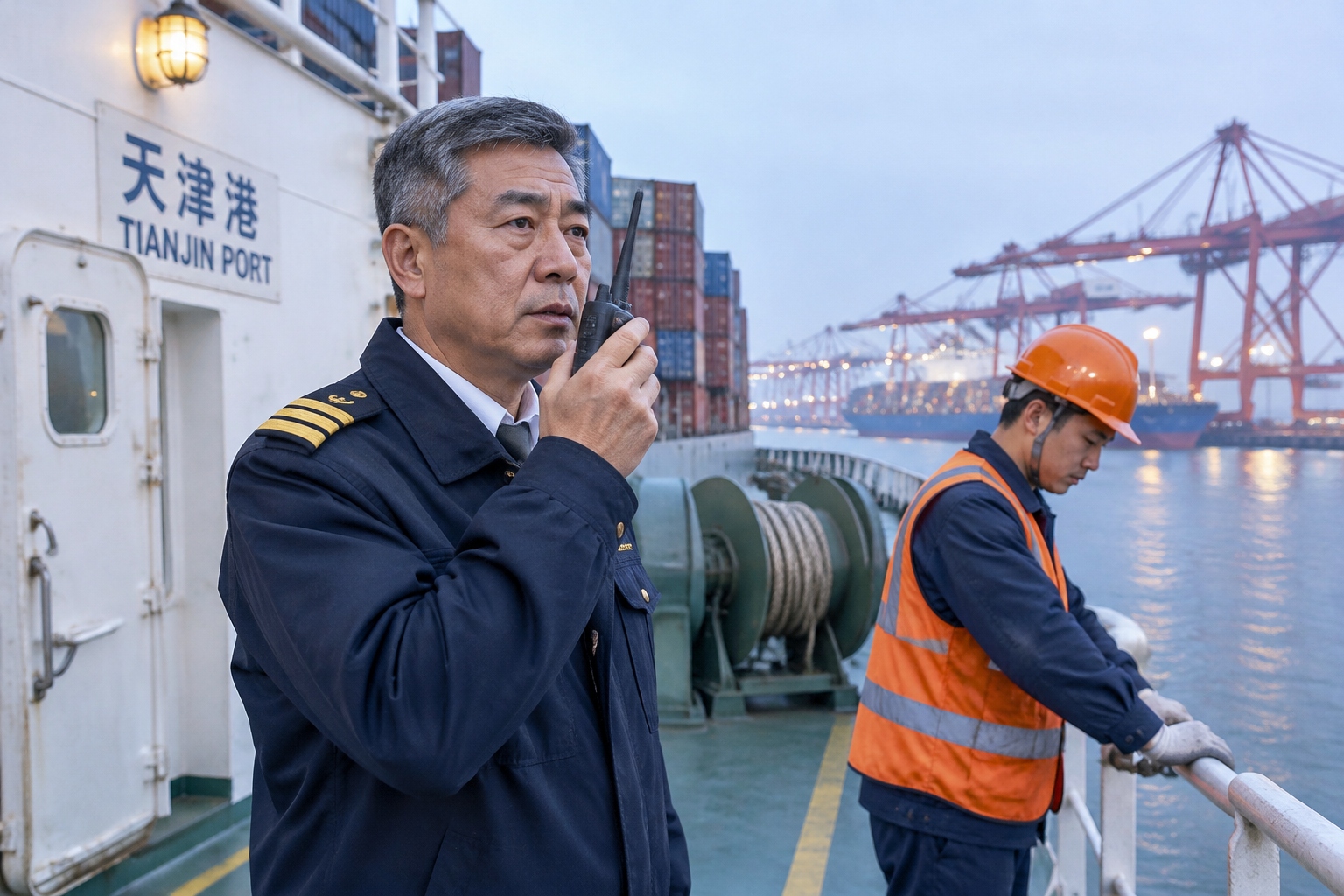
Short runs carry their own pressure. Traffic density is high, the channel is narrow, and the water is shallow enough that under-keel clearance becomes a set of numbers you watch on a screen. Fog can close visibility down to a few hundred metres in under an hour. In ice season the maritime authority issues warnings, icebreakers work the channel, and you either wait at anchor or follow another ship through at reduced speed.
I joined my first ship at 25, a small general cargo vessel carrying bagged cement along the coast. I got my master’s certificate in my forties. There is no dramatic story in that. It is a trade you learn by standing watches.
Trade, seen from the bridge
What moves on this water is not abstract. Out of Tianjin we carry containers — household appliances, car parts, consumer goods — and steel, often coiled plate from mills in Hebei. Into Tianjin and Caofeidian come iron ore, coal, grain and liquid chemicals. Qinhuangdao, further up the coast, is largely a coal port, feeding power plants and factories to the south.
A shipment of ten thousand tonnes of steel is a few hundred coils. Each one was rolled in a mill, trucked to the port, lifted twice, lashed down, and signed for by somebody. In a news report, trade is a number. From the bridge, it has weight, and volume, and a customs seal.
The paperwork has changed more than the water has. Twenty years ago a berthing meant a runaround: paper forms, stamps, an agent meeting you at the gate. Now most of it goes through one platform, and the terminal, the agent and customs are looking at the same data. It saves hours, not days, but hours are what a short route runs on.
The port and the city behind it
Tianjin Port handled more than 22 million containers in 2023 and over 500 million tonnes of cargo. It is the seagoing door for Beijing, Hebei, Shanxi and Inner Mongolia — a hinterland of hundreds of millions of people who mostly never see it.
Port work runs on shifts, so this part of the city keeps a different clock. At four in the morning the noodle shops near the gates are full: truck drivers who have been waiting for a slot, stevedores coming off nights, crews about to sail. A bowl of noodles, a boiled egg, a phone charging on the table.
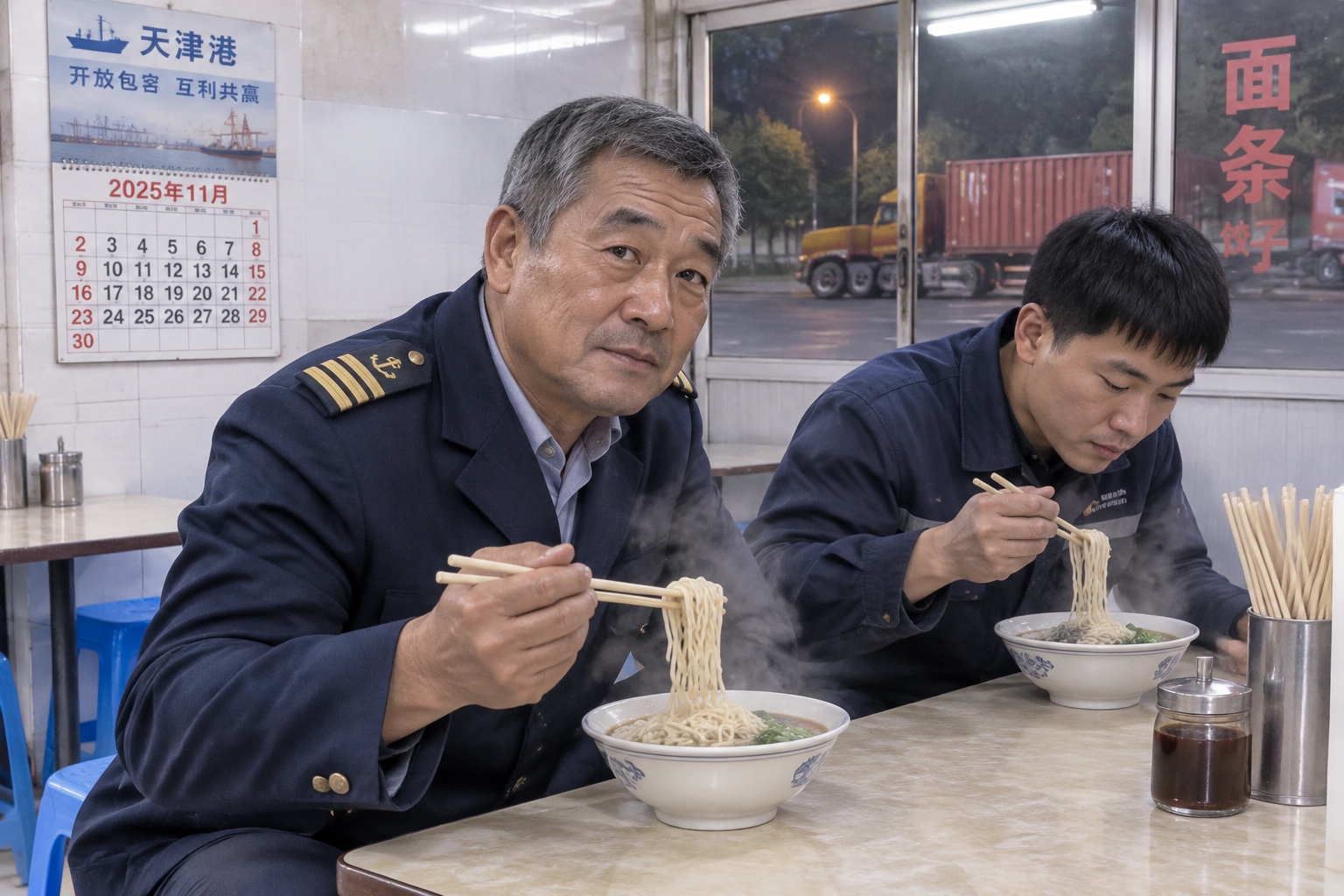
The jobs spread wider than the quay. Tug crews, linesmen, surveyors, repair yards, ship chandlers, container truck drivers, freight forwarders, the people who wash the windows of the port offices. When people ask whether shipping matters to ordinary life here, I think of that street at four in the morning.
An ordinary day at sea
Watches run four hours on, four off: midnight to four, four to eight, and so on. On a short route you are almost never truly at sea. You are either approaching a port, leaving one, or waiting outside one.
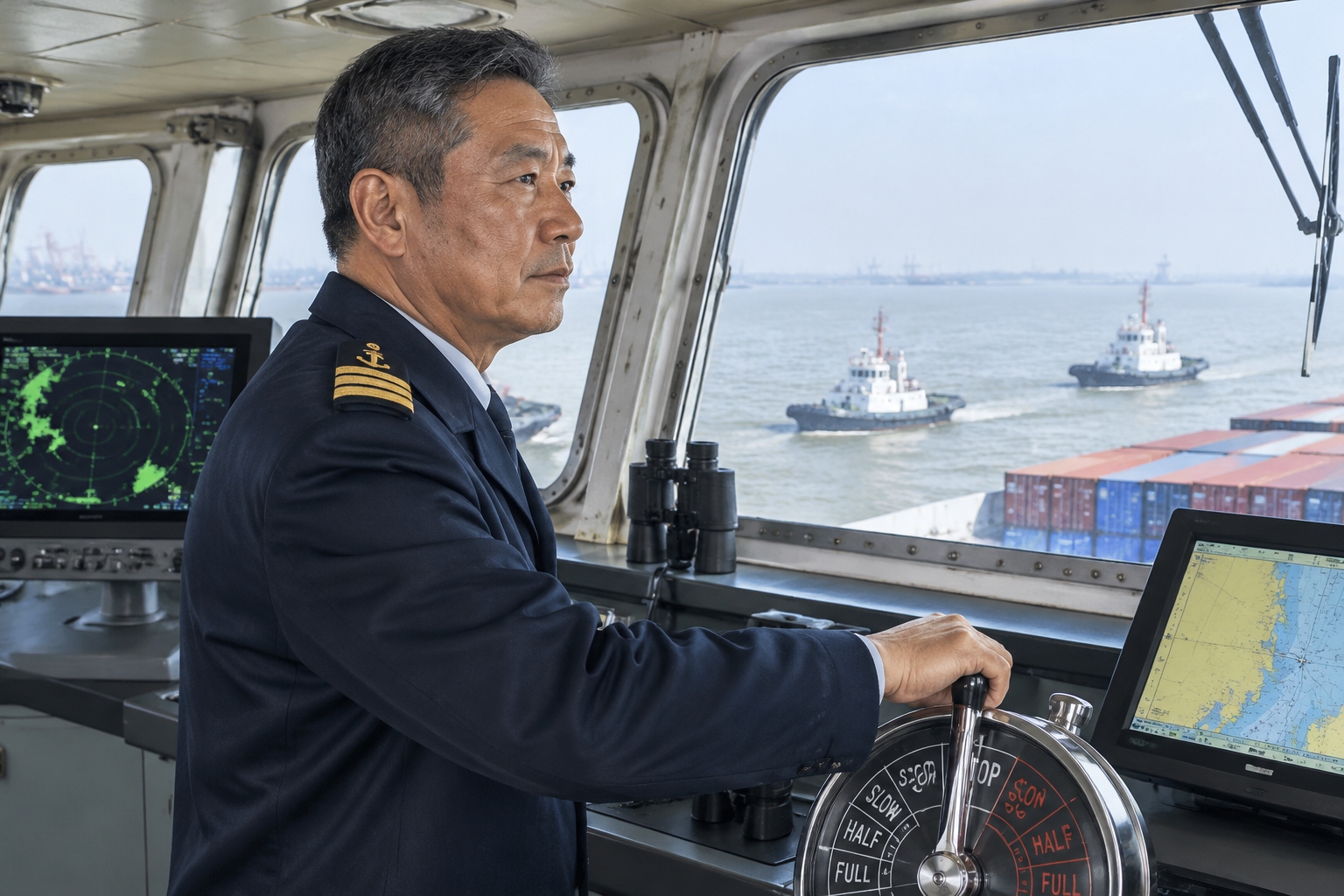
The hardest part is not heavy weather. It is fog and it is the berth. In fog you slow down, you sound the signal, you keep two people on lookout, and you trust the radar and AIS but not completely. Coming alongside is a twenty-minute job with no margin: pilot on the bridge, two tugs on the shoulder, the chief officer forward on the lines, the second officer aft, and me on the telegraph, watching the distance open and close in metres.
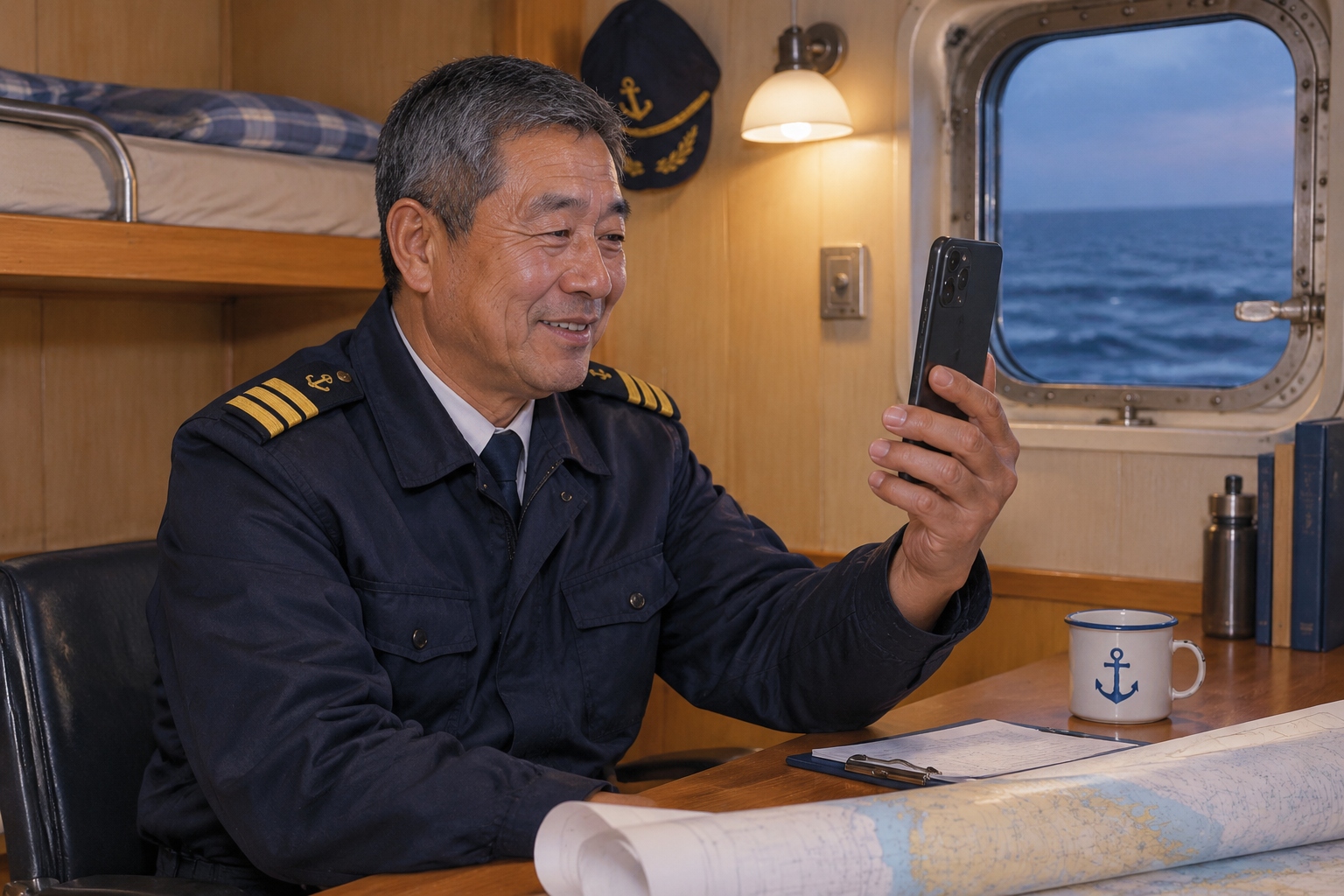
Crews on this run are mostly from Hebei, Shandong and Henan. Wages for an able seaman are modest — a few thousand to just over ten thousand yuan a month for coastal work, with officers earning more. The bigger difference from deep-sea life is that we go home more often. On an ocean ship you might be away eight months. Here, some men get back for a night or two every couple of weeks. My own family is used to me arriving without warning and leaving the same way.
Young people are less interested in this work than they were. There is a shortage of certificated officers across the industry, and everyone in the mess room has an opinion about why.
New rules on the water
Ten years ago, a ship alongside kept its auxiliary engines running and nobody thought much about the exhaust. That has changed. Under the national emission control rules for coastal waters, we burn fuel with a sulphur content of no more than 0.5 percent, and the low-sulphur bunker costs more. At the main container berths in Tianjin, shore power is available, so we can shut down the auxiliaries and plug in.
Garbage is sorted, entered in the garbage record book and handed to a reception facility in port — it does not go over the side. Ballast water goes through a treatment unit before discharge. AIS means the maritime authority can see where we are and how fast we are going, and inspections are routine rather than rare.
Rules are firm; making them work takes people. Shore power cables do not always fit, or the connection point is occupied and you wait your turn, and in the meantime the auxiliary engine keeps running. Nobody pretends otherwise.
One route, many people
The Bohai Bay is not a beautiful sea. The water is opaque — grey in winter, green in summer — and the horizon is usually cranes. I have sailed this stretch for twenty-one years and I can still tell you which channel buoy is where without looking at the chart.
My daughter works in Tianjin. She texts me when she sees a ship heading out and asks whether it is mine. It almost never is.
Tomorrow the pilot comes at five. There will be coffee, a forecast, a list, and the twenty minutes by the ladder waiting for him to climb up. China’s northern trade is not really a statistic. It is a lot of short, unglamorous routes, kept running by people who get up before it is light.