
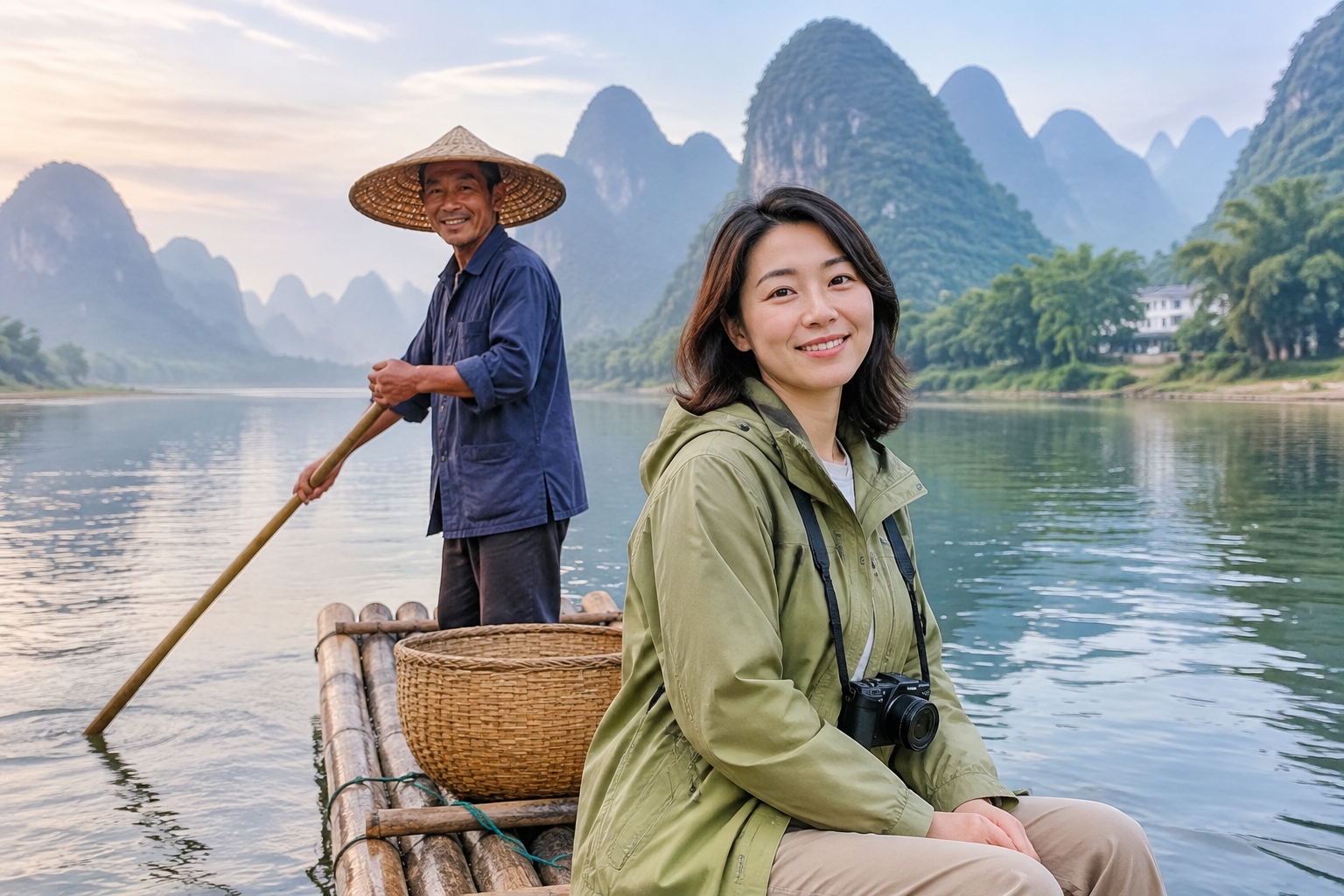

The scene on the back of China’s 20-yuan note is not a painter’s invention. It is a real stretch of the Li River near Yangshuo: gray-green water, bamboo rafts, and karst peaks rising from the bank like teeth. Most visitors see it for an hour from a cruise boat and tick it off. This eight-day route slows that view down, then changes the angle: by raft, bicycle, mountain trail, glass walkway, and finally by lantern light in Fenghuang.
The route in one sentence
Guilin · Yangshuo · Zhangjiajie · Fenghuang — eight days, from a Chinese ink painting into something closer to science fiction.
You will float down the river printed on the 20-yuan note. You will cycle for a whole day between rice fields and limestone towers, stopping only because you want another photo. You will stand on the real-life prototype of the floating mountains in Avatar, with 300 meters of cloud and valley below. And you will end in a riverside old town where the stilt houses light up one by one.
No climbing skills. No extreme fitness. The only real requirement is enough camera storage.
The less obvious way through a famous landscape
This is not a route for collecting landmarks. The famous views are here, but the pleasure comes from the in-between: a side road along the Yulong River, a quiet bend of Jinbian Stream before the tour groups arrive, a back lane in Fenghuang before the lanterns switch on. You are not trying to escape the map. You are trying to enter the landscape at different speeds.
Why these eight days are worth it
The scenery is real, but looks like a special effect
The Li River between Guilin and Yangshuo is the source code of Chinese landscape painting. For centuries, painters have copied it rather than invented it. Karst peaks stand up from flat ground one by one, in shapes that almost seem unreasonable. The river winds between them like a gray-green ribbon. On misty mornings the mountains become layers of fainter and fainter outlines — the same image you have seen a thousand times on the wall of a Chinese restaurant.
Zhangjiajie is a different kind of unreal. Thousands of quartz-sandstone pillars shoot straight up from the valley floor. The art team behind Avatar used this place as the model for the Hallelujah Mountains. The film’s floating rocks are CGI. These pillars are real. They somehow look more excessive than the effects.
Choose your effort level
The best thing about this route is that it does not punish people with average fitness. Want an easier day? Take the bamboo raft, cable car, shuttle bus or elevator, and let them carry you to the best viewpoints. Want to work for it? Hike the Longji rice terraces for a full day, cycle until your legs ache along the Yulong River, or walk Zhangjiajie’s mountain paths for five or six hours. In the same scenic area, a 70-year-old and a 20-year-old can both have a good time.
Four ways to see the same landscape
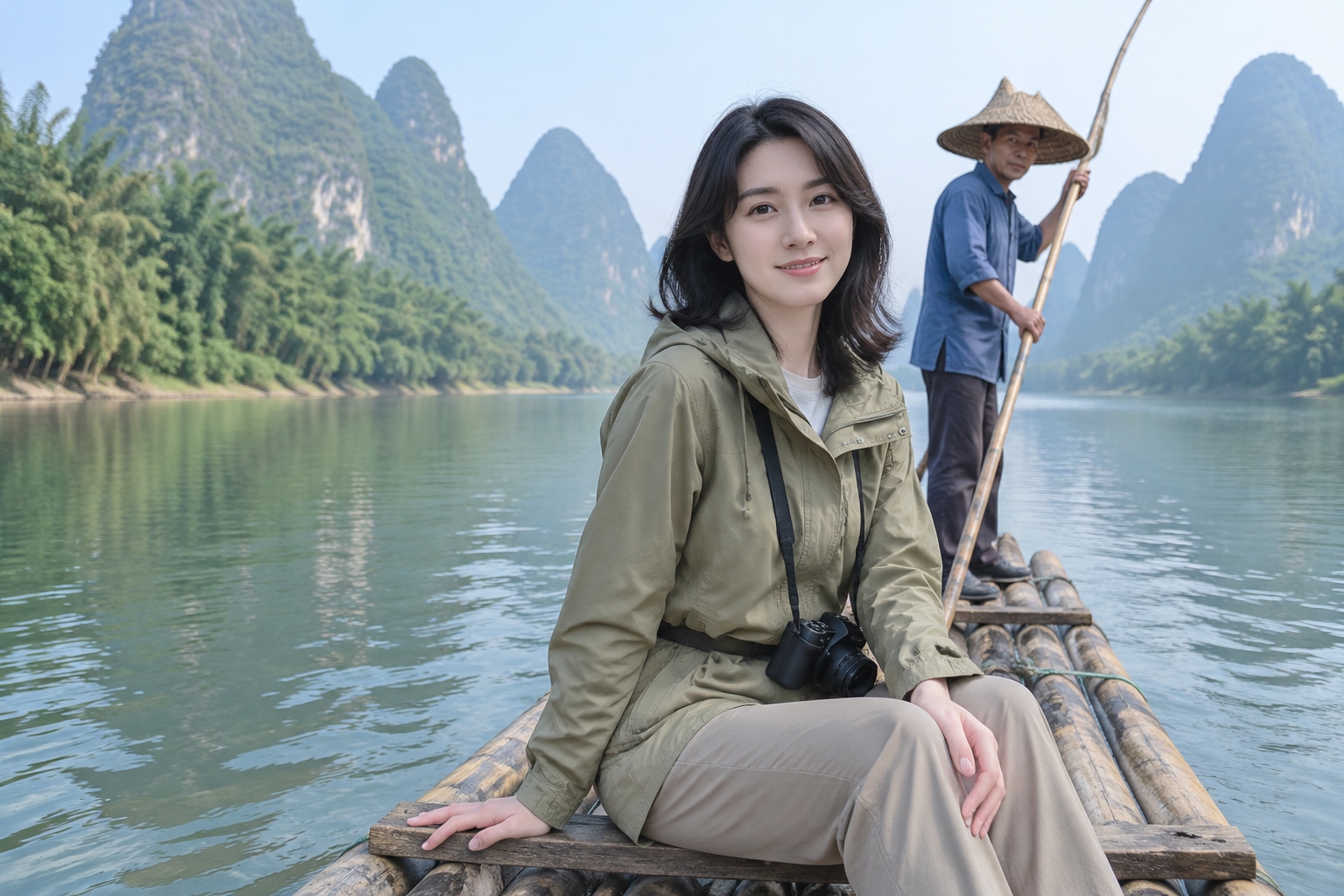
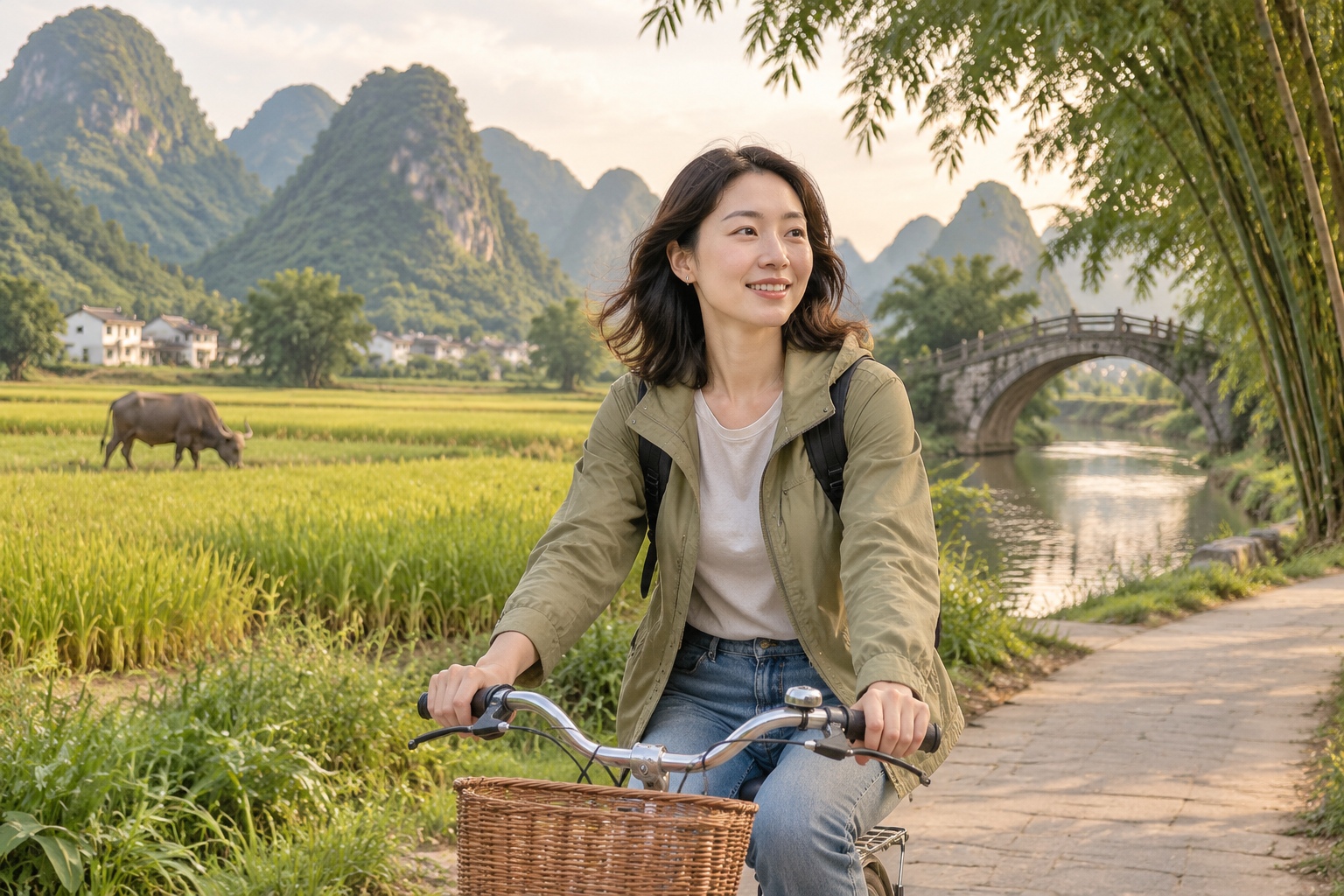
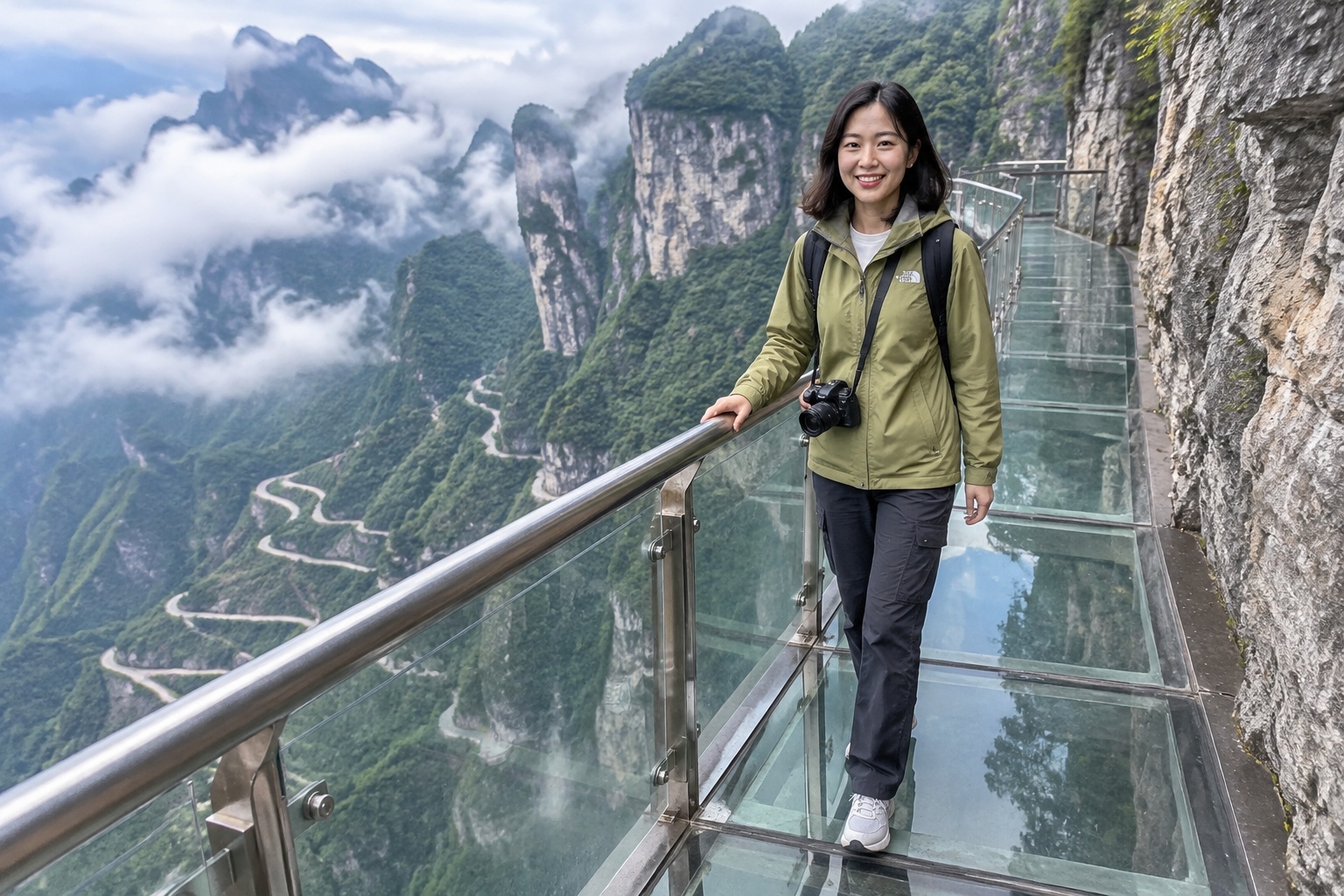
From a bamboo raft, you look at the mountains from the water. The mountains move; you are still. From a bicycle, you look at them from the foot of the hills, with rice fields, water buffalo and laundry hanging on bamboo poles all inside the frame. From a glass walkway, you look at them from the side and above, with empty air under your feet. And in Fenghuang at night, you look at them through lantern light, when the whole river turns warm orange.
One route, four viewpoints. You will not come home with eight days of identical photos.
Eight days, one by one
Day 1 · Guilin — land, then look at the lights
Arrive in Guilin. In the evening, walk around the Two Rivers and Four Lakes area. The Sun and Moon Pagodas stand in the water, bridge arches frame the lights into circles, and a full loop takes about an hour. No hard sightseeing on day one. Let your body catch up with the time difference.
Day 2 · Guilin — Longji rice terraces
Drive two hours north and up into the Longji rice terraces. The fields spiral from the valley floor to the ridge, layer by layer, like contour lines cut by a knife. In the flooded season, the whole mountain becomes thousands of mirrors. When the rice turns yellow, it becomes a golden staircase. Stop for lunch in a Yao village: bamboo-tube rice, cured pork, wild mountain vegetables. The Yao auntie wears her long hair coiled on top of her head. When she sings a toast song, you had better stand up to receive it.
Day 3 · Yangshuo — Li River, downstream by bamboo raft
In the morning, board a bamboo raft at Yangdi and drift downstream to Xingping. This is the best 20 kilometers of the Li River: Nine Horses Fresco Hill, Yellow Cloth Reflection, and the exact viewpoint printed on the back of the 20-yuan note. There is no engine noise, only the sound of the pole touching the water, and one stone peak after another sliding behind you. In the afternoon, arrive in Yangshuo and stay near West Street. At night it is loud, busy, and full of backpackers from everywhere.
Day 4 · Yangshuo — cycle first, climb later
Rent a bicycle and ride along the Yulong River. This river is smaller and quieter than the Li. Both banks are lined with rice fields, water buffalo and bamboo groves, and an old stone arch bridge has been standing there for 600 years. At dusk, climb one of the small hills by the river, around Xianggong Hill, and look down at the peak forest. A whole field of stone towers spreads out below you, with footpaths threading through the fields like lines. This is the best sunset on the route.
Day 5 · Zhangjiajie — change planets
Take a four-hour high-speed train to Zhangjiajie, then go straight into the Wulingyuan core scenic area. Jinbian Stream is a gentle valley walk with vertical rock walls on both sides. Monkeys may try to grab things from the path. The full walk takes about two hours and is barely tiring. Look up at the stone forest here today; tomorrow you will go up and look down on it.
Day 6 · Zhangjiajie — floating mountains and cloud seas
Yuanjiajie. The pillar called Qiankun Column is the real-world model for the Hallelujah Mountain in Avatar. From the viewing platform it stands alone in the valley, surrounded by deep green. Then go to Tianzi Mountain. If you are lucky enough to meet a sea of clouds, the tops of the pillars float above it, one by one, like islands.
Day 7 · Zhangjiajie — glass
Tianmen Mountain: the cable car rises directly from the city to the summit, passing through cloud, and then comes the glass skywalk pressed against the cliff. Below your feet are the vertical rock face and the winding mountain road hundreds of meters down. People afraid of heights can take the stone steps beside it and still see the same view. In the afternoon, go to the Grand Canyon Glass Bridge. The 300-meter transparent span crosses the gorge and was once the world’s highest and longest glass bridge. For the first three steps, almost everyone holds the railing.
Day 8 · Fenghuang — when the lights come on
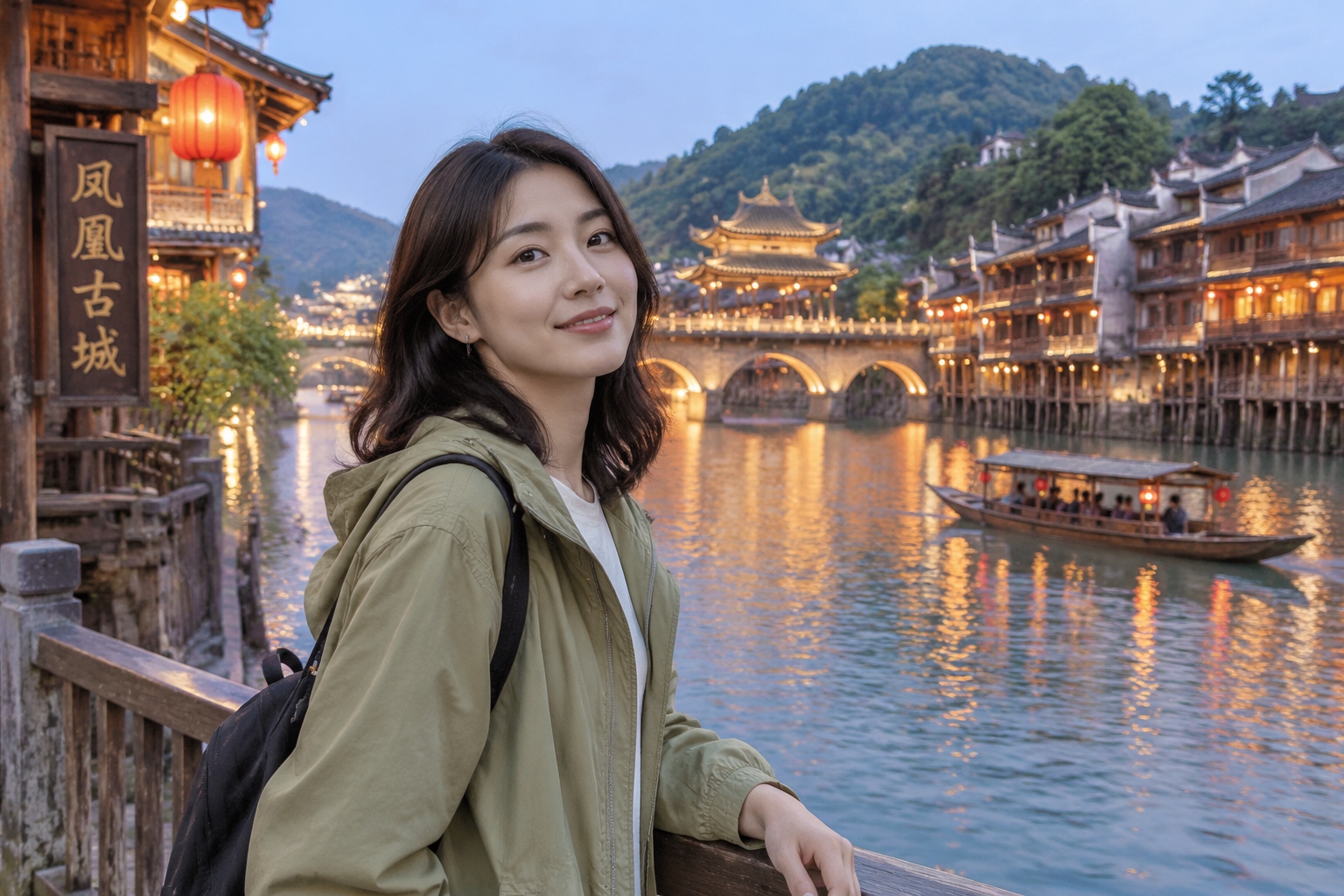
Drive three hours to Fenghuang. The town hangs on both banks of the Tuo River, and the wooden stilts of the old houses are planted in the water. In the early evening, take a small boat downstream and look at the Hong Bridge, the jumping stones, and people washing vegetables by the river. After dark, all the lights come on and the whole river turns warm orange. You will understand why Chinese travelers call it the most beautiful small town. The next day, leave from Zhangjiajie airport.
Practical notes
- Fitness: Overall easy. Zhangjiajie has cable cars and elevators, so you can avoid climbing entirely. The Longji terraces and Yuanjiajie each have a section of steps; if you are tired, walk less. If you fear heights, you can skip the glass walkway.
- Best time: April to June is rainier but has the strongest ink-painting atmosphere and the thickest mist. September to November has the most stable weather, golden terraces and the best visibility. July and August are hot and crowded. In winter, Zhangjiajie has rime ice — another kind of beauty, but you need to handle the cold.
- Be ready for weather: Mountain mist and cloud are the soul of this route and its only real uncertainty. Not seeing a sea of clouds is not a failure. Stone peaks in fog look even more Chinese.
- Yangshuo West Street is commercial: That is also its convenience — restaurants, bars, banks and bike rental are all on one street.
- Good for: Photographers and short-video creators; families traveling with parents; people who do not want hard hiking but still want world-class scenery.
- Not good for: People who want to avoid tourists completely; people sensitive to rain, humidity or carsickness on mountain roads.
What you actually take home
Not a postcard. A set of very specific feelings: the sound of a bamboo pole touching water, the smell of wet mud and rice in the terraces, the three seconds when your calves go weak on the glass, and the moment in Fenghuang when the lights come on and the whole river suddenly turns orange.
Eight days, four ways of seeing. You do not go home saying, I went to China. You go home saying, I walked into a painting, and then I walked out of it.