
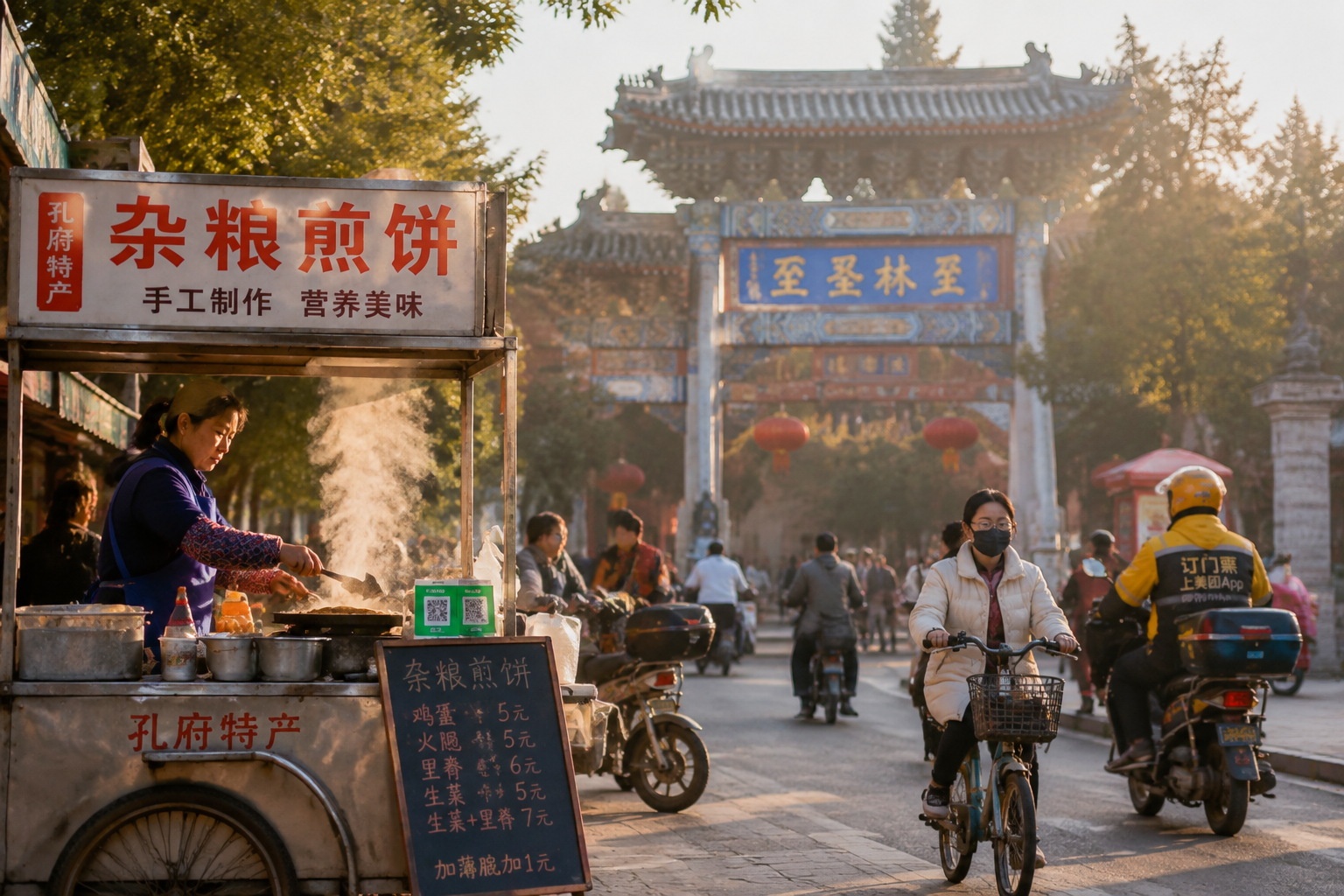

A Morning in Qufu: The Sage in the Steam
The first thing that hits you in Qufu is not the grand temple—it’s the steam rising from a street-side breakfast cart. A woman in a blue apron flips jianbing, the crispy crepe crackling as she spreads egg with a wooden spatula. Beside her, a man in a worn jacket waits with a bicycle, one hand holding a thermos. ‘Have you eaten yet?’ he asks another regular. It’s the old Confucian greeting: the first concern is always nourishment.
This is Qufu, the birthplace of Confucius (551–479 BCE), a city of 600,000 in Shandong province. Over 2,500 years after his death, his philosophy is not a museum piece here—it’s the air people breathe. The Temple of Confucius, the Kong Family Mansion, and the Cemetery of Confucius are UNESCO World Heritage sites, but the real story lies outside their walls, in the alleys where his descendants still live and in the habits of ordinary residents.
Walking the Old Streets: Where Philosophy Meets Pavement
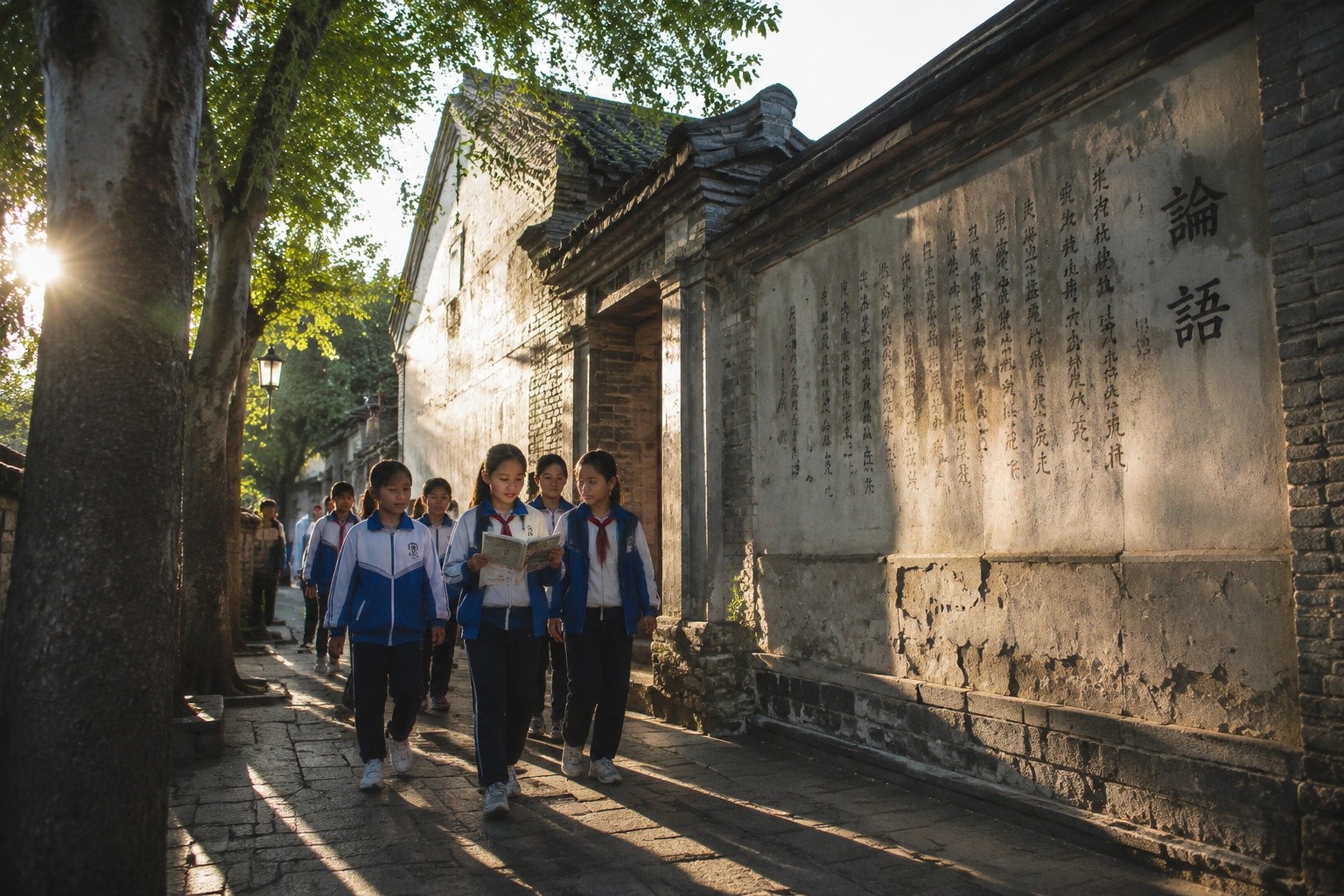
I leave the breakfast cart and turn into a narrow lane lined with old trees. A group of children in school uniforms passes, their voices rising in a chorus of the Analects: ‘Is it not a pleasure to learn and practice what you have learned?’ They recite from memory, not as a performance but as a morning ritual. Their teacher, a woman in her fifties, tells me later that the school starts each day with a passage from Confucius. ‘It’s not about memorization,’ she says. ‘It’s about planting seeds. They might not understand it all now, but one day they will.’
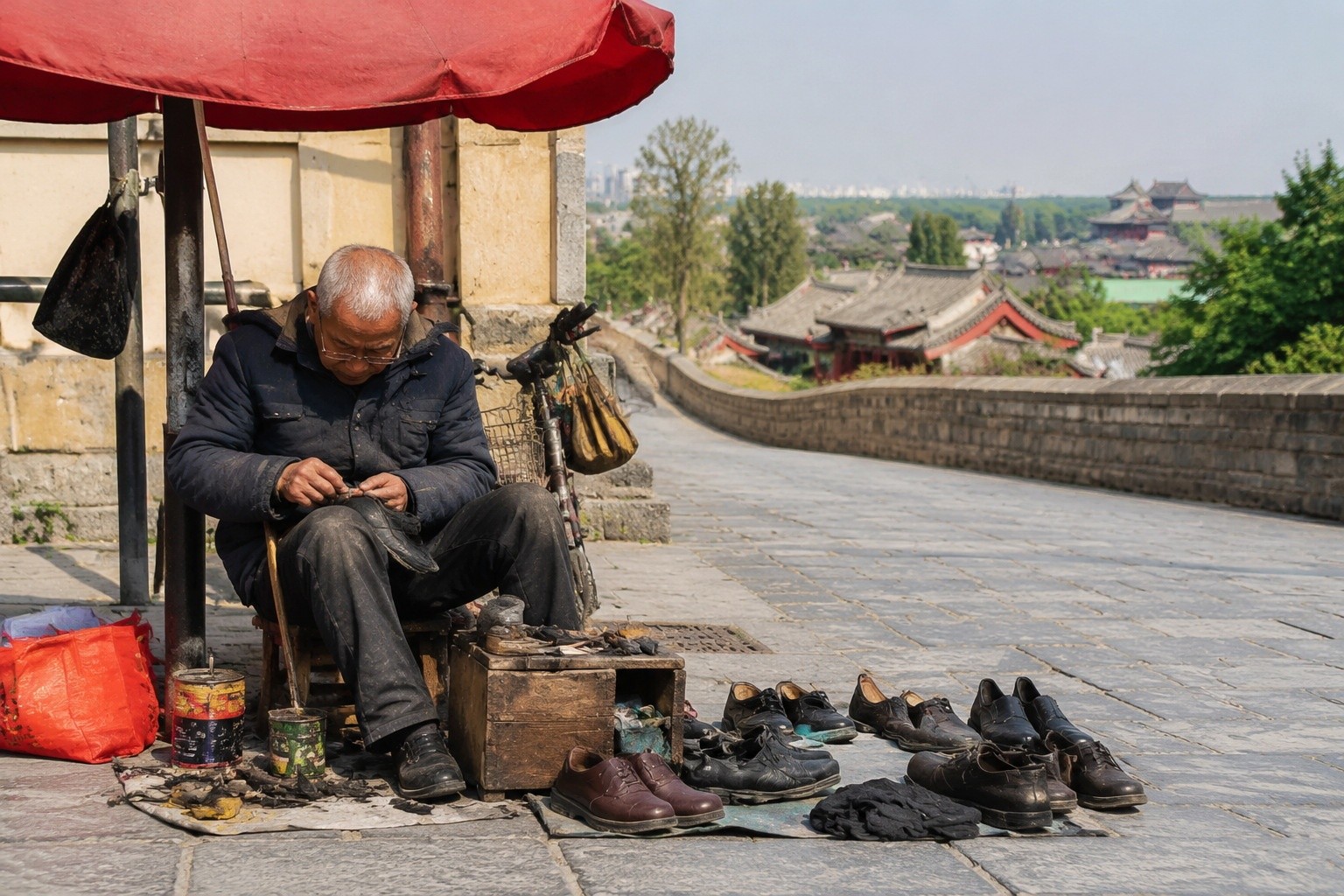
A few doors down, an elderly man sits repairing shoes on the sidewalk. His awning is a faded red umbrella. I ask him about Confucius. He laughs, showing a missing tooth: ‘Confucius? He taught us to treat others like family. I fix shoes for thirty years. Same people come back. They call me “teacher” because I show them how to care for things.’ His name is Mr. Kong, a distant descendant of the sage. He doesn’t make a big deal of it.
The line between the sacred and the mundane blurs constantly. At noon, I stop at a small noodle shop. The owner, a woman named Li, serves me a bowl of noodles with a side of pickled vegetables. On the wall hangs a carved wooden plaque: ‘Harmony is precious.’ She says her father hung it fifty years ago. ‘We don’t think about him every day, but the words are in our bones. When customers argue, I say, “Brothers, remember the plaque.” It works most of the time.’
Rituals in Daily Life: The Unseen Threads
Confucianism is often described as a philosophy of ritual and hierarchy, but in Qufu, it’s softer. A young mother I meet at a park explains that every evening, her daughter bows to her grandparents before bed. ‘It’s not rigid. She does it laughing sometimes. But it’s a moment of respect.’ The ritual is not about enforcing obedience—it’s about remembering connection.
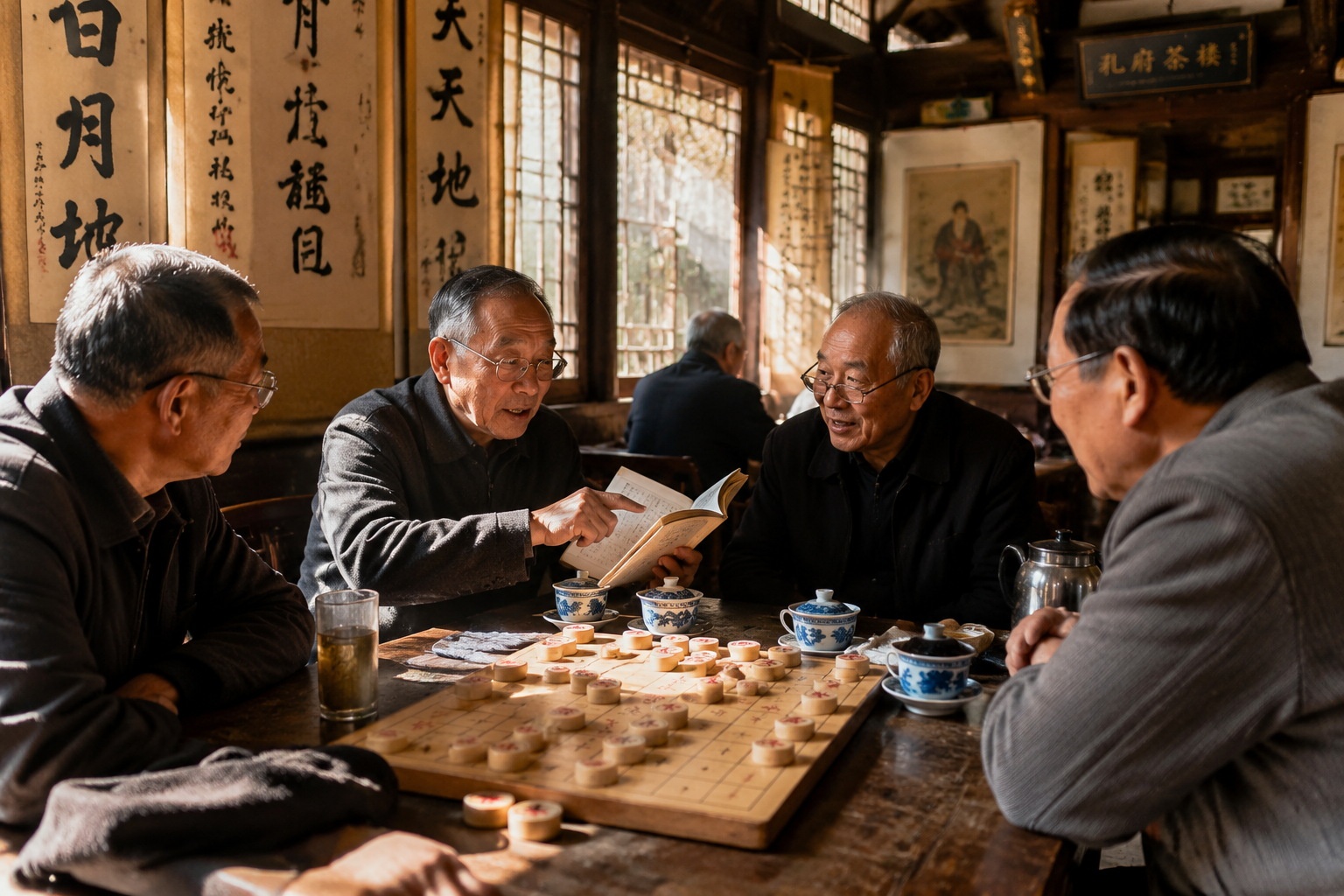
In a nearby tea house, a group of retired men gather to play chess and discuss classic texts. One of them, a retired teacher named Wang, points to a line from the Analects: ‘Do not do to others what you do not want done to yourself.’ He says, ‘I tell my grandchildren: this is all you need. If everyone followed this, the world would be peaceful.’ His friend chimes in: ‘But it’s hard. That’s why we keep talking about it.’
The city’s layout itself echoes Confucian values. The main axis runs south-north, aligning with the temple and mansion, symbolizing order. But the side streets are a messy web of commerce and community—a reminder that philosophy must adapt to reality. A vendor selling electronics has a small incense burner on his counter. ‘For good fortune,’ he says. ‘And for my ancestors. They taught me to work hard.’
Continuity and Change: A Living Tradition
Qufu is not a preserved relic. High-speed trains bring tourists, but they also bring new residents who work in factories and offices. A young woman named Chen works for a tech startup and lives in a modern apartment. She still visits the Confucius Temple once a month. ‘It grounds me. My grandmother used to take me there. Now I go alone. I light incense and think about how to be a better person.’ She admits she doesn’t follow all the rules: ‘I don’t bow three times. But I pause. I think. That’s enough.’
The challenge for Qufu is how to honor tradition without being frozen by it. Some worry that commercialization turns the sage into a brand. But many locals insist that the essence remains. A farmer who brings vegetables to market each morning says: ‘Confucius said to be honest in trade. I never cheat on my scales. That’s how I keep my customers.’
Conclusion: The Sage Next Door
As evening descends, the temple gates close for the day. But the streets fill with people—families walking, children playing, old men exchanging stories. A group of women practice tai chi in a square, moving slowly in unison. A young couple buys roasted sweet potatoes from a cart. The steam rises again, this time against the amber streetlights.
In Qufu, Confucius is not a distant figurehead. He is the neighbor who reminds you to eat well, to treat others kindly, to respect your elders, and to keep learning. His voice is faint but persistent, like the clatter of bicycle bells in the morning air. The sage lives here—not in marble, but in the everyday rhythms of a city that still listens.
Start the discussion at forum.chinacomes.com