

A Bite of Something Different
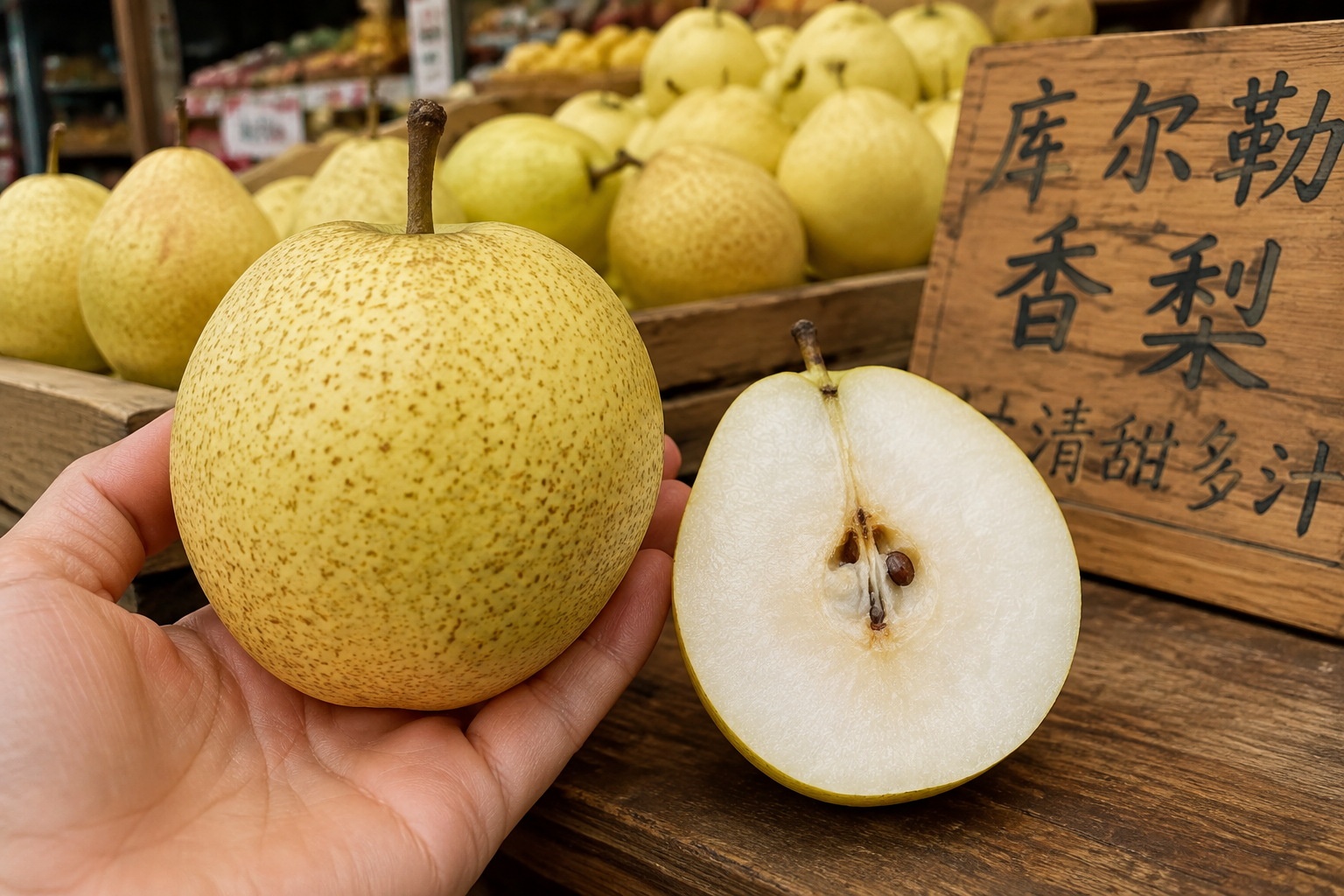
Imagine holding a pear no bigger than your fist. Its skin is pale green-yellow, smooth and a little dimpled. You bite in and hear a sharp crunch. Juice floods your mouth – it’s like sweetened water with a floral note. This is the Korla fragrant pear, a centuries-old fruit from Xinjiang in northwest China. I first encountered it at a dinner party in Shanghai. My host peeled one with a knife, the skin falling in one long ribbon. “These are from my hometown,” she said, and handed me a slice. The flesh was unbelievable – crisp and airy at the same time, melting on the tongue. She told me that these pears now travel to supermarkets all over the world. I was curious: what makes a pear grown in a desert oasis so special that people pay premium prices for it?
What Makes Korla Pears Special
The Korla pear is not just any pear. It belongs to a local variety known as “xiang li” (fragrant pear), and it has been grown in the Korla region for over 1,400 years. The fruit is small and slightly knobby, but its aroma is intoxicating. The sugar content can reach 14 to 16 degrees Brix, noticeably higher than most pears you find in a European supermarket. The reason is geological. Korla sits in a basin at the foot of the Tianshan Mountains, far from any ocean. The climate is dry, with fierce heat in summer and bitter cold in winter. But the key is the diurnal temperature range – often 20 degrees Celsius or more between day and night. This temperature swing forces the pear tree to accumulate sugars slowly. The orchards are watered by snowmelt from the Tianshan, and the soil is a mix of sand and loam with high mineral content. Local farmers also have a saying: “The pear drinks from heaven and grows with the mountain.” They do not need much fertilizer because the soil is naturally rich. When you pick a Korla pear at the right time, it has a balanced sweetness and a hint of sourness that makes you want another bite.
Where Korla Is: Xinjiang in Context
For people who have never visited China, Xinjiang might sound like a distant, exotic place. It is a large autonomous region in the country’s northwest, bordered by eight nations and dominated by deserts – the Taklamakan being one of the world’s largest shifting sand deserts. Korla (pronounced ku-er-le) is an oasis city of about a million people, located near the foot of the Tianshan range. It lies on the ancient Silk Road, where caravans climbed snow-covered passes and stopped to trade silk, spices, and local fruits. Even today, Korla’s name in the Uyghur language is said to mean “looking at a garden” – and that garden is now mostly pear orchards. The city is a two-hour flight from Shanghai, but it feels like another world: buildings rise next to golden fields, and the sky is a deep, cloudless blue.
The Harvest: A Season in the Orchards
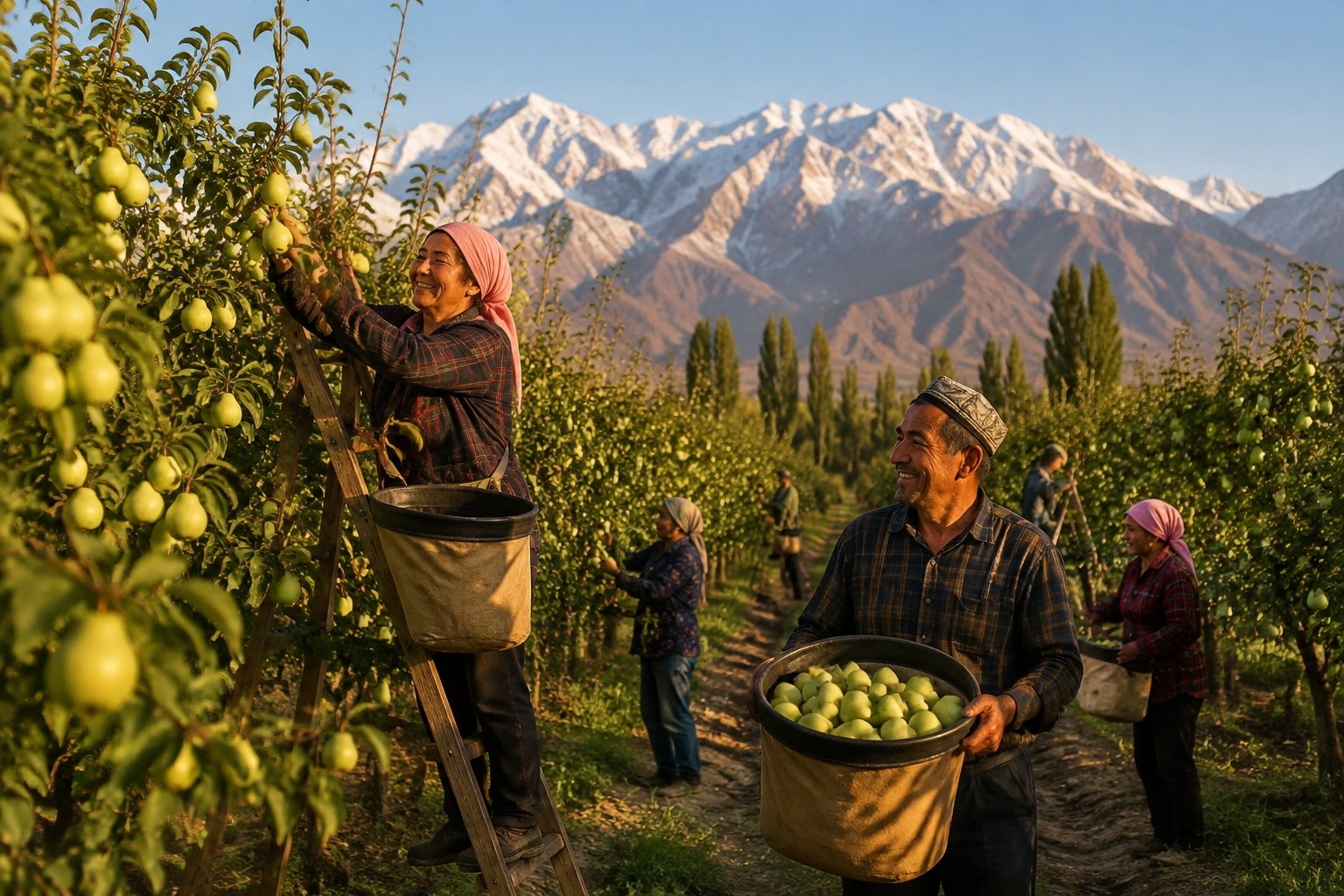
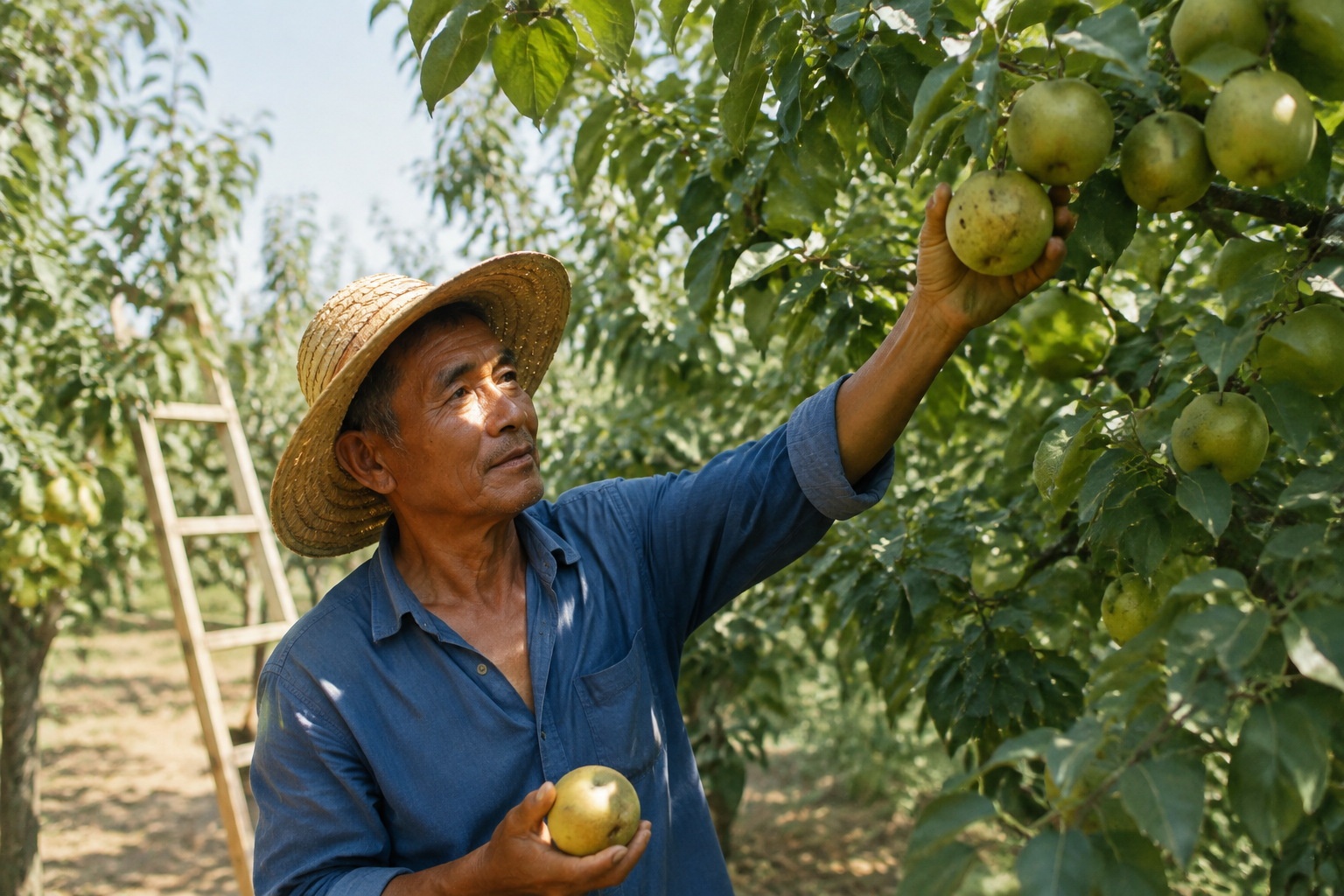
The pear harvest is a handmade affair. In late August, when the fruit’s skin turns golden and the fragrance intensifies, pickers move through the orchards with wooden ladders and canvas baskets. The work has to be gentle. A single bruise will make a pear unattractive to exporters. In an orchard just outside Korla, I met a farmer named Adil. He is in his fifties and has picked pears every year since he was a child. “You have to twist the fruit upward,” he explained, showing me. “If you pull down, you might tear the stem and damage the fruit.” Adil’s family has 1,000 pear trees, and each tree yields about 30 kilograms. He picks about 50 kilograms a day. The best pears – that is, those with perfect skin and sugars above 14 degrees – are taken to a cooperative for grading. The rest are sold locally or made into dried pears and jam. “We still use our hands because the pears are fragile,” he said, “but everything else has changed.”
From Orchards to Overseas Markets
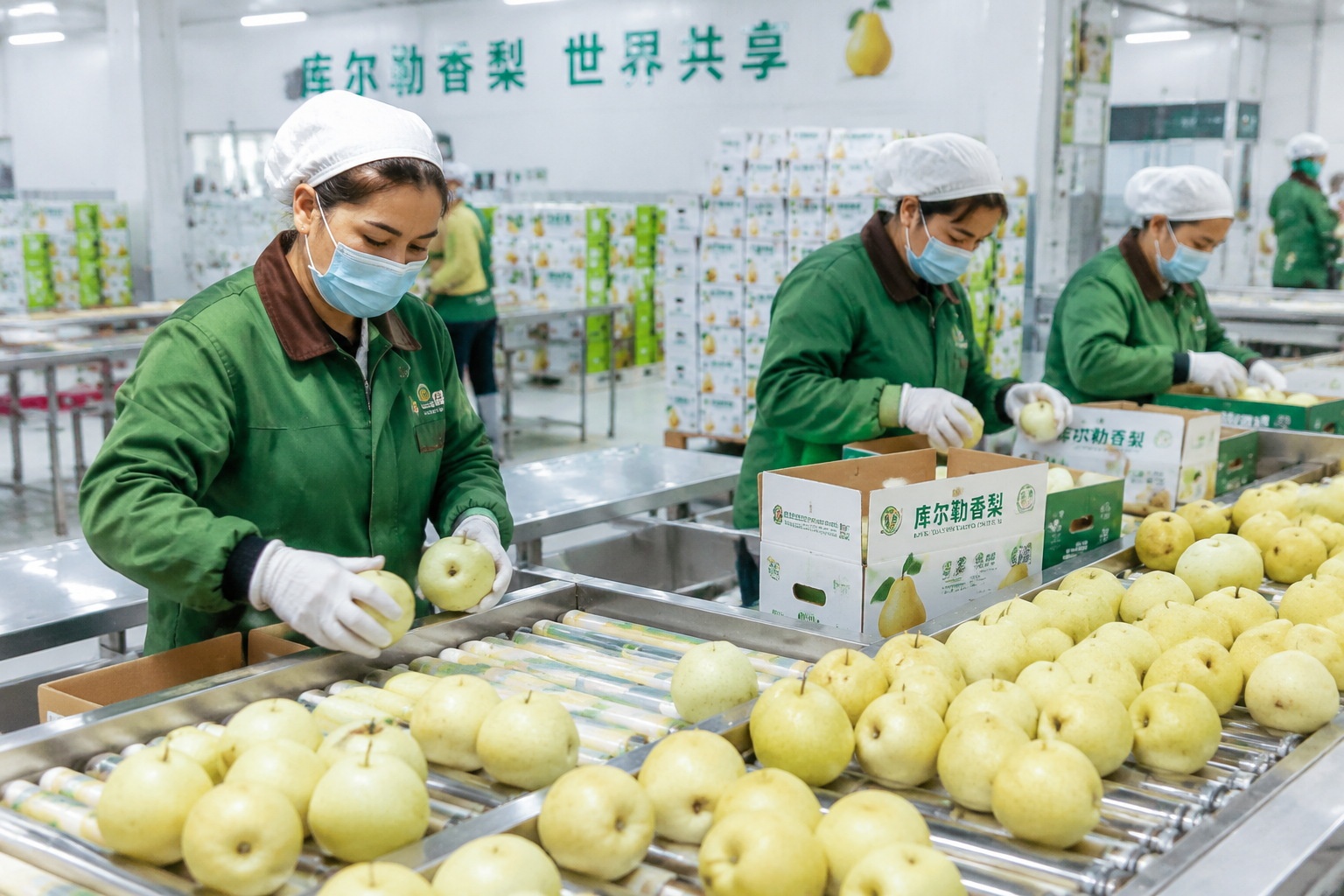
The export journey is a modern success story. After harvest, pears are rushed to packing houses within a few hours. At a packing facility on the outskirts of Korla, I watched a team of women sort pears on a conveyor belt. They wore cotton gloves and examined each pear one by one, rejecting any with a dark spot larger than a pinhead. The selected pears are washed, dried, and wrapped in soft paper, then packed into ventilated cartons. Each carton has a label that tells where the pear came from and a QR code for tracking. The next step is cold storage: pears are held at 1–2°C to keep them dormant and fresh. Then they travel in refrigerated trucks to coastal ports like Tianjin or Shanghai, where they are loaded into containers with a controlled atmosphere. The entire journey to European supermarkets can take 4 to 6 weeks. Korla pears have been granted a Protected Geographical Indication (PGI) in China and are now exported to over 30 countries, including the United States, Canada, Australia, Germany, and the Netherlands. According to a local agricultural bureau, the value of pear exports from Xinjiang has grown two-fold in the last five years, reaching around $200 million in 2024. One reason is that Chinese farmers and companies have invested heavily in post-harvest technology – something that was missing a decade ago. Another is that overseas buyers are increasingly looking for exotic fruit with a story.
In Local Kitchens and Beyond
For people in Xinjiang, the Korla pear is more than an export product. In late autumn, families buy boxes of pears to store for the winter, just as Europeans might store apples. The pears keep for months in a cool room. “My grandmother always kept a basket of them under the bed,” a friend from Korla once told me. “Their scent filled the room.” Pears are often served at the end of a meal to clean the palate. Kids eat them as a snack; adults peel them and slice them into salads. During the Spring Festival, giving a box of Korla pears is a thoughtful gift – the Chinese phrase for pear (li) sounds like the word for “profit” or “separation”, but in the context of gifts, it is usually seen as a blessing for health and wealth. In many Chinese cities, you can find Korla pears in almost every supermarket. They are often the most expensive pears, priced two or three times higher than ordinary varieties. Producers often use anti-counterfeit QR codes to ensure consumers get the genuine fruit. That has made them a symbol of quality and trust.
A Pear That Changed a City
The pear has transformed Korla from a small trading post into a regional economic hub. Today, the pear industry directly employs over 200,000 people, from orchard workers to logistics drivers. The annual output is around 1.5 million tons. The price in a good year can be as high as 8 yuan per kilogram at the farm gate (about $1.10), which might not sound like much, but it is significantly more than wheat or cotton. And because the pear is a labor-intensive crop, it creates jobs that keep young people in the area. A new generation is also marketing pears through live-streaming e-commerce. A young woman named Liu Yang started selling pears from her parents’ orchard during the pandemic. Today, she has a small brand and sells thousands of boxes a month. “We used to rely on middlemen,” she told me. “Now I can reach customers in Beijing or Guangzhou directly. My phone doesn’t stop ringing in October.” The pear even shapes the city’s landscape: streets are lined with pear trees, and in early April, the pink and white blossoms attract tourists from other provinces.
Challenges and the Road Ahead
But not everything is rosy. Climate change is hitting the region harder than many places. Extreme weather events – early snow, hail, sandstorms – have damaged harvests in recent years. In 2021, a rare late frost killed a large share of flowers, causing production to drop by nearly 20%. Farmers are experimenting with protective measures like wind machines and irrigation systems that release heat at night. Rising labor costs are also a concern. As more young people move to big cities, orchard owners must pay higher wages for hired pickers. To stay competitive, some farms are adopting precision agriculture: soil sensors, drone monitoring, and automated drip irrigation. However, these technologies need investment. A simple weather station costs around 5,000 yuan, and a drone more than 100,000 yuan – not cheap for smallholders. Brand protection is another battle. Because “Korla fragrant pear” is a well-known label, many growers in other regions call their pears by the same name. The government has launched a certification system, and export companies now test for pesticide residues and other quality standards. Despite these challenges, the mood is cautiously optimistic. “We have a good product and a good reputation. We just need to adapt,” an orchard cooperative leader told me.
A Simple Fruit, A Complex Story
So next time you see a small pear in the fancy fruit section of your supermarket, pick it up and smell it. If it has a sweet, floral scent, it might be a Korla pear. It started as a seed in an oasis, was shaped by 1,400 years of care, and then traveled across mountains, ports, and oceans to your table. It is a tiny object, but it carries a bigger story: about a region investing in its future, about farmers who combine tradition with technology, and about how a single fruit can build bridges between far-apart places. The first bite always makes me smile – not just because of the sweetness, but because I know the effort compressed into that small, unassuming package.
Start the discussion at forum.chinacomes.com