

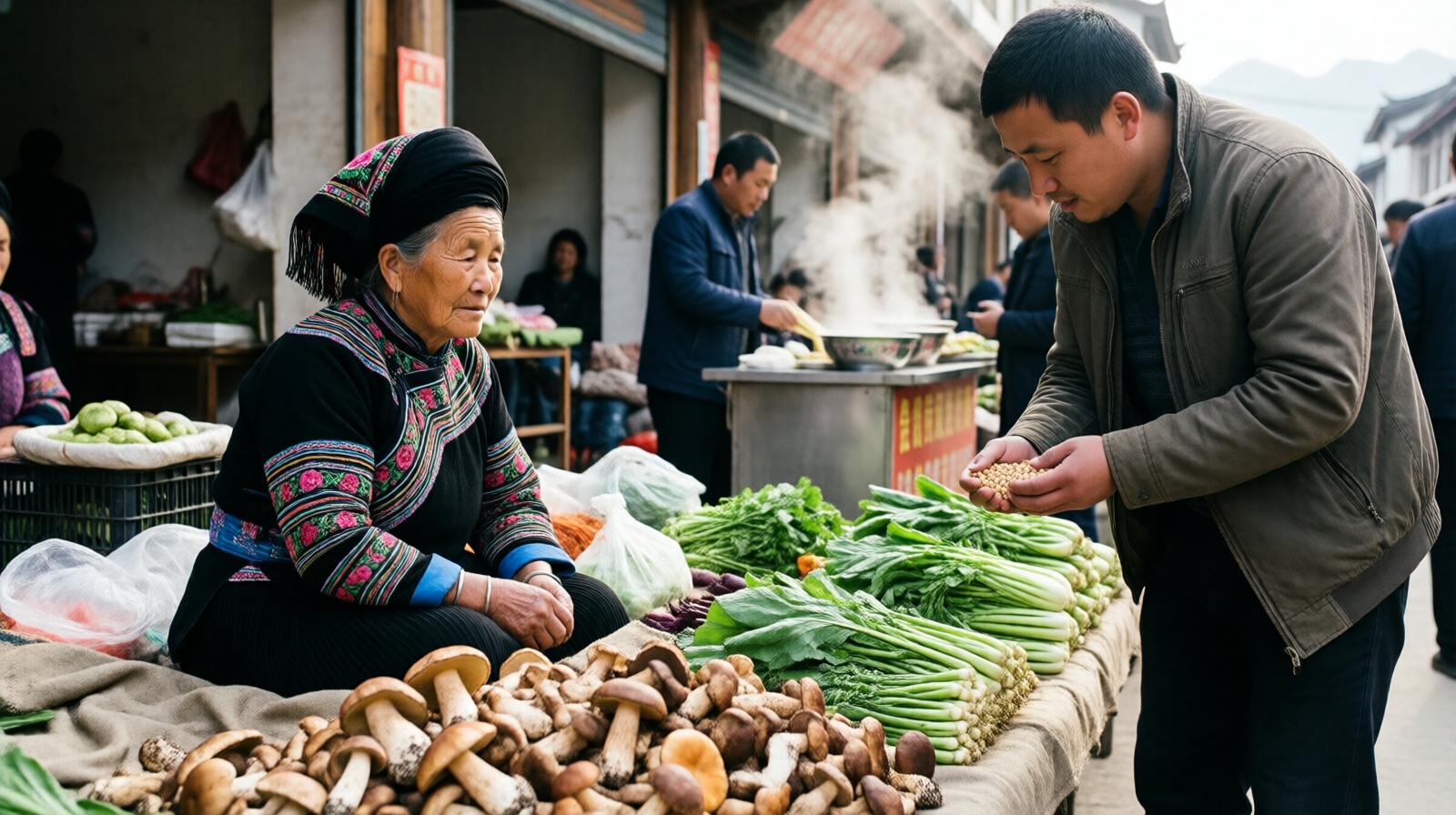
At 7 a.m., Donghua Street Market in Panzhihua is starting to hum. An elderly Yi woman with a black embroidered headscarf lays out wild mushrooms on a faded canvas. Next to her, a Han butcher sharpens his cleaver, and a few stalls away, a young Lisu man stirs a giant pot of rice noodles with pickled greens. For outsiders, this might look like a model of diversity. Here, it is simply Tuesday.
Panzhihua, a city of about 1.21 million people in southwest China, sits at the junction of the Jinsha and Yalong Rivers, in a valley surrounded by dry, rugged mountains. In the mid-1960s, the Chinese government launched the “Third Front” campaign — a strategic industrial build-up in the country’s interior. Panzhihua, with its huge iron ore deposits, became a focal point. Over a decade, hundreds of thousands of workers poured in from Shanghai, Shenyang, Harbin and other industrial cities. They built steel plants, hydropower stations, and cramped housing blocks on the slopes. Many stayed, marrying into the local Yi and Lisu communities. The city that emerged was, from day one, a fully mixed society.
A Steel City Forged by Migrants
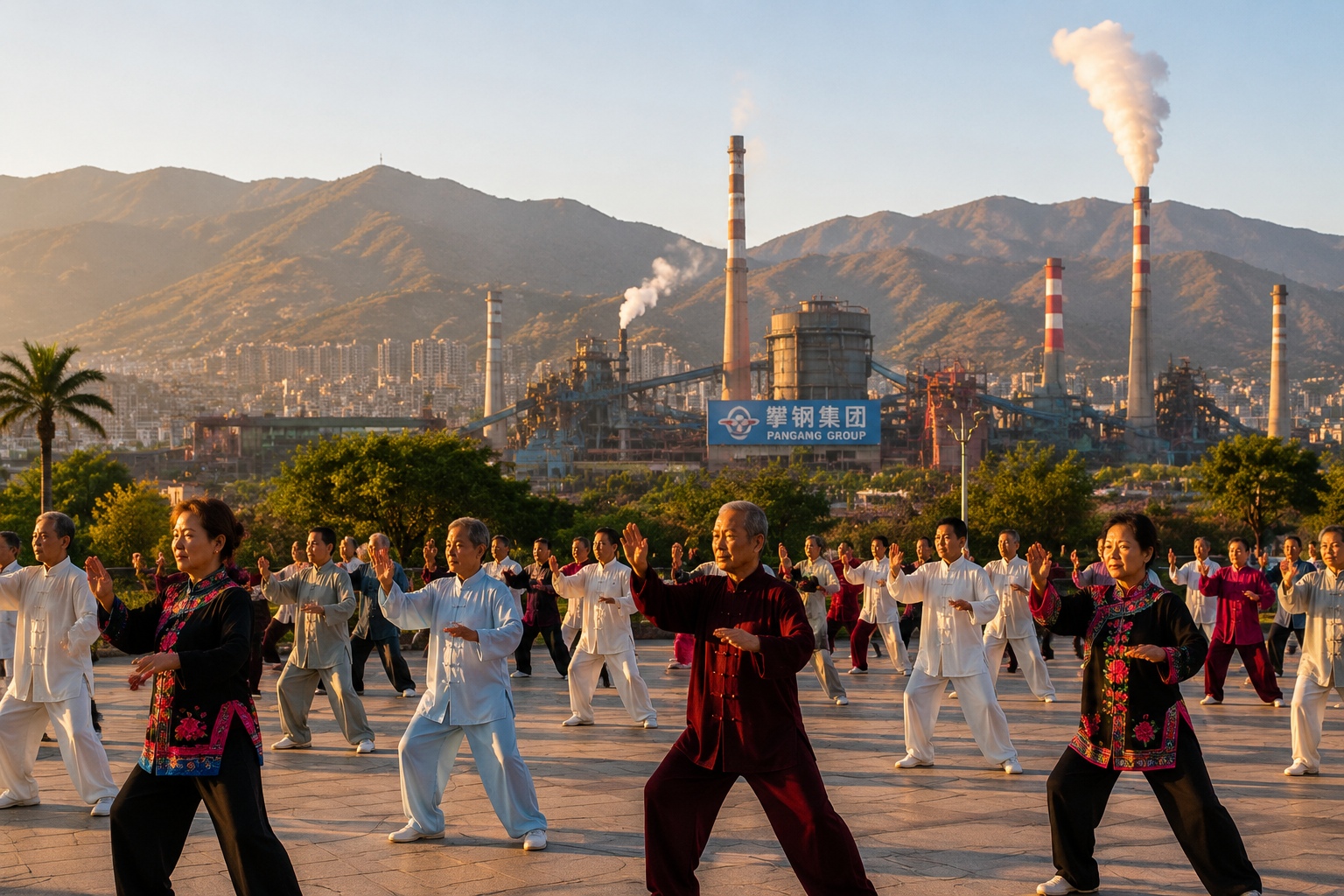
The steel industry was the original glue. The Panzhihua Iron and Steel Corporation (Pangang) was founded in 1965. It supplied crucial steel for China’s railways and military hardware. In the 1970s and 1980s, a job at Pangang came with a home, a school, and a hospital. Workers from different provinces lived in dormitories converted from warehouses. During the lunar New Year, the cafeterias served both Northern dumplings and Southern rice specialty. Couples like Chen Wei’s parents formed across ethnic lines. Chen’s father was a Han engineer from Liaoning, and his mother came from a Yi family further up the valley. “Our household was split: my father read the news in Mandarin, my mother said prayers in Yi under her breath, and we kids switched dialects depending on who we were talking to,” Chen recalled. “With my friends, I spoke a mixed tongue that no one else in China could easily understand.”
That mixed tongue is itself a marker of Panzhihua’s identity. A local scholar once described it as “Mandarin with an industrial accent, spiced with Yi and Northeastern slang.” The city’s census data shows that residents’ places of origin span more than a dozen provinces. It is not uncommon to meet a Panzhihua native whose grandmother speaks with a heavy Shanghainese accent.
Daily Encounters with Diversity
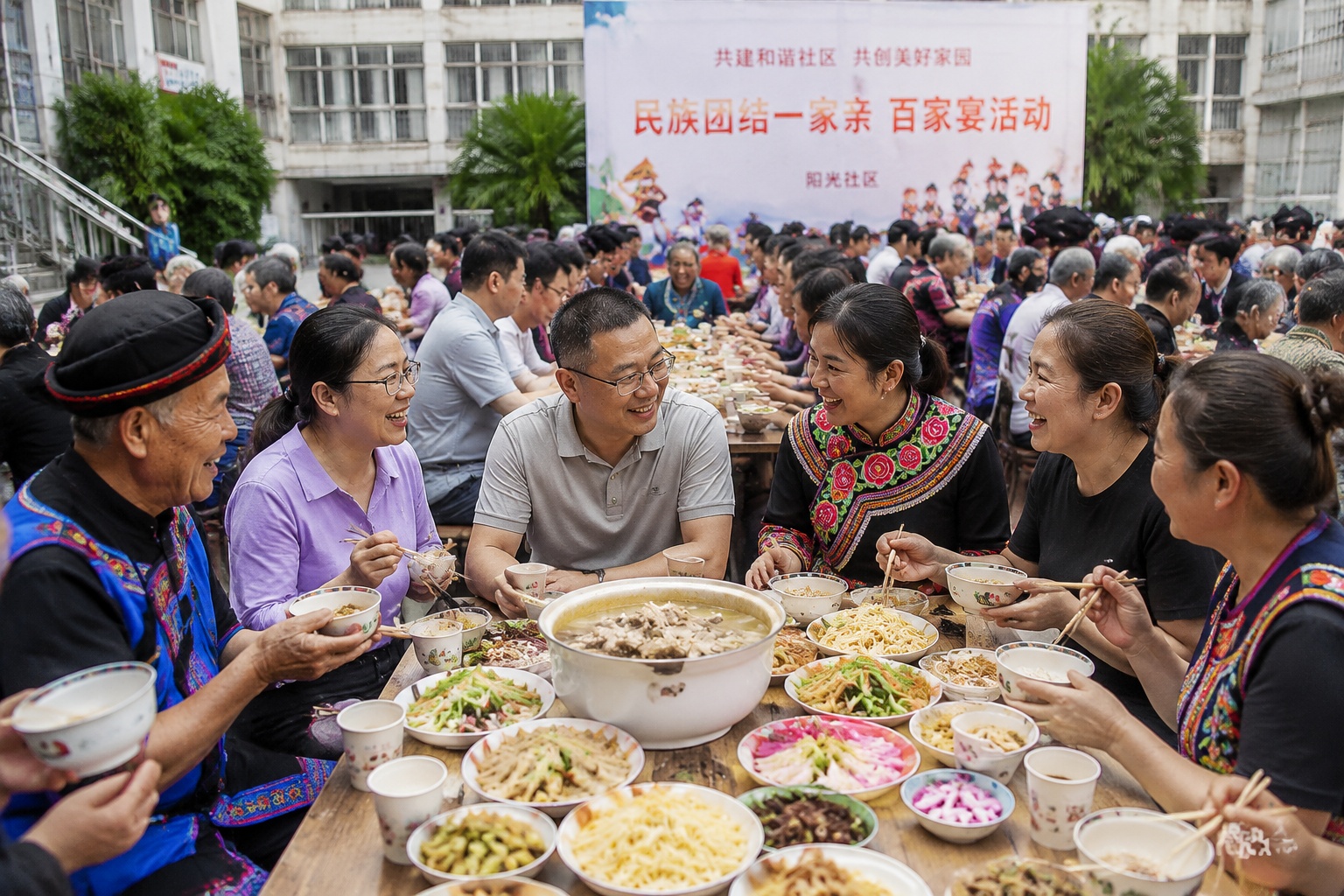
Today, the mixture plays out in daily life across the city. In Renhe District’s Lunan Community, for example, roughly 31 percent of the 16,000 residents belong to one of 19 non-Han groups. Every Saturday evening, the community square becomes an open-air stage. Older women practice the Yi “dati” dance, their arms moving in the signature long-sleeve motions. Men from the northern mountains, in the city for the evening, sit in groups playing Chinese chess. Above the square, the community center holds a “Local Kitchen” where residents cook for each other. Last month, a Yi woman taught neighbors how to wrap “tuotuo rou” (boiled pork chunks with chili); the following week, a Lisu family introduced a wild-greens stir-fry.
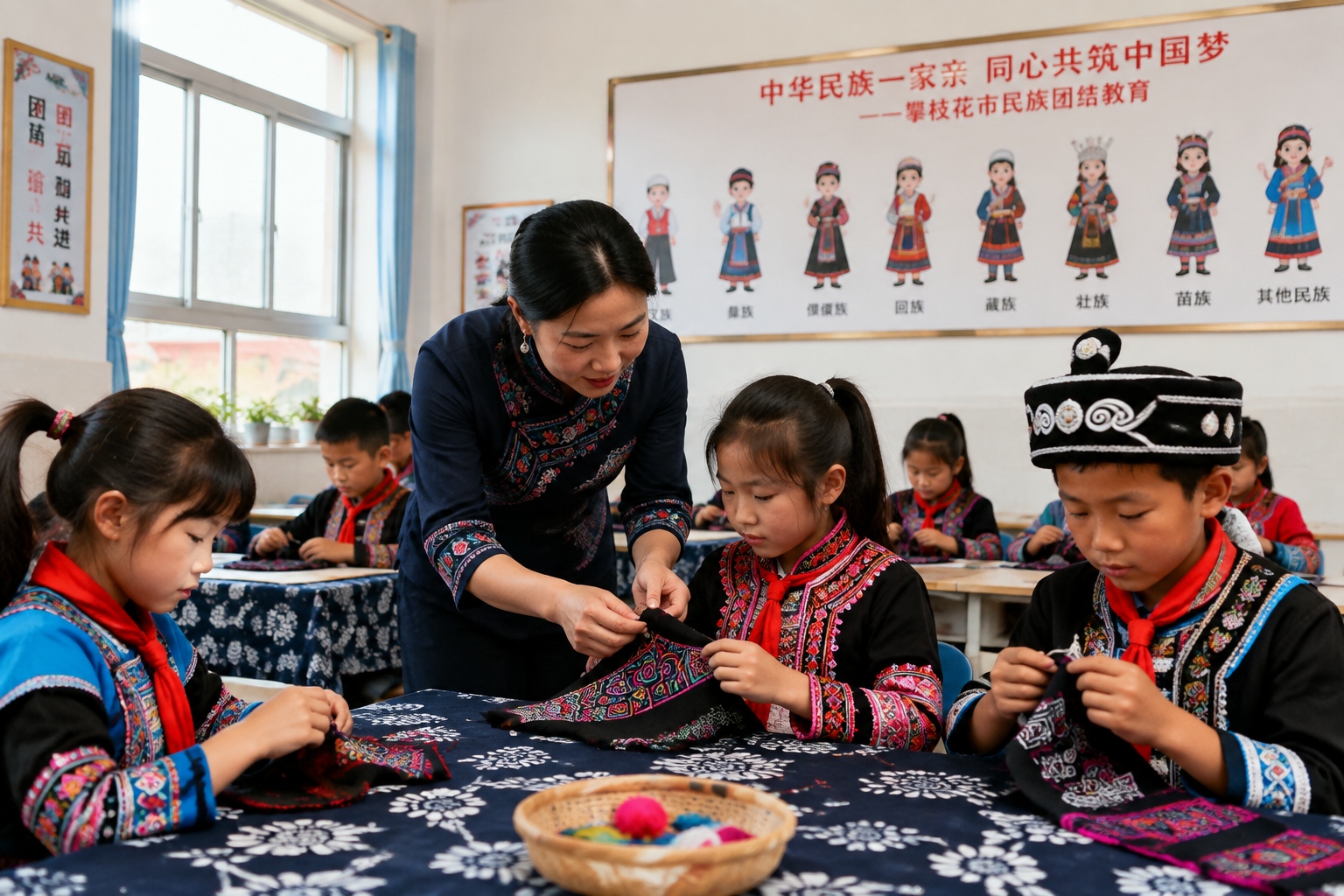
The cultural calendar has expanded accordingly. The Yi Torch Festival, originally a mountain ritual, now fills the city center with bonfires, parades, and an evening half-marathon. The Lisu Spring Festival, which brings together river towns in the valley, is recognized by the city as a public celebration. In schools, “ethnic unity” is part of the curriculum. At Dongfeng Primary School, students spend an hour each week making Yi embroidery and learning to count in the Lisu language. Teachers say the idea is not to treat minority cultures as museum exhibits, but as living knowledge.
Policies That Make It Workable
The daily mixing is not left to chance. Municipal authorities have crafted policies that quietly support the social fabric. Since 2015, the city has invested in rural road improvements for the mountainous villages where many Yi and Lisu families still farm. Fiber-optic cables now reach some of the steepest villages, letting children access online classes and remote health consultations. In Muyu, a village known for its Yi traditions, the new roads and internet have allowed families to operate guesthouses and trekking tours. Younger residents no longer have to choose between leaving home or giving up opportunities.
Language programs also get funding. Two middle schools in Renhe District offer Yi language electives, and adult literacy classes for Yi-Chinese interpretation are free. In a 2020 provincial assessment of ethnic relations, Panzhihua ranked in the top three of all 21 prefectures and cities in Sichuan on a composite index that measures social integration, intermarriage rate and community activity participation.
There are also practical measures inside workplaces. At Pangang’s renovated factories, a “multi-ethnic dormitory” initiative pairs Han and non-Han workers as roommates, on purpose, to break down silence. A female worker told the local paper: “At first I thought it was strange. Then I picked up some Yi dinner phrases and learned to make a decent sour-soup fish.”
The New Generation’s Challenge
Despite these gains, not everything is smooth. School enrollment statistics for minority students in remote villages remain lower than the urban average. Many girls, especially, drop out after middle school to help with family work at home. The city’s industrial economy is also vulnerable to shifts in steel demand, and unemployment can shake community confidence. In 2022, a factory closure temporarily forced some workers, including minority employees, to relocate. Yet the city’s response was to allocate housing subsidies and retraining vouchers, not diktats.
The younger generation, meanwhile, is creating its own path. Xu Min, 26, works in a logistics startup in Panzhihua’s new high-tech zone. She speaks a fluent mix of Mandarin and, when needed, simple Yi learned from her grandmother. “Sometimes I feel like I have one foot in the mountains and one in the marketplace,” she said. “That’s actually a good place to be, because both worlds are changing.”
Xu’s generation is also redefining local identity. They organize a small music festival that brings together Yi mountain songs and indie rock. In a video that went viral locally, a team of young designers recreated the patterns of Yi clothing in neon colors for skateboards. The city, once defined by its smoky steel industry, is slowly becoming known as a meeting point of cultures.
Looking Ahead
Panzhihua is preparing for a future beyond steel. The city is aggressively courting solar power installations on the dry hills, and its mild winter climate has turned it into a retirement destination for people from all over China. The central government has also approved a high-speed railway link to Kunming, which will slash travel time from the nearest major city by two-thirds.
Can the new economy sustain the same level of integration? The answer is unfolding. But the social foundations laid in the 1960s are solid. On a warm Saturday evening, the riverfront promenade is filled with families. Han grandparents, Yi mothers in embroidered aprons, Lisu teenagers in jeans — all standing together, watching a performance of a Mongolian singer. As he sings a folk song, the applause sweeps the crowd. In a city built to produce steel, the deeper product is the shared space itself.
Start the discussion at forum.chinacomes.com