

Morning in the Miao Village
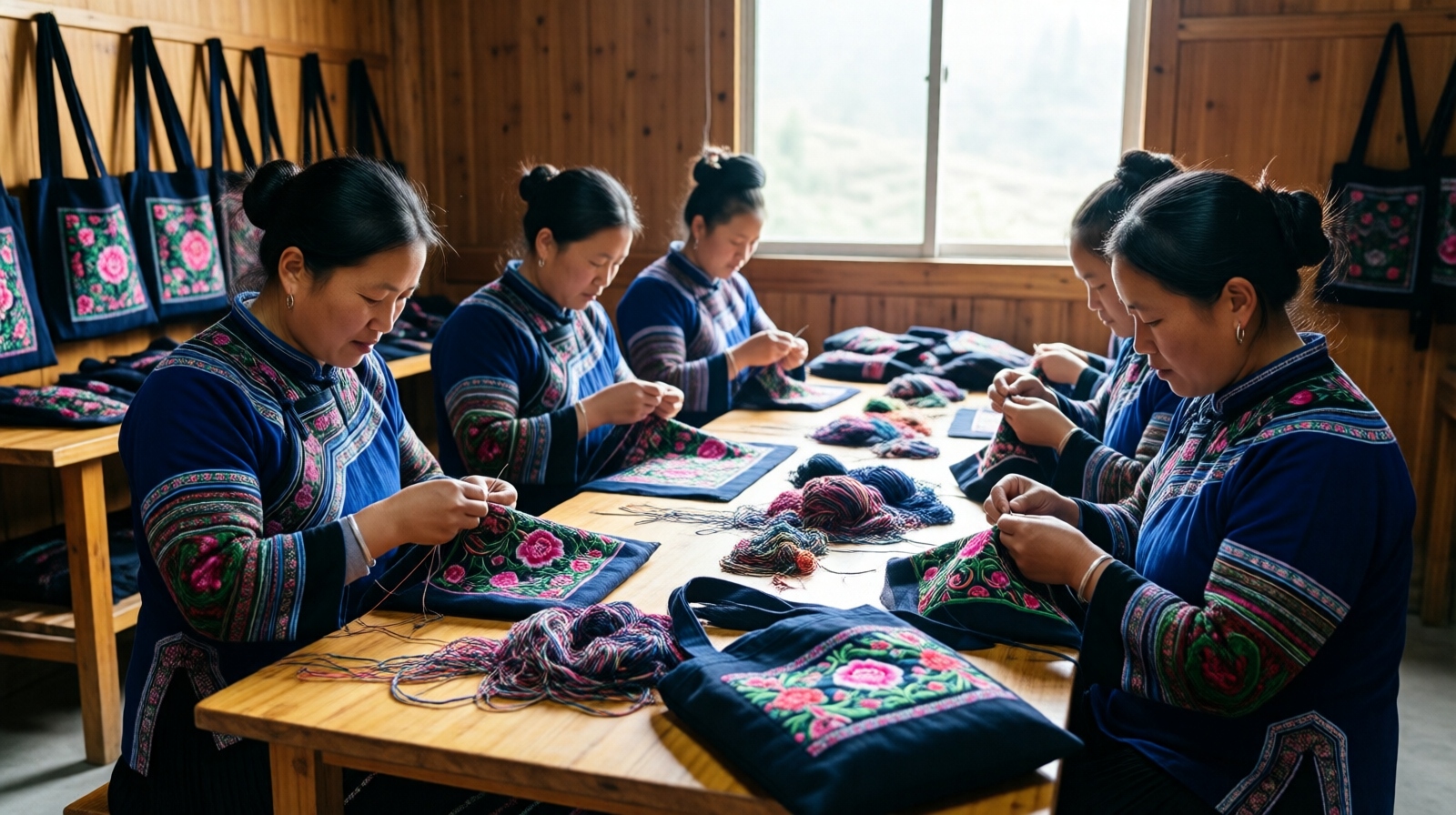
The sun rises late in the mountains of southeast Guizhou. Inside a bright workshop in the village of Panlong, a dozen women sit at low wooden tables, needles moving steadily across indigo-dyed cloth. The air smells of dye and wood smoke. The only sounds are soft laughter and the rhythmic pull of thread through fabric.
This could be a scene from a hundred years ago. But the workshop is also a packed office. On a shelf near the window sits a 3D printer testing a brooch design. In the corner, a young woman films a short video showing the stitching process. On the walls hang certificates and orders from customers in Shanghai, Chengdu, and even overseas.
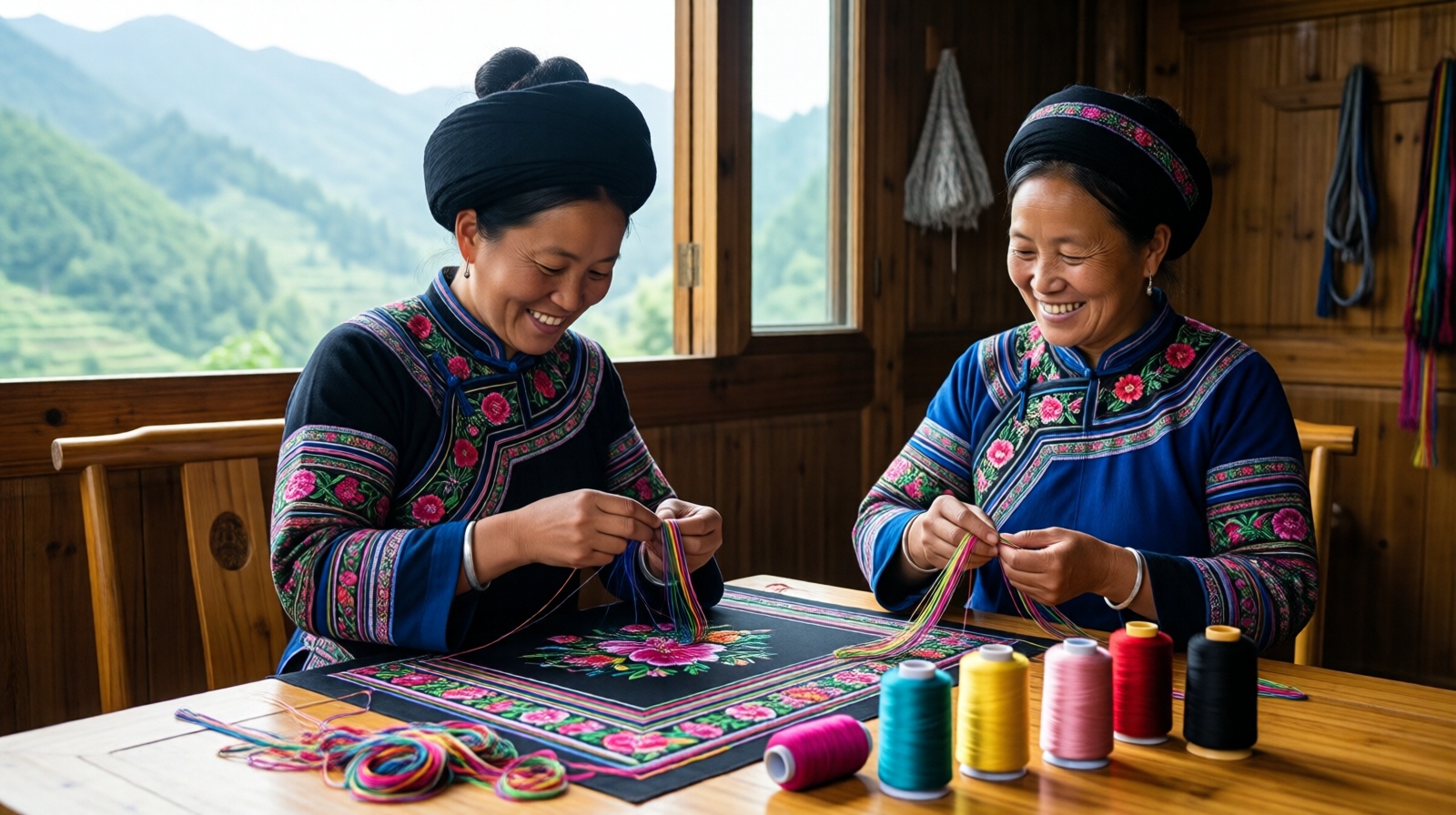
The woman running this operation is Wu Liping, 46, a Miao native who grew up in a house with no running water. Today, she is the founder of a textile company that employs 48 embroiderers, most of them women from her own and neighboring villages. She is part of a quiet revolution happening across China’s southwest: ethnic minority women turning traditional handicraft into modern enterprise.
Threads of the Past
For generations, Miao embroidery has been more than decoration. Patterns tell stories of ancestors, mountains, and rivers. Girls learn to stitch from their mothers and grandmothers, often starting at age six or seven. The clothes they make are wearable history.
But in the 1990s, when Wu Liping was in her twenties, this skill was becoming a burden. Factory-made clothes were cheap and fast. Tourists bought embroidered pieces for a few yuan, not aware of the dozens of hours each one required. Many women in her village gave up needlework to work in coastal factories like the ones that made those cheap clothes. “The embroidery was something you did for your family, not for money,” she says. “If you wanted real income, you left the village.”
Wu Liping herself spent four years working at an electronics factory in Shenzhen. She hated it — the long hours, the noise, the sense of being a small part of a heartless machine. When she heard that her mother was ill, she returned home. She planned to stay only until her mother recovered. But something unexpected changed her course.
An Unexpected Opportunity
In 2009, a local government program called “Heritage in Action” began offering training to women in rural areas. Wu Liping attended a workshop led by a veteran embroiderer and a design professor from a provincial university. The message was simple: your skills are valuable, but they need to speak to today’s market.
“At first I thought it was a joke,” she recalls. “We had been told for years that our work was backward. Now someone was saying it had value.” The professor showed examples of traditional patterns adapted to fashion accessories, and digital prints made from original embroideries. Wu Liping began to see possibilities.
She signed up for two more courses, one on product design and one on basic accounting. She also learned to use a smartphone for more than phone calls. Her daughter, then a high school student, taught her how to search for trends online.
Building a Cooperative
In 2012, Wu Liping gathered eight women from her village and formed a cooperative. They combined their savings to buy cloth and thread. Their first product: small embroidered keychains and phone cases, which they sold at a tourist market in the nearby town of Kaili. They were a hit.
Encouraged, they expanded to larger items: bags, scarves, pillow covers. But success brought problems. Orders came in faster than they could produce. Some women embroidered faster but with uneven quality. And upfront costs for raw materials strained their cash flow.
They learned by doing. They set quality standards, dividing work into specialized tasks. They agreed on a fixed payment per piece, with bonuses for precision. When a big order from a Shanghai boutique required a specific color palette, they spent two weeks dyeing and re-dyeing fabric until they got it right.
“We made every mistake you can imagine,” Wu Liping says with a laugh. “But each mistake taught us something no teacher could.”
Going Digital
In 2016, a new challenge appeared: e-commerce. Platforms like Taobao and Pinduoduo were already widespread in China’s cities, but in rural areas, many people were still suspicious. Wu Liping’s daughter urged her to open an online store. She hesitated. How could they sell embroidery without customers touching it?
She attended a live-streaming training organized by the county government. The trainer showed how to use personality and storytelling to sell products. “People don’t just buy a bag,” he said. “They buy the story of who made it and how.”
Wu Liping started with small live sessions. She showed the embroidery process, introduced the women by name, and explained the meanings of the patterns. To her surprise, viewers were deeply interested. A bag that she hoped to sell for 80 yuan (about $11) sold for 180 yuan at a live auction. The customer said she wanted to support the women, and the story made it worth more.
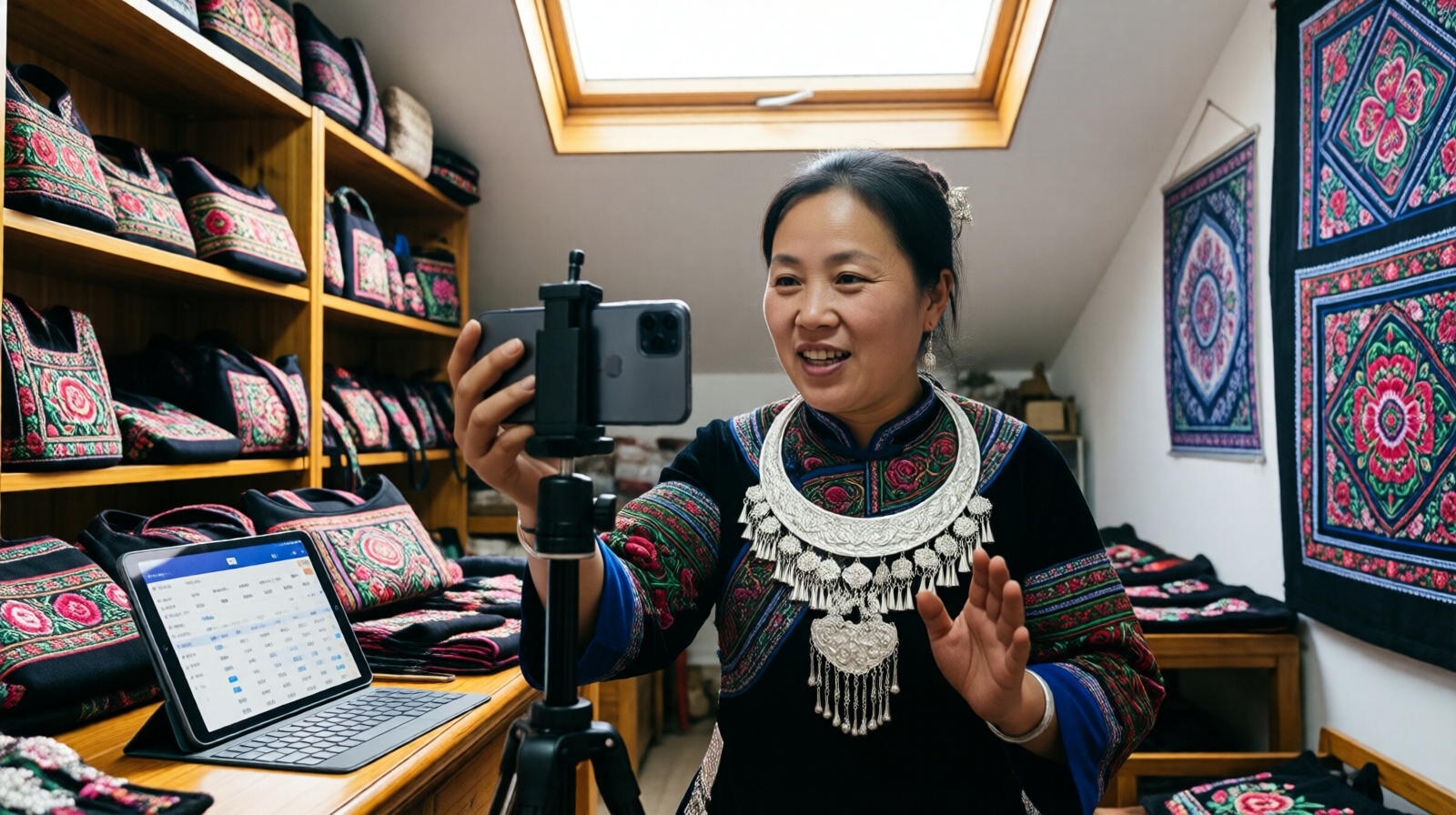
Today, about 40% of the company’s sales come from live-streaming and social media. Customers are mostly Chinese urban professionals, but also some overseas buyers who find them through English-language social media posts made by international volunteers.
From Cooperative to Company
In 2019, the cooperative became a formal company, registered as “Miao Craft Culture Co.” Wu Liping became the legal representative and general manager. The name gives her mixed feelings: “I never wanted to be the boss. But the bank needed a legal person. The tax office needed a legal person. The contract with the museum needed a legal person. So I became it.”
The transition brought more structure. They now work with designers who help translate traditional patterns into contemporary products. They have a partnership with a modern clothing brand in Chengdu. Their products range from 20-yuan hairpins to 3,000-yuan custom-made wedding dresses. In 2023, the company earned revenue of 4.6 million yuan (about $630,000), with an average monthly income of 3,200 yuan for the embroiderers—a significant sum in a region where the average rural income is around 1,800 yuan.
But Wu Liping is careful not to overstate her progress. “Growing a business here is harder than in a city. We don’t have a logistics hub. Young people leave. Many customers don’t want ‘traditional’ designs; they want something that fits modern life. We are still learning.”
What the Change Means
The impact isn’t just economic. For many women, earning their own money has changed how they are seen—and how they see themselves. Among the company’s embroiderers is 68-year-old Wang Laifeng, a widow who used to rely on her son’s remittances. She now earns an independent income. “I felt like a burden before,” she says softly. “Now I’m a person with value.”
Her daughter-in-law, 27-year-old Luo Haijuan, is also part of the team. She returned to the village after a harsh factory job in the east. “I am raising my daughter while doing something meaningful,” she says. “It’s not just a job. It’s my culture.”
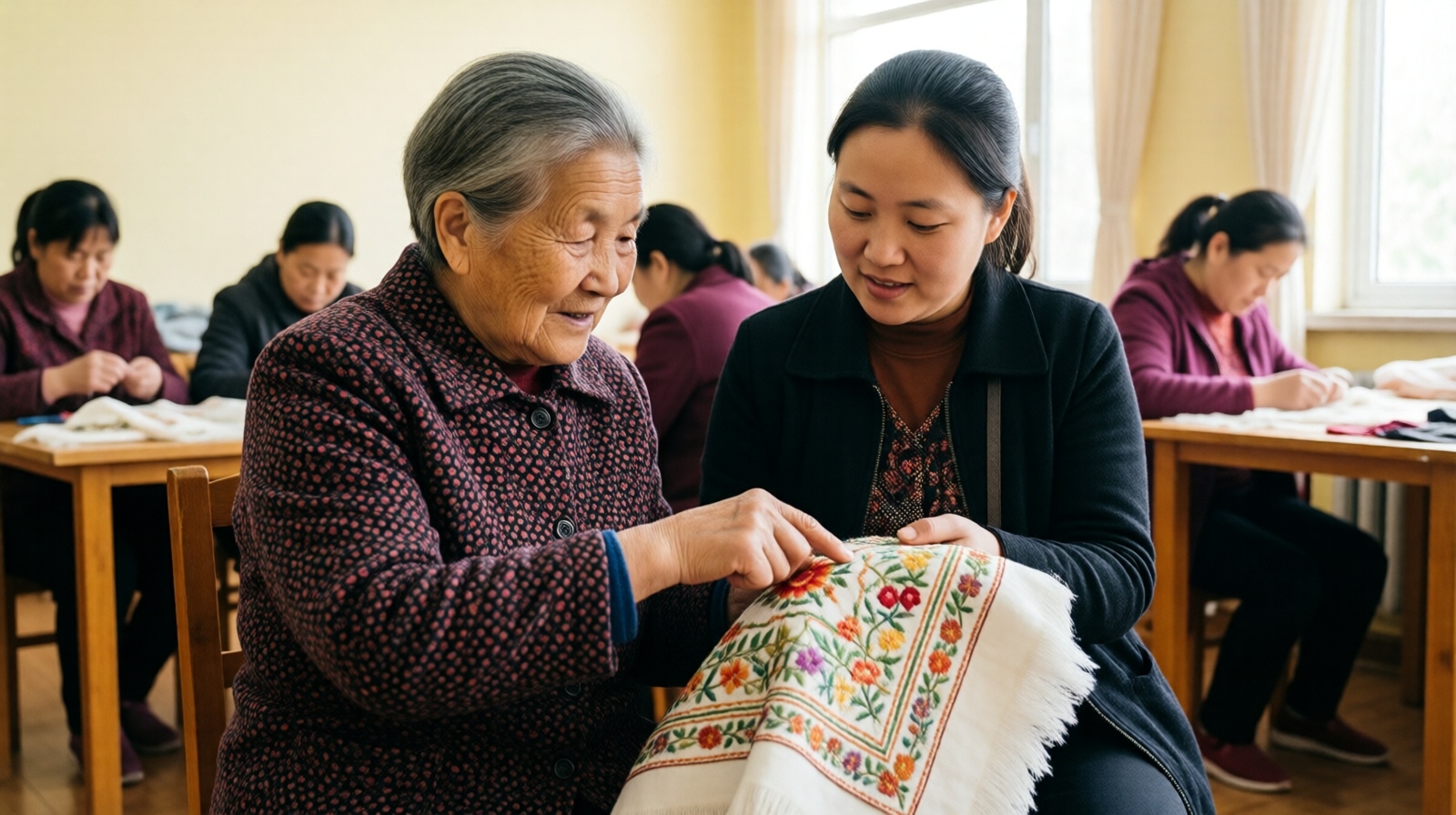
There are also young women who bring new energy. Some have used the company as a base to start their own small ventures—one makes embroidered straps for glasses, another runs a side business renting traditional Miao costumes for weddings. Wu Liping encourages this: “If they outgrow us, that’s a success.”
The Road Ahead
Not everything is smooth. The company still struggles with talent retention—skilled embroiderers are aging, and few young women in the village want to learn it as a full-time craft. There is also the risk of cultural commodification. Wu Liping remembers a tourist asking if her patterns were “real” or “made up.” She replied, “This pattern tells the story of our village crossing the river. It is as real as your grandmother’s recipe.”
She is trying to set up a training school to pass on skills, and exploring new sales channels like live-streaming on international platforms with the help of a translator. But she worries about scaling too fast and losing authenticity. “We don’t want to be a factory that happens to do embroidery. We want to be a community that happens to have a business.”
A Quiet Revolution
Walking through the workshop, I notice a woman on the phone negotiating with an express delivery driver in rough Chinese. Another woman is selecting thread colors from a chart pinned to the wall, standing in front of an old wooden loom that once belonged to her grandmother. The old and new are not opposed—they are layers.
Wu Liping says the phrase that sums up her journey: “From the needle to the company boardroom. But the needle is still in my hand.” Her hands, like those of many women here, show the calluses of decades of stitching. Those hands have also tapped on keyboards, signed contracts, and recently learned to use a card machine.
She doesn’t think of herself as a revolutionary. But in a region where women’s roles were often defined by marriage and family, she represents something new: a woman who builds her own path, carrying her ancestors’ patterns into the future.
“It’s not that I invented anything,” she says. “I just believed my mother and grandmother when they said the work of our hands was valuable. It took a while, but now the market agrees.”
Start the discussion at forum.chinacomes.com