


On a misty morning in Leishan County, set in the mountains of southeast Guizhou, I walked along a narrow path between emerald tea terraces. At a stone bench overlooking the valley, a young Miao woman, wearing a silver headpiece that chinked softly as she moved, clipped her smartphone to a small tripod and adjusted the ring light. She glanced at the live chat, smiled, and began talking to about 1,300 viewers in cities like Guangzhou and Shanghai.
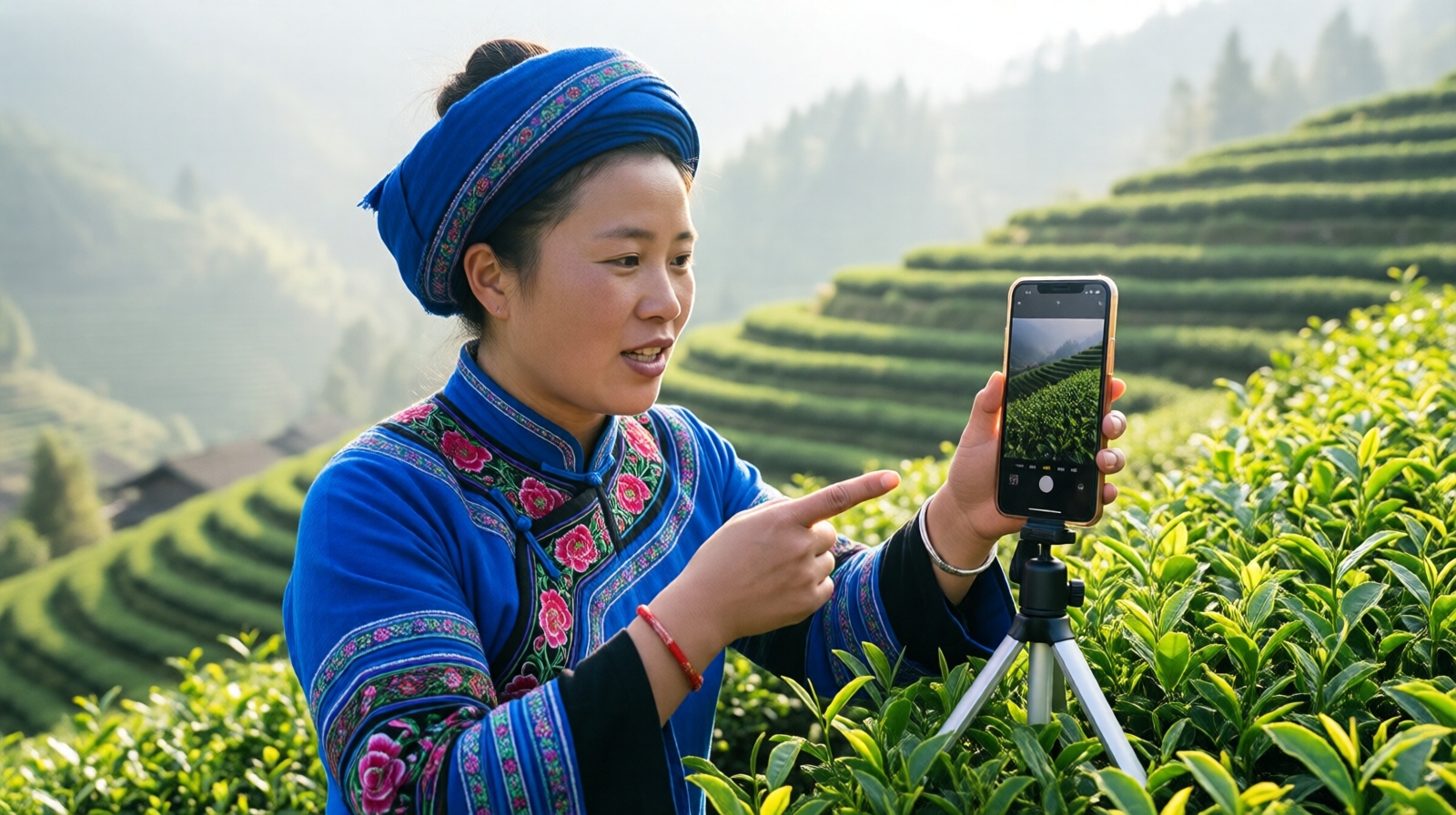
This is not a tourist performance. It is a new kind of farm work, and the smartphone is now the tool that connects a village to the rest of China. “My grandmother sold tea at a market two hours’ walk away. My mother waited for tea buyers to drive up the mountain, paying less than half the city price,” she said. “Now I sell my tea while sitting on the field and drinking a cup of it.” She expects to ship 2,000 jin (1,000 kg) of spring tea this month alone.
From Dirt Roads to Fiber-Optic Life
Guizhou is one of China’s most mountainous provinces, and historically one of the poorest. Many villages were cut off for weeks during heavy rain; goods moved slowly and prices were low. Today, those same villages have broad roads to the nearest highway, and high-speed broadband lines run along the same paths. By the end of 2023, virtually all of Guizhou’s administrative villages had access to fiber-optic broadband and 4G, with 5G covering most townships.
The change did not happen overnight, but it was transformative. In 2013, when the national “Internet village” program started, fewer than 20% of rural Guizhou households had access to the internet. Now the number is above 80%. The young people who used to leave for factory jobs in coastal provinces found a reason to return: they could sell products to the whole country without leaving home.
The New Toolbox: Phone, Tripod, and a Lighting Ring
Walk into a live-streaming studio in a Miao village, and you might mistake it for a small home kitchen. Wooden shelf with dried chili peppers, a rustic table with ripe oranges, and a smartphone mounted on a tripod. That is all. On the platform Douyin (TikTok in China), the keyword “live from the countryside” has billions of views. In Guizhou, many villages have set up shared production rooms for villagers to pack and ship.
According to the Ministry of Commerce, online retail sales of Chinese agricultural products reached 531.38 billion yuan (about $73 billion) in 2022. Guizhou’s share is small but fast-growing. Provincial data show that rural online retail sales in Guizhou grew by about 32% year-on-year in the first half of 2024, outpacing the national average. Local e-commerce officials credit live-streaming and a wave of “new farmers.”
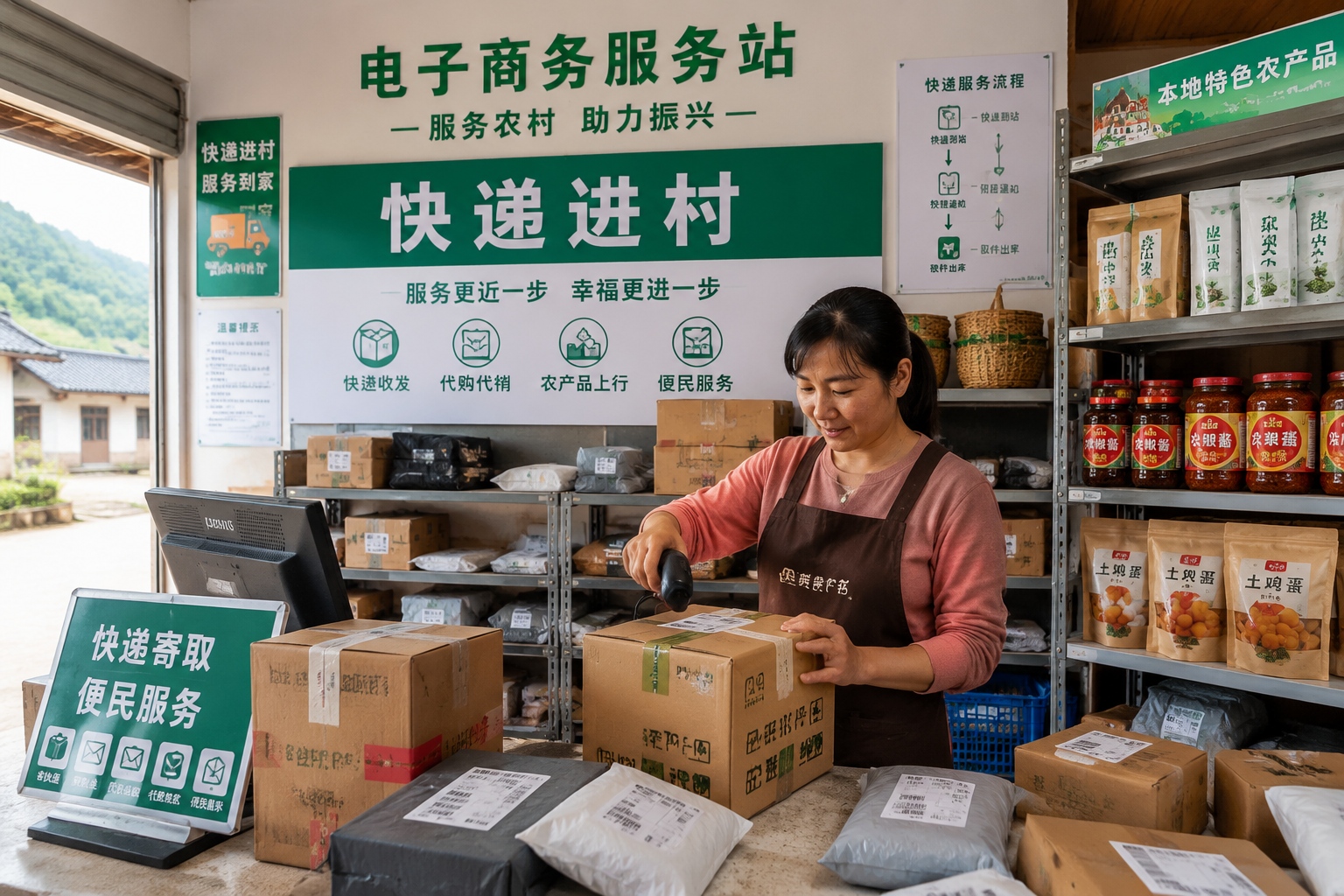
“The biggest challenge was teaching older villagers to trust the phone,” explained a local e-commerce trainer who has taught classes in more than 20 villages. “They think viewers are just ghosts in the phone. Then a tea farmer watched her neighbor pack fifty orders in one night, and next day she asked me to show her how to turn on the broadcast.”
More than Tea: Silver, Embroidery, and Tourism on Air
In many Miao villages, live-streaming is not only for farm products. Miao silver ornaments, embroidery, and batik fabrics have always been prized by tourists, but the market was narrow. Now village women broadcast from their workshops. A group of embroiderers in Xijiang, one of the largest Miao villages in China, runs a weekly show in which they stitch live while answering questions about symbols and colors. Their embroidery packs sell for between 200 and 3,000 yuan. The livelier the broadcast, the better the sales; some have become local celebrities with tens of thousands of followers.
The effect spills into tourism. In the first three quarters of 2024, Guizhou received more than 800 million tourist trips, and about one in five visitors said they discovered their destination after watching a live-stream. A small homestay owner in the village of Huilong told me that a short video she posted from her rooftop, showing layered rice terraces and the sound of morning birds, bought her six months of bookings.
Real Challenges: Logistics and Skills
For all the progress, the road is not smooth. The mountainous terrain pushes up logistics costs. A single package from a village in Guizhou may cost twice as much to deliver as one from a coastal city. Fresh produce is especially tricky. Villagers often rely on cooperative logistics stations near highway exits, where a refrigerated truck picks up twice a day. But many small households cannot afford their own cold chain.
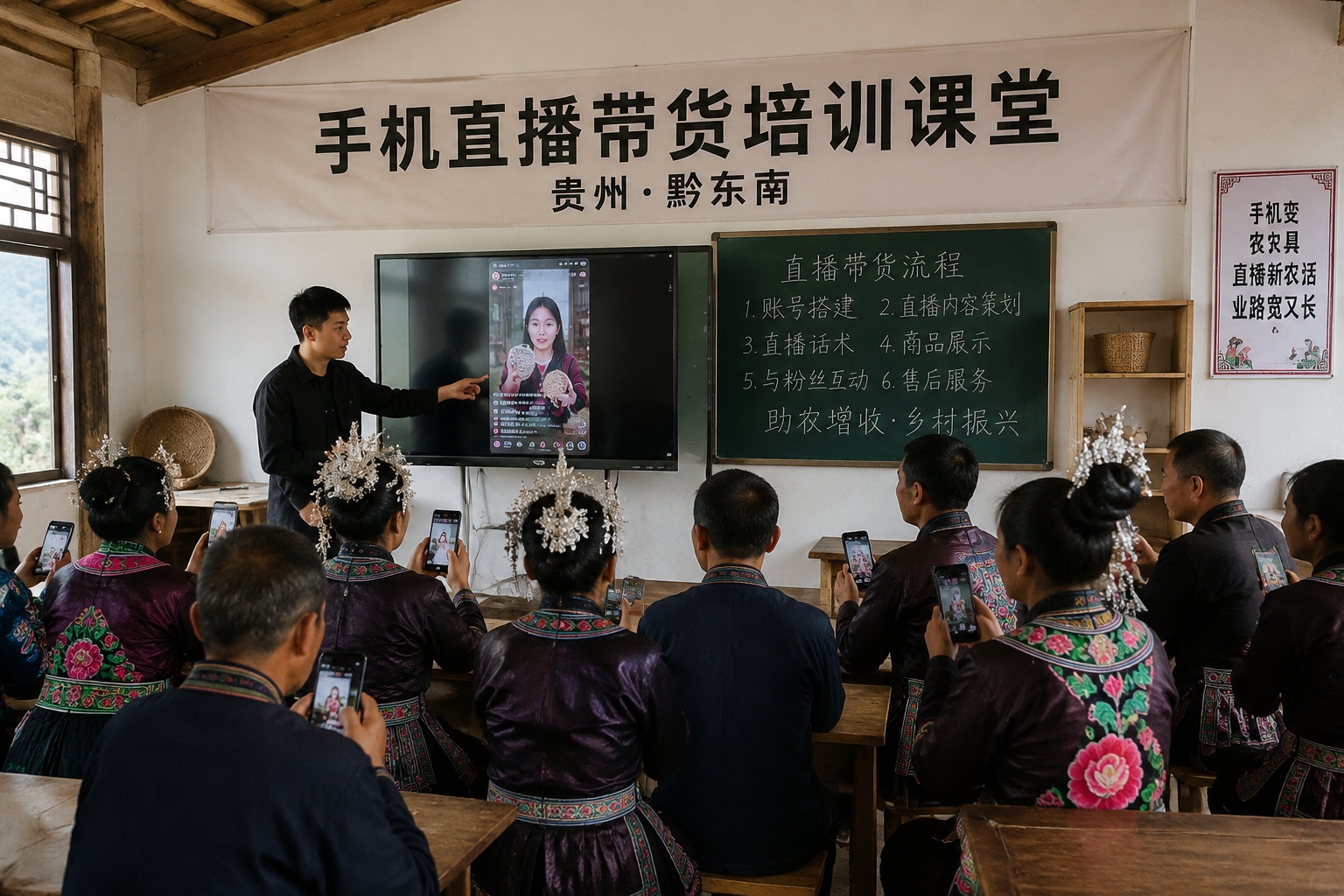
Skills gaps still divide communities. Older villagers, especially those over 70, often feel lost in front of a screen. In some villages, only a handful of families control the live-streaming income, while others fall behind. The Chinese government has launched training programs — in 2024 alone, it plans to train over 30,000 “new farmers” in digital skills in Guizhou. But locals say the more effective teachers are the young people who have moved back, because they can teach in their own dialect.
A Window into Rural China’s Future
Standing on that tea-scented hillside, I began to understand why the Chinese phrase “手机成了新农具” — the smartphone has become a new farming tool — feels so accurate. It is not just a slogan. A machine that once was used to call relatives is now used to reach the market. The phone does not plow the soil, but it opens a distribution channel that previously did not exist. Through this small screen, farmers no longer have to depend on outside buyers; instead, they build direct relationships with consumers across 3,000 kilometers.
But what is more profound is the change in confidence. A Miao woman who learns to present her own tea, her own sewing, and her own culture on a screen begins to see her home differently. The mountain village is no longer an edge, but a stage, with an audience of hundreds of millions. And the tool that made it possible is not a giant machine. It is something almost everyone carries in their pocket, and that perhaps is the most modern and the most human part of China’s rural transformation.
Start the discussion at forum.chinacomes.com