
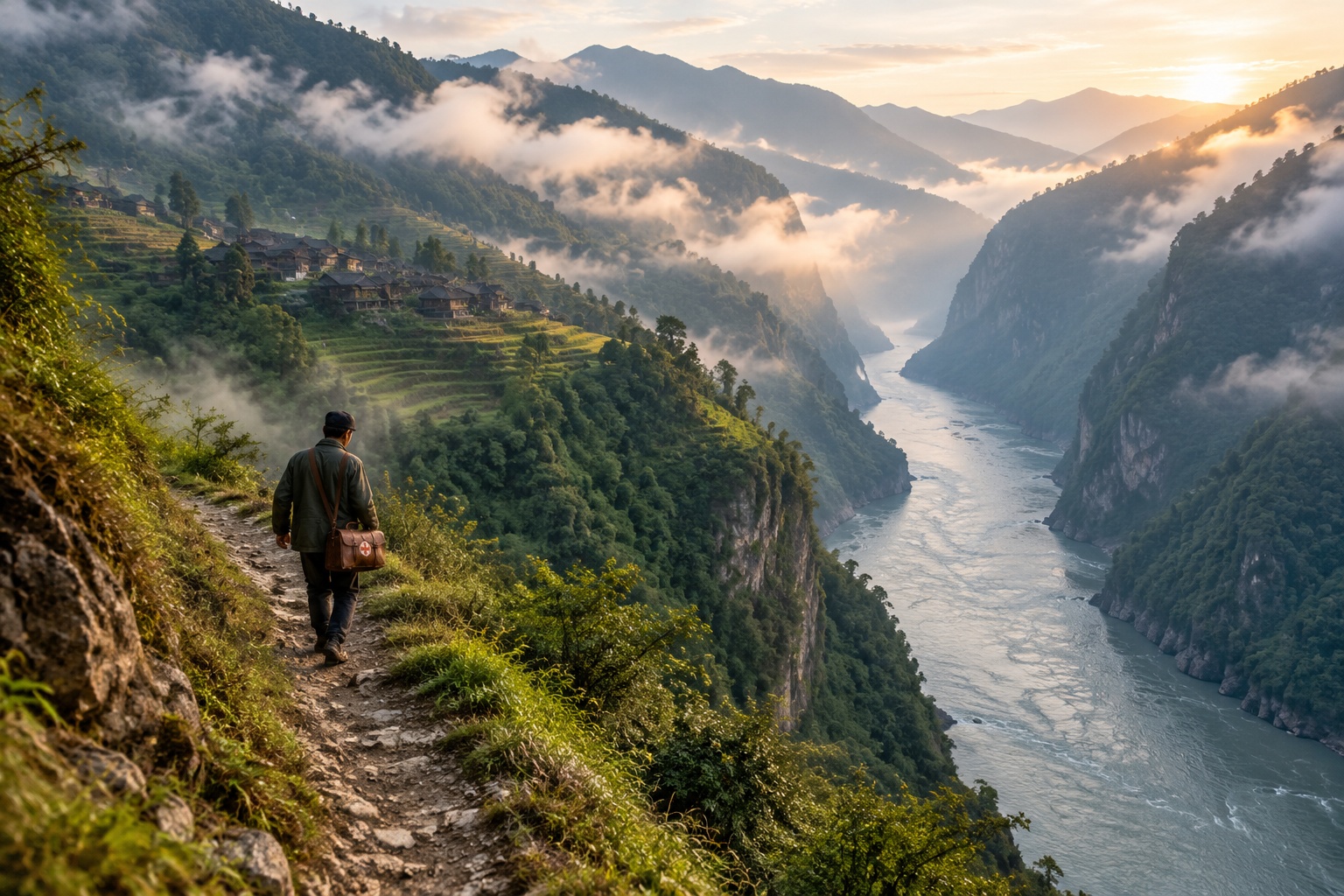

I met Dr. Li on a misty morning at the edge of the Nujiang River. He was 43 years old, with a weather-beaten face and a quiet smile, tightening the strap of a vinyl medical bag. "Care to join me on my rounds?" he asked. I glanced at the steep footpath climbing up into the clouds. "Yes," I said. So we began.
Li is one of China’s "village doctors"—a grassroots health worker who is the only medical professional for miles in a remote Lisu community. His "hospital" is a small room in the village council building, but today’s work will take him to three different households, each scattered on the steep slopes of the Nujiang Grand Canyon in Yunnan province. The Nujiang, which outsiders call the Salween, is one of the most spectacular rivers in the world. It cuts through deep gorges between Tibet, Yunnan, and Myanmar, forming part of the boundaries of the Three Parallel Rivers UNESCO World Heritage site. Li’s village sits on the eastern bank, at an elevation of about 1,800 meters.
The Path to the Patients
The Lisu are one of China’s 55 ethnic minorities. For centuries, they have lived in these high mountains, farming corn and buckwheat on steep terraces, and hunting in the nearby forests. Their wooden houses are built on stilts, often with a fireplace at the center for warmth and cooking. In the past, the Lisu were known as skilled archers and riders; today, many still speak their own language and follow traditional customs. But the world has reached them, through new roads, cell towers, and satellite television.
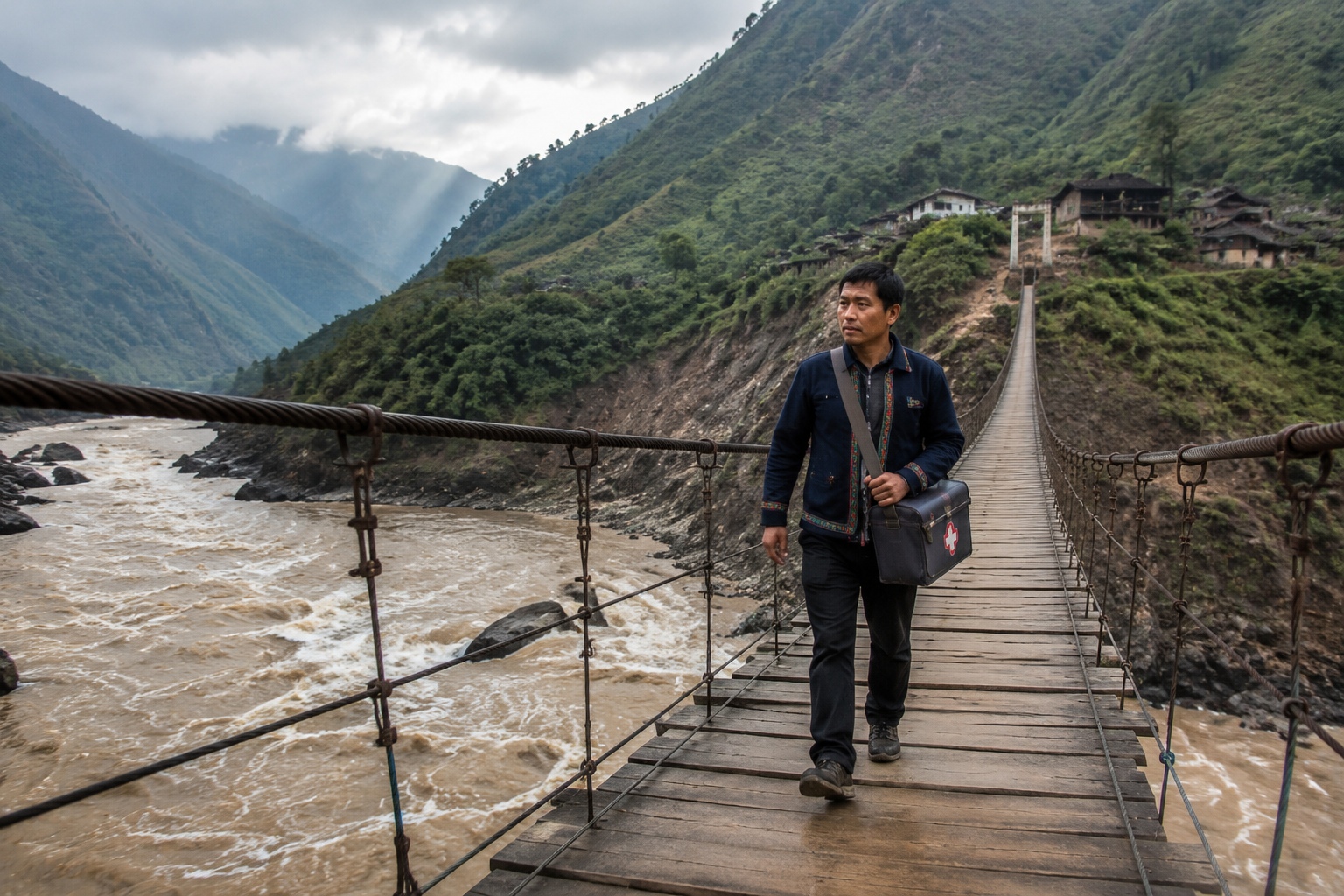
Li’s rounds start with a walk along a ridge. The path is only a meter wide, with a drop of several hundred meters on one side. He points out a white marking on a rock—a memorial to a woman who lost her footing ten years ago. "Things are better now," he says. "In that village across the stream, we had to cross by a wooden log. In 2015, a suspension bridge was built, and in 2016, a concrete path was laid to my village."
His first patient, Wang Jin, is a 78-year-old widower who lives alone. The house is cool and smells of woodsmoke. Li unpacks his electronic blood pressure monitor and gets a reading of 156/95 mmHg. "A bit high. Did you forget to take your medicine again?" he says in Lisu, with a gentle scold. Wang looks down like a child caught in a lie. Li cuts out a strip of medication from a blister pack and draws a circle with a marker on the package, next to the word "morning." He hands it to Wang. "This is a drawing of the morning sun. See these pills? The sun says you must take them."
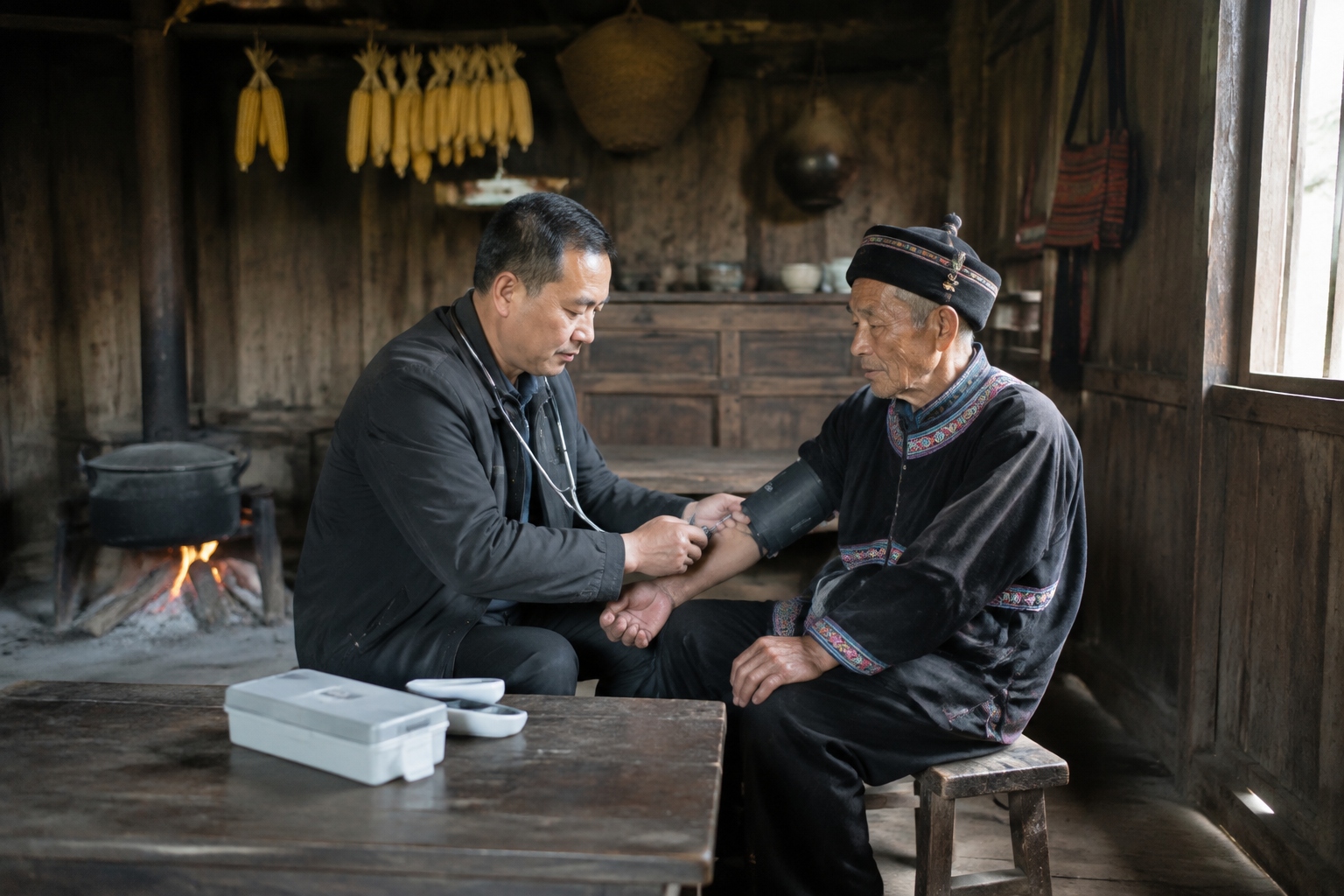
The medicine is free of charge, explained by China’s New Rural Cooperative Medical Insurance. This scheme, launched in 2003 and expanded over the years, now covers almost all rural residents, with government subsidies for the poorest families. Village doctors like Li are paid a token visit fee, but their main income comes from basic public health services—annual checkups, chronic disease management, and health education—which are funded by the government.
Treating the Largest Clinic: the Community
From Wang’s home, we climb to the primary school, where three children have skin rashes. Li questions the teacher, looks at their limbs, and prescribes an antifungal cream. He also takes the opportunity to give a short lesson on hygiene: why soap matters, why you should not share a towel. The children giggle but listen.
Then we walk to the home of 88-year-old Ah Yao, the village elder. She is sharp in mind but weak in body. Li checks her heart and lungs with a stethoscope, feels her ankles for swelling, and asks her granddaughter to report any changes. He leaves a packet of traditional medicine, which is popular among the elderly.
In between visits, Li tells me about the challenges of his job. The biggest one is not the distance, but communication. Many older villagers speak only Lisu, so Li must act as a translator between them and the outside medical system. Some families are reluctant to be "registered" in the health system because they worry about data privacy. And there’s always the issue of trust: "They don’t believe in the pills if they don’t believe in me," he says.
His solutions are simple. He visits each family at least once every month. He remembers their names, their sons’ names, even their livestock. He carries a paper notebook as backup to his tablet, because the mountain signal is unreliable. He also teaches the young people how to use mobile apps for health appointments, though he knows that many will leave.
The Next Generation of Village Doctors
Village doctors in China have deep roots. In the 1960s and 1970s, the "barefoot doctors" were peasants with basic health training who waded through rice paddies carrying a red leather medical box. Since then, the role has evolved into a formal one. Today, to become a licensed village doctor, a candidate must complete a medical school program and pass the national qualification exam. The government aims to have at least one village doctor and one qualified nurse in every administrative village by 2025.
But attracting young people to remote villages is hard. Li says that he is 43 years old, with 20 years of service behind him. In the entire township, the average age of village doctors is 52. Most of his fellow doctors may retire within the next 15 years, and there is no one knocking on the door to replace them. "Young people in the city can earn three times more, and they don’t have to walk up mountains," he says. "I don’t blame them."
To bridge the gap, the local government has started an incentive program: a one-time allowance for young doctors who sign a contract to work in a village for at least five years. According to the Nujiang Health Commission, the number of village doctors in the prefecture has increased slightly since 2018, but the turnover remains high.
Technology Arrives Slowly
In a village health room, Li opens his laptop with a new telemedicine interface. Once a week, he connects to the township health center for a video consultation with a doctor. When he needs a specialist, he can forward the case to a county hospital. It’s a great relief for patients who otherwise would have to travel for hours, costing money and time.
Li also shows me his upgraded "village doctor workbag." Inside, alongside the usual stethoscope and blood pressure cuff, there is a portable ECG monitor, a finger oxygen sensor, and a small ultrasound device that he shares with two neighboring villages. "When I started in 2004, I had only a thermometer and a blood pressure cuff," he says. "Now, I can even get a real-time view of a patient’s heart rhythm and send it to a cardiologist."
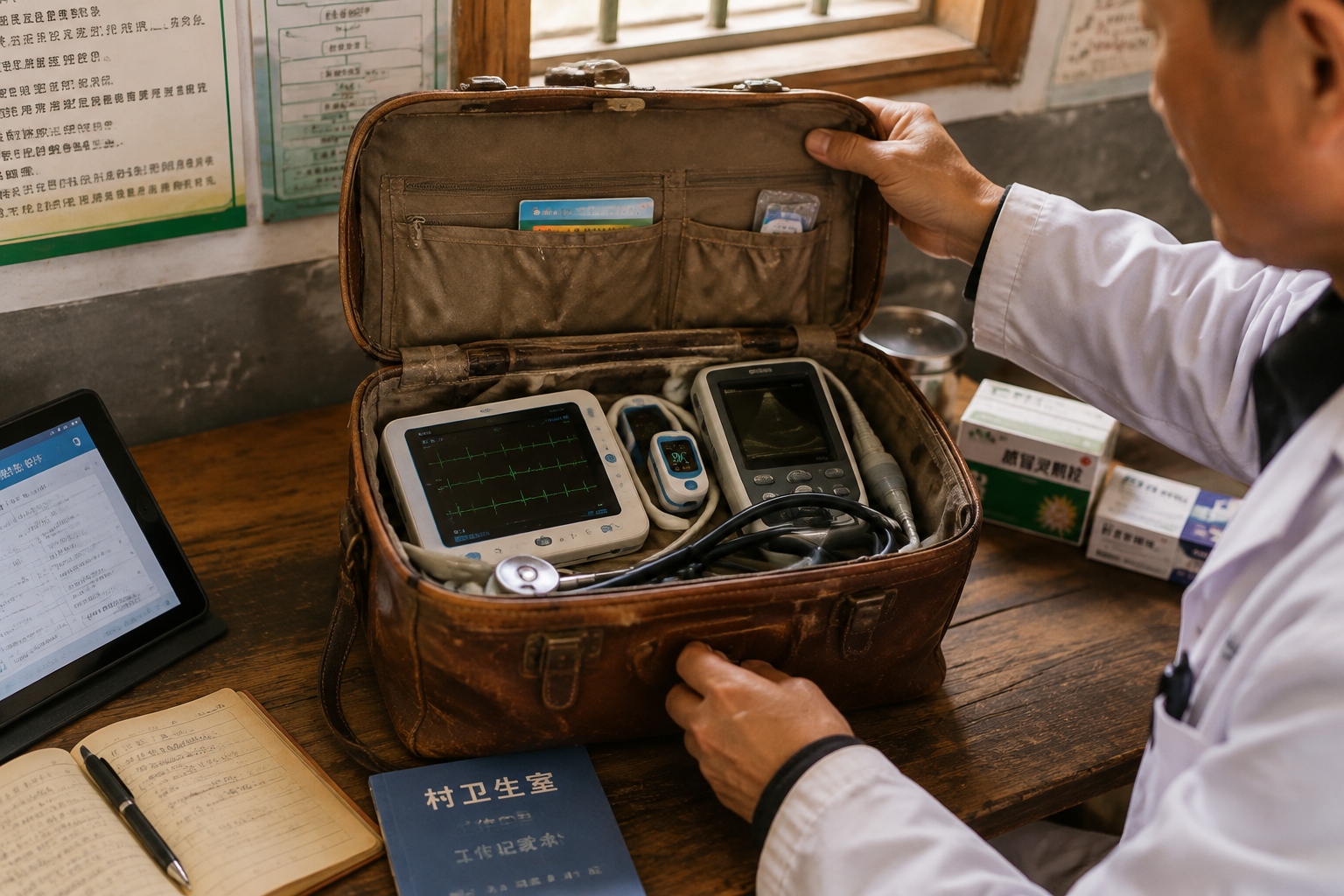
Still, the internet can be spotty, and the equipment is only as good as the battery. Li laughs and points to a solar charger his village installed last year. "We are not in a futuristic world. We are a canyon, but we are getting there."
What the Locals Say
I ask some villagers what they think of Dr. Li. A woman named Zong Mei says, "He has saved my life twice. Once when I had a severe allergic reaction to bee stings, and once when my child had fever-induced convulsions." Another man, a former farmer, says, "If he didn’t come, we would have to take the minibus to the town, which costs 30 yuan and takes two hours. For an old person, it’s impossible."
Even with such praise, Li remains modest. "They say I’m a good doctor, but I know my limits. I always tell people to go to the hospital for anything serious. I’m the first line, not the last."
Returning Home
By mid-afternoon, we finish the three visits. Li invites me to a villager’s house for a cup of local tea. We sit on wooden stools, watching a goat chew on something across the street. He tells me about his own family: his wife runs a small shop, his daughter studies in a middle school in the county seat. He was born in this village and would like to stay here, but he’s not sure if his generation will be the last of the village doctors.
Before we part, I ask him what the hardest part of his job is. He thinks for a moment, then says, "The hardest is walking back up these paths when I know I couldn’t save someone. It happened last winter. A man with a heart attack, too far away. We don’t have a defibrillator. I held his hand until the ambulance from the town arrived, but it was too late."
I didn’t know what to say. He took a deep breath and poured me more tea. "But I will continue. Because the mountains are my home, and these people are my family."
As I left, Li was already preparing for the next day’s round: a two-hour walk to a hamlet with just twelve households, all elderly. He waved, and his figure gradually disappeared behind a ridge.
In China, there are about a million village doctors working in the vast rural landscape. They are the pulse of a health system that reaches the last mile. Their daily rounds may not make headlines, but for the people in Nujiang, they are a lifeline.
Start the discussion at forum.chinacomes.com