


Introduction: The Laptop Left Alone
It’s 3 p.m. on a Tuesday in Chengdu, a city in southwestern China. In a small coffee shop that also sells records and secondhand books, a young man in a hoodie stands up from a table by the window. He leaves his silver laptop open on the table, a phone beside it, and a jacket on the back of the chair. He walks to the counter to order a refill. Nobody at the next tables looks up. Nobody whispers. The barista doesn’t offer to watch his things. It’s as normal as breathing.
This is not a careless move. In fact, it’s typical behavior in China. From Shenzhen to Hangzhou, from Xi’an to Guangzhou, people routinely leave laptops, tablets, and bags unattended in cafes, libraries, and even fast-food restaurants while they go to order, use the restroom, or step out to take a phone call. For many Chinese citizens, this isn’t an act of bravery—it’s a quiet expectation that their belongings will be safe.

What the Data Says: The Decline of Theft in China
One might wonder if this is just a feeling, not a fact. But statistics from the Chinese government and independent research paint a clear picture. According to the Supreme People’s Procuratorate, the number of prosecuted cases for theft in China declined significantly between 2015 and 2021. The Ministry of Public Security’s annual reports show that the incidence of “street crime” such as robbery, snatching, and pickpocketing has fallen for eight consecutive years. In 2019, the national count of all criminal cases was around 1.6 million, with a population of 1.4 billion—a rate that is lower than most countries in Europe and the Americas.
Of course, these are official numbers, and some researchers caution against overreliance on them. But the lived experience aligns with the data. A quick walk through any Chinese city at night reveals a sense of order: families strolling in parks, teenagers buying bubble tea, and women jogging alone after 10 p.m. While this isn’t universally true in every neighborhood, it is common enough to be a social norm.
So what explains this low crime rate? The answer is not one thing; it’s the result of a layered system that combines technology, social trust, and urban design.
The Invisible Shield: Technology and Real-Name Records
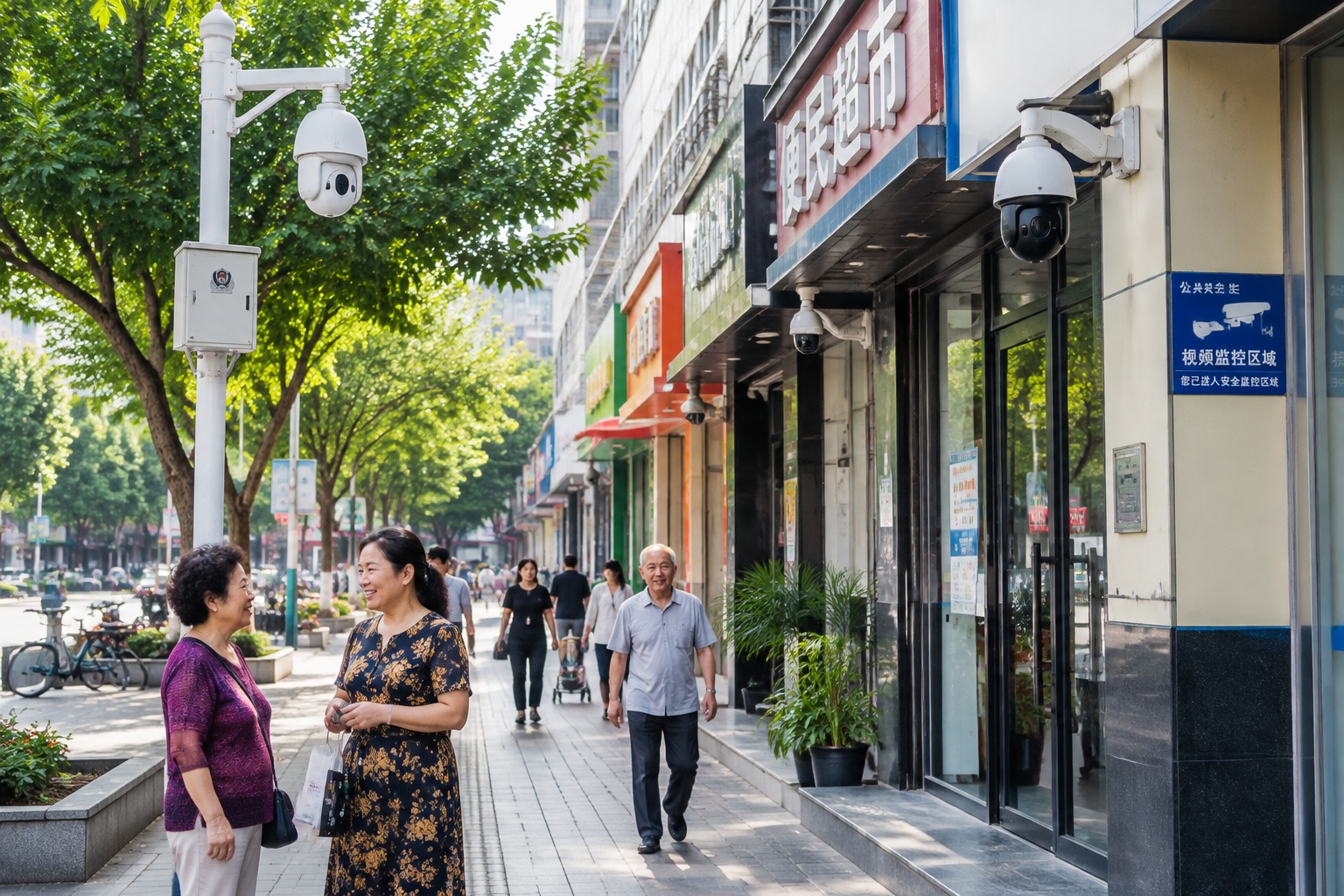
China is often described as having the world’s most advanced surveillance network. The “Sky Net” (天网) system, which integrates millions of high-definition cameras, has been built up over the past decade and is especially dense in urban areas. These cameras are not hidden; they are visible on streetlamps, traffic poles, and building entrances. Their presence deters potential thieves, who know that a face can be identified within hours. Police can track a suspect’s route via facial recognition and license plate recognition, which significantly increases the chance of being caught.
But technology alone isn’t enough. A crucial piece is how mobile payment apps like Alipay and WeChat Pay have changed the economics of theft. In China, cash is rarely carried; even street vendors accept QR codes. That means a stolen phone or wallet doesn’t yield much cash. More importantly, phones are deeply tied to real-name accounts. To use a phone and its payment apps, you need to bypass biometric locks and identity verification. This makes stealing phones much less profitable than in countries where a phone can be easily wiped and resold. According to industry reports, the rate of smartphone theft in China has dropped dramatically since the adoption of real-name registration for SIM cards and mobile payment accounts.
Community Governance: The Human Layer of Control
Beyond digital infrastructure, China’s urban neighborhoods are organized through a system that many Westerners find hard to imagine. Every residential compound has a wuye (property management) office, and every street often has a jiedao (street office) and a juweihui (neighborhood committee). These organizations are responsible for day-to-day social order. They mediate disputes, watch for problems, and maintain a network of informants and volunteers. In some cities, “grid managers” are assigned to small areas, and they are expected to know the people who live and work there.
This system is not just top-down; it also creates a sense of mutual responsibility. Shopkeepers on the same street know each other and will call out a suspicious stranger. Neighbors greet each other in elevators. In the era of WeChat, many neighborhoods have group chats where residents report lost dogs, broken lights, or unusual activity. This digital neighborhood watch is extraordinarily effective because it leverages the existing social fabric.
The Deterrent of Swift Justice
Another factor is the efficiency of the criminal justice system in handling theft cases. Police are usually quick to respond to reports, thanks to the technology mentioned earlier. Once a suspect is identified, background checks can be done in minutes. Although China does not have a jury system, its court system has streamlined procedures for minor crimes. The combination of high detection rates and relatively swift punishment acts as a powerful deterrent. In surveys conducted by the Chinese Academy of Social Sciences, a large majority of respondents said they believe there is a large probability of being caught if they commit a crime in their city.
Cultural Roots: “Not Picking Up Lost Items Is the Way”
Statistics and governance don’t tell the whole story. There’s also a cultural attitude inherited from Confucianism and reinforced by modern education. The idiom “道不拾遗” dates back over two thousand years to the Book of Rites, describing an ideal society where people don’t pocket what they find on the road. This ideal has become a moral benchmark. In China, elementary school textbooks include stories of students who return lost wallets, and the legal code explicitly requires finders to return lost property to owners or turn it in to authorities.
This cultural belief is not just rhetorical. In 2023, a viral video showed a man returning a thick bundle of cash he found at a subway station in Nanjing. He refused a reward. The comment section praised him without much debate. In another case, a delivery driver in Shanghai had his dropped phone returned by a stranger within an hour. These acts go unnoticed because they are so common.
Interestingly, this high level of trust extends beyond belongings. It can be seen in how people ask strangers to hold their place in line, how delivery riders leave orders at the door, and how parents allow children to run errands alone earlier than in many other countries. The social fabric is woven with assumptions about honesty.
Not a Uniform Reality: Differences and Limits
It would be misleading to suggest that all of China is equally safe. In busy tourist areas, such as the Temple of Heaven in Beijing or the Waitan area in Shanghai, pickpocketing still occurs, often targeting foreigners who seem distracted. In some cities with large migrant populations, street crime can spike in certain periods. Even in cafes, there are occasional stories of laptops being stolen. A quick search on Chinese social media reveals warnings about thieves operating in popular coffee chains.
So how do Chinese people reconcile this with the common practice of leaving laptops alone? The answer is that people are not oblivious; they are selective. They know that in a trusted, familiar environment—like a neighborhood cafe they visit regularly—the risk is low. They also understand that in crowded, anonymous spaces, caution is necessary. This nuance is often lost in foreign media portrayals, which either depict China as a surveillance state afraid to breathe or as a magical crime-free utopia. The reality is more banal: it’s a society that has made crime unprofitable and socially unacceptable, but it’s not a perfect world.
Why This Matters: Understanding Modern China
For a visitor, experiencing this sense of safety can be a revelation. It changes the texture of daily life. You can carry less cash, walk around at night, and even forget your backpack on a cafe chair while you order a latte. But this comfort shouldn’t lead to carelessness. As one seasoned traveler put it, “China is not Eden; it’s a place where you still need to use common sense, but you can lower your guard just a notch compared to many other places.”
For people outside China, the phenomenon of the unattended laptop offers a lens through which to understand the complex interplay of technology, governance, and culture in today’s China. It shows that public safety is not the result of a single policy but of an ecosystem—one that is imperfect, evolving, and deeply integrated into ordinary life.
Start the discussion at forum.chinacomes.com