
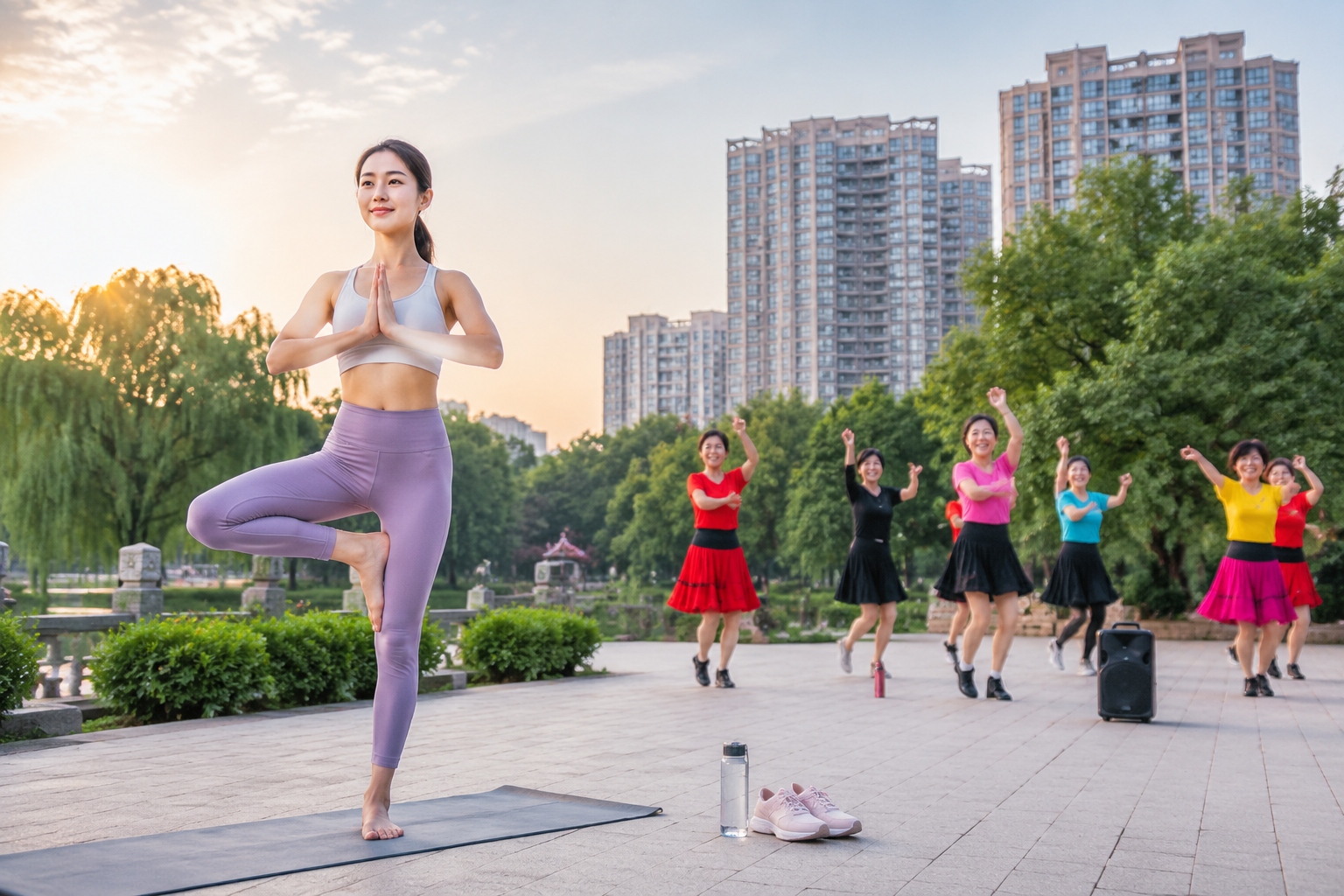

The 7 a.m. Park Divide
It is a typical Tuesday morning in Fuxing Park, Shanghai. A woman in her early 30s, wearing black leggings and a sports bra, unrolls a navy-blue yoga mat under an old plane tree. She taps her phone, and a calm voice from a fitness app begins counting breaths. Ten meters away, a group of women in their late 60s have arranged their speakers on a stone bench. The melody of ‘The Most Dazzling Ethnic Style’ bursts out, and they start moving in lockstep, their coordinated arms and hips cutting through the morning air.
Neither group seems bothered by the other. The yoga woman occasionally glances over, but mostly she is focused on her practice. The dancers, for their part, have carved out a circle that touches the edge of her mat. There is even a kind of choreography between them: a silent arrangement of space.
For a visitor from Europe or the US, this visual paradox is fascinating. In most Western cities, you go to a gym, a yoga studio, or a park’s designated fitness area to work out. You rarely see two completely different fitness cultures sharing the same lawn with such ease. Why do Chinese parks look like this? And what does the contrast between yoga and square dance tell us about a changing society?
Square Dance: A Collective Movement
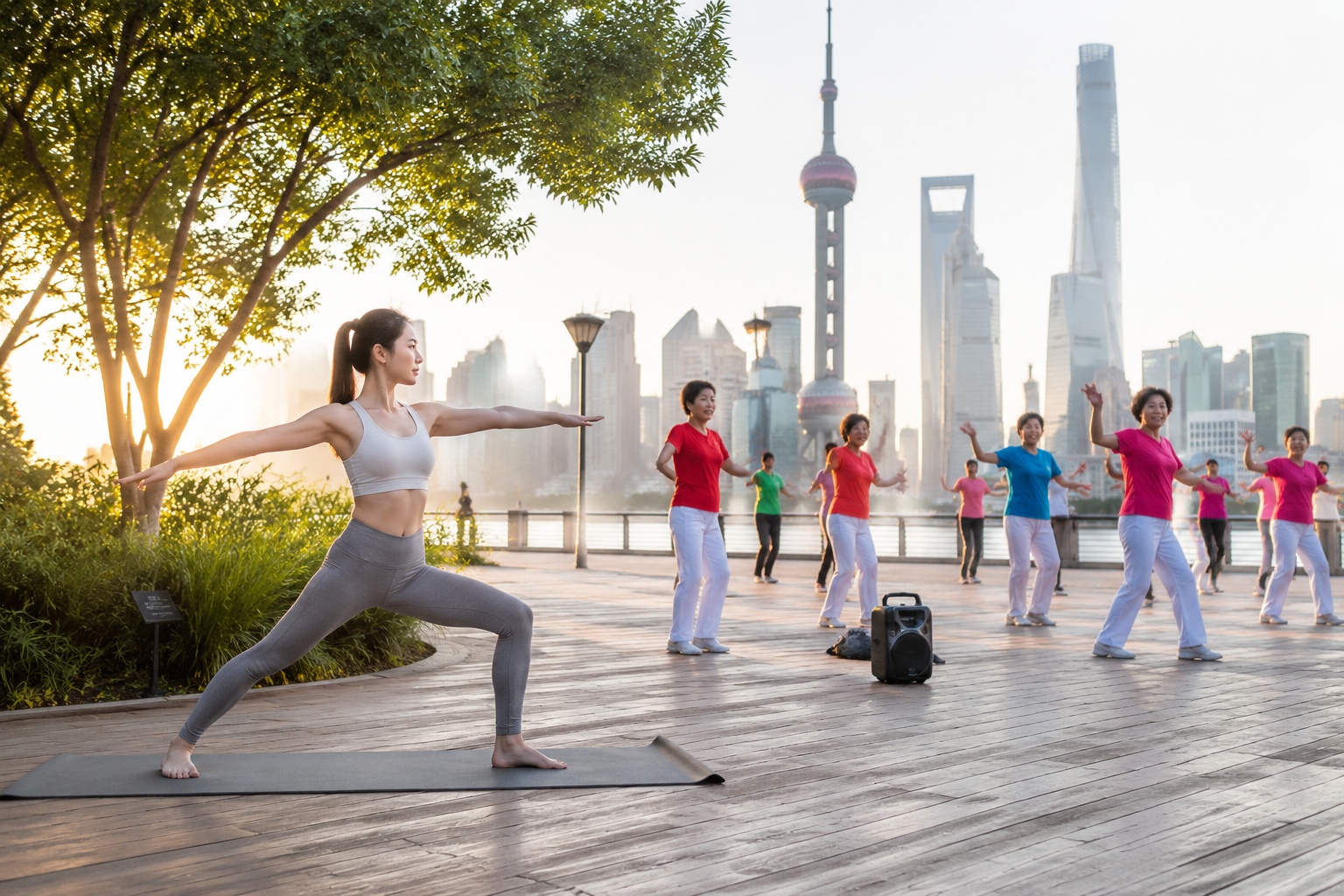
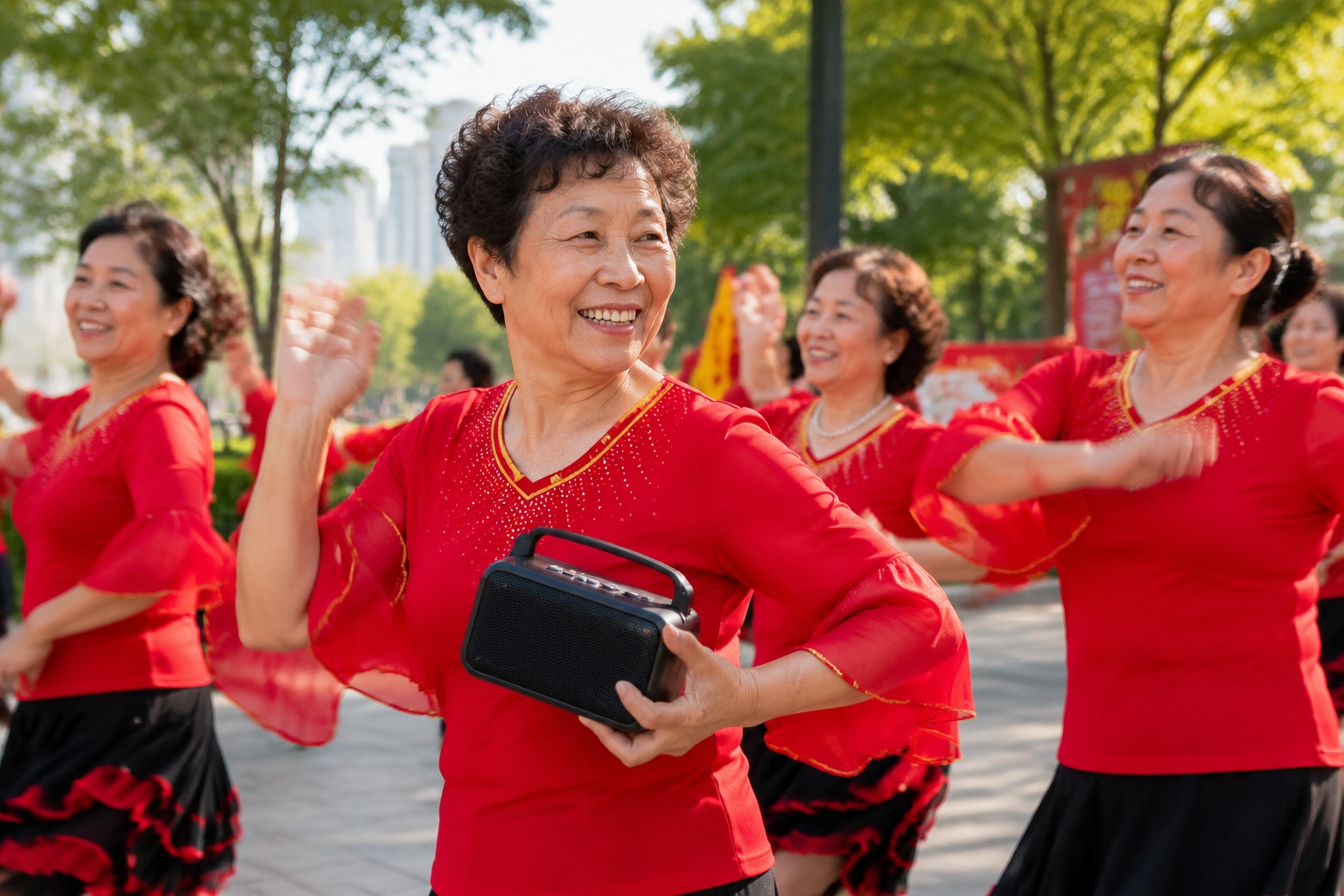
Square dancing, known locally as guangchangwu, is more than a workout. It is a grassroots social movement. The majority of participants are women over 50, many of them retired. They gather in public squares and parks, bring their own sound systems, and follow a leader who runs through a repertoire of simple routines set to folk-pop music. The steps are easy enough to learn by watching, so newcomers can join in at any time.
The dance fills a critical gap in the lives of China’s elderly. Urban families often live in small apartments without a garden or shared courtyard. Grandparents may have moved to the city to help care for grandchildren, leaving behind their old social networks. The square dance circle becomes their new village. Research in Chinese sociology journals has found that participants report lower loneliness and a stronger sense of belonging, in large part because they meet the same people every day.
The music’s volume is not an accident. In the early days, dancers had to use portable speakers; the louder the music, the more visible the group. Even now, with cheaper Bluetooth speakers, the volume stays high. This is partly for the beat – the dance is aerobics – but also for presence. A square dance group that can be heard across the park is a group that cannot be ignored. It claims space in a city where space is scarce.
This visibility has a flip side: noise complaints. Since at least 2014, Chinese media have run stories about residents who threw water, glass bottles, or even home-made ‘noise guns’ at dancers. Local governments have responded not by banning the dance but by creating rules: designated hours, decibel limits, and specific zones. In many parks you see signs that say ‘No amplified music after 9 p.m.’ rather than ‘No dancing.’
Park Yoga: The Quiet Luxury of Self-Care
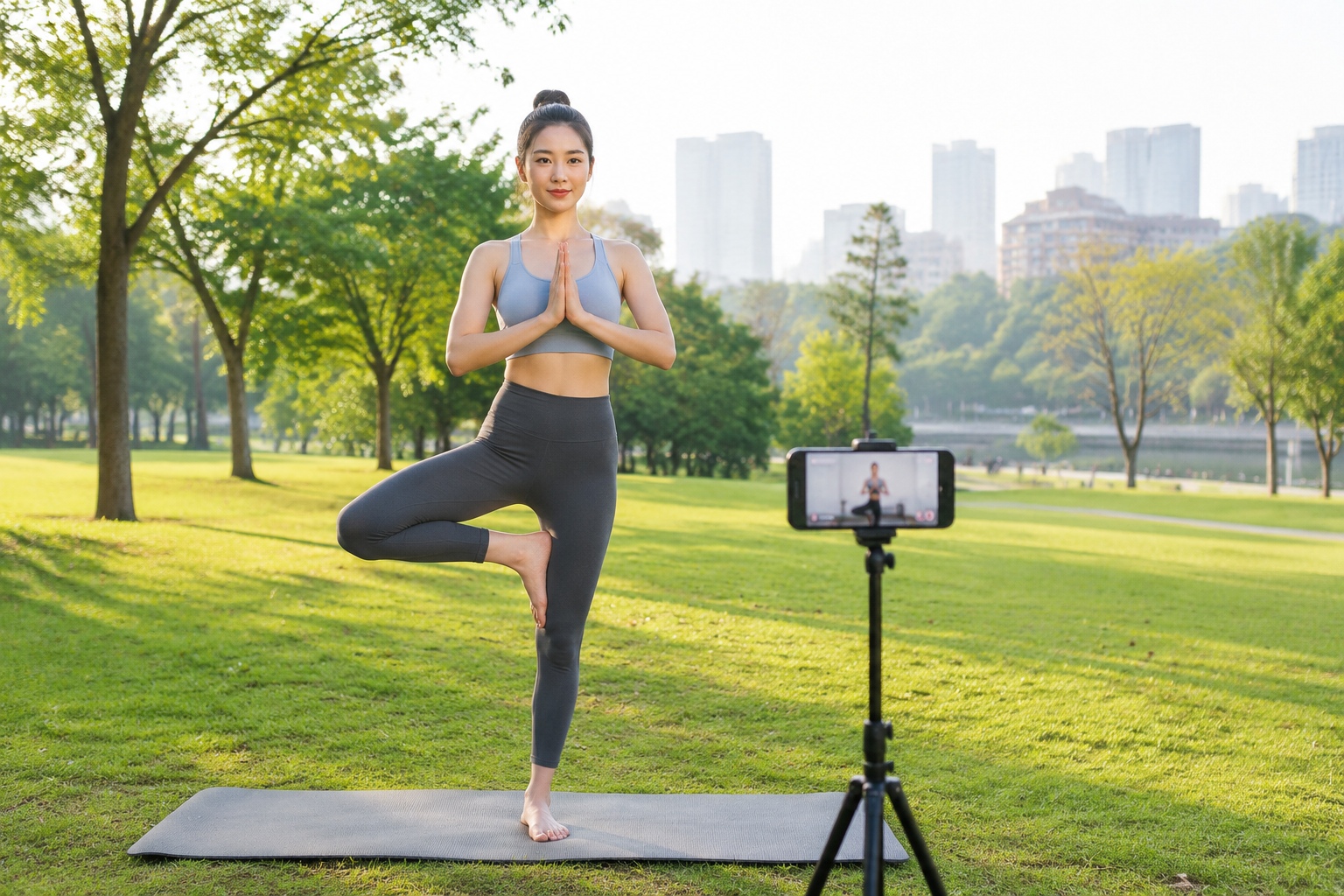
Park yoga in China is a different story. Its practitioners are mostly young professionals – women and some men – who were educated overseas or have absorbed global wellness culture through social media. They wear imported activewear, own a mat that costs as much as a fancy dinner, and are likely to have a fitness app such as Keep installed on their phones.
Why the park, though? In a city like Shanghai or Shenzhen, a private yoga studio can charge anywhere from 30 to 100 US dollars per class. A monthly gym membership also adds up, and time after work is unpredictable. The park is free, open year-round, and located right outside many apartment blocks. At 7 a.m., before the noise of the city fully wakes up, you can find a corner with trees and grass and treat it as your personal studio.
But cost and convenience are not the only reasons. There is something powerfully private about doing yoga outdoors in a dense city. The practice is introspective; you focus on your breath, your alignment, your own body. In a park, that inner stillness is set against the backdrop of the city’s motion – joggers passing by, birds singing, the occasional distant siren. It is a way to be alone without being alone.
Some groups take it a step further. Community-organized ‘sunrise yoga’ meetups have become popular in cities like Beijing, Chengdu, and Hangzhou. They use online sign-up forms, and a certified instructor volunteers to lead. These groups are not commercial, but they are unmistakably middle-class in their language – they talk about ‘flow’, ‘energy’, and ‘wellness’.
Two Generations, Two Worldviews
Put these two scenes side by side, and you have the outline of China’s social atlas. Square dance belongs to the generation that grew up in a collectivist society – people who are used to moving in groups and who find meaning in shared activity. Park yoga, by contrast, is an imported practice that emphasizes individual choice and self-improvement. In the West, that distinction might be described as ‘communal’ vs. ‘individual’. But in China, the line is less ideological and more generational.
When a 30-year-old and a 65-year-old enter the same park, they are entering a shared space with different maps. The older woman reads the space as a community hall; the younger one reads it as a quiet garden. Neither is wrong. The park is both at once.
Class, Status, and Self-Image
Exercise is a form of consumption, and consumption is a way of saying who you are. For the urban middle class, wearing a Lululemon-style top is not just about comfort – it signals taste, income, and a link to a global culture of wellness. Yoga mats, smoothie bottles, and smart watches are the props of this identity. In China, they are relatively new symbols, by no means universal.
Square dance, in contrast, is often seen as ‘lowbrow’ by younger Chinese. On social media, there are countless jokes about ‘dancing aunties’ – sometimes affectionate, sometimes condescending. This is partly a class distinction: many square dancers are working-class retirees, not university-educated professionals. It is also an age distinction. Youth is associated with innovation and globalism; age is associated with tradition and locality.
But the stereotypes miss the reality. Some younger people are joining square dance groups for the social aspect, and some retired professionals practice yoga. Cities like Guangzhou have seen a growing number of older participants in yoga classes, some organized by community centers. The boundaries are not as rigid as they may seem.
Conflict and Negotiation
When space is finite, boundaries must be drawn. The most publicized conflicts have occurred over basketball courts. In 2017, a viral video showed a man in Luoyang, Henan, confronting a group of young basketball players, insisting that ‘the square dancers were here first’. In response, the local government painted separation lines on the court, designating one half for dancing and the other for basketball.
Similar negotiations happen every day in less dramatic ways. A yoga practitioner might move her mat to avoid the sound of a speaker; a dance group might reduce its volume when a young mother with a baby walks by. These small acts of adjustment are the real texture of urban life in China. They are not the stuff of viral videos, but they matter.
Why Parks Host Everything
If you are from a country where parks are carefully zoned, China’s parks might look loosely managed. But there is a rationale: Chinese cities build parks as multi-purpose public living rooms. They are landscaped with both spectacle and function in mind – paths for joggers, open plazas for mass events, and shaded corners for tai chi and chess. There is no strict rule that one area is for quiet use and another for amplified music. Instead, the rule is social negotiation, backed by informal landmarks and a few official signposts.
This flexibility is a legacy of both scarcity and pragmatism. Land is expensive, and green spaces are relatively small compared with park networks in London or Berlin. Making every park single-purpose would be a luxury China cannot yet afford. So it lets the grass itself become the venue – and the rule is ‘first come, first claimed’ plus ‘don’t ruin it for others’.
The result is a form of urbanity that looks messy but has a logic of its own. It’s not a perfect system. Occasionally it breaks down into arguments over noise or space. But for the most part, it works because everyone knows that the park is shared, and sharing means compromising.
What This Says About China’s Middle Class
The park yoga movement might be small compared to square dancing, but it is part of a larger pattern in Chinese middle-class behavior. From cycling classes to rock climbing, upwardly mobile Chinese are eager to adopt fitness habits that signal cosmopolitanism. But they often adapt these habits to local conditions. Instead of paying for a boutique studio, they use a free park and a subscription app. In that sense, park yoga is not a watered-down version of Western yoga; it is a Chinese hybrid.
The square dance, on the other hand, is not obsolete. It is a vibrant, homegrown form of exercise that has outlasted every change in urban fashions. It even survived the COVID-19 pandemic, when dancers took to online video calls and later returned to the parks. In 2023, a national square dancing competition drew thousands of participants, proving that this ‘old people’s thing’ remains a national pastime.
Conclusion: Same Green Grass, Different Worlds
Both park yoga and square dance are rooted in the same challenge: living in a bustling city with limited private space. They are two ingenious answers to that challenge. Yoga is a private exercise that borrows public space; square dance is a public exercise that borrows private pride. They coexist not because they are similar, but because they share an environment and the willingness to make it work.
If you visit China and wander into a park in the early morning, don’t be startled by the mix of techno music and Om chants. Stand still for a moment. You will see a panorama of Chinese society – the past and the future, the collective and the individual, dancing and breathing side by side.
Start the discussion at forum.chinacomes.com