
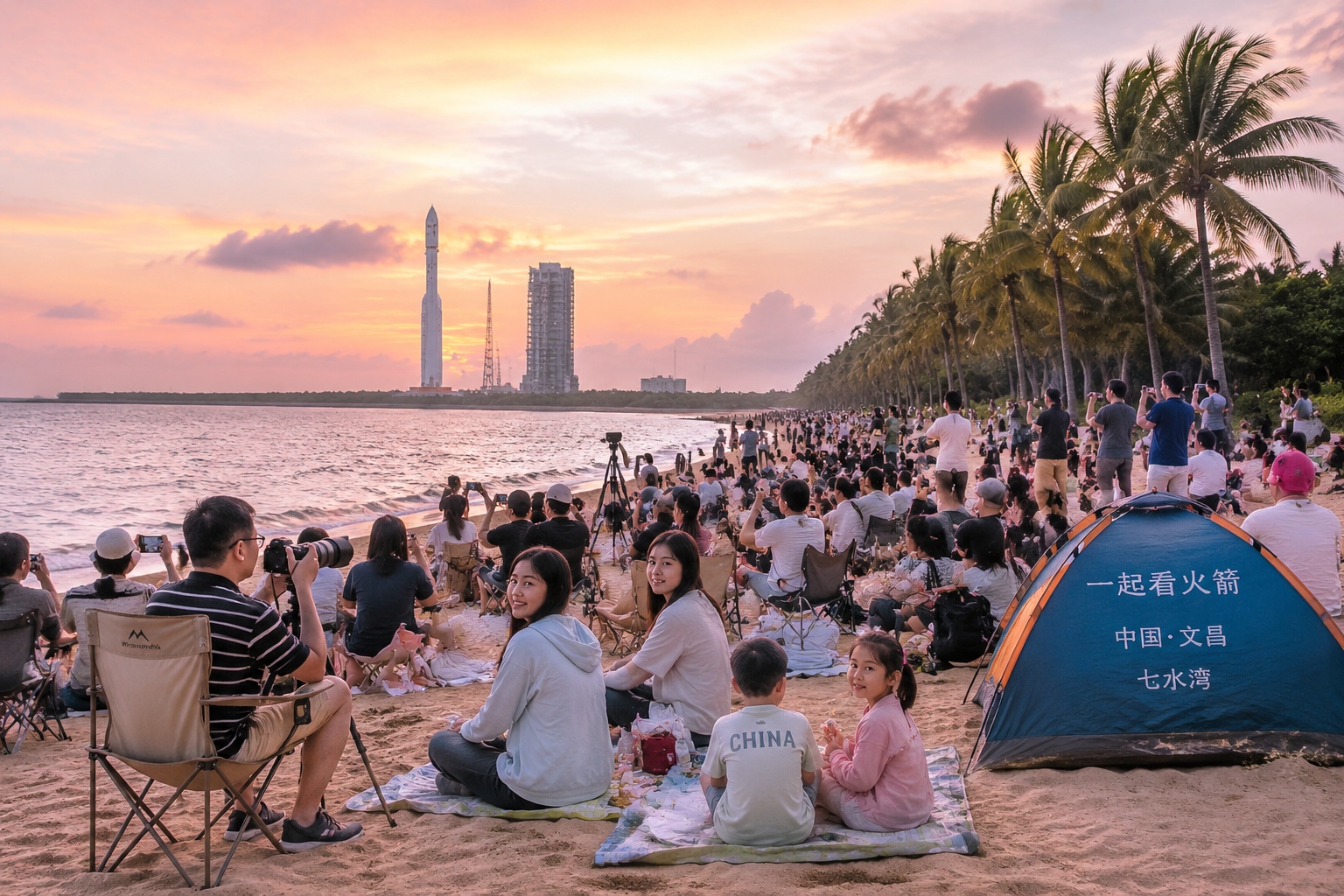

At five in the morning, the beach at Qishui Bay was already half-covered. Folding chairs, picnic blankets, camera tripods, and at least one small tent had claimed every patch of sand. A man in a straw hat filled a thermos cup with coffee and handed it to his wife, while their daughter, still in pajama shorts, curled up on a sleeping bag and stared at the dark sky. Over the South China Sea, the clouds were just starting to glow. Every few minutes, someone would say: ‘See it? There.’ And everyone would look to the northeast, at the thin white tower that stood behind the coconut palms. That tower is the Wenchang Space Launch Site. And four kilometers away from where we stood, a Long March 5 rocket was waiting for its countdown.

For many people here, this was not a once-in-a-lifetime trip. They had driven through the night, flown to Hainan, or ridden the high-speed train. Wenchang, a low-key coastal city on Hainan Island’s northeast shore, has in recent years become an unlikely tourist magnet. The reason is not the beach, but the launch pad. Since the site opened in 2016, the public has been allowed to stand close and watch gigantic rockets lift off. Locals call it ‘chasing rockets’ (追火箭), and the phrase has become a popular hashtag on Chinese social media.
Why Wenchang Makes Rocket-Watching Possible
In China, there are several space launch sites. Jiuquan sits in the Gobi desert, Taiyuan is high in the Shanxi mountains, and Xichang is tucked in a Sichuan valley. All of them are either too remote or security-sensitive for casual visitors. Wenchang, in contrast, was built on the coast so that spent boosters would fall into the sea rather than on populated land. The open shoreline makes it possible for ordinary people to watch from a beach, without special access. There are even official observation zones, but the free beach access is what draws the crowds.
The Long March 5 is central to China’s space plans. It lifts the core module of the Tiangong space station, sends Chang’e lunar probes, and will be used for future Mars missions. It is about 57 meters tall, with a core diameter of five meters, and each booster burns a huge amount of fuel in just a few minutes. But for the people on the beach, all that engineering only matters because it produces an unbelievably loud roar.
The launch site opened in 2016, and over the years, the surrounding area has evolved. Observation spots now include human-made lawns, viewing decks, and a network of beach paths. Local villagers have adapted, too, turning fields into parking lots for launch days and selling coconuts, ice-cooled drinks, and even rented binoculars. The whole scene is a blend of space-age technology and rural coastal life.
Practical Planning for Launch Day
How to get there
Most visitors fly into Haikou, Hainan’s capital, then take the island’s inter-city train to Wenchang station. From the station, shared minibuses and taxis head toward the coast, about forty minutes away. During launch days, the local government sets up temporary parking areas in nearby villages and provides shuttle buses. Many visitors choose to rent a car, but be prepared for traffic jams after the launch ends. It can take an hour or more just to get out of the parking lot.
Where to stay
Hotels fill up fast. On one occasion, even the small town of Longlou, a few kilometers from the beach, sold out every room. Some people book months ahead, others simply camp or sleep in their cars. If you want a decent hotel, book at least two months before the launch date. There are also homestays in nearby villages where you can wake up to coconut palms and roosters.
What to bring
Bring a wide-brimmed hat, sunscreen, and at least two liters of water per person. There are small vendors selling drinks and snacks, but lines can be long. A foldable seat is helpful, because the wait can last several hours. Also consider a set of earplugs if you have young children, because the boom, though thrilling, is loud enough to startle.
Choosing a viewpoint
The most popular spot is Qishui Bay beach, which is free and open. Another option is the Longlou public viewing area, which has a lawn and better facilities but lacks the beach feel. Some people watch from the roofs of nearby houses, for a small fee. Each has pros and cons. The beach offers the closest view but the least shade. The lawn has a clear line of sight but is farther away. Rooftop spots give you an elevated angle, but you’ll need to climb steep stairs and pay about 50 yuan.
China announces launch windows a few days ahead, but they can change due to weather. Follow the official WeChat account of the Wenchang Space Launch Site or reliable space news accounts. But even if the launch shifts, the area remains charming: the Longlou Bridge, the mangrove park, and the seafood restaurants along the coast are all worth a look.

The Long, Social Hours Before the Launch
We arrived at 5:30 a.m. and still found the good spots taken. The air was thick and damp, and the ocean breeze barely moved. Around us, groups of friends were playing cards on the sand. A middle-aged woman sold fresh coconuts and cut open the top with a machete. Her supply, she said, would sell out within two hours. A few hundred meters away, a line of food stalls offered Hainan noodles and grilled seafood. There was no official countdown announcement, but people checked their phones constantly.
By 7 a.m., the beach was packed. The temperature climbed quickly, and people did what people everywhere do when they have time to kill: they made friends with their neighbors. A retired schoolteacher from Chongqing told me he had come to see his fourth launch. “The first time, I cried,” he said. “I don’t know why. I’m not part of the space program. But the sound just got to me.”
Beside us, a young couple set up a tripod and took turns filming each other with the launch pad in the background. A little boy waved a tiny Chinese flag, his father lifted him onto his shoulders. Vendors walked along the sand with baskets of qingbu (a local snack) and watermelon slices. Someone played music from a portable speaker. The mood was more like a slow summer festival than a pre-launch countdown.
About forty minutes before launch, the crowd noise dropped. Phones went up. The rocket support arms had already swung open, and a thin wisp of white gas curled out from the side of the booster. It was quiet enough to hear seagulls.
The Launch Moment: Thunder, Light, and Cheers
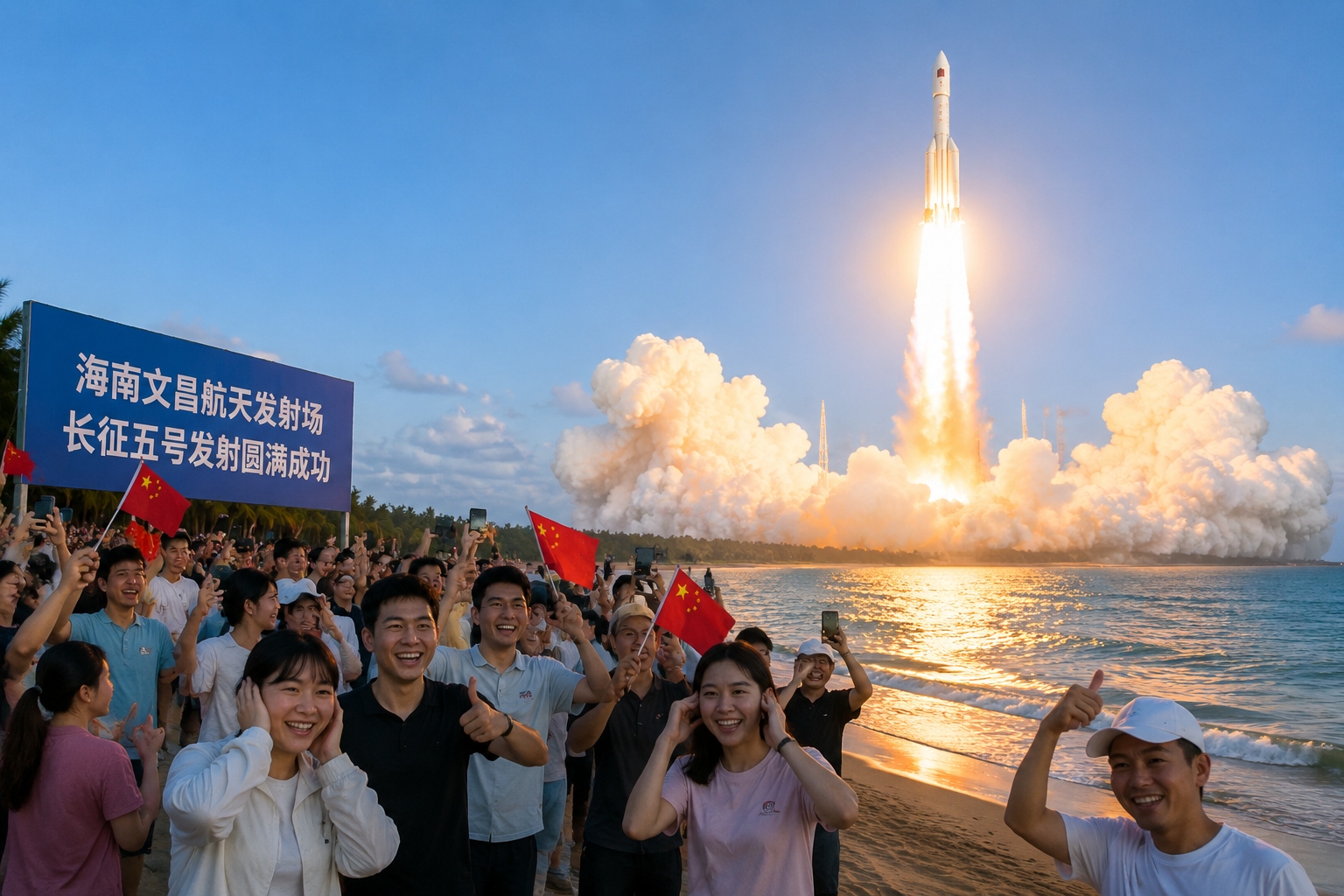
At 10:22 a.m., a low rumble rolled across the sea. It was not a crack or a bang, but a deep, continuous vibration that seemed to come from the earth itself. A second later, a brilliant white light ignited into full view. The flame looked like a giant sunflower turned sideways, and the light cast a sharp shadow on the beach. The rocket climbed slowly at first, as if testing its own strength, then accelerated with a force that felt almost impossible. The ground trembled. The smoke rolled across the water, and the white trail peeled off the boosters like strings of cotton candy.
Even after the rocket became a tiny bright dot, the sound continued — a heavy, whooshing roar that bounced off the sea and the sky. People were cheering, crying, and laughing. A group of students from a local school started singing the national anthem, and soon many around them joined in. It was not a formal ceremony. It was just something that happened, in the moment, among strangers on a beach.
After the Smoke Clears
Back on the road, the crowd moved slowly. Many people stopped to look at the sky, where the white spiral was fading into the blue. A woman next to me was on a video call with her mother, holding her phone up to the sky. ‘Mum, I saw it! It was huge!’ she said, wiping her eyes with her free hand. Her mother, on the small screen, was crying too. I thought about how space missions are often described in titles and numbers, but here, on this beach, it was personal. It was a family outing, a date, a bucket-list moment, a shared memory.
Chasing rockets in Wenchang is not about getting the perfect photo. It’s about standing there, feeling the heat of the engines reach you, and realizing that billions of dollars of technology are burning upward in front of you. It’s a way for ordinary people to feel that the space program belongs to them, too.
A Few Final Tips
If you’re thinking of going, choose a launch if you can, but don’t be disappointed if it slips. The beach at dawn is quiet, the coconut water is cold, and the white tower on the horizon is a reminder that someday soon, another giant will climb into the sky. Just be ready to wait, to sweat, and to shout when that first rumble hits.
Start the discussion at forum.chinacomes.com