
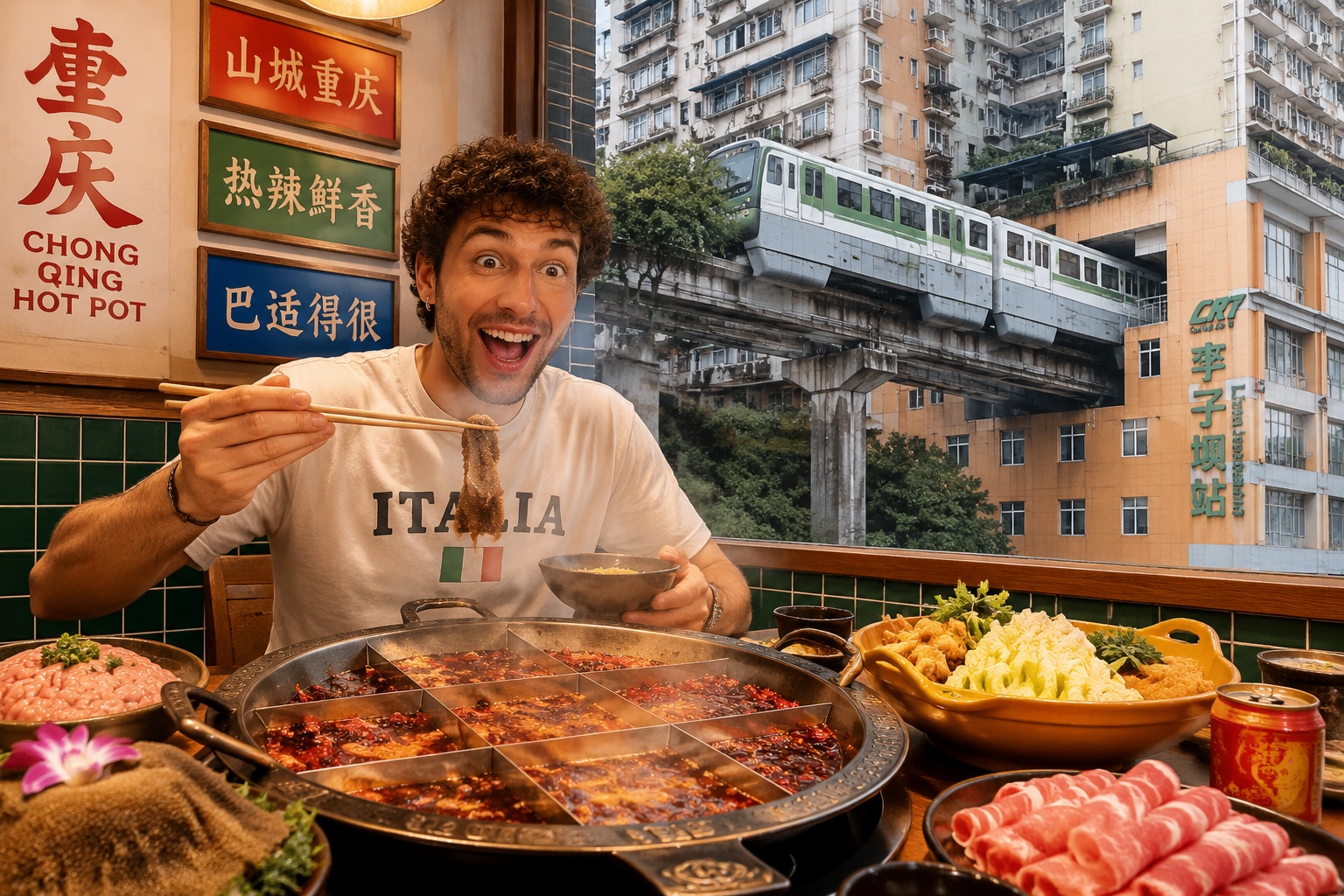

A Roman Meets Chongqing: A Railway Runs Through It
Marco Rossini is not your typical travel blogger. The Roman, who once filmed himself eating pasta in 23 different cities, has a knack for finding the ridiculous in the everyday. So when he decided to explore Chongqing, a mega-city in southwest China, his viewers knew they were in for something special. The result is “From Hotpot to Light Rail,” a vlog that has racked up over 2.3 million views since it dropped in late April. The opening scene sets the tone: Marco, holding chopsticks like they’re alien utensils, stares into a bubbling pot of neon-red broth while outside the window, a monorail train twists through the canyon of skyscrapers. “In Rome, we have the metro, but it doesn’t go through someone’s bedroom,” he says, deadpan. “Then again, Roman architects had enough trouble with traffic as it is.”
The Hotpot: A Trial by Fire
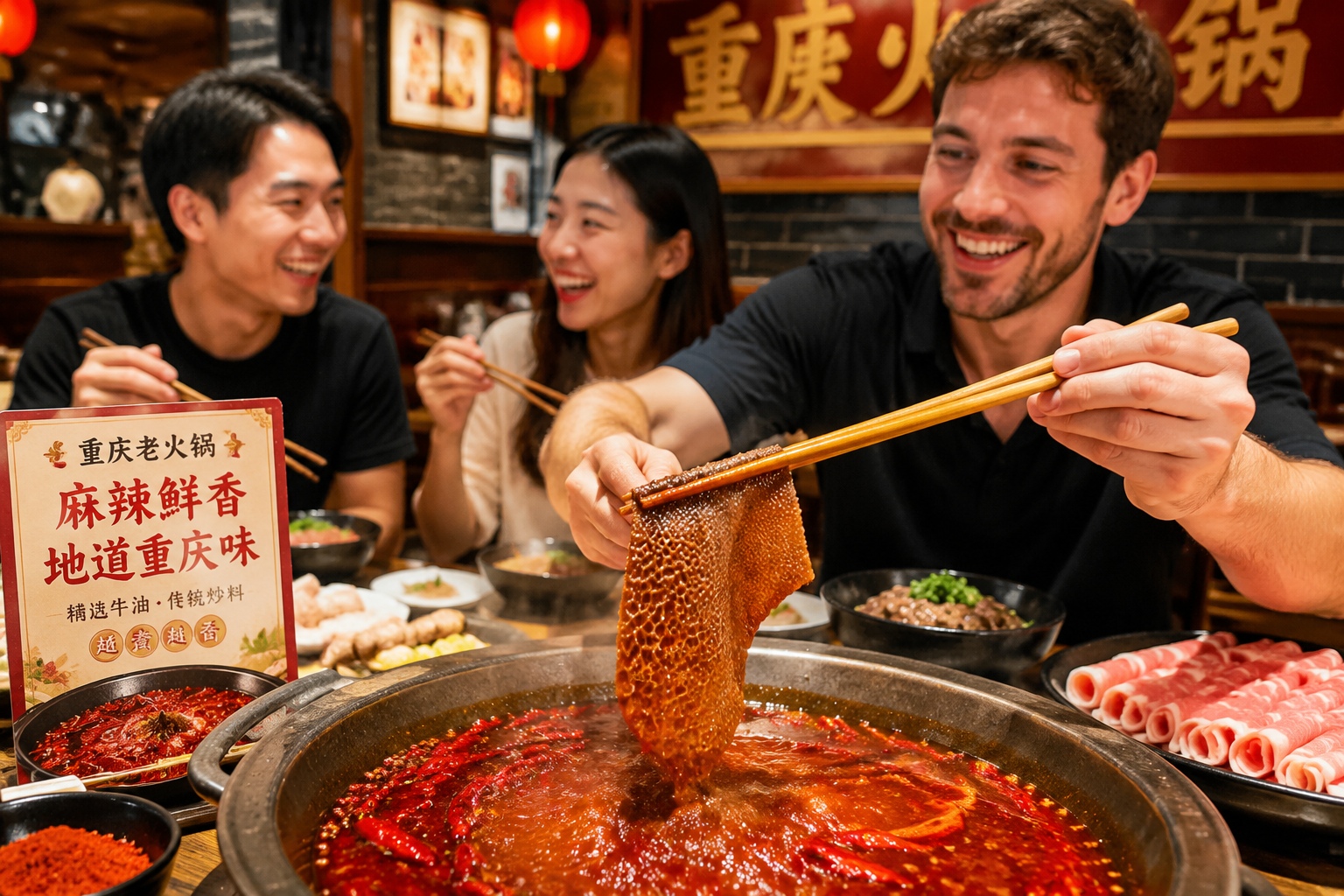
Marco’s culinary initiation happened at a hotpot joint tucked into a narrow alley near Jiefangbei, the city’s historic commercial heart. His local friends ordered the classic nine-grid pot, and the table quickly filled with plates of sliced lotus root, pig brain, duck blood, and, of course, tripe. “The waiters bring everything raw, and you cook it yourself. That’s not a meal; it’s a pressure test,” he jokes. His first bite of beef tripe, dipped in sesame oil and garlic sauce, triggers an immediate reaction: his eyes water, his nose starts running, and he reaches for the soy milk like a lifeline. “I’ve eaten ’nduja, I’ve eaten habaneros, but nothing makes you feel as alive as a mouthful of Sichuan peppercorns. It’s like a thousand needles doing the tango on your tongue.”
But after the initial shock, Marco discovers something deeper: hotpot is a social equalizer. In a city where people often work long hours, hotpot is the great unifier. Friends and strangers crowd around the same pot, reaching in with chopsticks and sharing stories. He compares it to the Italian tradition of the Sunday lunch, but with more chili oil and less insistence on seated at exactly 1 PM. “The longer you stay, the spicier it gets, and the better you feel. It’s like a marriage, but with food,” he reflects.
He also attempts to cook a piece of pig brain, which he describes as “looking like a noble piece of tofu that has given up.” After a few seconds of silence, he gives it a thumbs-up: “Tastes like butter that went to college.” This clip has become a meme on Chinese social media, with fans dubbing him “il signore del cervello” (the lord of brains). He also tries a bowl of Chongqing xiaomian, a spicy wheat noodle bathed in sesame paste and chili oil. “It’s like carbonara without the egg,” he says. “The soul is the same: comfort food that punches you in the face. And then you want more.”
The Light Rail: A Ride Through a Building
The second half of the vlog focuses on what Marco calls the “most insane public transit I’ve ever seen.” Chongqing’s Line 2 is a straddle-beam monorail that snakes through the city’s mountains and along the rivers. It was the first monorail in China, opening in 2004. Its most famous stop is Liziba, where the train passes directly through a residential tower. Marco captures the moment with the wide-eyed wonder of a child at a theme park: “You see the building, you see the train, and they’re on a collision course. But at the last second, the train just… enters. It’s like a magic trick, except the magician is a civil engineer.”
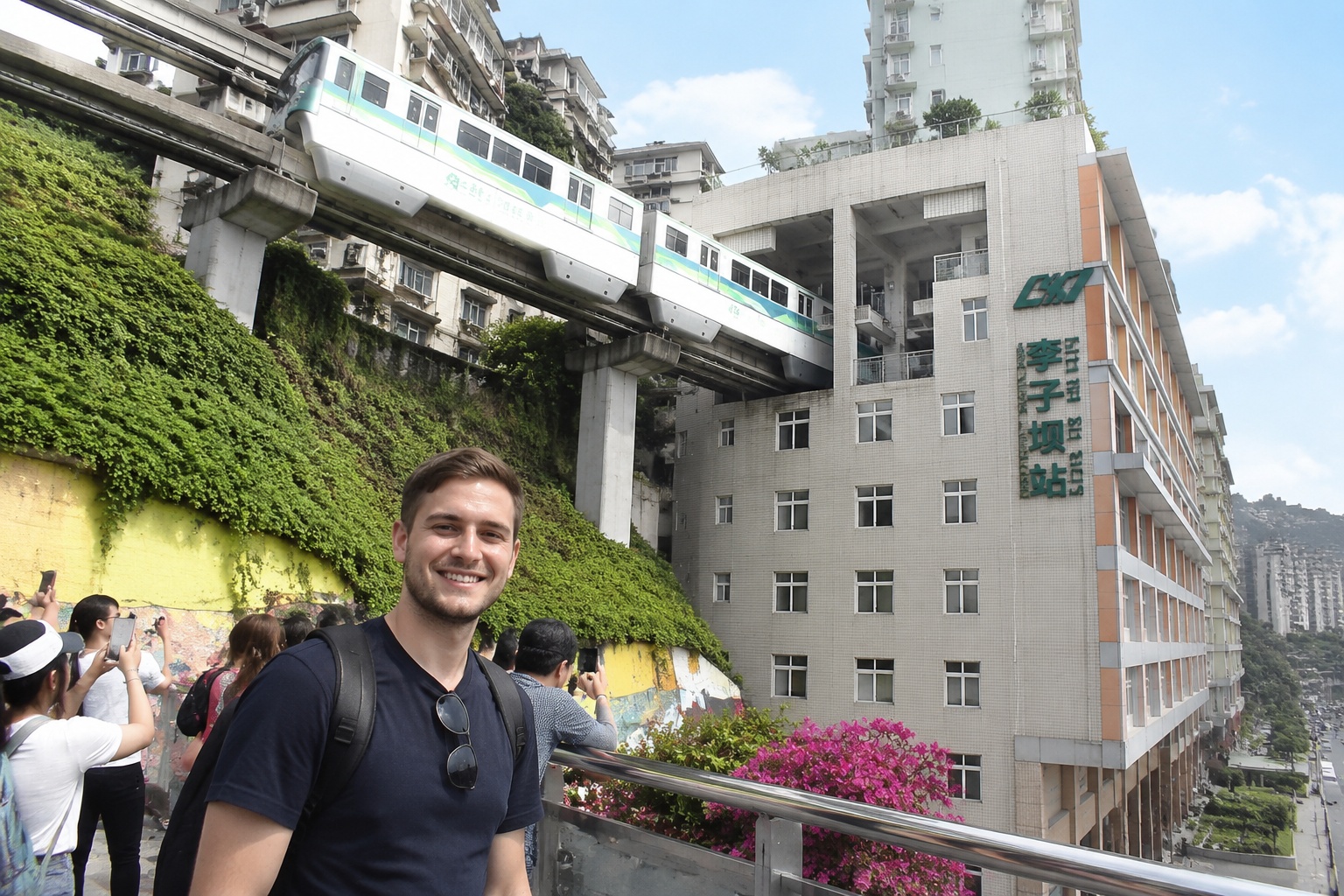
He spends an entire day riding the line, hopping off at stations like a kid with a new toy. He interviews a woman who lives in the building at Liziba, asking if it’s noisy. She smiles and says, “You get used to it. The station has been here for over 20 years. It’s like living next to a railway in your country, but the train is in your lounge.” Marco’s voiceover adds, “This is the perfect metaphor for Chongqing: a city that doesn’t fit into categories, so it just makes its own rules.” He also walks through the station’s observation deck, where a crowd of tourists has gathered to take selfies with every passing train. “In Rome, we have the Colosseum for that. Here, people just go to the train station.” He notes that the area around Liziba has turned into a mini-tourist hub, with street vendors selling cold drinks and spicy skewers. “It’s like a train station and a street food market had a baby,” he laughs.
More Than a Vlog: The Everyday Surrealism of Chongqing
What makes Marco’s vlog stand out from the endless barrage of “China YouTubers” is his willingness to veer off the scripted path. Between the hotpot and the monorail, he captures the city’s surreal daily moments: an elderly man using a chopstick as an antenna for his radio, a group of dancers in the park performing to a Latin beat, a restaurant where a robot waiter delivers your noodles, and a street vendor who proudly tells him, “We’ve been making this sauce for 40 years, but we’ve been sharing it on Douyin for only one.”
He also dives into the payment revolution. “I was not prepared for this,” he admits. “Back in Rome, you go out with a wallet, keys, phone, maybe some coins, and a prayer. Here, you just use your phone to scan a code. You even pay for a bag of oranges at a market stall by scanning a piece of paper.” The internet joke “dinosaur” becomes a recurring theme when he fumbles through his messy backpack for cash. “I felt like a dinosaur,” he says. “But a well-fed dinosaur.”
The vlog also includes a quiet moment at a teahouse in Ciqikou, an ancient town that has become a tourist magnet. He sips on a cup of green tea and reflects, “In Italy, we say that food is love. Here, food is everything: it’s fuel, medicine, social glue, and entertainment. And somehow, the city itself is the same: it’s a spice, a train, a mountain, and a river, all in one chaotic harmony.”
Why We Can’t Look Away
Why did this particular vlog resonate so deeply? Perhaps because Marco doesn’t try to explain China. Rather, he lets the city speak for itself. It’s not a geopolitical speech or a history lesson; it’s a personal, funny, and deeply human journey. In the final minute of the video, he’s atop Nanshan Mountain, overlooking the two rivers that split the city into three parts. He says, “People ask me if Chongqing is what I expected. I say it’s like Dante’s Inferno—it’s a place that exists in reality, but it feels like fiction. And I love fiction.”
The comment sections on both YouTube and Bilibili are filled with viewers from all over the world expressing a mix of amusement and wanderlust. Many Italians wrote, “Now we want to come!” while Chinese netizens praised him for “truly understanding the spirit of Chongqing.” For many outsiders, this vlog is a refreshing reminder that China is not a monolith; it’s a country of immense variety, where you can eat a fiery hotpot in the morning and ride a train through a building in the afternoon. That’s not just worth vlogging about—that’s worth seeing for yourself.
Start the discussion at forum.chinacomes.com