


Can a foreigner actually buy a car in China?
When Lena, a German product designer living in Shanghai, decided she needed a weekend getaway car, her first question was not about color or engine size. It was: Can a foreigner even buy a car in China? She had a work residence permit, a rental flat in Jing’an, and had heard mysterious stories about Shanghai’s expensive number plates.
The answer is yes. Foreign residents can buy and register cars in their own name, and the basic process is very similar to what a Chinese citizen faces. But you need the right paperwork, a valid residential address, and a Chinese driving licence before you get behind the wheel. This guide breaks down the full process — from showroom floor to your first proper license plate — with practical detail on taxes, registration, and the special quota systems in big cities.
Who can buy a car: eligibility and paperwork
Chinese law does not restrict car ownership to Chinese citizens. You can buy a car as a foreigner if you hold:
- A valid passport and a Chinese residence permit (work, study, family reunion or permanent residence);
- A proof of residential address, usually a police registration form called the Temporary Accommodation Registration Form (临时住宿登记表);
- A Chinese driving licence — this is not needed to sign a purchase contract, but you cannot drive the car without it.
If you are on a short-term tourist visa, you will generally not be able to register a car in your name. You also need to be physically present to sign documents. Some dealerships claim they can “assist” with everything, but the ownership documents must show your passport details.
Why the accommodation registration form matters
Every foreign resident in China is legally required to report their place of stay to the police within 24 hours. If you live in a hotel, the hotel will usually do this for you. If you rent an apartment, you need to go to the local police station and get the form yourself.
This small piece of paper often becomes a requirement when you apply for a vehicle plate, because the car is registered to an address. Make sure the address on your accommodation form matches your residence permit and the address you will use for registration. If you move to another city, you need a new registration there before applying for a plate in that city.
Step-by-step: buying the car at a showroom
Once you know you are eligible, the actual buying process is more straightforward than many expats fear. Chinese dealerships operate much like those anywhere else, although the settlement details matter.
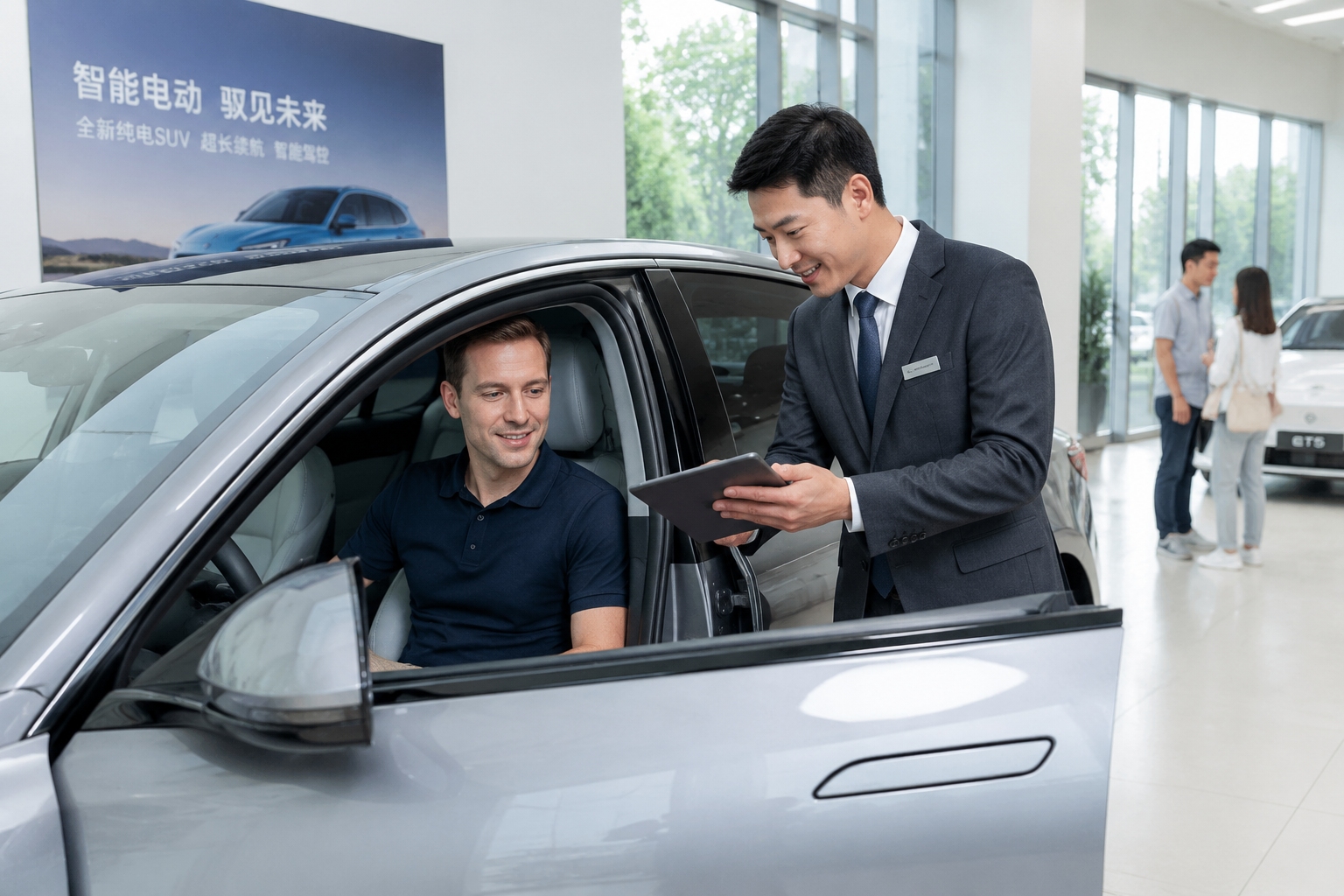
1. Choose your car and negotiate the price
You will find international brands, Chinese brands and electric vehicles in every major city. Test drives are common, but the salesperson will first ask to see your Chinese driving licence. Many dealerships also ask if you already hold a plate quota in cities like Shanghai or Beijing, because in those places you cannot register a new car without one.
2. Sign the purchase contract and pay
After you agree on a price, you sign a standard vehicle sales contract and make the payment. Some people pay by bank transfer; credit card installments are less common for large amounts. Keep every receipt.
3. Collect your two crucial documents
After the full payment, the dealer should give you two essential papers:
- The Special VAT Invoice (机动车销售统一发票);
- The Vehicle Certificate of Conformity (车辆合格证).
Without these two documents, you cannot pay vehicle tax or register the car. If the dealer says the papers will come later, treat that as a red flag. Some smaller dealers keep these papers as collateral for bank loans, so always confirm in writing that you receive them within days of final payment.
4. Get a temporary plate before driving home
A new car cannot legally drive on public roads without a plate or insurance. If you plan to drive home from the dealership, ask the salesperson to apply for a temporary paper license plate (临时行驶车号牌), which is usually valid for a few days to a few weeks. The dealer can normally handle this.
Tax: how much does it really cost?
China’s vehicle purchase tax (车辆购置税) is the biggest extra cost after the list price. It is usually paid by the buyer before registration. The current standard rate is 10% of the price of the car excluding VAT.
Prices in China are typically advertised including the 13% VAT. Therefore, to estimate your tax, divide the invoice price by 1.13 and then multiply by 10%. For example, a car with a 200,000 RMB total price would generate purchase tax of about 17,699 RMB.
If you buy a new-energy vehicle (NEV), such as a pure battery-electric car, you may qualify for an exemption or a reduced tax rate depending on the year and the model. The central government has often extended preferential policies, but the rules change based on vehicle type and purchase date. Always ask the dealer to write the estimated tax into the offer sheet before you sign.
Insurance, inspection and registration
Tax is not the only mandatory cost. Before you can drive a newly bought car to the registration office, you need to buy at least the compulsory traffic accident liability insurance, usually called Jiao Qiang Xian (交强险). This covers bodily injury and death caused to third parties. Most dealers can arrange it for you on the spot.
Also recommended is commercial insurance for your own car, such as damage coverage, theft protection and higher third-party liability. In a busy city, this can be worth more than you expect. The dealer will present a policy from one or more Chinese insurance companies; you can compare prices, but it is easier to take the dealer’s offer if the price is within the market range.
Next comes the vehicle inspection, known in Chinese as 验车. For new cars, the inspection is usually quick and in many cities the dealer will drive the car to the inspection station for you. The inspector checks the chassis, engine number and VIN against your documents. After this step, you are ready for the official registration at the local vehicle management office.
Choosing a number plate: what happens at the DMV
In most Chinese cities, you should book an appointment at the vehicle management office first, often through the government app 交管12123 or the local vehicle management office website. You can also go directly to some offices because they accept walk-ins for private car buyers, but the online booking is safer.
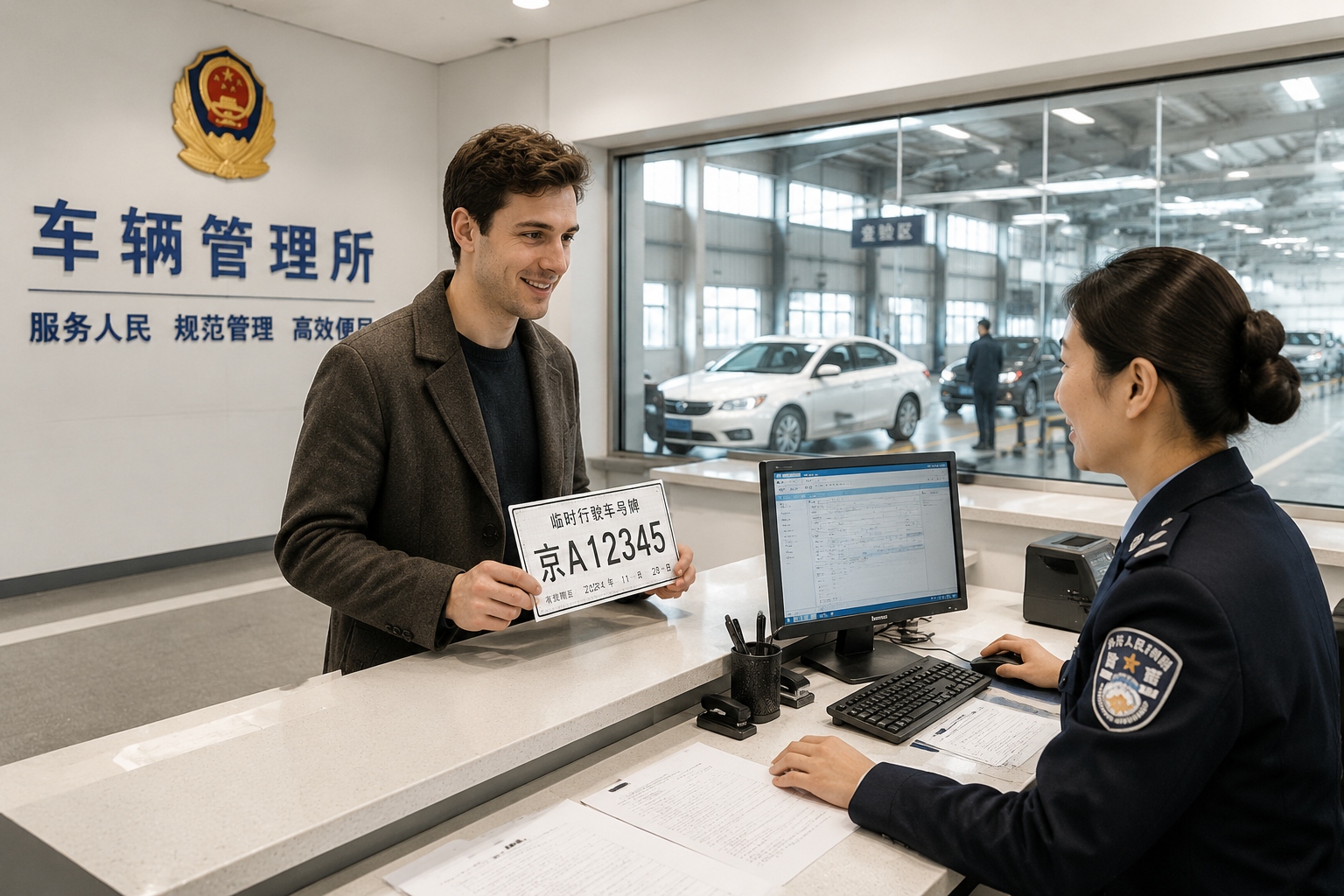
At the office, you will present your passport, accommodation registration, vehicle invoice, certificate of conformity, tax payment proof, Chinese driving licence and insurance certificate. Staff will scan your documents, ask you to look at the screen, and let you select a plate number from a randomly generated group of 50. Online self-planned numbers are also possible in many cities before the physical registration.
When the registration is completed, you will receive two important certificates: the vehicle license (行驶证) and the motor vehicle registration certificate (机动车登记证书). The tangible plate is either installed at the vehicle management office or mailed to your address within a few working days. New-energy cars have green plates, while petrol cars use blue plates.
What about restricted cities? Beijing, Shanghai, Guangzhou and Shenzhen
Outside China’s restricted cities, buying a car and receiving a license plate is a simple administrative matter. However, in cities like Beijing, Shanghai, Guangzhou and Shenzhen, the local government controls the total number of plates to manage traffic congestion and emissions. You cannot simply walk into a car dealership and drive away with a permanent plate.
Foreign residents are allowed to participate in these quota systems, but the process varies considerably.
| City | How plates are issued | Realistic cost / odds | Foreigner participation |
|---|---|---|---|
| Beijing | Lottery (摇号) in monthly draws | Very low odds; no direct purchase | Yes, with resident permit and Chinese driver licence; extra local tax/social security requirements may apply |
| Shanghai | Monthly online auction (拍牌) | Winning bids often 90,000–100,000 RMB | Yes, with residence registration and driver licence |
| Guangzhou | Lottery plus auction | Auction price often 15,000–40,000 RMB | Yes, with local residence proof and driver licence |
| Shenzhen | Lottery plus auction | Auction price often 20,000–50,000 RMB | Yes, with local residence proof and driver licence |
Beijing uses a strict lottery system. You submit an application each month, wait for the draw, and hope your name comes up. A separate lottery queue exists for new-energy cars, but it has also become crowded. Shanghai is different: the government releases a fixed number of plate quota certificates each month and residents submit real-money bids in an online auction. The cost can be equal to the price of a small used car. Guangzhou and Shenzhen use a mix of lottery and paid auction.
Before you start the purchase process, find out whether you need a plate quota first. In Beijing and Shanghai, you generally need the quota before buying a car, because the quota is tied to the buyer, not to the vehicle. The dealer will ask to see your quota certificate. Auction or lottery applications also usually require that you hold a Chinese driving licence, so the licence is always the first step.
New-energy vehicles are not a loophole, but they follow their own rules in many cities. For example, in Shanghai, a qualified foreign resident may apply for a free new-energy plate for a pure electric car under certain conditions, but rules have tightened in recent years. In Beijing, even NEV plates go through a quota system. Since these policies change frequently, always confirm the latest local regulations when you start your search.
Don’t forget: you must have a Chinese driving licence
Foreign driving licences and International Driving Permits are not recognized on their own in China. To drive legally, you need a Chinese driving licence. In most cases, holding a licence from your home country helps you get one more quickly through a conversion process. You will need to have your foreign licence translated into Chinese and certified, then pass a written knowledge test known as Subject One (科目一). A few countries have mutual agreements with China that allow direct exchange without a written examination.
This process can take anywhere from a few days to a couple of weeks, so start before you look at cars. You will not be allowed to test drive without a Chinese licence, and driving a new car on a temporary plate still requires a valid licence. Keep your licence and passport in the car whenever you drive.
Final tips to simplify the whole process
- Start by checking your city’s plate quota rules and how long you have been in the city.
- Get a Chinese driving licence as soon as possible; the written test is much less painful than the waiting lists for plates.
- Have your police accommodation registration and passport ready, and make sure the addresses match.
- Ask the dealer to give you a written price breakdown with the vehicle purchase tax and insurance.
- If the EV tax exemption matters to you, confirm the eligibility of that exact model in the current policy period.
- Do not drive without a temporary or permanent plate and at least the minimum insurance; traffic cameras are everywhere.
Buying a car in China as a foreigner is not as complicated as it first seems. Once you understand your residential paperwork, the order of payments and the local plate quota, the process is quite manageable. The biggest bottleneck is often not the passport or the dealership — it is the patience you need for the city’s plate system.
Always double-check with the local vehicle management office or the official service hotline, because rules in Chinese cities can shift with little notice. With the right preparation, your new car will not stay in the showroom for long.
Start the discussion at forum.chinacomes.com