


When David, a marketing manager from the UK, first arrived in Shanghai for a six-month secondment, his Chinese colleague helped him book a high-speed rail ticket to Nanjing using the 12306 app. ‘Why can’t I book with my passport directly?’ he asked. The colleague laughed: ‘You can, but you have to switch to the English version.’ That was the beginning of David’s learning curve. If you’re a foreigner in China, this guide walks you through buying high-speed rail tickets with a passport, boarding the train, and dealing with cancellations and refunds.
Can Foreigners Buy High-Speed Rail Tickets with a Passport?
Yes. China’s railway system uses a real-name booking system, which means every ticket is tied to the passenger’s identity document. For foreign nationals, the most common accepted document is a passport (both ordinary and diplomatic). Some countries’ nationals may also use a residence permit or a permanent residence ID card for aliens, but this guide focuses on passports.
Practical implication: when you book, your passport number must exactly match what you’ll show at the station. If you make a typo, you may be refused entry. Always double-check.
How to Book on the 12306 English Site: Step by Step
12306 is the official railway booking platform. Its English-language website (www.12306.cn/en) and mobile app are fully functional for foreign users, though the interface takes a little getting used to.
Step 1: Register a traveler profile
To register, you’ll need an email address and a phone number that can receive SMS. The system sometimes accepts international numbers, but a Chinese mobile number is always safer. After registering, you’ll be asked to add a passenger profile with your full name (as on passport), passport number, nationality, and date of birth. This profile must be approved, which is usually automatic, but allows you to book only after verification.
Step 2: Search and pay
Once verified, you can search for trains, choose your seat (second class, first class, business class), and pay online. Accepted payment methods vary: you may use certain international credit cards (Visa, Mastercard, sometimes Amex) or domestic payment systems like Alipay if you have them. Some users report that website payments work better with Alipay than with foreign cards.
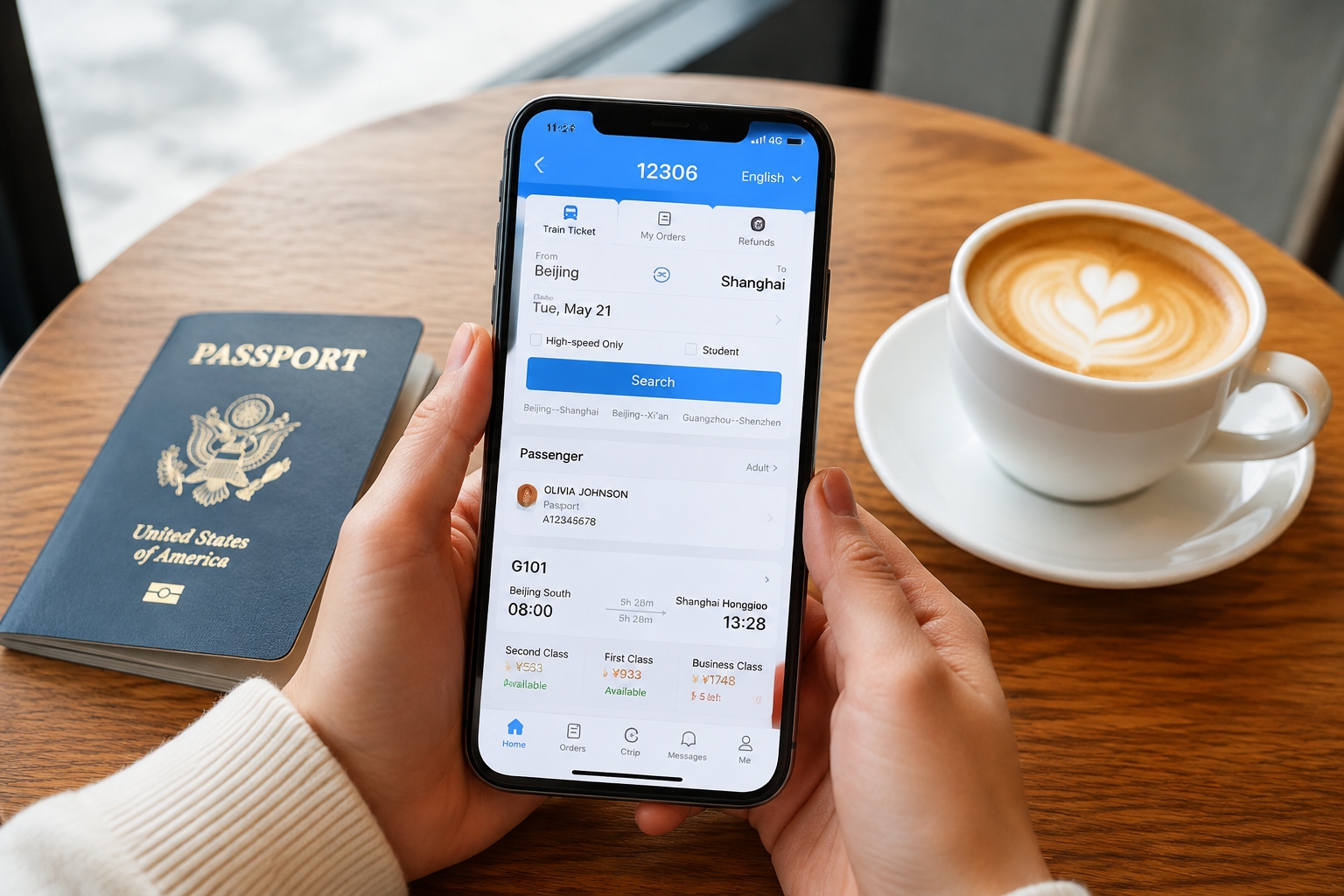
Practical implication: if you already have a Chinese bank account or Alipay, the whole process is smoother. Otherwise, keep trying; the system does accept some foreign cards.
What about e-tickets?
Since 2020, China’s rail system has moved to paperless travel. When you buy a ticket online, you don’t receive a paper ticket. Instead, an electronic record is stored in the system tied to your passport number. You’ll get a booking confirmation with a carriage and seat number. At the station, you don’t need to collect a physical ticket – just go to the gate and present your passport. Don’t forget that the name on your passport must match the reservation exactly.
Boarding the Train: Why Manual Lanes Are for Passport Holders
At most Chinese stations today, the automated gates are designed to read the chip in China’s resident ID card (shenfenzheng). They do not recognize chips in ordinary foreign passports. That means you – and other foreigners using passports – will normally be directed to a dedicated manual check lane.
How to find the manual lane
Look for signs that say ‘人工通道’ (ren gong tong dao) or ‘Manual Check’. These lanes are usually located beside the main automatic gates. In large, modern stations such as Beijing South or Shanghai Hongqiao, the staff are used to processing passports, and the signs may also include English.
What to expect
At the manual lane, a railway staff member will ask for your passport. They may scan it or type your details into a machine. In many cases, they will also do a quick facial recognition check by taking a photo of you and comparing it with your passport’s chip photo. This process usually takes less than a minute, but queues can form during peak hours.

Practical implication: don’t cut it too close. Arrive at the station at least 30 to 45 minutes before departure while you’re still learning the station layout. Even if you have an ‘e-ticket’ and don’t need a printed paper ticket, the manual check requires an actual person, so give yourself a buffer.
Refunds and Exchanges: The Rules You’ll Actually Meet
Plans change. Here’s the basic structure for refunds, based on current official rules. Note that railway policies are occasionally updated, so always check the latest information in the 12306 app or at a station window before you act.
- If you cancel more than 8 days before departure, the refund is free.
- If you cancel between 48 hours and 8 days beforehand, you pay a 5% fee.
- If you cancel between 24 and 48 hours beforehand, the fee is 10%.
- If you cancel less than 24 hours before departure, the fee is 20%.
Practical implication: wait to book if you’re not sure. Refund fees add up quickly on long-distance trips. When you request a refund, the money usually goes back to the original payment method within a few business days.
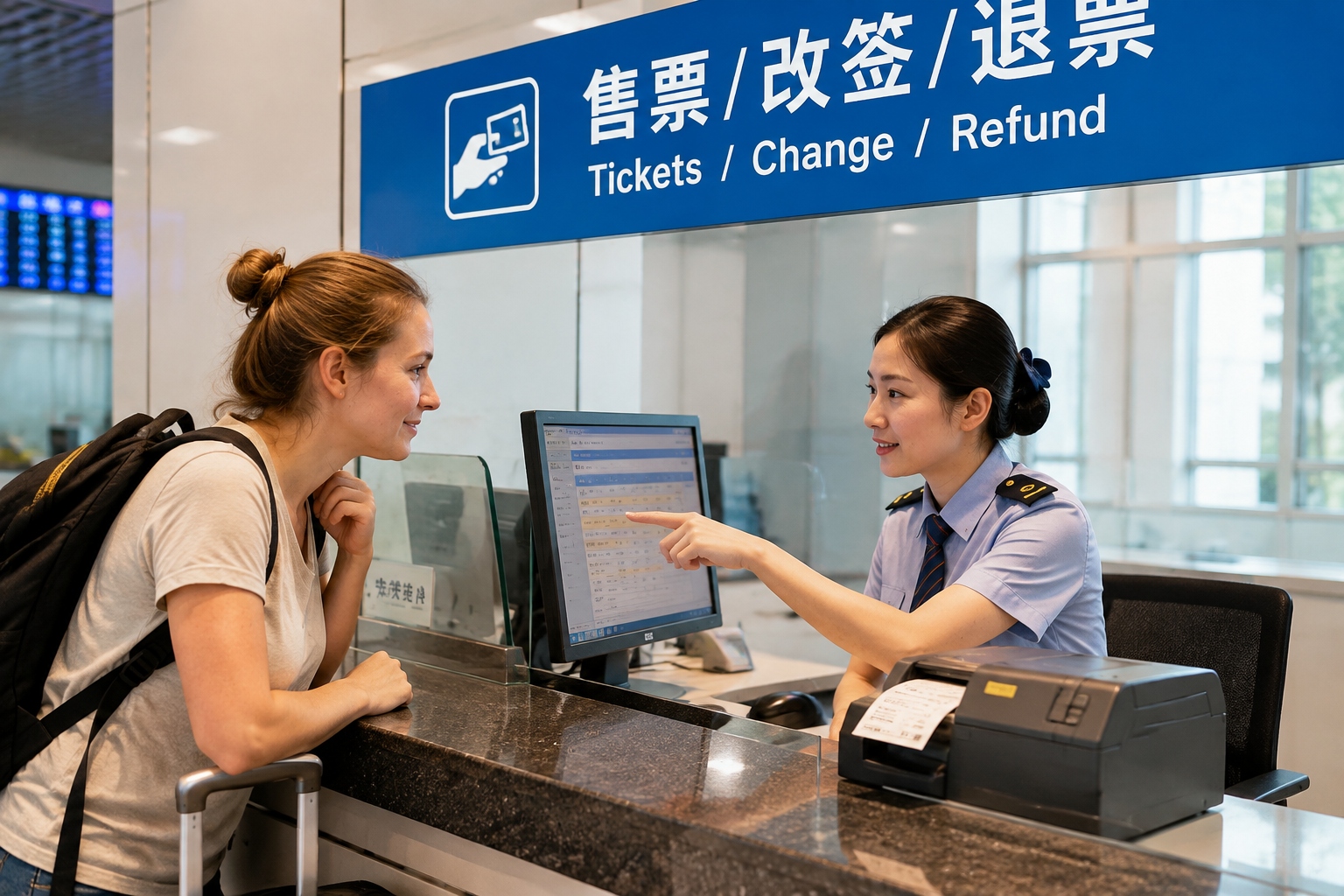
For exchanges (changing your ticket to a different time or train), you can typically make one free change before departure, provided you find a train with available seats. The price difference – if any – is charged or refunded immediately. In some cases, you can change to a later train on the same day even after you’ve missed yours, but you have to go to a staffed counter at the station within a short window. Policies differ for after-departure situations, so it’s always best to ask a station staff member.
Refund-specific nuance for passport users
If you purchased through a third-party app, such as Trip.com or Ctrip, the refund rules may be the same, but the third party may also charge a service fee. The official 12306 channel is almost always cheapest and most straightforward.
Can Foreigners Join the ‘Railway Chang-Xing’ Loyalty Program?
‘Railway Chang-Xing’ (铁路畅行) is China’s national rail loyalty program, analogous to frequent-flyer miles. Yes, you can register as a foreign passport holder, as long as you have a Chinese mobile phone number (the system requires a mainland number for account setup). Once you’re a member, you earn points on every ticket purchase: roughly 5 points per 1 yuan of ticket price (some routes or promotions differ). Points can later be used to book free tickets, typically 100 points = 1 yuan.
Practical implication: if you travel a lot within China, it’s worth signing up. You need to register your passport and then link your tickets to your membership number. You can do this by logging in to the 12306 app and adding your membership number before buying. Points expire after 12 months, so plan to use them before they run out.
What to Do If Something Goes Wrong
Lost passport on a travel day
This is the nightmare scenario. Without your passport, you cannot prove your identity, and station staff will not let you board. You have to visit the nearest local police station to report the loss, then go to your country’s embassy or consulate to apply for an emergency travel document. Your ticket can be refunded (with proof of loss) or changed to a later date, but you’ll need to show a new identity document. The most practical advice is to leave a photocopy or digital scan of your passport separately, and also keep a photo on your phone.
Expired passport
You can’t buy a ticket or board a train with an expired passport. If you discover your passport is expired at the station, you’ll be rejected. You’ll need a new passport from your embassy or consulate. There’s no substitute for foreigners, except occasionally the newer permanent residence ID card works at automated gates, but not all stations support it.
Missed your train
If you missed your train because you didn’t know the rules, you can sometimes change to a later train on the same day for no additional fee (price difference may apply if the new train is more expensive). Look for the ‘missed train’ counter or ask the staff. Availability is not guaranteed if the next trains are full, and you can’t get a refund once the train has departed. If you arrive just a few minutes after departure, you may still be able to change to another train if seats are left.
Bottom Line
Using a passport to travel on China’s high-speed rail network is entirely possible. The key is to use the official 12306 English platform, carry your passport everywhere, and head to manual lanes. With a bit of patience and advance preparation, high-speed rail becomes one of the most comfortable, punctual, and convenient ways to travel through China.
Have you traveled by high-speed rail as a foreigner in China? Share your experience in the comments below.
Start the discussion at forum.chinacomes.com