

When a German designer in Shanghai tries to buy coffee
Anna, a product designer from Berlin, has lived in Shanghai for six months. She uses Alipay and WeChat Pay for almost everything, but when her Chinese colleague pays for a morning coffee by scanning a small blue-and-white QR code, Anna is curious. “That’s the digital yuan, you can use it with your passport now,” her colleague says. Anna tries it that afternoon and discovers that setting up a digital RMB wallet is not as complicated as she expected.
Digital RMB, officially called e-CNY, has slowly moved from a pilot scheme to a payment tool you can actually use in many Chinese cities. If you are a foreigner in China, you can use it too. This guide walks you through what digital RMB is, how to open a wallet with your passport, what limits you need to know, and where it works in daily life.

First things first: what is digital RMB?
Digital RMB is China’s central bank digital currency. Think of it as digital cash issued by the People’s Bank of China. One digital yuan equals one paper yuan, and it does not earn interest. It is not a replacement for Alipay or WeChat Pay – those are payment platforms. Digital RMB is the money itself, similar to having a digital version of a banknote in your phone.
For foreigners, the key difference is that you do not need a China-issued bank card to start using a low-level wallet. In practice, many foreigners still connect a bank card for larger transactions, but small daily purchases are possible after a simple phone registration. The pilot has expanded to dozens of Chinese cities, from Beijing and Shanghai to Shenzhen, Suzhou, Xi’an and many others.
Can foreigners use it? Yes, here is the proof
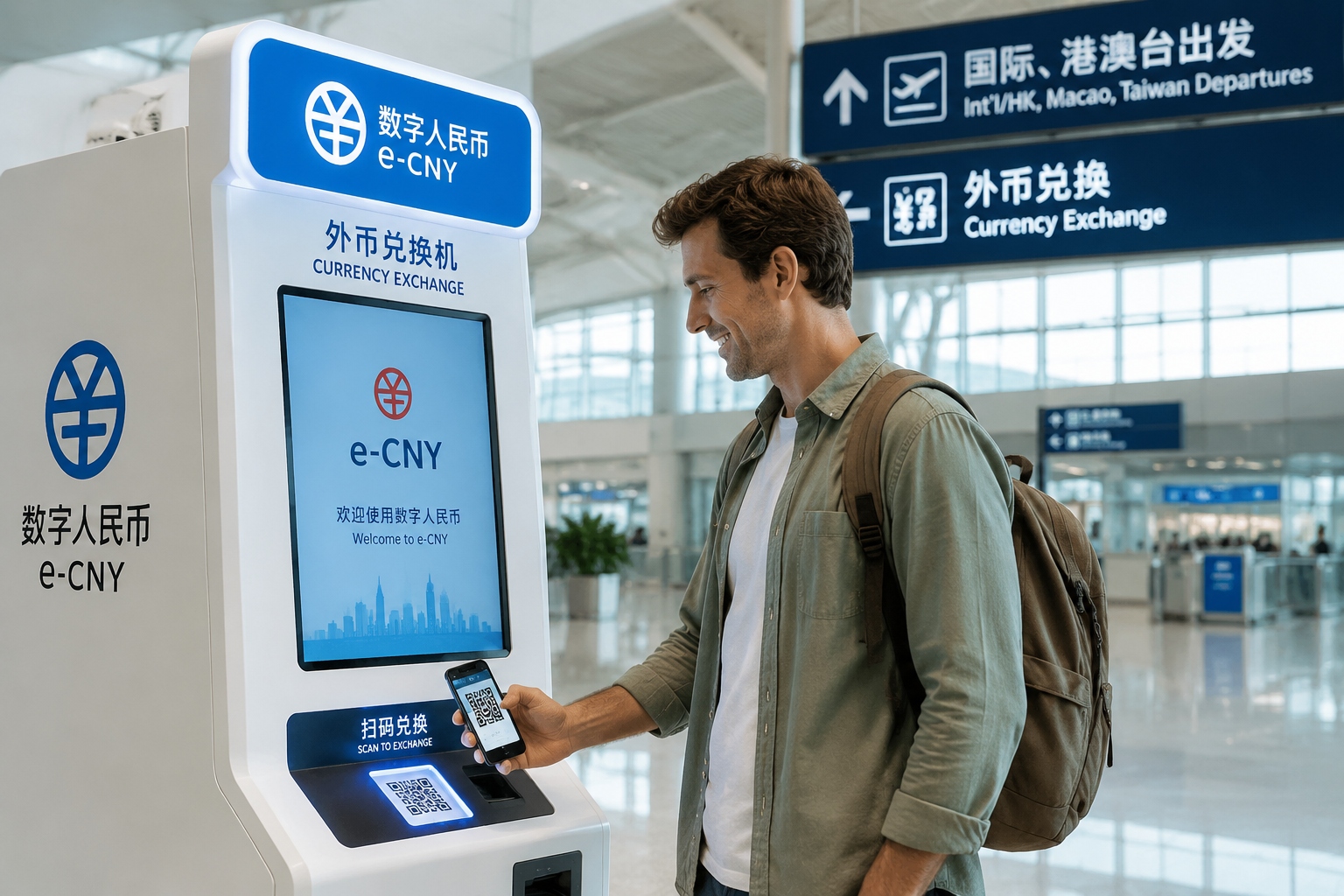
Digital RMB originally opened only to mainland Chinese ID holders, but that changed gradually since 2021. The Winter Olympics in Beijing and Zhangjiakou in early 2022 became a key test: foreign athletes, journalists and visitors could open wallets using their overseas passports or even overseas phone numbers. Special currency-exchange machines allowed visitors to convert foreign cash into digital RMB.
Since then, foreign visitors at the Canton Fair in Guangzhou and many embassy staff in Beijing have also used digital RMB. According to public reports from the People’s Bank of China, the goal is to make digital RMB a convenient payment option for foreigners who do not have a Chinese bank account. The exact rules and features may vary by city and venue, so always check the latest local instructions when you arrive.
Opening a wallet with a passport: four steps
Anna’s first attempt took about 15 minutes in a bank branch, but there is now an easier do-it-yourself route through the official digital RMB app. The steps below reflect how most visitors and residents can start.
Step 1: Download the official Digital RMB App
Search for “e-CNY” or “数字人民币” in your app store. The full name is Digital RMB. Some overseas app stores may not have it, so make sure you have a China-based marketplace or switch your Apple ID / Google Play region if needed.
Step 2: Register with your mobile number
You can use an international mobile number in several pilot cities, though a Chinese number makes it smoother. The app sends a verification code, and then you create an account. Do not worry about the QR code language too much; major version nowadays supports English.
Step 3: Open a wallet
After login, tap to open a digital RMB wallet. By default, you get a “fourth-tier” wallet, which allows small transactions with limited anonymity. This type requires only your phone number and does not need passport identification.
Step 4: Upgrade by verifying your passport
If you want higher transaction limits, upgrade your wallet by verifying your identity. In the app, you can select “Real-name authentication” and then choose “Foreign passport.” Sometimes the app requires you to visit a bank branch or an ATM with passport-reading capabilities to complete facial and passport checks. After that, you can move to a third-tier wallet or higher.
Some foreigners find the app interface intimidating, but there are bilingual guides inside. If you get stuck, any bank that partners with digital RMB – including Bank of China, ICBC, Construction Bank and others – has staff trained to help foreigners.
Wallet tiers: from anonymous small spender to full verified
Your digital RMB wallet limits depend on how much personal information you provide. This is common in China’s payment systems, but the good news is that digital RMB publishes these tiers more clearly.
- Fourth-tier wallet – Only needs a phone number. Balance limit is around 10,000 yuan, with single payment caps of around 2,000 yuan and daily caps around 5,000 yuan. Good for buying metro tickets, coffee and snacks.
- Third-tier wallet – Requires a valid passport or Chinese ID. Balance limit rises to about 20,000 yuan, single payment up to 5,000 yuan and daily cap to 10,000 yuan. This is the most practical level for most tourists and new residents.
- Second-tier wallet – Requires a bank account as well as identity verification. Balance limit can be 500,000 yuan, with higher transaction limits. Useful if you are a long-term expat or need to pay for large services.
- First-tier wallet – Fully verified, no upper limit announced. You need to open this in person at a bank, and it involves a more detailed background check.
These numbers come from publicly available pilot guidelines and may change over time. Not all cities follow the exact same caps. If you are planning a single large purchase, confirm your wallet level in advance or keep an alternative payment method.
The “anonymous” element of the fourth-tier wallet is often misunderstood. Digital RMB is not private cryptocurrency. The central bank says it offers “controllable anonymity” – small transactions do not reveal your name, but suspicious large flows can still be traced by regulators.
Using digital RMB in the wild: Olympics, Canton Fair, daily life
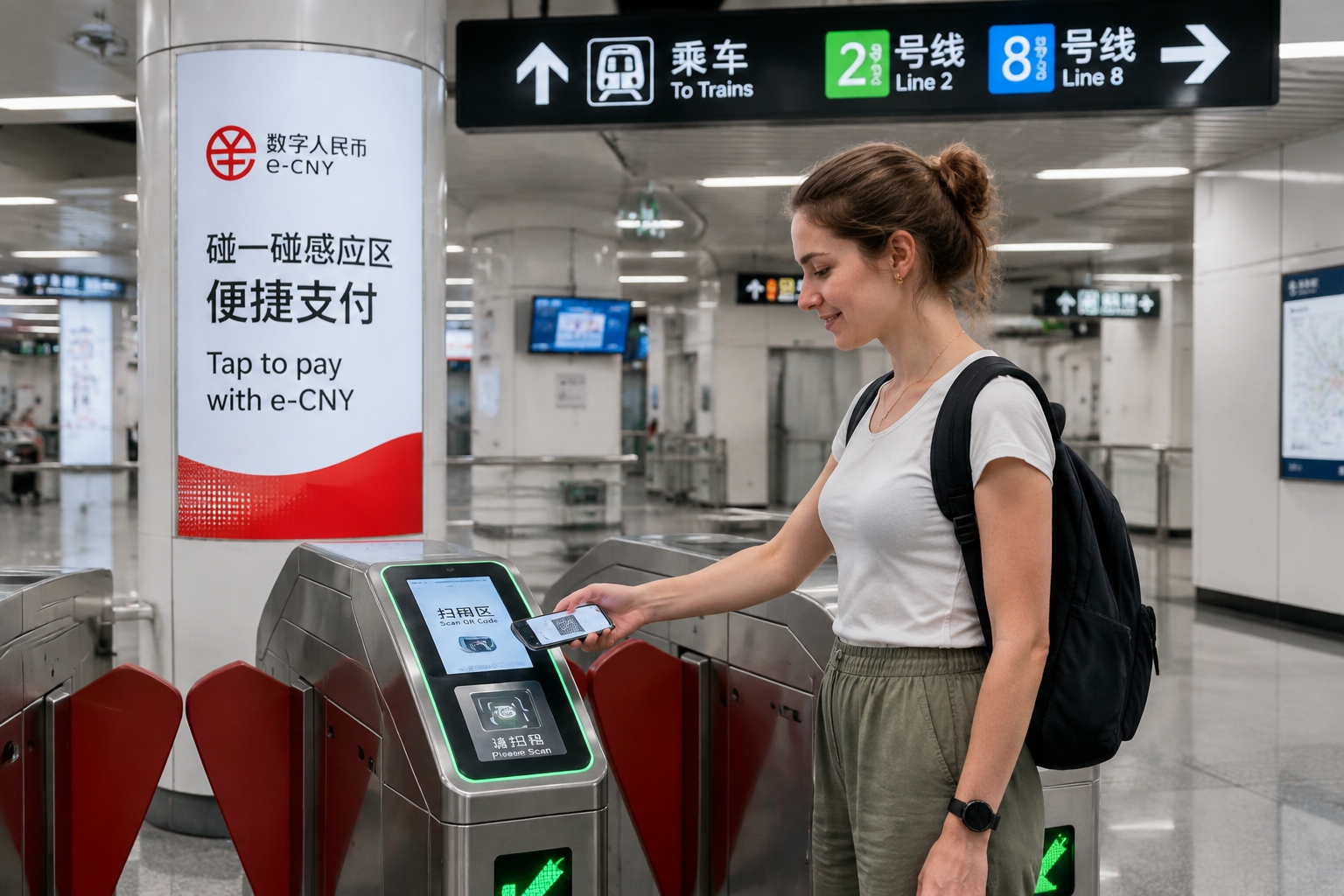
Anna used her digital RMB first at the Shanghai Metro. She followed her colleague’s advice, upgraded with her passport, and scanned a digital RMB QR code at a station vending machine. It worked exactly like Alipay, but without the dull moment of waiting for her bank to confirm the transfer.
During the 2022 Beijing Winter Olympics, many foreign athletes and reporters paid for meals and transport with a special “Olympic Wallet.” Currency exchange machines set up at the airport and Olympic Village accepted US dollars, euros, yen and more, and loaded digital RMB onto wristbands or phones. It was one of the first real-world stress tests.
At the Canton Fair in Guangzhou, overseas buyers could use digital RMB to buy samples from thousands of suppliers. Local government arranged on-site help desks for foreign buyers who had no Chinese bank card. That trend has continued: major Chinese cities now have “demonstration zones” where digital RMB is accepted by a wide range of merchants.
Where can you spend digital RMB today? Subway systems in Shanghai, Suzhou, Beijing and some greater bay area cities support it. Most large supermarkets, convenience stores, coffee chains and even many street vendors in pilot areas display a special digital RMB QR code. You may also see self-service kiosks and vending machines with the digital RMB logo.
Digital RMB vs Alipay and WeChat Pay: what is actually different?
For a first-time user, the experience of scanning a code is similar to Alipay or WeChat Pay, but there are important differences:
Money vs platform. Alipay and WeChat Pay connect to your bank account or a stored balance. Digital RMB is official money, so it does not need an internal settlement step between the merchant and your bank. This means payments can be done faster and, technically, offline. The “dual offline payment” feature lets two phones complete a transaction without internet, though most everyday users still rely on an online connection.
You do not need a bank card. Foreigners often find it difficult to open a Chinese bank account or link an international card. With a low-tier digital RMB wallet, you can get started with just a phone number and top up using cash at supported exchange machines. For higher tiers, however, you will likely need a Chinese bank account, which brings it closer to existing payment apps.
Merchant QR codes are not all universal. A shop that accepts Alipay may not accept digital RMB. Over the past two years, merchants have gradually added digital RMB logos, but coverage remains uneven. In most large cities, you will find digital RMB accepted in government services, metropolitan transport, and large chains, while smaller family-run shops often still rely on Alipay and WeChat Pay.
Fees and refunds. One advantage for consumers is that digital RMB normally does not charge transaction fees for personal transfers or purchases. Refunds return to your digital RMB wallet instantly, rather than waiting for a credit card settlement. For tourists on a tight budget, that can be really useful.
Practical problems foreigners ask about
What happens if my passport number changes?
If you are in China and renew your passport, go to your main issuing bank or use the app’s customer service to update your identification. Until you do, your wallet will remain linked to your old passport number, and you may not be able to upgrade or perform certain financial operations.
Can I use digital RMB outside China?
As of early 2025, digital RMB is mainly usable within mainland China. Some Hong Kong banks have tested cross-boundary connections, and a small number of tourist destinations in Hong Kong and Macau have piloted digital RMB acceptance for transactions with mainland visitors. But for a foreigner planning to use the same wallet after leaving China, do not expect it to work.
Can I convert foreign currency to digital RMB?
Yes, at selected airport branches and tourist information centres, you can use designated machines. Some machines accept foreign cards or cash to load digital RMB. The exchange rate follows the central bank’s daily rate. You will need to have the digital RMB app installed and your wallet active.
What if I lose my phone?
Because digital RMB is tied to your identity and wallet, you can call the app support line or go to a bank branch to freeze the wallet and reinstall on a new phone. Like cash, any balance spent before you report the loss may be gone; physical security still matters.
Bottom line
Digital RMB is not a gimmick. For many foreigners in Chinese cities, it has become a genuinely convenient alternative – especially if you do not want to carry a Chinese bank card or teach yourself a new payment app. The onboarding process is easier than it was a few years ago: download the app, use your passport to upgrade, top up at a supported exchange machine, and you are ready to scan, tap or even pay without internet.
Still, be a smart traveller. Digital RMB does not yet cover every street vendor, and rules change by city and trial phase. Use it for what it is best at – small cashless payments in public transport, convenience stores and local services – and keep a backup payment method such as Alipay, WeChat Pay or an international card until you feel sure of your current limits.
Anna is glad she gave it a try. “It is not a magic money system,” she says. “It is just another way to pay, and knowing how to use it made me feel a little bit more local.”
Start the discussion at forum.chinacomes.com