


Anna’s Sunday Morning Problem
Anna, a French landscape architect, lives in Shanghai. On a Sunday morning, she walks into a bakery to buy a loaf of sourdough. The cashier points to a QR code, but Anna’s Alipay is not linked to any Chinese bank account — she has been using cash or her foreign credit card, which many shops hesitate to accept. Her Chinese friend suggests she try the digital yuan app. “You can use it even without internet, and you don’t need a local bank card,” the friend says. Anna is curious but cautious: Is it safe? Is it really anonymous?
Anna is not alone. Since China began trialling its central bank digital currency (CBDC) in 2020, the ecosystem has expanded to multiple cities. In recent years, the government has opened the wallet to foreigners more broadly, allowing visitors and expats to register with their passports. In this guide, I’ll walk you through the actual steps, the places you can use e-CNY, and the real story about its “anonymous” limits.

What Is Digital Yuan, and Why Should Foreigners Care?
Digital yuan (officially e-CNY) is China’s legal tender issued by the People’s Bank of China (PBOC). Unlike Bitcoin, it is not a decentralized cryptocurrency. It is a digital version of the renminbi, and every e-CNY is backed by the state. The central bank runs the system, while commercial banks such as Industrial and Commercial Bank of China (ICBC) and Bank of China handle distribution.
For foreigners, this represents a genuine alternative to Alipay and WeChat Pay — the two super-apps that dominate daily payments. Those apps have historically been tricky for visitors: you need a mainland Chinese bank card to fully unlock them. Foreign credit cards often carry high fees or are rejected. e-CNY, at least in pilot zones, allows passport holders to create a wallet with a simple sign-up and, if you choose the least-verified tier, you can even avoid linking a card at all.
How to Open an e-CNY Wallet with a Foreign Passport
The whole process can be done through the official “数字人民币(试点版)” app, which is available on Chinese iOS and Android app stores. Here’s a practical step-by-step for foreigners, based on actual expat experience in cities like Shanghai, Beijing, Suzhou, and Shenzhen.
Download and register
Search for “Digital Yuan” (or the Chinese name) in the app store. The app should have an English interface option — I recommend changing languages right away.
For registration, you only need a mobile phone number. Virtually any country’s SIM can receive the verification SMS while roaming, but to use the full service inside China, a number that works locally is more convenient.
Identity verification: choose your level
After login, the app will ask you to “open a wallet” with one of the operating banks. Here comes the important part: you can open a “fourth-tier” wallet with just your phone number. This tier has the lowest transaction limits — we’ll get to those numbers in the anonymity section below.
If you want higher limits, you must upgrade. To upgrade, you’ll need to provide your passport and pass facial recognition. Some banks may also ask for a valid visa or entry stamp. A typical expat can complete the upgrade in under ten minutes.
Where Does e-CNY Actually Work?
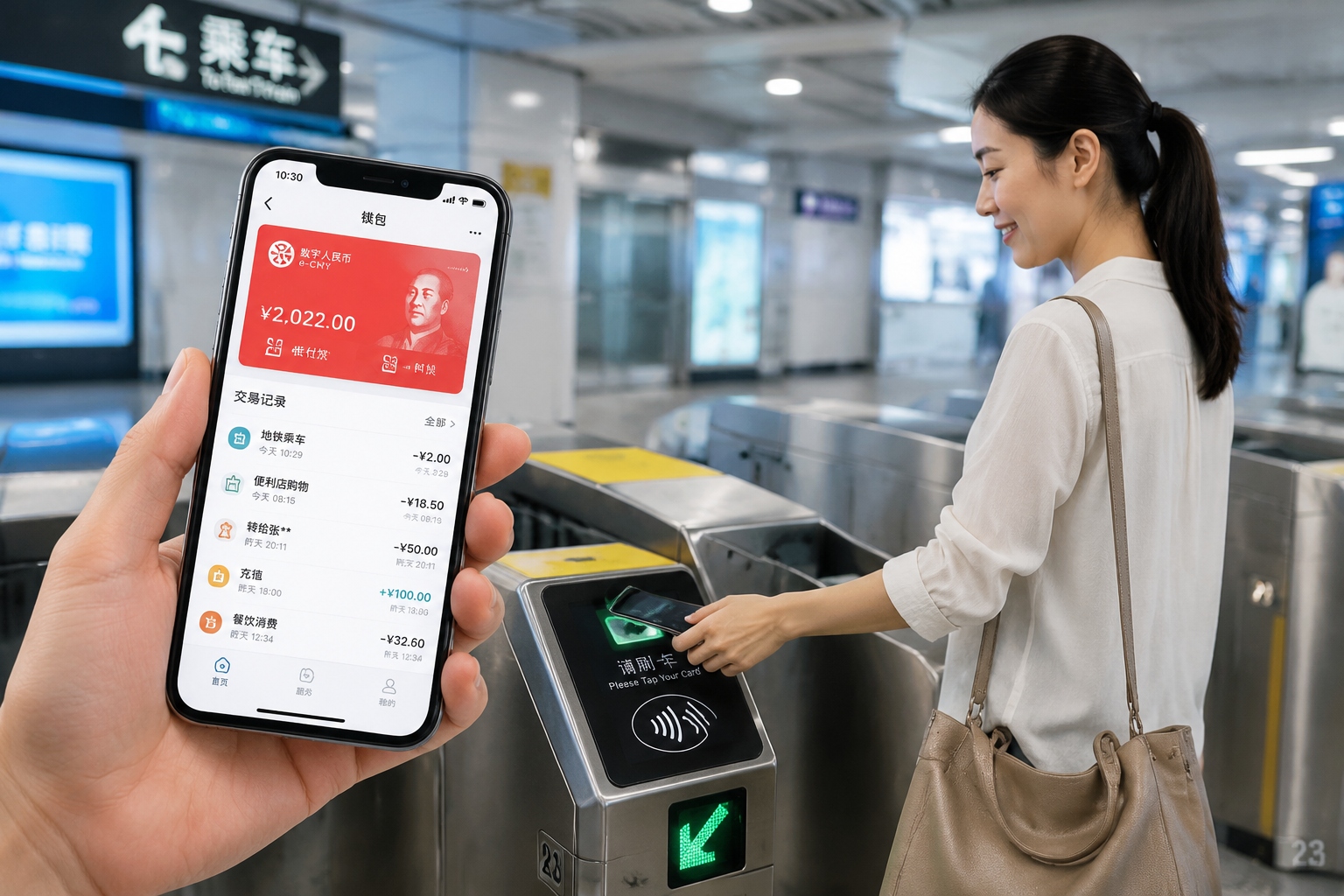
Everyday usage is much broader than Anna expected. Look for merchants that display the official e-CNY logo — often found near the cash register. You can scan their QR code or show your own code, just as you would with other mobile payments. The most useful scenario is paying for meals at restaurants, groceries at supermarkets, ticket machines at metro stations, and even electricity bills in your apartment through utility mini-programs.
Since 2022, major e-commerce platforms like JD.com, Meituan, and Pinduoduo in China have been accepting digital yuan. International versions? Not yet involved.
The particularly clever function is the “touch-and-pay” offline mode. If your phone supports NFC, both your device and the merchant’s point-of-sale terminal can use the built-in hardware wallet (called SIM card wallet in some cases) to complete a transaction even when there is no internet signal.
The Real Truth About Anonymity and Limits
China calls this system “controllable anonymity.” It’s not like a ski-mask anonymity; it’s more like a privacy shield that behaves differently depending on how much you verify.
Foreigners who use the fourth-tier wallet (phone number only) are not listed by name or ID on any public ledger. According to operational rules, a tier-four wallet can normally hold a balance of up to RMB 10,000 (about US$1,400) and a single payment of up to RMB 2,000 (US$280). If those numbers make you wince, you can upgrade to a Tier-2 wallet with your passport. Then the upper balance cap can rise to RMB 500,000 and a single transaction of RMB 50,000. Every step up implies you have exchanged your anonymity for transaction power.
Another point: e-CNY does not tie your purchase history to a commercial account, unlike Alipay or WeChat Pay. The central bank can trace transactions when necessary for anti-money-laundering, but commercial platforms are not allowed to mine the data for targeted ads. This is a meaningful trade-off for privacy-aware travellers.
e-CNY vs Alipay and WeChat Pay: What Changes for You?
The practical benefits might surprise you. First, you do not need a Chinese bank account. You can top up your e-CNY wallet in cash at designated bank branches or accept digital remittances from a friend. Second, you do not need to open a separate bank card, because you directly hold the digital currency — similar to holding cash. Third, there are no transaction fees for merchants, which is a reason why more and more small vendors are joining the system.
On the other hand, the ecosystem is not as wide as Alipay or WeChat Pay. Whether it will replace them remains to be seen. For now, it’s a viable second payment method that extends your ability to pay in places where foreign cards are rejected. Anna’s sourdough bread definitely falls into this category.
The Takeaway
For foreigners living in or visiting pilot Chinese cities, digital yuan has moved from being a theoretical policy project to a practical payment aid. The onboarding process is simpler than you might expect, requiring little more than a passport and a willingness to try. The anonymity ceiling is lower than crypto maximalists would want, but for pedestrians in China, that’s not necessarily what you need — you need a transaction that actually works.
If you are about to fly to Beijing or Shanghai, spend fifteen minutes activating your wallet before you land. It’s one of those little moves that makes you feel remarkably less foreign.
Start the discussion at forum.chinacomes.com