

A Fever in a Foreign City
At 6:30 a.m. on a Wednesday, I woke up in my Beijing apartment with a throat that felt like sandpaper and a forehead burning against my own hand. I had been in China for three months, teaching English. I knew the procedure for everything from renting an apartment to ordering street food, but nothing about hospitals.
My Chinese friend Wang, who lived upstairs, knocked on my door after I texted her. She took one look at me and said, “We have to go to the hospital now, before the queues get too long.”
She pulled up a ride-hailing app on her phone, ordered a taxi, and led me downstairs. Ten minutes later, the car stopped at the entrance of a large district hospital in Chaoyang, one of Beijing’s busiest neighborhoods.
The Hospital Lobby at 8 AM
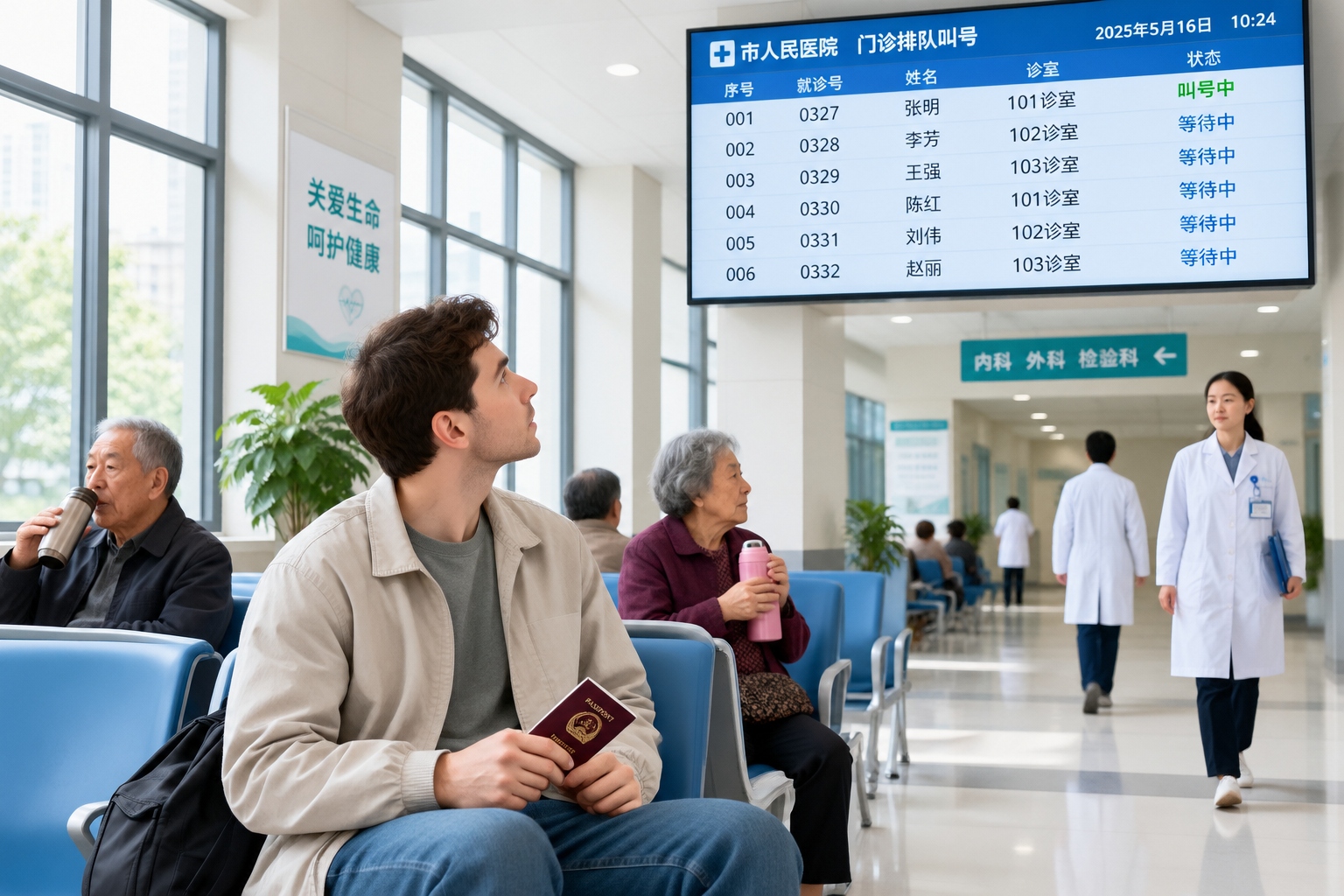
The hospital was already moving. Patients streamed out of the sliding doors with printouts and plastic bags of medicine. Inside, the lobby was bright and crowded, with long lines at the counter and self-service machines flashing near the entrance.
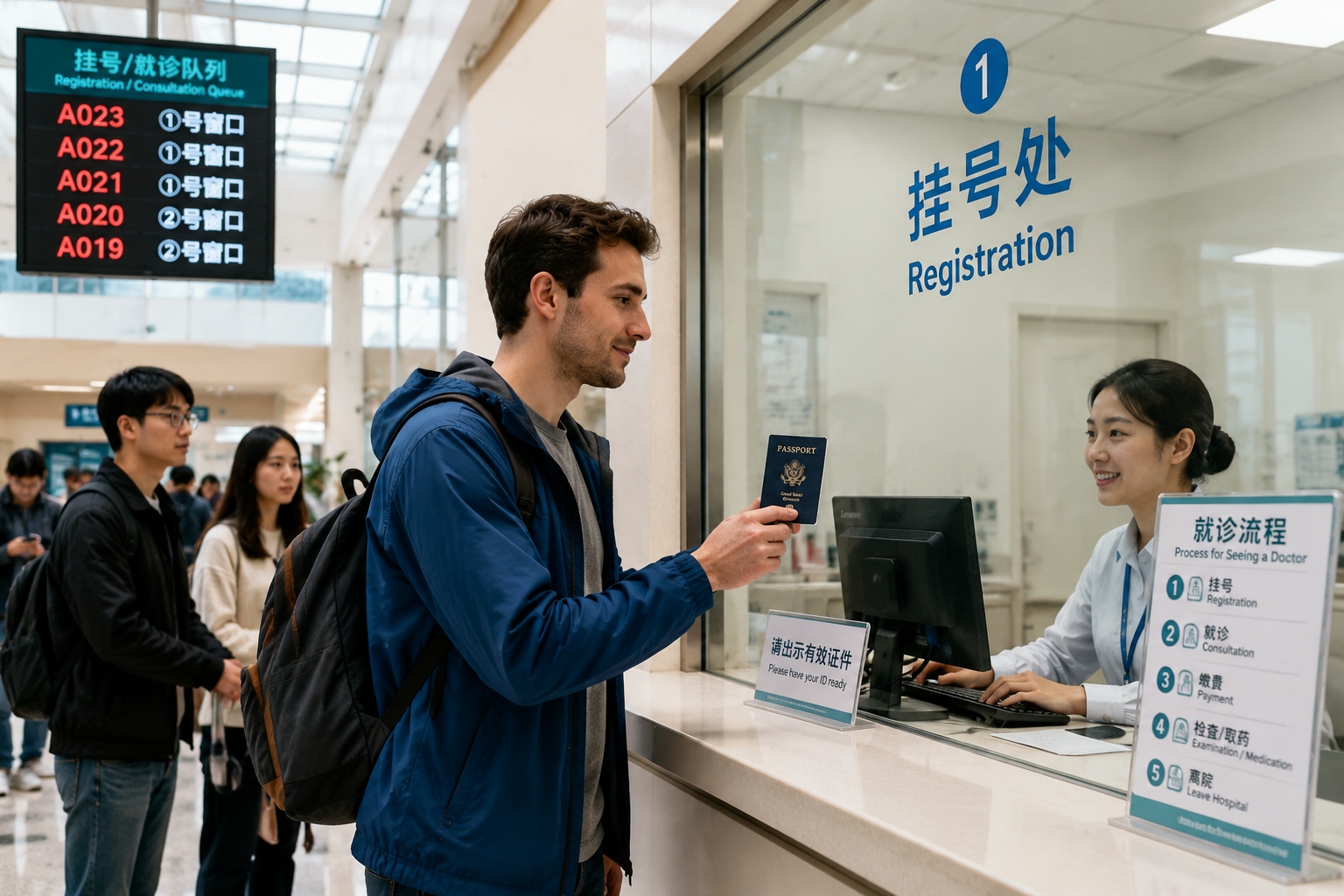
In China, the first step to treat your illness is to “挂号” (guà hào) — get a registration number for a doctor. You don’t just walk into the clinic area; you have to pay a registration fee and wait for your turn. My friend told me that many hospitals now let you do that on a smartphone app or via WeChat, but since I was not set up on those apps, we joined the line at the counter.
At the counter, the staff asked for my passport. The process took less than two minutes. I paid a registration fee of 50 yuan (about $7) with my bank card — though mobile payment is everywhere, cash and bankcards are still accepted. A machine printed out a slim receipt with a number and my name transliterated into Chinese.
A volunteer in a blue uniform noticed us looking lost and directed us to the internal medicine floor. On the second floor, electronic boards above each consultation room displayed the names of doctors and the numbers they were seeing. My number was 43. The screen said the doctor was at number 31. “It’s not too long,” Wang said. We settled into plastic chairs. Around us, a woman in her 60s drank from a thermal flask, a young couple scrolled through their phones, and from an open room I could hear the beep of a blood pressure monitor.
Talking to the Doctor with a Phone as Translator
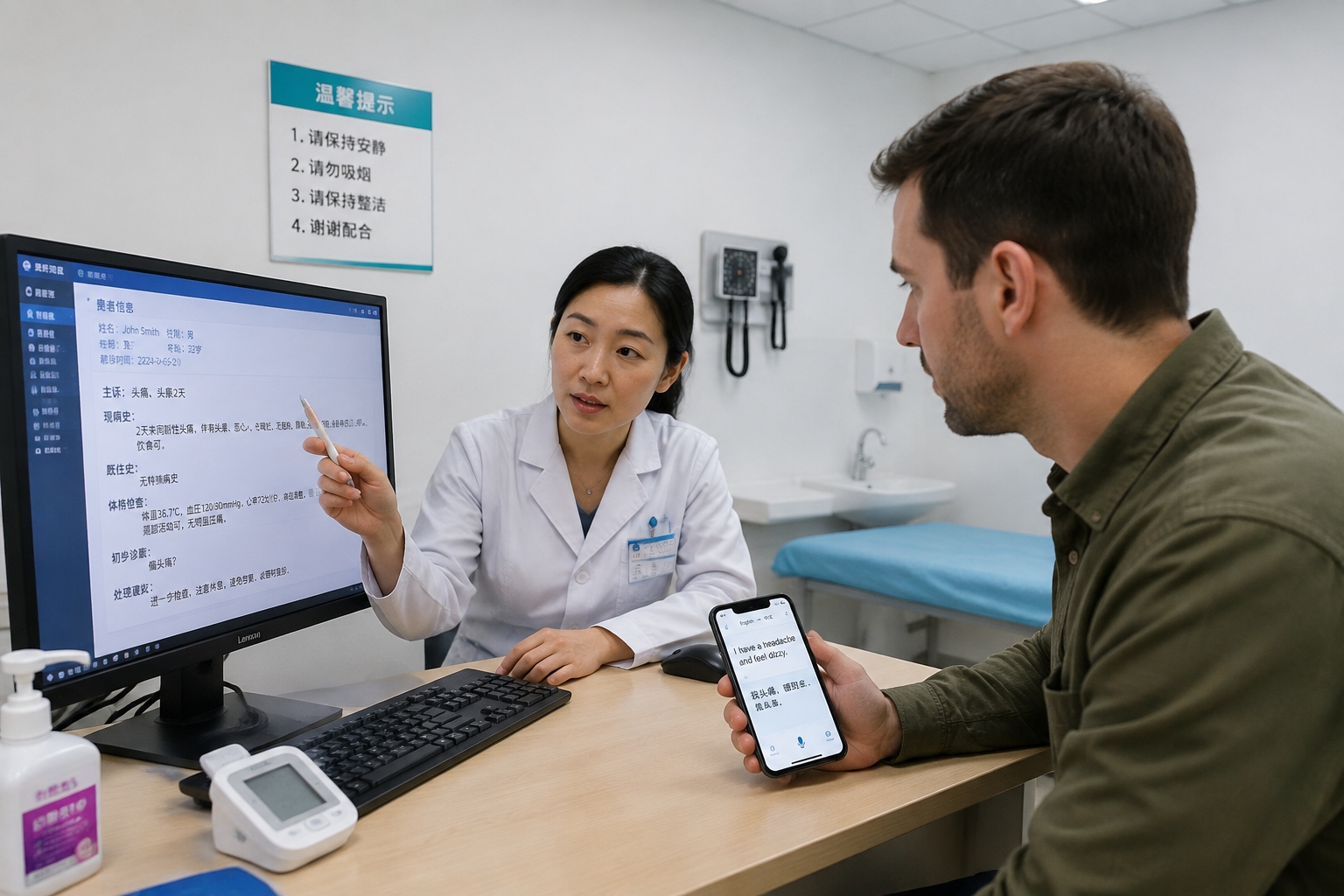
Twenty minutes later, a female voice announced my number over the intercom in Chinese and English. I walked into the consultation room. A doctor in a white coat sat behind a neat desk, in front of her a wide-screen monitor. She looked at me and said, “Hello. How are you?” Her English was basic, but friendly.
I explained in simple English that I had a fever, sore throat, and chills. She nodded, typed a few things into her computer, then asked me to open my mouth. She looked at my throat, used a cold stethoscope on my back, and felt my neck. Then she turned to Wang and talked quickly in Chinese. Wang translated not only the words but the tone — the doctor seemed calm and certain, like she had seen hundreds of these cases that week.
“She wants to do a blood test,” Wang said. “Do you have any allergies?” I shook my head. The doctor printed out a form, pushed it toward me, and pointed to a door across the hall. “Laboratory,” she said.
The consultation itself lasted less than five minutes, but I didn’t feel rushed. The doctor had paid attention to my physical symptoms. She simply skipped the small talk and the careful performance of medicine that I knew from my own country. What followed was direct: a blood test and a diagnosis.
For the blood test, I walked to an extraction room where a nurse used a small needle in my arm, patched it with a piece of cotton, and told me to wait 30 minutes. Thirty minutes later, a machine produced a report printed with a row of numbers that I couldn’t understand, but the doctor read them easily. She diagnosed me with acute pharyngitis and a viral infection.
The Surprising Cost of Care
Now comes the part that I found almost impossible to believe: the bill. I went to the payment counter and gave the clerk my patient card. The machine made a soft hum and printed a receipt. Total cost for the visit — registration, blood test, and a one-week supply of medication — was 246 yuan, roughly $36. The registration fee had been 50 yuan; the blood test was 120 yuan; and the drugs, which included a pack of amoxicillin and several boxes of traditional patent medicine, cost 76 yuan. For someone used to the high cost of healthcare in North America or Western Europe, this was almost startlingly low.
A teacher from my school later told me I was lucky. The hospital I chose was a district-level hospital, so the prices were lower. If I had gone to a top-ranked tier-3 hospital attached to a university medical school, the queues would have been much longer and the costs could be higher. But in general, even at those places, basic public hospitals in China are state-subsidized, and the price of a routine consultation is not designed to turn a profit.
Here is something foreign visitors should understand. China’s public medical system is not like the National Health Service in the UK, where a universal insurance scheme covers treatment for everyone. In China, most people are covered by the national basic medical insurance plan, which is largely paid by their employers. If you are a foreign resident without Chinese social insurance, you can still go to a public hospital and pay out of pocket. Most routine visits will be affordable — a few hundred yuan for a cold, a few thousand yuan for a more serious condition that requires hospitalization. With travel insurance, you may need to pay first and then file a claim. For longer stays, it is smart to buy a private international medical plan. Many large hospitals also have “international departments” or “VIP clinics” that cater to foreigners — they usually cost much more but have shorter waits and better English.
If you need emergency care and you’re not covered, don’t worry too much about the bill upfront. Chinese public hospitals generally do not refuse treatment, but they may ask you to deposit a sum. As a foreigner, it is always safer to have insurance details in your pocket or on your phone.
In the Pharmacy: Tiny Boxes and Hot Water
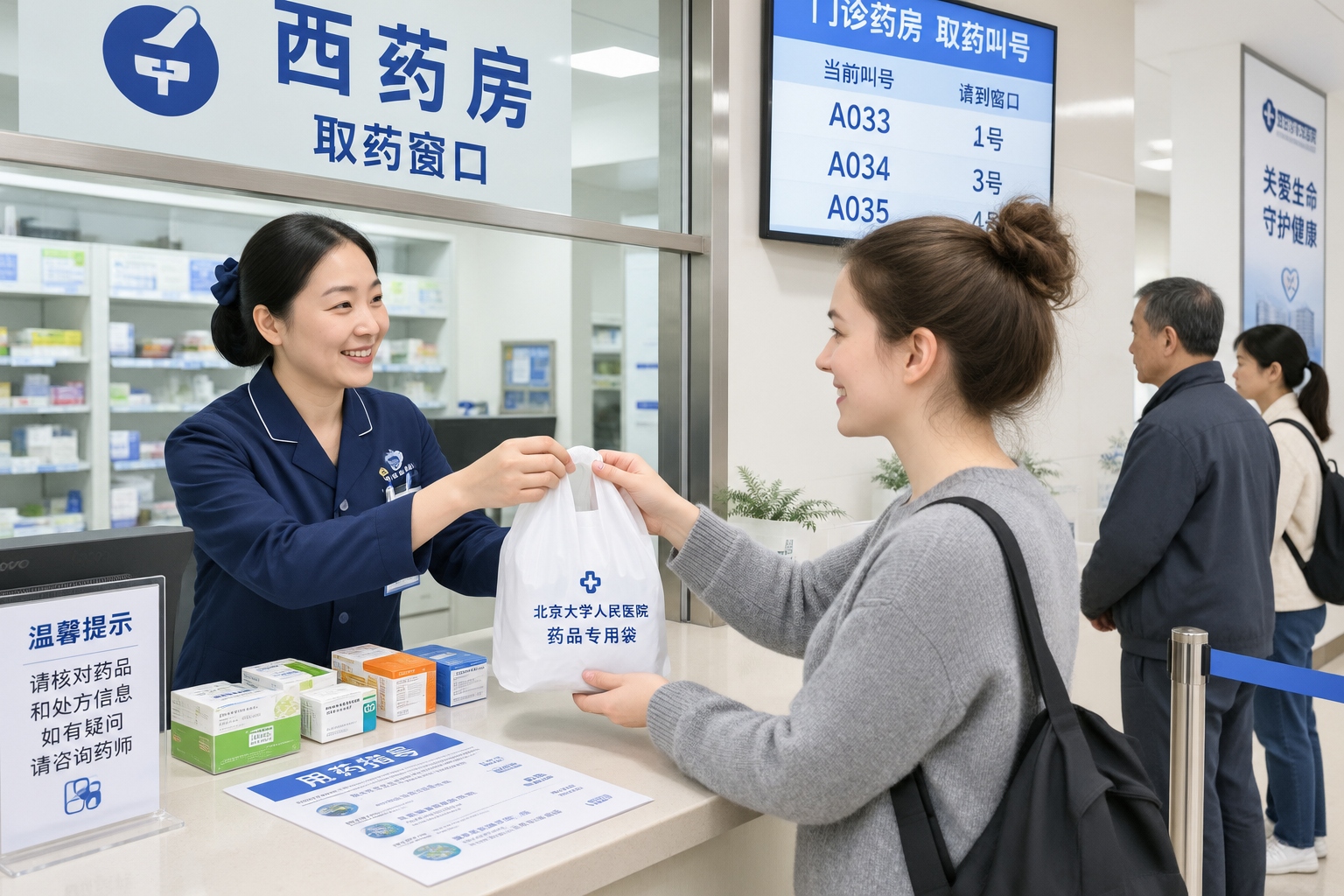
After paying, I went to the hospital pharmacy window on the first floor. A large screen announced my name. A pharmacist behind thick glass handed me a cardboard box with four smaller boxes inside: one for the antibiotics, one for a bottle of cough powder, one for paracetamol, and one for a traditional Chinese medicine product in little granules.
Wang said, “She told you to take a break, drink a lot of warm water, avoid spicy food, and maybe try the Chinese medicine. It works well for a sore throat.” The note on the medicine in Chinese was translated by Wang: “dissolve in warm water twice a day.” Wang laughed and said, “In China, every doctor will tell you to drink hot water. It’s the national home remedy.”
Lessons for Any Foreigner Visiting a Hospital in China
Looking back at my first experience with the Chinese hospital system, I came away with a few pieces of practical advice for any foreigner who needs to see a doctor here:
1. Bring your passport. This is non-negotiable. You need it to create an outpatient medical card or to verify your identity. If you are in Beijing, you can use your passport to register at the counter. That paper card will be your key to every future visit, and the hospital usually keeps a record linked to your passport number.
2. Use a translator app. Even though many doctors learn some English in medical school, they won’t necessarily use it in practice. A reliable voice translator such as Waygo or Papago, or simply typing out a sentence to show the doctor, works fine. Many hospitals also offer English-speaking guides at their international departments or VIP clinics if you pay a premium.
3. Choose the right hospital. For minor illnesses, skip the famous “top-three hospital” queues. A mid-sized district hospital is often quietly efficient, and the cost tends to be lower. A doctor at a major hospital is more likely to speak English, but you might have to wait hours. Decide based on urgency.
4. Ask for receipts. The little printed slip you get after payment is your proof. If you have international insurance, that slip and the doctor’s clinic record are all you need to file a claim. For larger expenses, hospitals can issue an official tax receipt (发票, fāpiào).
5. Have a Chinese friend on speed dial. Honestly, your life will be simpler. They can help with forms, explain the doctor’s thinking, and tell you which line is the right line.
6. Don’t underestimate the power of hot water. Yes, it was a daily conversation topic. But when I finally drank cups of hot water with the traditional Chinese medicine, my throat did feel calmer. Maybe there is something to it.
From the Hospital Back to Daily Life
That evening, I crawled into bed with a cup of warm water and a box of antibiotic capsules. I felt awful all night, but the next morning the fever was gone. The doctor was right: I had a viral infection that my body needed to fight. By the third day, I was back to eating noodles as though nothing had happened.
What stayed with me after that first hospital visit was not the bright lobby or the clinical manner of the doctor. It was the way everything functioned like a carefully — if sometimes messy — machine. For all the complaints you hear about China’s overcrowded hospitals, the system does solve problems for millions of people every single day. The printed corridors, the beeping monitors, the efficient nurse, the polite pharmacist — all of it makes the foreigner feel, after a little disorientation, that you are in safe hands.
And as you leave with your tiny medicine boxes, you understand slightly better why so many Chinese people carry a thermal flask wherever they go. If every doctor, Chinese or not, tells you to drink plenty of water, maybe the real secret to living well anywhere is simply to listen.
Start the discussion at forum.chinacomes.com